Ethereum (ETH) has been experiencing a period of subdued price action, a trend that coincides with a significant downturn in the activity of its largest holders, often referred to as "whales." This decrease in large-scale transactions on the Ethereum network, as reported by blockchain analytics firm Santiment and highlighted by crypto analyst Ali Martinez, suggests a potential shift in sentiment among major investors amidst a complex global economic and geopolitical landscape. The decline in whale participation, coupled with broader macroeconomic pressures, paints a picture of caution within the cryptocurrency market, prompting a closer examination of the factors influencing Ethereum’s current trajectory and its long-term prospects.
Sharp Decline in Whale Transactions Signals Cautious Investor Sentiment
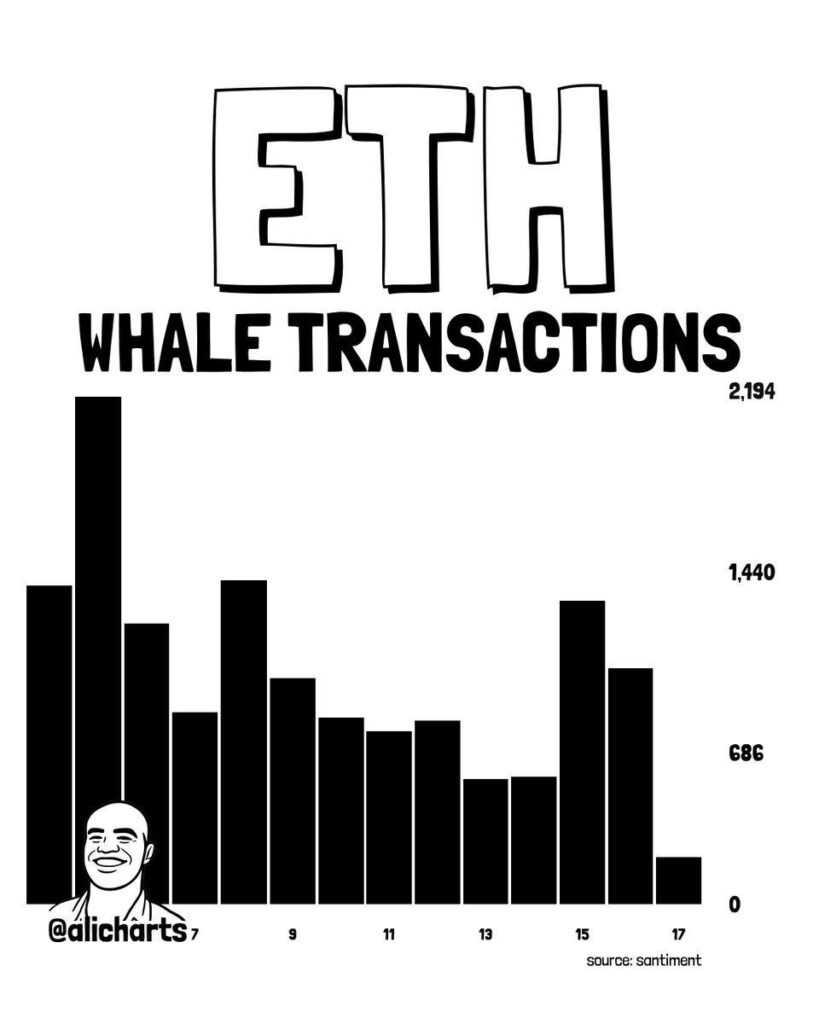
Recent data from Santiment, a prominent blockchain analytics platform, reveals a dramatic decrease in large Ethereum transactions over the past two weeks. Crypto analyst Ali Martinez shared these findings, noting an 86.6% drop in whale activity. Specifically, the number of large transactions plummeted from 2,194 on June 5th to a mere 294 by the time of the report. This sharp decline represents one of the most significant contractions in whale engagement observed in recent months, indicating that major holders are significantly less active on the Ethereum network.
Large transactions are a critical metric for market watchers as they often serve as indicators of institutional interest, substantial capital flows, and the overall conviction of major market players. While this reduction in activity does not inherently signal immediate selling pressure, it strongly suggests that large investors are adopting a "wait-and-see" approach. This cautious stance is likely driven by the prevailing market uncertainty, a common characteristic of periods marked by heightened geopolitical tensions and shifting macroeconomic policies.

Macroeconomic Headwinds and Geopolitical Tensions Weigh on Ethereum
Ethereum’s recent price weakness is not occurring in a vacuum. It is deeply intertwined with a confluence of global macroeconomic concerns and escalating geopolitical risks. Persistent inflation fears continue to loom large, prompting expectations of a more hawkish stance from central banks, particularly the U.S. Federal Reserve. The prospect of sustained higher interest rates tends to diminish market liquidity and can exert downward pressure on speculative assets like cryptocurrencies.
Adding to this economic uncertainty are growing geopolitical tensions in the Middle East. Escalating conflicts between Israel and Iran have stoked concerns about potential disruptions to global energy markets. Such disruptions could reignite inflationary pressures, further complicating the economic outlook and reducing investor appetite for riskier assets. This heightened global instability contributes to broader weakness across the cryptocurrency markets, as investors tend to de-risk their portfolios during times of uncertainty.
Technical Indicators Point to Pressing Challenges
From a technical analysis perspective, Ethereum is currently facing considerable headwinds. The cryptocurrency is trading below key moving averages, including its 50-day, 100-day, and 200-day simple moving averages. This positioning reinforces the prevailing bearish trend observed in the market. Momentum indicators offer a mixed signal; while the Moving Average Convergence Divergence (MACD) remains in a downward trajectory, suggesting bearish momentum, the Relative Strength Index (RSI) has entered oversold territory. This divergence indicates potential for a short-term bounce, but the overarching trend remains under pressure.
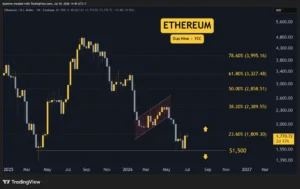
Market participants are closely observing the $1,500 price level, which has emerged as a critical support zone. A successful defense of this level could provide a foundation for a potential recovery. However, a decisive breach below $1,500 could expose Ethereum to further downside, with some analysts identifying $1,000 as the next significant psychological support level. On the upside, reclaiming the $2,000 mark would be a crucial step for Ethereum before it can challenge stronger resistance levels around $2,380.
Long-Term Optimism Persists Amidst Short-Term Volatility
Despite the current market challenges and the notable decline in whale activity, a segment of analysts remains optimistic about Ethereum’s long-term potential. These projections are often based on historical market patterns and the fundamental growth trajectory of the Ethereum network.
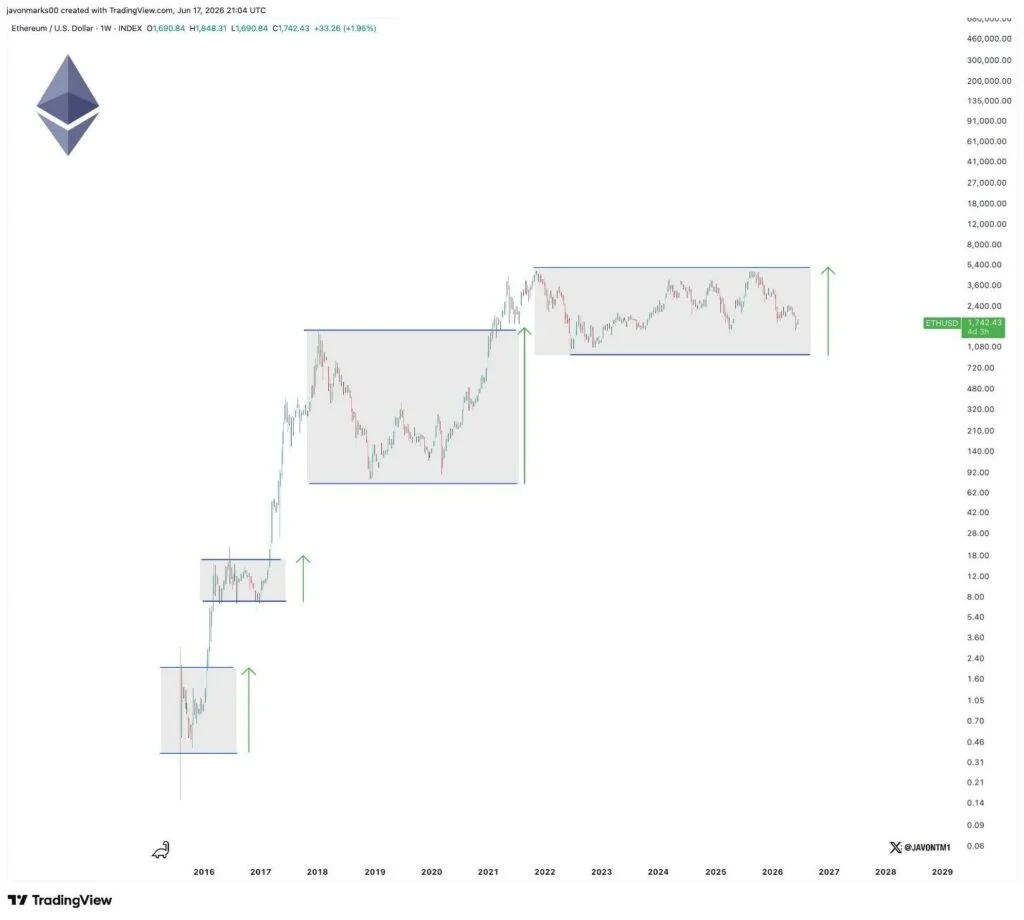
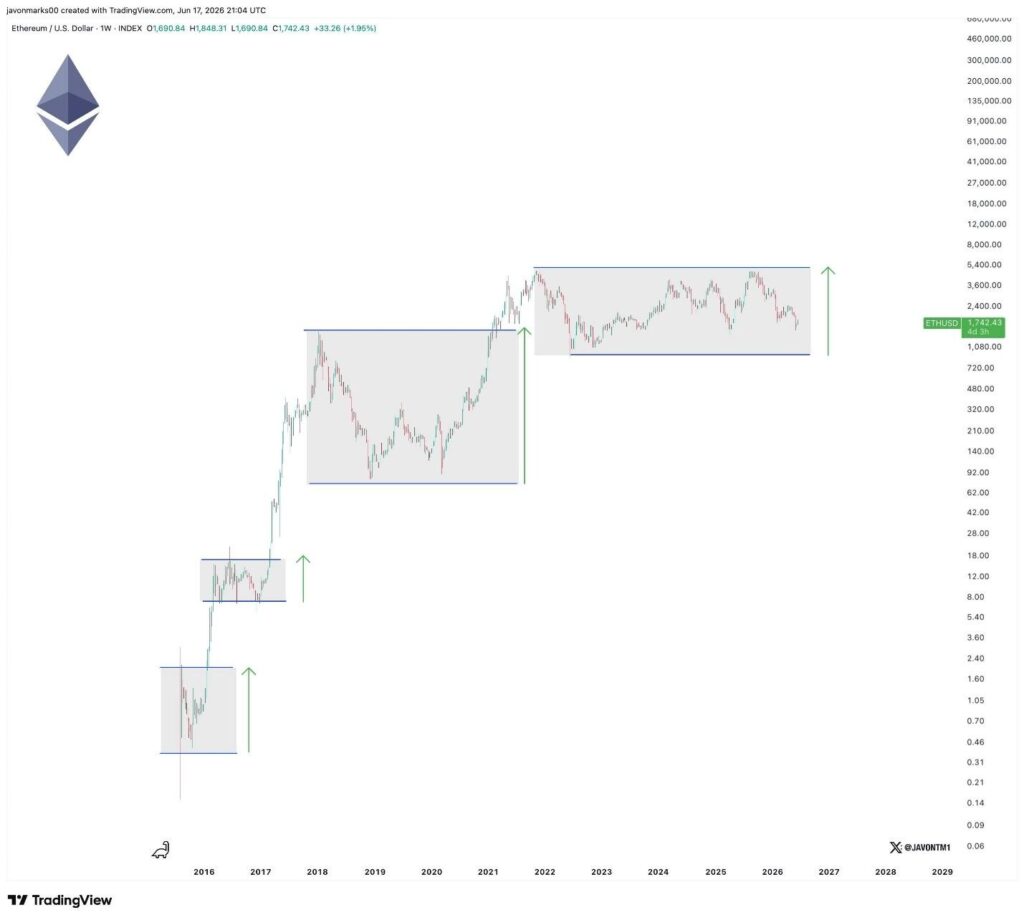
Analyst Javon Marks, in a recent analysis shared via a weekly ETH/USD chart, highlighted historical consolidation ranges and breakout formations dating back to 2016. Marks contends that Ethereum’s current price structure exhibits "structural integrity," suggesting resilience at current levels. Based on past expansion cycles, Marks projects an initial upside target for ETH between $4,800 and $5,000. He further suggests that if historical market behavior repeats, Ethereum could eventually reach approximately $8,500. This perspective emphasizes Ethereum’s potential for significant appreciation driven by its established network effects and ongoing development.
Further extending the long-term outlook, analyst Crypto Patel has outlined a broader roadmap for Ethereum’s valuation extending into 2029 and 2030. Patel’s framework presents several potential valuation scenarios. His "ultra-bear" outlook places Ethereum around $5,000, while a more "base-case" scenario targets approximately $12,000. Under the most aggressive bullish assumptions, Patel forecasts that ETH could eventually trade between $30,000 and $60,000. These ambitious projections are partly based on comparing Ethereum’s potential future market capitalization to that of major global corporations, such as Nvidia. This comparison suggests that Ethereum may increasingly be viewed not just as a speculative cryptocurrency but as a mature and integral component of the global financial network, underpinning a vast ecosystem of decentralized applications and services.

The Role of Whale Activity in Market Dynamics
The observable decline in whale activity on the Ethereum network warrants a deeper understanding of its implications. Whales, holding substantial amounts of cryptocurrency, can significantly influence market prices through their buying and selling activities. When whales become less active, it can suggest several possibilities:
- Consolidation and Accumulation: Whales may be quietly accumulating ETH during periods of lower prices or sideways movement, without executing large, visible transactions. This "quiet accumulation" phase could precede a period of increased buying pressure.
- Profit-Taking and De-Risking: Conversely, a decrease in whale activity could indicate that large holders have taken profits and are moving to more stable assets, or are simply reducing their exposure to the volatile cryptocurrency market.
- Strategic Patience: In the face of macroeconomic uncertainty and geopolitical risks, many large investors may be adopting a patient approach, waiting for clearer market signals before making significant moves. This could involve holding existing positions rather than actively trading.
- Shift in Investment Strategy: The evolving regulatory landscape and the increasing institutional adoption of digital assets may also be influencing how whales interact with the market. They might be employing more sophisticated strategies that involve less overt on-chain activity.
The current data points to a notable shift, with the sharp 86.6% decrease in large transactions serving as a significant signal for market observers. This metric, when analyzed alongside broader economic indicators and geopolitical developments, provides a comprehensive picture of the forces shaping Ethereum’s market dynamics.
Broader Impact and Future Outlook
The current period of subdued whale activity and market pressure on Ethereum has several implications. It underscores the interconnectedness of the cryptocurrency market with traditional financial markets and global events. The reliance on macro factors such as inflation, interest rates, and geopolitical stability highlights that digital assets are no longer isolated from mainstream economic concerns.
For retail investors, the reduced whale participation might be interpreted as a sign of caution, potentially advising against aggressive investment strategies during this period. However, the long-term optimistic forecasts from analysts like Marks and Patel suggest that underlying technological advancements and adoption trends within the Ethereum ecosystem remain strong. These projections, while ambitious, are grounded in historical market cycles and the perceived transformative potential of blockchain technology.
The upcoming period will likely see continued scrutiny of whale movements, as these large holders often act as bellwethers for major market shifts. Simultaneously, the Ethereum community will be closely watching the broader economic environment and any significant geopolitical de-escalations that could reduce market uncertainty. The resilience of the $1,500 support level will be a key determinant of short-term price action, while the long-term vision for Ethereum continues to be shaped by its technological innovation, network adoption, and its growing role in the global digital economy.
As of the latest reporting, ETH was trading around $1,700, reflecting a modest decline of 0.65% in the preceding 24 hours. This price point, while indicating a slight dip, situates Ethereum within a critical juncture where both immediate technical levels and the broader macroeconomic narrative will play a significant role in determining its future path.