The normally reticent and highly competitive hardware wallet industry witnessed an unprecedented display of rapid, coordinated communication today, as leading manufacturers including Ledger, Trezor, Bitkey, Jade, and Tangem swiftly issued public statements to reassure their user bases. This unusual unanimity stemmed from a critical security vulnerability discovered in Coldcard hardware wallets, which has reportedly led to the theft of over $38 million in Bitcoin. The incident underscores the foundational importance of cryptographic randomness in securing digital assets and has prompted immediate action from affected users and a deeper investigation into the underlying flaws.
The Exploit Emerges: A $38 Million Breach
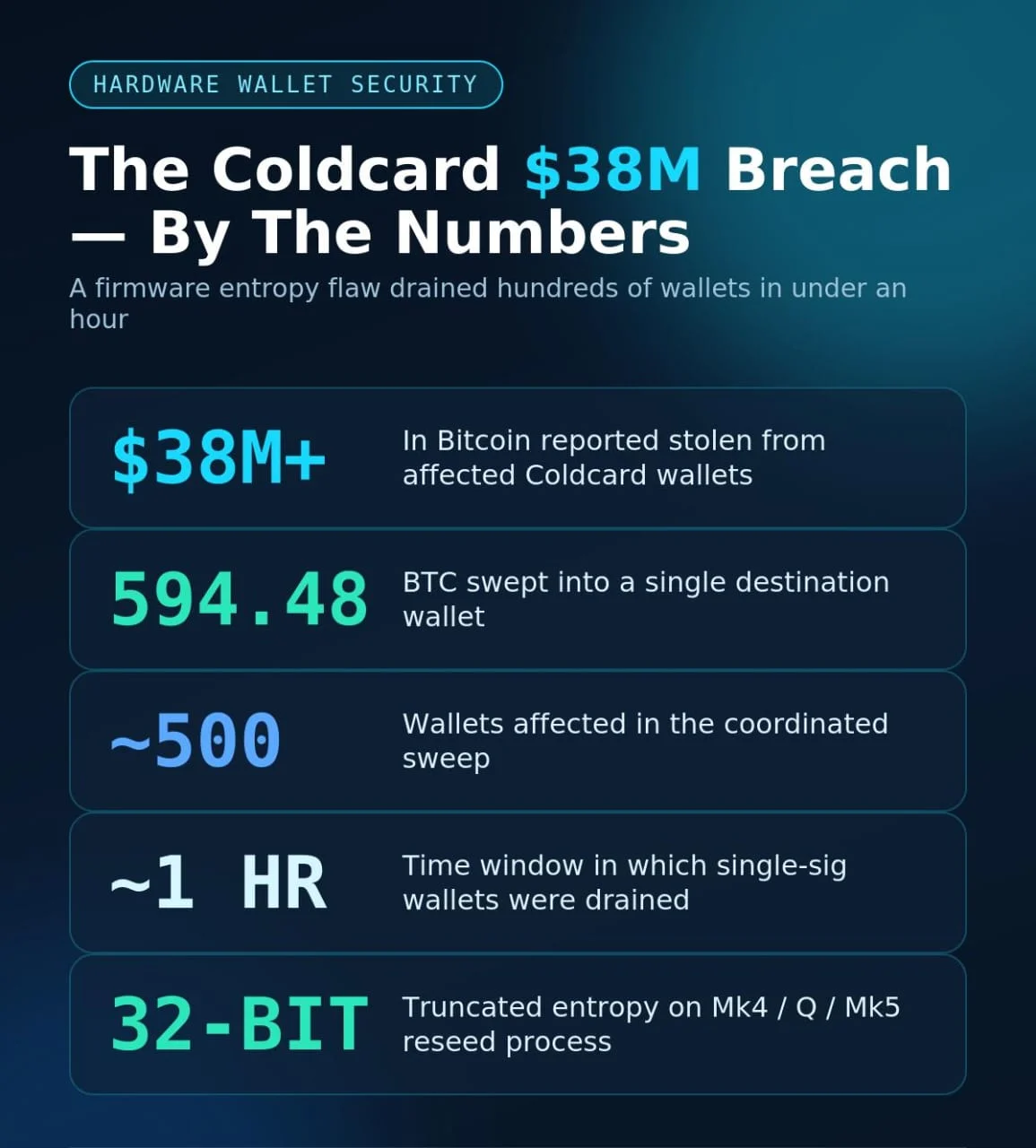
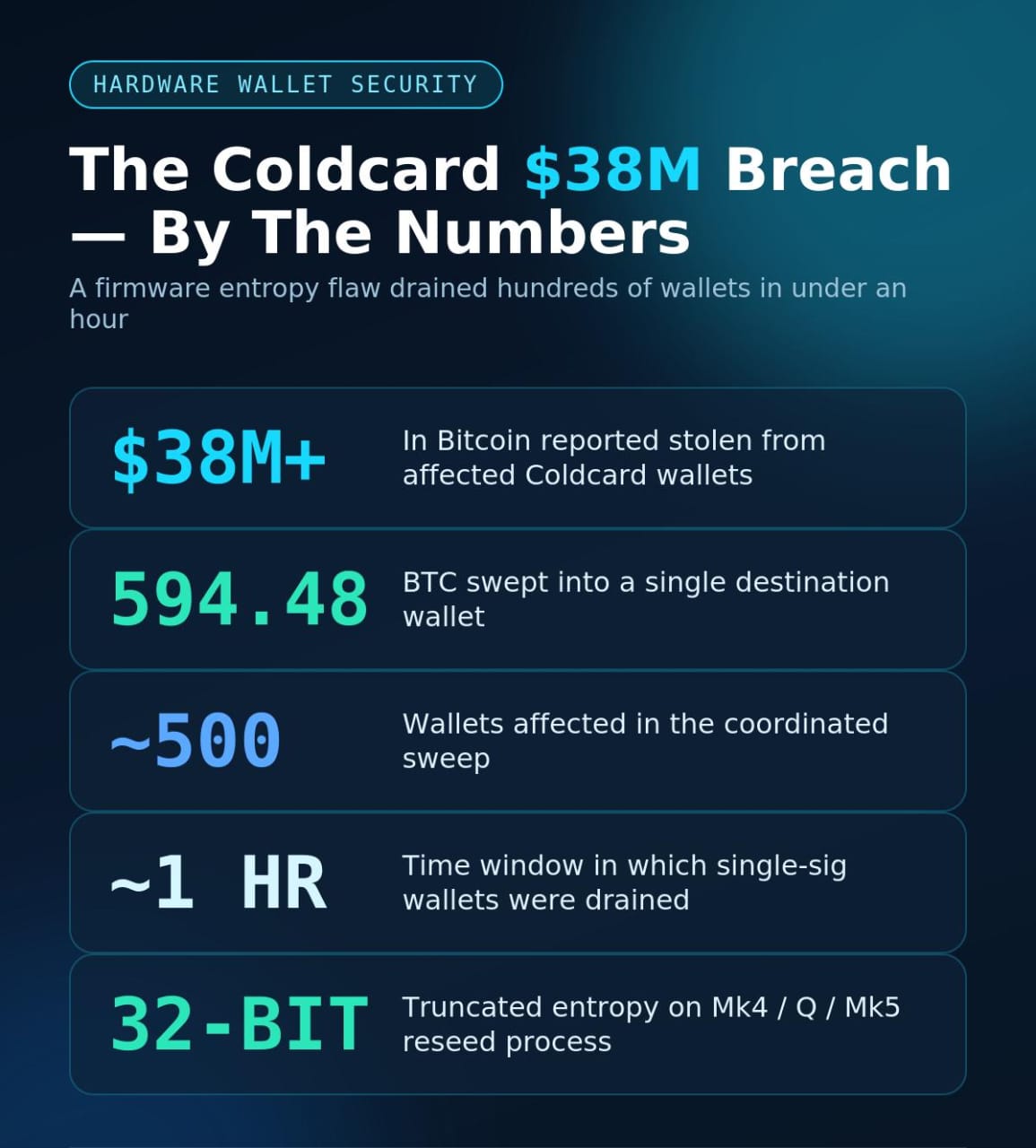
The catalyst for this industry-wide reaction was the public revelation of a significant exploit affecting certain Coldcard hardware wallets. Reports surfaced detailing a coordinated sweep of approximately 500 wallets, resulting in the theft of a combined 594.48 Bitcoin (BTC), valued at over $38 million at current market rates. All stolen funds were reportedly consolidated into a single destination wallet, suggesting a highly organized and targeted operation rather than scattered, opportunistic attacks. The concentration of funds into one address immediately signaled to security researchers and industry observers the severity and specific nature of the exploit.
The core of the problem was quickly identified as a critical flaw within Coldcard’s firmware, specifically impacting its entropy generation process—the mechanism responsible for creating the truly random numbers that form the basis of a wallet’s recovery seed phrase. Without genuinely random seed generation, the security of a hardware wallet, and thus the funds it protects, is fundamentally compromised.
Rapid Industry Response and Reassurance
In the hours following the news of the Coldcard exploit, the leading hardware wallet manufacturers moved with unusual speed and coordination to distance their products from the incident. This collective response from companies that rarely collaborate publicly highlights the gravity with which the industry perceives any breach of trust in hardware security. The primary objective for these companies was to mitigate potential panic among their own users, who might naturally wonder if their devices were susceptible to similar vulnerabilities.
Ledger, a prominent player in the hardware wallet space, was among the first to issue a clear statement. The company asserted that its devices were unaffected by the Coldcard Mk3 advisory, emphasizing its proprietary True Random Number Generator (TRNG) built directly into its Secure Element chip. Ledger’s statement specifically highlighted its TRNG’s capability to generate the full 256 bits of entropy required for every 24-word recovery phrase, a standard benchmark for robust cryptographic security.
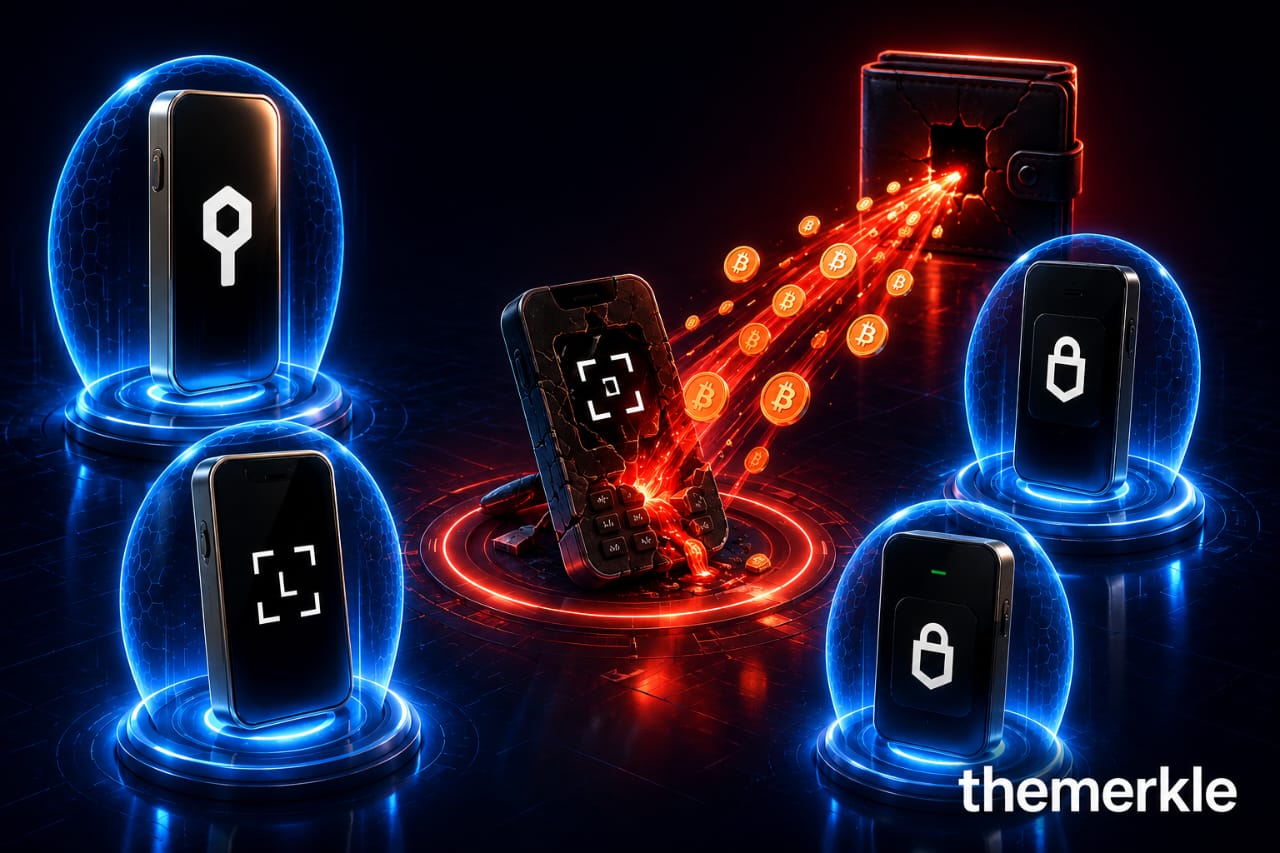
Similarly, Tangem, known for its card-based hardware wallets, released a swift reassurance to its user community, affirming the integrity of its own entropy generation mechanisms. Trezor and Jade, other significant competitors in the market, echoed these sentiments across their official channels. Each company individually affirmed that their respective processes for generating cryptographic entropy—the unpredictable data used to create secure keys—remained untouched by the specific flaw identified in Coldcard devices. Bitkey, the hardware wallet developed by Block, also confirmed its products were safe, but took an additional step, initiating its own in-depth investigation into the Coldcard incident, which would later yield critical insights.
This wave of near-simultaneous communication underscores the industry’s acute awareness of the delicate balance of trust that underpins the self-custody of digital assets. In a sector where user confidence is paramount, no manufacturer wanted to be perceived as silent while their competitors actively addressed user concerns. However, security experts cautioned that while these immediate reassurances were important for market stability, they largely relied on internal audits and prior verifications, rather than fresh, independent scrutiny specifically triggered by the Coldcard incident.
Coldcard Confirms Firmware Flaws
Coinkite, the manufacturer of Coldcard, officially confirmed the underlying problem shortly after the exploit became public. The company disclosed a critical entropy-generation flaw impacting specific versions of its Coldcard firmware. This vulnerability, as confirmed by Coinkite, may have severely reduced the effective randomness behind seed phrases generated on affected Mk2 and Mk3 devices. The company explicitly linked this firmware flaw to the reported multi-million dollar theft, acknowledging the direct impact on its users.
Coinkite’s guidance to its user base was direct and uncompromising: users who had generated a seed using the affected firmware were instructed to immediately update to a patched firmware version, generate an entirely new seed phrase, and, crucially, migrate all funds away from any address associated with the old, potentially compromised seed. The instruction to generate a brand-new seed, rather than simply patching the firmware and continuing with the existing one, highlighted the severity of the vulnerability. A firmware patch can only fix future seed generation; it cannot retroactively secure a seed that was already created with insufficient randomness before the patch was implemented. This directive underscored that the fundamental cryptographic integrity of the original seed was irreversibly compromised.
Block’s Independent Investigation Uncovers Deeper Vulnerabilities
Perhaps one of the most significant developments in the aftermath of the Coldcard exploit came from an unexpected source: Block, the parent company behind the competing Bitkey hardware wallet. Block’s security team, despite confirming that no Block products were affected, took the proactive step of launching an independent investigation into the reports of non-Bitkey wallets being drained. This altruistic approach was motivated by a broader commitment to protecting individuals holding Bitcoin in self-custody, irrespective of their chosen hardware wallet.
Block’s investigation yielded a more detailed and concerning picture, uncovering not one, but two distinct vulnerabilities within Coldcard’s firmware. Initially, the observed attacks primarily targeted single-signature wallets, which were drained remotely over approximately an hour. Block’s team issued a cautionary note that the attack was likely ongoing, posing a continued threat to more wallets, including those utilizing weak 25th-word passphrases or certain multisig setups where multiple keys might have been insecurely generated.
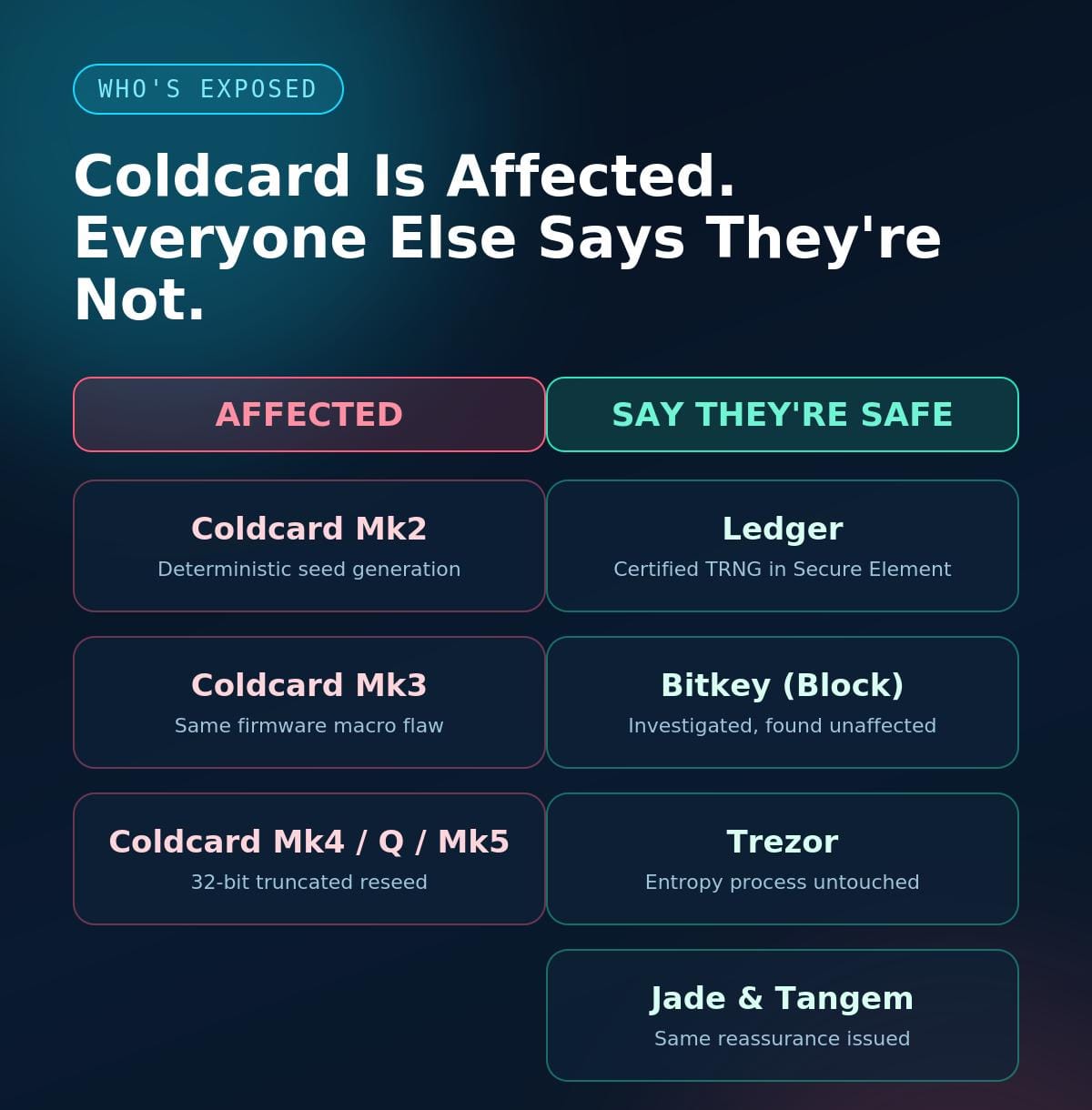
The first vulnerability, specific to Mk2 and Mk3 devices, involved a critical error in the firmware. While the firmware was designed to utilize the hardware’s robust random number generator for key creation, a macro mistake inadvertently caused it to rely instead on a combination of a known device Unique Identifier (UID), the device’s internal timer state, and its call history. This flaw rendered wallet generation deterministic rather than genuinely random, making the generated seed phrases potentially predictable and, therefore, vulnerable to reconstruction by an attacker.
The second vulnerability, affecting Mk4, Q, and Mk5 devices, presented a different but equally critical issue. These newer models attempted to compensate for potential randomness issues at boot-up by incorporating input from a secure element. However, Block’s analysis revealed that the reseed process truncated this crucial input down to a mere 32 bits. This severe truncation dramatically limited the actual secret entropy contributed to the seed, falling far short of the cryptographic standards required for secure wallet generation. A 32-bit entropy space is astronomically easier to brute-force than the industry standard of 256 bits, exposing these seeds to potential compromise.
Block’s team emphasized a crucial point for users: if a seed was originally generated on a vulnerable Coldcard device and subsequently exported or imported into an entirely different hardware or software wallet, that insecure seed remains compromised regardless of its current location. The underlying cryptographic weakness is inherent to the seed itself, not solely the device that initially created it. Block promptly disclosed these findings to Coinkite, which acknowledged them, before Block chose to make its comprehensive analysis public to safeguard the broader self-custody community.
The Attacker’s Operational Security Lapse
Amidst the technical complexities of the exploit and the scramble for industry reassurance, a detail emerged from Block’s investigation that could prove pivotal for law enforcement and cybersecurity researchers. While meticulously reviewing the patterns of the fund sweeps, Block’s engineering lead identified an unusual operational security error on the part of the attacker. The perpetrator utilized a paid account at a well-known blockchain-services provider to query the source addresses and facilitate related activities during the illicit transfers.
This operational security failure is genuinely significant. Professional investigators often rely on such missteps to establish concrete leads. Using a paid, and presumably KYC (Know Your Customer)-linked, account to conduct activities related to a multi-million dollar theft provides law enforcement and blockchain sleuths like ZachXBT with a tangible thread to pull. While it does not guarantee immediate identification, it introduces a critical point of potential vulnerability for the attacker, offering a path for investigation that would be absent in a fully anonymous attack. This detail transforms a purely technical exploit into a criminal investigation with a potentially identifiable perpetrator.
Immediate Directives for Coldcard Users
For individuals who own a Coldcard hardware wallet, particularly Mk2 or Mk3 devices, the consensus from both Coinkite and Block is clear: immediate action is imperative. This is not a situation that allows for a "wait-and-see" approach.
- Update Firmware Immediately: Users must update their Coldcard devices to the latest patched firmware version as soon as possible. This step is critical to prevent future seed generations from inheriting the same entropy flaws.
- Generate a Completely New Seed: Crucially, users should not continue using their existing seed phrase if it was generated on an affected device before the patch. A new, cryptographically secure seed must be generated.
- Migrate Funds: All digital assets currently tied to an old seed that could have been generated with compromised randomness must be migrated. This involves sending funds from addresses derived from the old seed to new addresses generated by the newly created, secure seed.
- Consider Exported Seeds: If a user ever exported their original Coldcard seed (even to a different hardware or software wallet), those funds should also be treated as exposed. The underlying cryptographic weakness travels with the seed itself, irrespective of the device housing it. Funds from such exported seeds must also be migrated to addresses derived from a freshly generated, secure seed.
Broader Implications for Hardware Wallet Security and Trust
The Coldcard incident extends beyond a single product failure; it serves as a stark reminder of the foundational principles underpinning hardware wallet security. Users trust these devices precisely because they assume the randomness generating their seed phrase is unimpeachable—a bedrock of cryptographic integrity. This event unequivocally demonstrates that even this fundamental assumption requires rigorous, periodic, and independent scrutiny.
The speed and scope of the industry’s reaction highlight the fragility of trust in the self-custody ecosystem. Any crack in this trust can have far-reaching consequences, potentially eroding confidence in the entire category of hardware wallets. The incident will undoubtedly prompt other manufacturers to re-evaluate their own entropy generation mechanisms, internal auditing procedures, and external security certifications. It reinforces the need for transparent disclosure of vulnerabilities and clear, actionable guidance for users when such flaws are identified.
The Evolving Landscape of Digital Asset Security
The Coldcard exploit will likely influence the evolving landscape of digital asset security in several ways. It underscores the critical role of independent security researchers and organizations like Block, whose commitment to broader ecosystem security can uncover flaws that might otherwise go unnoticed. It also highlights the responsibility of hardware wallet manufacturers to not only build secure products but also to educate their users on best practices for self-custody, including the importance of firmware updates and understanding the implications of seed phrase generation.
In an environment where regulatory scrutiny of digital assets is increasing globally, incidents like this could also draw attention to the need for standardized security audits and certifications for hardware wallets. While self-custody offers unparalleled financial autonomy, it also places significant responsibility on the user. Events such as the Coldcard exploit serve as powerful, albeit costly, lessons in the continuous pursuit of robust, verifiable security in the rapidly advancing world of cryptocurrencies.
Disclosure: This is not trading or investment advice. Always do your research before buying any cryptocurrency or investing in any services.
Follow us on Twitter @themerklehash to stay updated with the latest Crypto, NFT, AI, Cybersecurity, and Metaverse news!