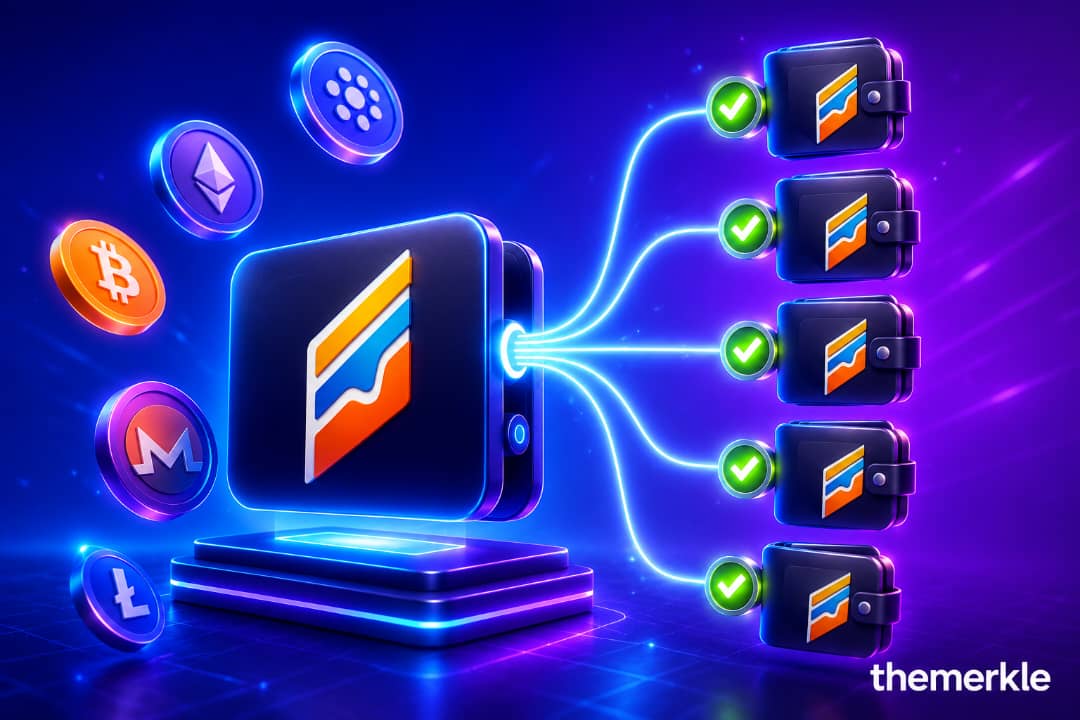
Cake Wallet distinguishes itself in the crowded cryptocurrency wallet landscape as a multi-currency solution that extends far beyond merely supporting a handful of digital assets. While many wallets claim multi-currency capabilities, often implying a limited selection, Cake Wallet offers a robust suite of features, with one particular innovation standing out as profoundly impactful yet frequently overlooked: the ability to execute batch transactions by sending crypto to multiple addresses within a single operation. This functionality, upon closer examination, reveals significant efficiencies in terms of both network fees and user time, addressing a fundamental friction point that persists across numerous other wallet platforms.
The digital asset ecosystem has witnessed exponential growth and evolution since the inception of Bitcoin in 2009. Early cryptocurrency wallets were largely rudimentary, often single-currency, and required a significant degree of technical proficiency. The user experience was secondary to the underlying cryptographic security. As the market matured and diversified, the demand for more versatile and user-friendly solutions grew. This led to the proliferation of multi-currency wallets, designed to consolidate various digital assets under one interface. However, while these wallets offered convenience in asset management, many failed to innovate on the fundamental transaction process, leaving users to grapple with repetitive actions and accumulating costs for multiple payments. The persistent challenges of network congestion, fluctuating transaction fees, and the sheer time involved in processing numerous individual transfers have long been a pain point for both individual users and businesses operating within the crypto space. This is where Cake Wallet’s batch sending feature emerges as a practical and cost-effective solution, fundamentally rethinking the mechanics of multi-recipient transfers in a non-custodial environment.
The Genesis and Core Philosophy of Cake Wallet
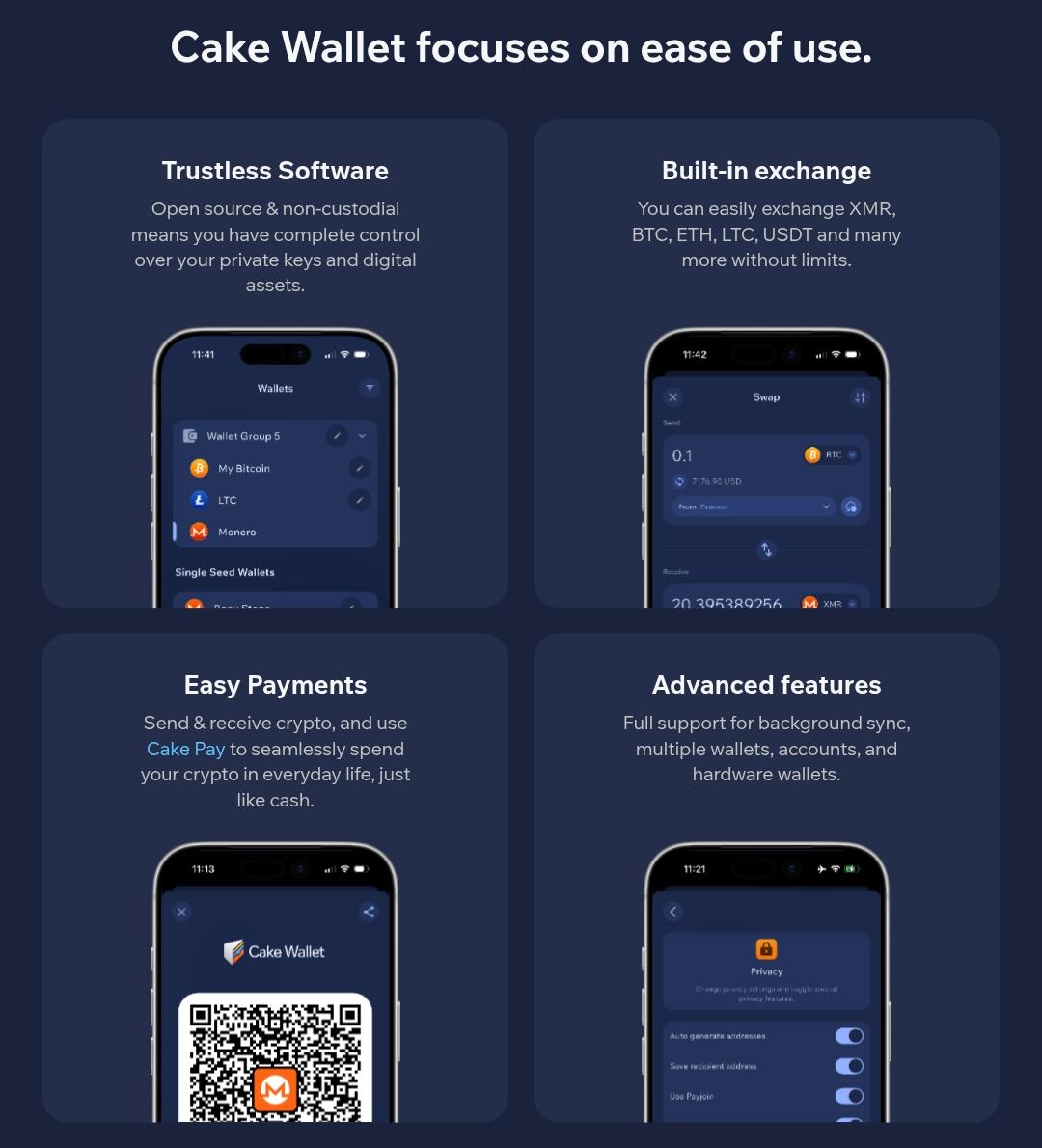
Cake Wallet is not just another multi-currency wallet; it represents a commitment to open-source principles, user sovereignty, and enhanced privacy. Developed by Cake Labs, it operates as a non-custodial, open-source cryptocurrency wallet, distinguishing itself early on with robust support for Monero (XMR), a leading privacy-focused cryptocurrency. The decision to make the wallet fully free and open source under the MIT license is a critical aspect of its appeal. This commitment to transparency allows anyone, from independent developers to security researchers, to inspect the underlying code. In an industry frequently plagued by scams, exploits, and opaque operations, an auditable codebase fosters a level of trust and verifiable security that closed-source alternatives cannot match. Users are not simply taking a company’s marketing claims at face value but can independently verify the security and privacy assertions made by Cake Labs. This philosophical stance aligns with the foundational ethos of decentralization and user empowerment inherent in the broader cryptocurrency movement.
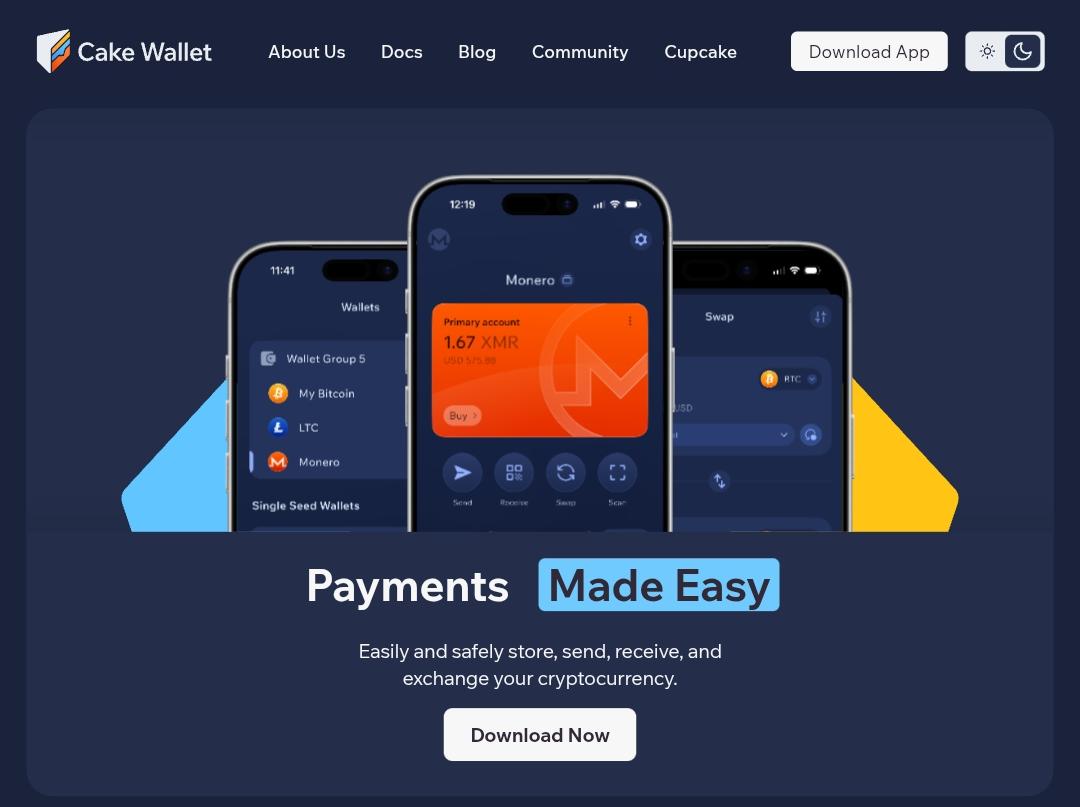
Beyond basic send and receive functionalities, Cake Wallet integrates several features designed to enhance usability and expand the utility of cryptocurrencies. These include Cake Pay, which facilitates spending crypto directly for everyday purchases, streamlining the conversion process between digital assets and real-world utility. The wallet supports full background synchronization, ensuring that users always have access to up-to-date transaction histories and balances without constant manual refreshing. Furthermore, the ability to manage multiple distinct wallets and accounts from a single application interface simplifies asset organization for users holding various portfolios or managing different financial needs. For those prioritizing cold storage security, Cake Wallet also offers hardware wallet compatibility, bridging the gap between robust offline security and a more intuitive, user-friendly software interface.
Unpacking the Efficiency of Batch Sending
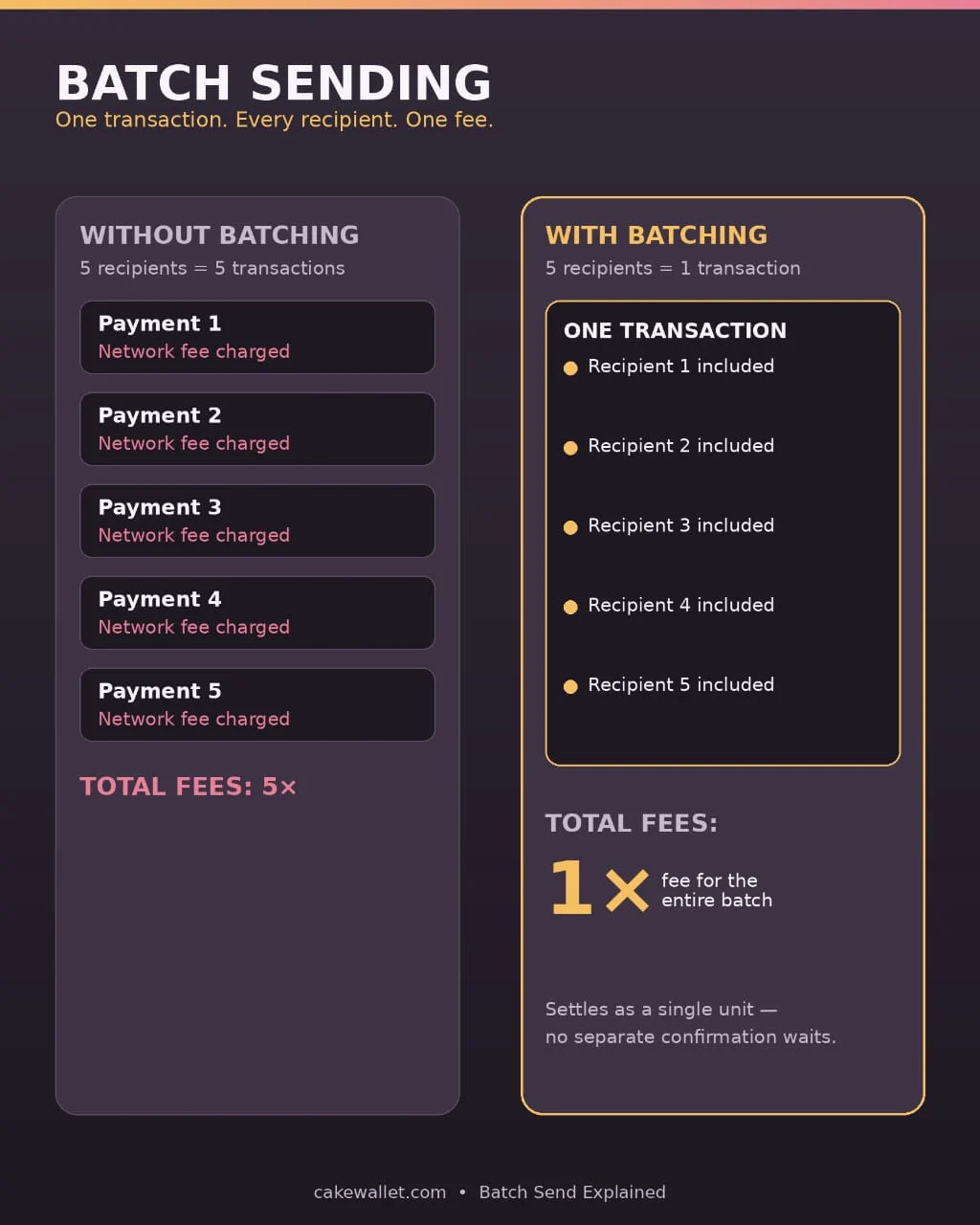
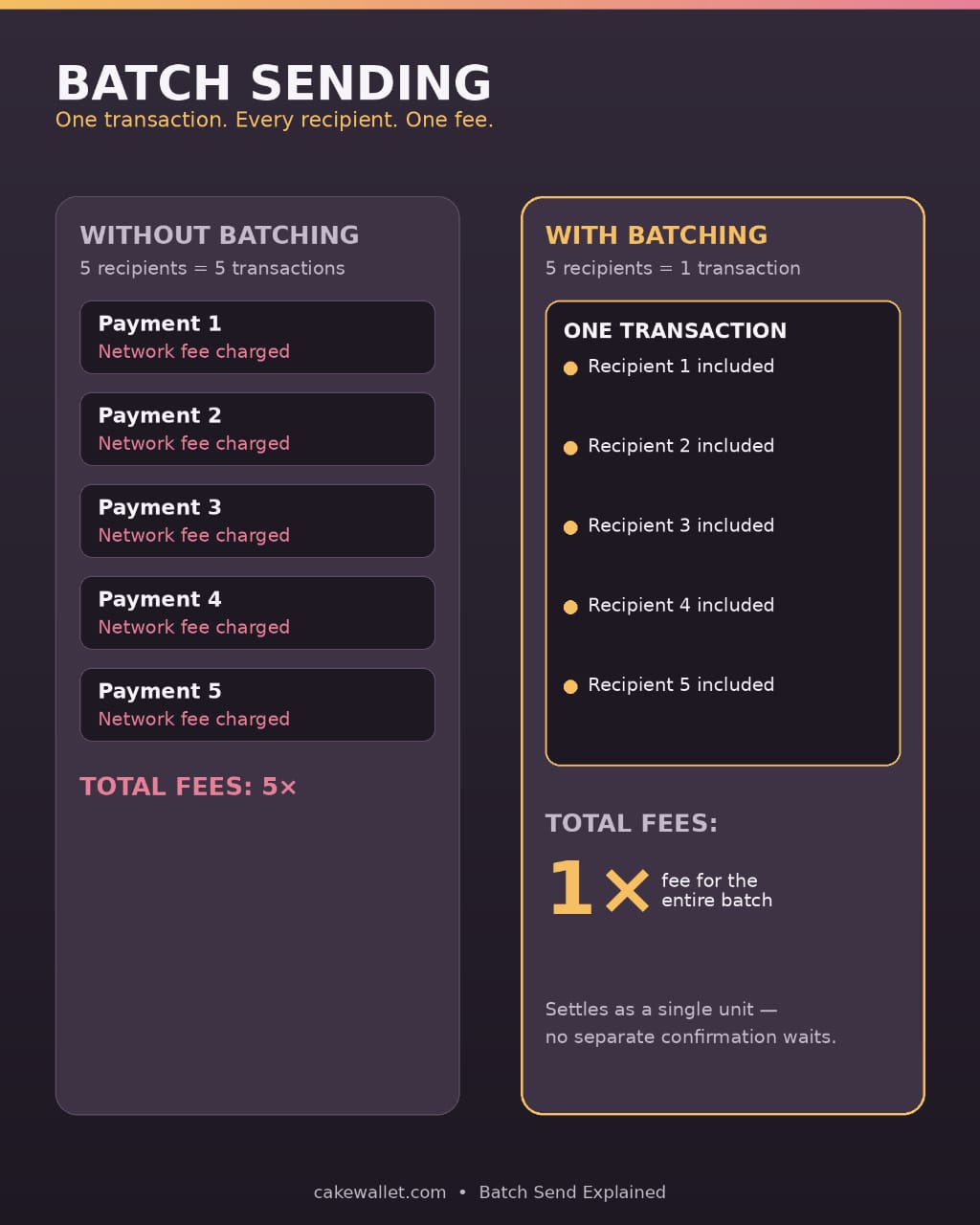
The batch sending feature is perhaps the most compelling, yet often underestimated, innovation within Cake Wallet. Unlike conventional wallet operations where sending funds to five different individuals necessitates initiating and confirming five separate transactions, each incurring its own network fee and waiting period, Cake Wallet allows users to consolidate these payments into a single transaction. This capability is not merely a theoretical claim; it is explicitly documented within the project’s official resources and its public GitHub repository, demonstrating its integral role in the wallet’s architecture.
The practical advantages of this approach are multifaceted and significant. Each individual transaction on a blockchain network requires a fee, which can vary widely based on network congestion, the cryptocurrency being sent, and the chosen transaction priority. By bundling multiple recipients into one transaction, users pay a single, combined network fee. While the fee for a batch transaction might be marginally higher than a single transfer due to increased data size, it is almost invariably a fraction of the cumulative cost of several individual transactions. For instance, if a network fee is $5 per transaction, sending to five recipients individually would cost $25 in fees. With batch sending, this cost could be reduced to, for example, $7-$10, representing a substantial saving, particularly for frequent users or businesses. Over time, these avoided fees accumulate, translating into tangible financial benefits.
Moreover, batch sending significantly reduces the time overhead. Each individual transaction must be broadcast to the network, confirmed by miners or validators, and then processed. This introduces latency, especially during periods of high network activity, where transactions can get "stuck" or experience prolonged confirmation times. By consolidating payments, users benefit from a single confirmation process for all recipients, drastically cutting down the overall waiting period and the risk associated with individual transaction delays. For entities involved in payroll, contractor payments, or regular fund distributions, this efficiency translates directly into operational savings and improved workflow. A study published by blockchain analytics firm Glassnode in 2021 indicated that transaction fees on major networks like Bitcoin and Ethereum can spike dramatically during periods of high demand, underscoring the economic benefit of fee-optimization strategies like batch sending. For example, average Bitcoin transaction fees peaked at over $60 during certain periods in 2021, and Ethereum gas fees frequently exceeded $100 for complex transactions. While Cake Wallet primarily highlights Monero, the principle of fee savings through batching applies across various supported cryptocurrencies where fees are tied to transaction complexity and network demand.
Navigating the Send Flow: A Step-by-Step Overview
The user experience for initiating a transaction within Cake Wallet is designed for clarity and ease of use, even for complex operations like batch sending. The process begins intuitively: users simply tap "Send" from their balance screen. From there, destination addresses can be entered via multiple convenient methods: pasting a standard cryptocurrency address, scanning a QR code, or selecting from a pre-saved address book. Once an address is entered, the user specifies the amount, either in the active cryptocurrency or its fiat equivalent, with an "ALL" button available for sending the entire wallet balance if desired.
Crucially, for batch sending, the interface allows for the addition of multiple recipient fields, enabling the user to build a list of destinations and corresponding amounts within the same transaction. Before broadcasting, users can adjust the network fee priority, offering control over how quickly their transaction is likely to be confirmed. An option to add a private internal note, visible only within the app, further enhances organization for personal record-keeping. The transaction details are then presented for final confirmation, ensuring users review all parameters before commitment.
A fundamental concept for all cryptocurrency users, especially those new to the ecosystem, is the distinction between the send amount and the network fee. The network fee is an independent charge, paid to the blockchain network for processing the transaction, separate from the funds being transferred to the recipient(s). For example, if a user has 1 XMR, sends 0.5 XMR, and the network fee is 0.01 XMR, the total expenditure from the wallet will be 0.51 XMR. This distinction becomes even more critical with batch sending, as users are paying one combined fee for all recipients within that single transaction, rather than incurring a separate fee for each individual payment. This aggregated fee structure is the core mechanism by which batch sending delivers its significant cost savings.
Advanced Address Flexibility: Beyond Standard Formats
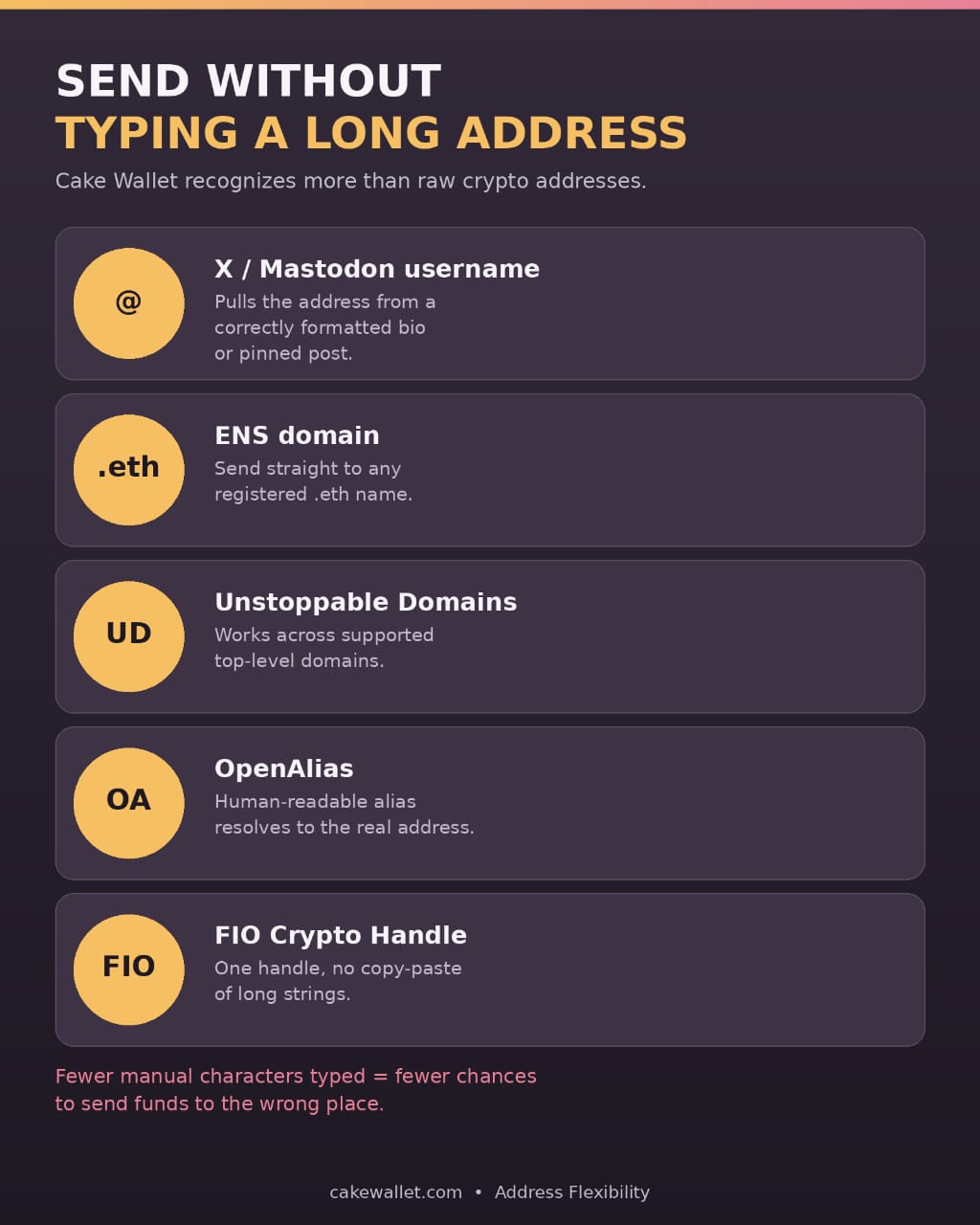
Cake Wallet further elevates its utility beyond a basic multi-coin application through its advanced address recognition capabilities. Understanding that traditional, long string cryptocurrency addresses are prone to human error and can be intimidating for new users, Cake Wallet has integrated support for a variety of human-readable addressing standards. This includes OpenAlias addresses, Ethereum Name Service (ENS) domains (e.g., ending in .eth), and Unstoppable Domains across various top-level domains, as well as FIO Crypto Handles. These services map complex blockchain addresses to simpler, memorable names, akin to how domain names simplify IP addresses on the internet.
Perhaps one of the most innovative features in this regard is the wallet’s ability to directly resolve Mastodon or X (formerly Twitter) usernames. If a social media account has a correctly formatted cryptocurrency address posted in its bio or a pinned post for the relevant asset, Cake Wallet can automatically detect and surface that address when the username is entered into the send screen. This level of abstraction significantly reduces the potential for error, as typing a short, familiar username is far less prone to mistakes than manually copying and pasting a lengthy hexadecimal string.
This comprehensive feature set, particularly when combined with batch sending, paints a clear picture of Cake Wallet’s design philosophy: to minimize friction, reduce the number of steps, and mitigate the risk of error in cryptocurrency transactions. Human error, such as mistyping a single character in a wallet address, has historically been one of the most common and irreversible ways users lose funds in the crypto space. By supporting user-friendly domains and social media handles, Cake Wallet significantly reduces this risk, making transactions more accessible, safer, and less daunting for a broader user base. This commitment to user experience is crucial for bridging the gap between early adopters and mainstream adoption of digital assets.
Monero’s Privacy Cornerstone: Dedicated Tooling
Given Monero’s foundational role in Cake Wallet’s identity, the wallet provides specialized privacy tooling designed to leverage Monero’s inherent features. Monero is renowned for its robust privacy mechanisms, including ring signatures, stealth addresses, and confidential transactions, which obscure sender, recipient, and transaction amounts respectively. Cake Wallet integrates these features seamlessly. By default, the wallet automatically generates new subaddresses after each use. This practice is a cornerstone of privacy, as it prevents multiple transactions from being easily linked to the same identity on the blockchain, thereby enhancing pseudonymity.
For advanced users who require more granular control, the option to disable automatic subaddress generation and manage subaddresses manually is available. Furthermore, Cake Wallet offers an advanced setting to discard the recipient address entirely after sending Monero. While this maximizes privacy by ensuring no record of the recipient is stored within the wallet, Cake Wallet explicitly recommends this option only for experienced users who fully comprehend the implications, as it means losing any internal record of where funds were sent. This highlights the wallet’s commitment to empowering users with privacy choices while also educating them on the associated trade-offs.
Wallet creation and restoration within Cake Wallet default to a 16-word Polyseed, a robust and secure method for generating and recovering wallet keys. An option for the older 25-word legacy seed format is also available for compatibility. A critical operational requirement for Monero wallets, including Cake Wallet, is full synchronization with the Monero blockchain. This is typically indicated by a green dot on the home screen. Until this synchronization is complete, most wallet functions will not operate correctly, as the wallet needs to scan the entire blockchain to identify relevant transactions and calculate the accurate balance. While this sync requirement can be a minor initial friction point, particularly for newly restored wallets or on slower connections, it is a technical necessity for Monero’s privacy model and ensures the accuracy and security of the user’s funds.
The Strategic Advantage: A Holistic Approach to Crypto Transactions
While batch sending, in isolation, might not be an entirely revolutionary concept—various Bitcoin-focused tools have offered similar capabilities for some time—it is Cake Wallet’s unique combination of features that truly sets it apart. The integration of fee-saving batch transaction capability with genuinely broad multi-currency support, coupled with deep, Monero-specific privacy tooling, flexible address recognition across human-readable usernames and domains, and a fully open-source codebase, all within a single non-custodial application, represents a significant advancement. This holistic approach contrasts sharply with the fragmented landscape where users often need to juggle multiple tools to achieve similar functionalities, sacrificing convenience or security in the process.
For individuals and organizations that regularly engage in multi-recipient cryptocurrency transactions—be it for payroll, recurring group payments, distributing royalties, or simply consolidating funds across personal wallets—batch sending is a feature that delivers quantifiable value. It quietly, yet consistently, saves real money over time by circumventing accumulated network fees. Furthermore, it saves invaluable time and reduces the cognitive load associated with repetitive manual transfers. While features like Cake Pay might garner more immediate marketing attention due to their direct consumer utility, batch sending addresses a core operational inefficiency that impacts a broad spectrum of crypto users.
This functionality is often most appreciated once a user has experienced the frustration and cost of processing multiple individual transactions manually. By then, many users may have already endured months of inefficient operations with other wallets, unaware that a more streamlined and economical option existed. Cake Wallet’s integrated design, emphasizing user control, transparency, and efficiency, positions it as a forward-thinking solution in the evolving digital asset space. It not only addresses current pain points but also sets a higher standard for what users should expect from non-custodial wallets. As the cryptocurrency ecosystem continues to mature and attract a wider user base, solutions that prioritize user experience, cost efficiency, and verifiable security, such as Cake Wallet, will play an increasingly vital role in fostering broader adoption and utility of digital assets.
Some visuals in this article are AI-generated illustrations created to demonstrate Cake Wallet’s features and are not actual screenshots of the app. For accurate, up-to-date information or to interact directly with the wallet, please visit https://cakewallet.com/.
Disclosure: This is not trading or investment advice. Always do your research before buying any cryptocurrency or investing in any services.
Follow us on Twitter @themerklehash to stay updated with the latest Crypto, NFT, AI, Cybersecurity, and Metaverse news!