The global prediction market sector experienced a notable decline in open interest during July, a direct consequence of the conclusion of the FIFA World Cup and the subsequent release of event-driven capital. This contraction, while impacting all platforms, led to a significant shift in market share dynamics, with Kalshi maintaining its lead but seeing its advantage narrow, while Polymarket gained substantial ground, primarily by retaining capital more effectively than smaller competitors. The shift underscores the volatile nature of speculative capital tied to major global events and highlights the evolving competitive landscape within the burgeoning prediction market industry.
The Post-World Cup Contraction: An In-Depth Analysis
The end of the FIFA World Cup in late 2022 marked the close of a period of unprecedented activity for prediction markets. Reports indicated that World Cup prediction markets had generated an astounding $20 billion in blockchain betting volume, showcasing the immense appeal of major sporting events in drawing speculative capital to these platforms. Prediction markets, which allow users to bet on the outcomes of future events, thrive on high-profile incidents that capture public attention and generate widespread debate. The World Cup, with its global reach and intense fan engagement, provided an ideal environment for such markets to flourish, attracting a diverse range of participants from seasoned traders to casual enthusiasts.
However, the very nature of event-driven capital dictates that once the event concludes and contracts settle, a significant portion of this capital will withdraw. The July data, observed several months after the tournament’s conclusion, vividly illustrates this phenomenon. Traders, having seen their World Cup positions resolved, either cashed out their winnings or withdrew their capital from losing bets, rather than immediately reallocating it to new contracts. This systemic outflow led to a decline in total open interest across the sector, signaling a return to more normalized levels after the extraordinary peak induced by the global football spectacle.
Market Share Dynamics in July: Kalshi’s Enduring Lead and Polymarket’s Strategic Ascent
Despite the overall market contraction, the competitive positioning of leading platforms underwent a significant realignment in July. Kalshi, a CFTC-regulated Designated Contract Market (DCM) in the United States, saw its share of total open positions slip from approximately 62% to 59%. While a seemingly modest percentage decline, this reduction in its dominant lead is noteworthy, especially given its heavy concentration of event-linked positions during the World Cup. Kalshi’s regulatory status allows it to offer event contracts on a wide array of topics, from economic indicators to political outcomes, and its presence in the US market provides a degree of institutional credibility.
Conversely, Polymarket, a decentralized prediction market platform, recorded an impressive increase in its market share, climbing from roughly 27% to 41%. This substantial gain occurred even as Polymarket itself experienced a decline in absolute open positions. The paradox is explained by the disproportionately steeper withdrawals from smaller, less established competitors. As capital exited the broader market, it did so more rapidly from these peripheral platforms, effectively consolidating the remaining exposure within the two leading venues. Polymarket, therefore, captured a larger portion of a shrinking pool, a testament to its relative stickiness and user retention capabilities compared to its smaller rivals.
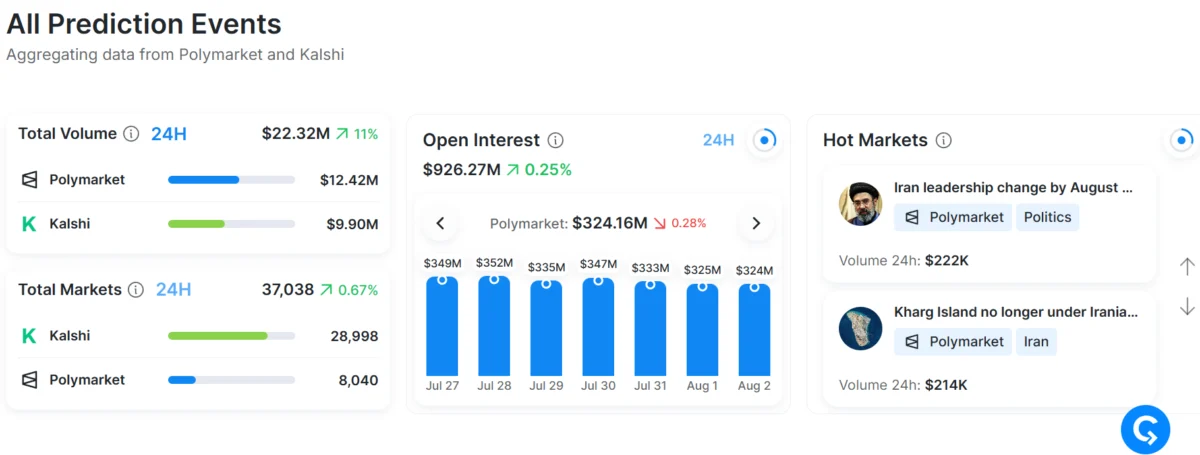
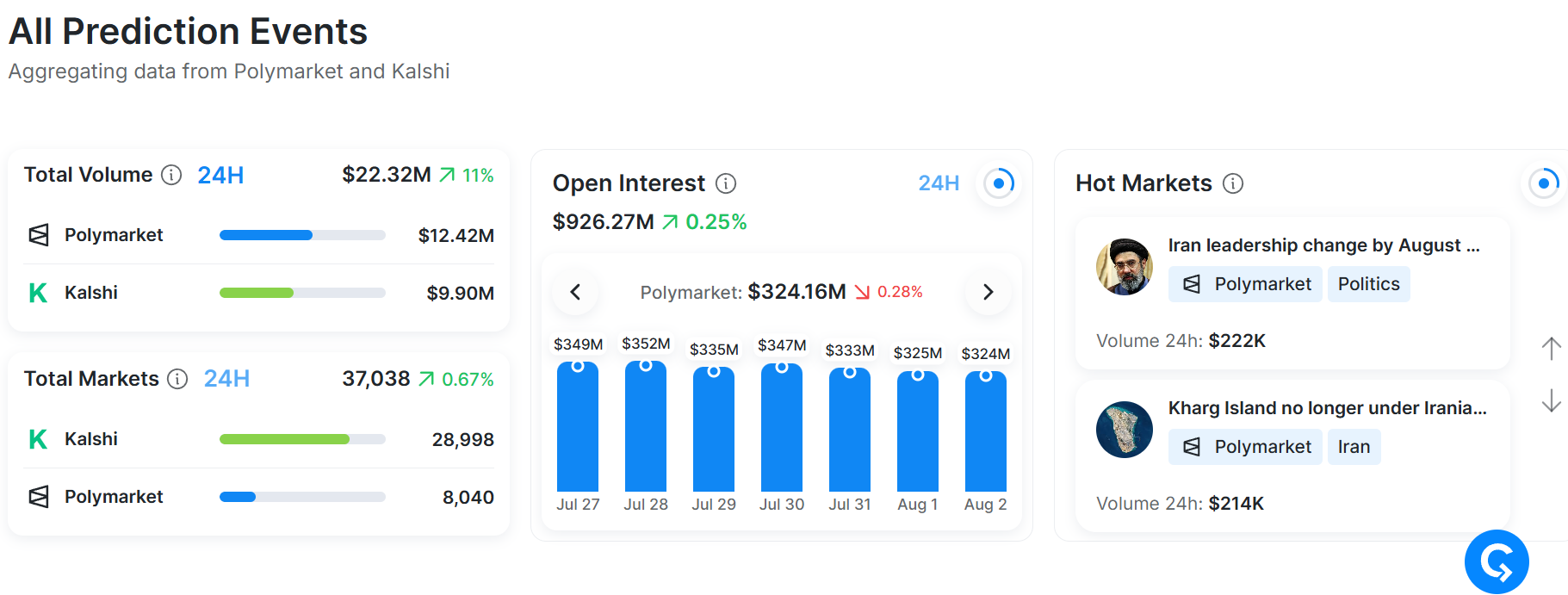
The latest available data reinforces this trend, showing total prediction market open interest at $923.61 million, marking a slight decline of 0.04% over a 24-hour period. Polymarket accounted for $321.54 million of this total, experiencing a 1.09% drop over the same timeframe. Its tracked open interest moved from $352 million on July 28 to $321 million by August 2. While this sequence included brief rebounds, the overarching trajectory remained downward. This pattern underscores a critical distinction in market analysis: absolute growth versus relative market share. A platform can indeed lose open interest in absolute terms yet gain industry weight if its rivals contract at an even faster pace, revealing where traders choose to maintain their capital even amidst a broader downturn.
Understanding Open Interest, Trading Volume, and Market Breadth
A deeper dive into the metrics of open interest, trading volume, and the number of listed markets provides further insight into the operational strategies and user behaviors on Kalshi and Polymarket. Open interest represents the total number of outstanding contracts that have not yet been closed or settled, serving as a proxy for the amount of capital committed to future predictions. Trading volume, on the other hand, measures the total value of contracts exchanged over a specific period, reflecting the level of activity and liquidity within the markets.
Despite Polymarket’s surge in market share for open interest, Kalshi continues to hold a substantial lead in the sheer number of active markets. CryptoRank data indicates that Kalshi hosts 28,996 markets, dwarfing Polymarket’s 8,040. This suggests that Kalshi offers a broader range of event contracts, potentially catering to a more diverse set of interests or providing more granular prediction opportunities. Its regulatory framework likely enables it to list a wider array of contract types, contributing to its extensive market breadth.

However, trading volume tells a different story over the most recent 24-hour period. Combined volume across the sector reached $22.38 million, an increase of 11.3%. Within this, Polymarket generated $12.48 million in volume, surpassing Kalshi’s $9.89 million. This split indicates that while Kalshi commands a larger base of open positions and a greater number of listed markets, Polymarket exhibits higher daily turnover. This could suggest that Polymarket users are more actively trading, engaging in shorter-term speculative plays, or that its markets, though fewer in number, are more liquid and attract more frequent transactional activity. This dynamic highlights distinct user engagement patterns across the platforms, with Kalshi potentially favored for longer-term positions and Polymarket for more agile, high-frequency trading.
The Role of Diverse Market Categories: From Sports to Geopolitics
The nature of prediction market open interest also helps compare retention across different event categories. The concentrated and often short-lived schedule of major sports events like the World Cup contrasts sharply with the longer timelines and evolving narratives of political and geopolitical contracts. While sports events generate intense, transient surges in capital, political outcomes can keep capital active for extended periods.
Current visible activity in the prediction market landscape is heavily supported by political and geopolitical contracts. Examples include predictions tied to leadership changes in Iran, control of strategic locations like Kharg Island, and even the highly speculative question of whether the United States will invade Iran before a specified deadline. The latter market alone demonstrated significant activity, recording $2.71 million in daily volume and $1.40 million in liquidity. These types of contracts differ fundamentally from sports betting. They tend to have wider timelines, often spanning months or even years, which can lead to more stable, longer-term capital commitment from participants.
However, political markets are not without their own unique dynamics. While they may retain capital for longer, they can also produce uneven trading bursts around breaking news, policy developments, or election cycles. A sudden announcement, a shift in diplomatic relations, or an unexpected political event can trigger rapid price movements and surges in trading volume. This makes them less prone to the sudden, mass exodus of capital seen after a definitive event like the World Cup but subject to periods of intense activity followed by relative dormancy, depending on the news cycle. This diversification into broader, more enduring event categories is crucial for the sustainable growth and stability of prediction markets, moving beyond the boom-and-bust cycles associated with singular, high-profile sporting events.
Navigating the Regulatory Landscape: Kalshi’s Compliance and Polymarket’s Resilience
The regulatory environment plays a critical role in shaping the operations, market offerings, and perceived legitimacy of prediction market platforms. Kalshi’s strategy has been centered on achieving regulatory compliance in the United States. As a CFTC-regulated Designated Contract Market (DCM), Kalshi operates under the oversight of the Commodity Futures Trading Commission, allowing it to legally offer event contracts to US residents. This regulatory approval differentiates Kalshi significantly from many other platforms, providing a foundation of trust and enabling it to attract a broader base of users who might be wary of unregulated or offshore entities. The CFTC’s approval, however, also places restrictions on the types of markets Kalshi can offer, primarily focusing on "economic" or "factual" events rather than pure "gambling." This nuanced distinction is central to the legal framework of prediction markets in the US. Kalshi has also successfully navigated legal challenges, such as a federal judge blocking Minnesota’s attempt to ban its operations, further solidifying its position within the US legal framework.
Polymarket, on the other hand, operates in a more decentralized and often legally ambiguous space. Its blockchain-based architecture offers a degree of resilience against traditional regulatory pressures but also exposes it to challenges in jurisdictions that view prediction markets as unregulated gambling. A notable instance of this was France’s move to block the platform, citing concerns over gambling regulations. Despite such hurdles, Polymarket has demonstrated significant resilience, continuing to attract users and maintain liquidity. Its appeal often lies in its decentralized nature, lower fees (due to blockchain efficiency), and a wider range of markets that might not be permissible on regulated platforms. The ongoing legal debate over whether prediction markets constitute legitimate financial instruments for forecasting or are merely forms of gambling remains a central challenge for the entire sector, particularly for decentralized platforms operating across multiple jurisdictions. The Minnesota ruling, which also benefited Polymarket by allowing it to operate in the state, underscores the evolving legal interpretations that will continue to shape the industry’s future.
Broader Implications for the Prediction Market Sector
The July data, while reflecting a post-World Cup correction, offers several critical insights into the broader health and trajectory of the prediction market sector.
Firstly, the concentration of capital among fewer, larger players suggests a maturing industry. As smaller platforms struggle to retain users and liquidity, capital naturally gravitates towards those with established user bases, stronger technological infrastructure, and greater market depth. This trend could lead to increased competition between the dominant players, potentially driving innovation in market design, user experience, and risk management.
Secondly, the distinction between event-driven capital and more sustained investment highlights a crucial challenge for prediction markets: how to cultivate long-term engagement. While major events will always attract speculative surges, platforms need to develop compelling reasons for users to keep their capital active between these peaks. This involves offering a diverse array of markets, fostering community engagement, and potentially integrating prediction markets into broader financial or data-driven ecosystems. The shift towards political and geopolitical contracts, with their longer horizons, is a positive step in this direction, offering more stable, albeit less explosive, growth potential.

Thirdly, the ongoing regulatory debate will continue to shape the industry’s evolution. Platforms that can successfully navigate legal complexities, whether through compliance or robust decentralized architectures, will gain a competitive advantage. The ability to distinguish prediction markets as legitimate forecasting tools, rather than just gambling platforms, is paramount for broader acceptance and institutional adoption. As evidence mounts regarding the accuracy of prediction markets in aggregating crowd wisdom, their utility beyond mere speculation could become a powerful argument for favorable regulatory treatment.
Finally, the differing performance metrics—Kalshi’s lead in open interest and market breadth versus Polymarket’s higher daily trading volume—indicate that the sector is likely to support multiple business models and user demographics. Kalshi might appeal to users seeking regulated, more "serious" event contracts, while Polymarket could attract a more agile, crypto-native trading community. This diversity could foster a more robust ecosystem, catering to a wider spectrum of participants.
In conclusion, the post-World Cup contraction in prediction market open interest during July serves as a crucial inflection point, revealing the inherent volatility of event-driven capital and ushering in a more concentrated competitive landscape. While Kalshi retains its overall lead, Polymarket’s strategic gains in market share underscore its resilience and ability to consolidate exposure amidst a broader downturn. The sector now faces the challenge of diversifying its market offerings, navigating complex regulatory environments, and demonstrating its long-term utility to foster sustainable growth beyond the transient excitement of major global events. The current dynamics suggest an industry in transition, refining its structure and strategies as it seeks to establish itself as a permanent fixture in the broader financial and informational landscape.