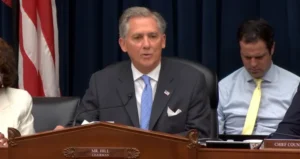
In a significant escalation of the technological rivalry between Washington and Beijing, United States Treasury Secretary Scott Bessent has warned that the Trump administration is prepared to leverage the full weight of federal sanctions against Chinese artificial intelligence (AI) companies. The warning, delivered during a Tuesday interview on FOX Business’ Mornings with Maria, centers on allegations that Chinese developers are systematically misappropriating intellectual property from leading American AI firms to narrow the competitive gap in the global technology race.
Secretary Bessent’s remarks signal a potential shift in US policy, moving beyond the restriction of physical hardware, such as high-end semiconductors, to directly targeting the software, training methodologies, and entities responsible for developing large language models (LLMs). This development follows growing concern within the US intelligence and technology sectors that American innovation is being utilized to fuel the rise of foreign competitors who do not adhere to the same copyright and intellectual property frameworks.
The Shift Toward Model-Based Sanctions
For several years, the primary lever of US economic pressure on China’s tech sector has been the restriction of advanced hardware. Under both the previous and current administrations, the Department of Commerce has implemented rigorous export controls on NVIDIA and AMD chips, aiming to starve Chinese data centers of the compute power necessary to train world-class AI. However, Secretary Bessent’s latest comments suggest that the US Treasury is now looking at the output of that training—the models themselves.
“If we see, especially, that overseas models are stealing from our great companies, we have the ability to sanction them because of this theft,” Bessent stated. He emphasized that while the Trump administration remains a proponent of open-source AI development to foster domestic innovation, that support does not extend to foreign entities that use American technology as a shortcut to bypass years of research and development costs.
The mechanism for such sanctions would likely involve the Treasury Department’s Office of Foreign Assets Control (OFAC). Placing Chinese AI firms on the Specially Designated Nationals (SDN) list would effectively freeze them out of the US-led financial system, preventing American companies from providing services, funding, or partnerships to the targeted developers.
The Rise of Chinese AI Capabilities
The timing of Bessent’s warning is not incidental. It coincides with a period of rapid advancement for Chinese AI developers, who have begun to challenge the dominance of Silicon Valley giants like OpenAI, Anthropic, and Google. Specifically, models such as Moonshot AI’s Kimi K3 have demonstrated remarkable proficiency in coding, complex reasoning, and "agentic" tasks—areas where US models have traditionally held a significant lead.
Industry analysts note that Chinese developers have pivoted toward efficiency, optimizing their models to run on less powerful hardware due to the ongoing chip bans. This lean approach to development has made Chinese AI increasingly attractive in emerging markets, posing a direct threat to the market share of American firms.
Furthermore, a recent report by Axios suggested that the Trump administration has engaged in internal discussions regarding broader restrictions on Chinese open-source models. While these claims have been met with some internal dispute and skepticism within the tech community, Bessent’s public comments lend weight to the idea that the administration is seriously considering a more aggressive posture toward foreign software development.
The Core of the Dispute: Model Distillation
At the heart of the intellectual property debate is a technical process known as "model distillation." This technique involves using a highly advanced "teacher" model (such as OpenAI’s GPT-4) to generate data that is then used to train a smaller, more efficient "student" model. By analyzing the outputs and logic of the teacher model, the student model can inherit many of its sophisticated capabilities at a fraction of the original training cost.
US AI companies have increasingly voiced frustration over this practice, characterizing it as a form of "industrial-scale plagiarism." They argue that foreign developers are effectively "skimming" the intelligence produced by billions of dollars in American R&D investment.
However, this position is far from universally accepted within the industry. Critics of the proposed sanctions argue that the US tech sector is attempting to redefine a standard research methodology as a criminal act. They point out that distillation is a common practice used globally to create smaller models for mobile devices and specialized applications.
Microsoft CEO Satya Nadella has recently injected a dose of skepticism into the debate. Nadella questioned the consistency of the US industry’s stance, noting that many major American AI companies rely heavily on "fair use" doctrines to train their own models on vast swaths of public data and copyrighted material. He suggested that it is logically inconsistent for these companies to claim fair use for their own training while simultaneously imposing highly restrictive terms of service that forbid others from using their outputs for distillation.
Historical Context and Chronology of AI Restrictions
The potential for sanctions against AI developers is the latest chapter in a long-standing technological decoupling between the world’s two largest economies. To understand the current climate, it is necessary to look at the timeline of US-China tech tensions:
- 2019-2020: The US government places Huawei and several Chinese surveillance firms on the Entity List, citing national security concerns and IP theft.
- 2022: The Department of Commerce introduces sweeping export controls on advanced computing chips and semiconductor manufacturing equipment destined for China.
- 2023: The US expands these restrictions to include "gray market" routes and third-party countries, specifically targeting NVIDIA’s H100 and A100 GPUs.
- Early 2024: Chinese firms like Alibaba, Tencent, and startups like Moonshot AI and DeepSeek release models that achieve parity with GPT-4 in specific benchmarks.
- Late 2024: Reports emerge of the Trump administration considering executive orders to restrict the export of "closed-source" model weights and potentially banning the use of certain Chinese AI software within US infrastructure.
- July 2026: Secretary Scott Bessent explicitly links Treasury sanctions to intellectual property theft in AI, marking a shift from "national security" justifications to "economic protectionism."
Internal Legal Challenges for US AI Firms
While the US government seeks to protect its domestic industry from foreign encroachment, that same industry is grappling with its own legal vulnerabilities regarding intellectual property. The argument that Chinese firms are "stealing" data is complicated by the fact that many US firms are currently being sued for the same behavior by American creators.
A prominent example is the recent legal battle involving Anthropic. A judge recently approved the commencement of payments under a $1.5 billion settlement between Anthropic and a group of authors. The lawsuit alleged that the AI company had illegally downloaded and stored thousands of copyrighted books to train its Claude models.
These internal legal setbacks provide a complicated backdrop for Secretary Bessent’s threats. If American courts determine that US companies "stole" data to build their models, it becomes diplomatically and legally difficult for the Treasury Department to sanction foreign companies for using the outputs of those same models.
Clem Delangue, CEO of Hugging Face—the world’s largest repository for open-source AI—has also pushed back against the narrative that China’s progress is solely due to theft. Delangue has stated that distillation is only a minor factor in the rapid advancement of Chinese AI. He attributes the success of firms like Moonshot AI to high-quality research teams, a robust engineering culture, and a more collaborative approach to open-source development that allows for rapid iteration.
Broader Economic and Geopolitical Implications
If the US Treasury moves forward with sanctions, the implications would be felt far beyond the software industry. Such a move would likely lead to:
- Fragmentation of the Global AI Ecosystem: We could see the emergence of a "Splinternet" for AI, where Western and Chinese models operate in entirely separate silos, with no cross-pollination of research or data.
- Retaliatory Measures from Beijing: China has historically responded to US tech sanctions with its own restrictions on critical minerals (such as gallium and germanium) necessary for electronics, or by targeting US firms like Micron and Intel operating within its borders.
- Impact on Global Standards: Sanctions could hamper international efforts to create unified safety and ethical standards for AI development. If the two leaders in the field are in an economic state of war, cooperation on existential risks associated with AI becomes nearly impossible.
- Investment Uncertainty: Venture capital flows into AI startups could be chilled if investors fear that a company’s training methods—no matter how standard—could eventually land them on a Treasury sanctions list.
Conclusion and Analysis
The comments by Secretary Scott Bessent represent a hardening of the US stance on technological sovereignty. By framing AI development through the lens of intellectual property theft, the US government is signaling that it views the AI race not just as a matter of national security, but as a core economic interest that justifies the use of its most aggressive financial weapons.
However, the path to sanctions is fraught with complexity. Defining what constitutes "theft" in the age of generative AI remains a moving target in both domestic and international law. As the Trump administration weighs its next moves, it must balance the desire to protect American "great companies" with the reality that the very methods it seeks to penalize are often the same ones that fueled the American AI boom.
For now, the warning serves as a clear signal to Beijing and the global tech community: Washington is no longer content with just guarding the "shovels" (the chips) of the AI gold rush; it is now claiming ownership of the "gold" (the models) themselves. Whether this strategy will successfully preserve the US lead or simply accelerate the development of a completely independent Chinese tech stack remains the defining question of the current decade.