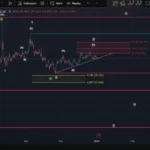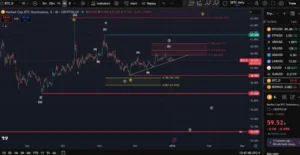
The digital asset market is currently witnessing a significant transformation in investor behavior as Bitcoin, the world’s largest cryptocurrency by market capitalization, recently breached a critical technical trendline that has supported its price action for several months. This technical breakdown, identified by prominent market analyst Justcryptopays, suggests that the period of absolute Bitcoin dominance may be transitioning into a more diversified phase of market growth. As Bitcoin struggles to maintain its footing above the psychologically significant $90,000 threshold, market participants are increasingly observing a rotation of capital into the altcoin sector, a phenomenon often referred to in the industry as the beginning of an "Altcoin Season."
For much of the preceding year, Bitcoin has served as the primary engine of the cryptocurrency market, capturing the vast majority of institutional inflows and retail interest. However, the recent failure to consolidate gains above $90,000—with the asset currently hovering around the $90,525 mark—has introduced a level of caution among traders. This stagnation in the flagship asset’s momentum often serves as a catalyst for investors to seek higher-beta returns in alternative assets such as Ethereum (ETH), Solana (SOL), XRP, and Cardano (ADA), as well as emerging sectors within the Decentralized Finance (DeFi) and Web3 ecosystems.
The Technical Breakdown and the $90,000 Support Level
The technical significance of Bitcoin’s recent price action cannot be overstated. Trendlines represent the collective sentiment of the market, acting as invisible boundaries that define the health of a prevailing trend. When Bitcoin broke below its primary ascending trendline, it signaled to institutional and retail desks alike that the parabolic phase of the current rally might be reaching a point of exhaustion.
The $90,000 level has emerged as a fierce battleground between bulls and bears. In psychological terms, round numbers often act as "magnets" or "walls" for price action. A sustained failure to turn $90,000 into a definitive support floor suggests that the immediate demand at these price levels is being met with equal or greater sell pressure. For investors who entered the market at lower valuations, this stagnation provides a logical exit point to realize profits, which are then frequently redistributed into assets that have yet to reach their full cyclical potential.
According to data from various exchanges, the liquidity around the $90,000 mark is dense, with significant sell orders clustered just above this price point. This "overhead resistance" has forced Bitcoin into a period of sideways consolidation, a environment in which altcoins traditionally begin to outperform.
A Chronology of Market Dynamics: From 2025 Momentum to 2026 Transitions
To understand the current shift, it is essential to examine the trajectory of the market over the past twelve months. The year 2025 was characterized by a period of significant volatility and, at times, bearish momentum that tested the resolve of long-term holders. Bitcoin’s rise to the $90,000 range was a hard-fought recovery, driven largely by the maturation of spot exchange-traded funds (ETFs) and a clearer regulatory framework in major economies.
However, as the calendar turned to 2026, the "Bitcoin-only" narrative began to show signs of fatigue. While Bitcoin provided the stability necessary to restore confidence in the broader asset class, it also reached a market cap that makes 10x returns increasingly difficult to achieve in short timeframes. This mathematical reality has pushed the narrative toward an "Altcoin Awakening."

Throughout late 2025, many altcoins remained suppressed, failing to mirror Bitcoin’s percentage gains. This divergence created a valuation gap, making assets like Ethereum and Solana appear "cheap" relative to Bitcoin’s all-time highs. The current break in Bitcoin’s trendline is the first major signal in 2026 that this gap may finally begin to close.
The Waterfall Effect: How Capital Rotates
The concept of capital rotation in the cryptocurrency market typically follows a predictable "waterfall" pattern. This cycle begins with Bitcoin, where the majority of new fiat currency enters the system. Once Bitcoin reaches a peak or enters a consolidation phase, that capital flows into Ethereum, the second-largest asset and the foundation for most decentralized applications. From there, it trickles down into large-cap assets like Solana and XRP, before finally reaching mid-cap tokens and speculative memecoins.
Current market indicators suggest we are in the second stage of this waterfall. Ethereum has shown signs of decoupling from Bitcoin’s negative price action, and Solana continues to capture significant market share in the NFT and retail trading sectors. The "Altcoin Season Index," a metric used to track whether the top 50 altcoins are outperforming Bitcoin over a 90-day period, has begun to tick upward, reflecting the shift in dominance.
Analysis of Leading Altcoin Contenders
As capital begins to rotate, several key assets are positioned to lead the charge. Each represents a different sector of the digital economy, providing a diversified front for the anticipated altcoin rally.
Ethereum (ETH) and the DeFi Resurgence
As the primary platform for smart contracts, Ethereum remains the bellwether for the altcoin market. While it faced criticism in 2025 regarding high gas fees and competition from faster chains, its recent upgrades and the proliferation of Layer-2 scaling solutions have solidified its position. A rotation into ETH is often seen as a move toward "productive" assets, as the network generates significant fee revenue.
Solana (SOL) and High-Throughput Innovation
Solana has emerged as the primary challenger to Ethereum’s dominance. Known for its high speed and low transaction costs, Solana has become the preferred home for retail-driven memecoin trading and high-frequency DeFi applications. If the market shifts toward a high-volatility environment, Solana’s ecosystem is likely to see a disproportionate increase in trading volume.
XRP and Cardano (ADA): The Legacy Giants
Both XRP and Cardano have maintained dedicated communities despite years of regulatory and developmental hurdles. For XRP, the resolution of long-standing legal battles has cleared the path for institutional adoption in the cross-border payment sector. Cardano, meanwhile, continues to focus on a peer-reviewed, research-driven approach to blockchain governance, appealing to investors looking for long-term structural stability.
The Role of Memecoins
While often dismissed as purely speculative, memecoins serve as a vital indicator of retail sentiment and liquidity. When capital flows into memecoins, it suggests a high "risk-on" appetite among traders. The recent resilience of major memecoins despite Bitcoin’s trendline break suggests that retail investors are not retreating from the market but are instead moving further down the risk curve in search of exponential gains.
Institutional and Analyst Perspectives
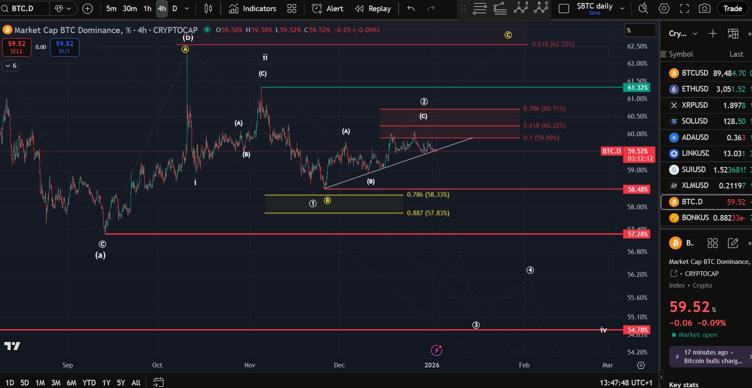
The observation by Justcryptopays regarding the trendline break is echoed by several other technical analysts who monitor "Bitcoin Dominance" (BTC.D). Historically, when BTC.D peaks and begins to decline, it provides the necessary liquidity for altcoins to "moon," or experience rapid price appreciation.
Institutional desks have also begun to adjust their portfolios. Reports from digital asset fund managers indicate a slight increase in the weighting of multi-asset funds, moving away from Bitcoin-heavy allocations. This suggests that the "smart money" is preparing for a more balanced market where value is distributed across various technological use cases rather than concentrated in a single store-of-value asset.
Broader Implications for the Global Crypto Economy
A shift toward an altcoin-centric market has broader implications for the blockchain industry. An "Altcoin Season" is not merely a period of price increases; it is a period of increased utility and adoption for decentralized applications. As more capital flows into ecosystems like Solana or Ethereum, developers receive more funding, liquidity in DeFi protocols increases, and the barrier to entry for new users often drops due to the competitive nature of these platforms.
However, this transition is not without risks. Altcoins are notoriously more volatile than Bitcoin, and a significant "shake-off" of the bearish momentum from 2025 remains a challenge. If Bitcoin were to experience a more severe correction—dropping well below $85,000—it could drag the entire market down, regardless of the trendline breaks. Investors must remain vigilant, as the "rotation" can quickly turn into a "retreat" if macroeconomic conditions, such as interest rate hikes or geopolitical instability, impact global liquidity.
Conclusion and Future Outlook
The break below the key trendline and the struggle to maintain $90,000 mark a pivotal moment for Bitcoin in early 2026. While the flagship cryptocurrency remains the foundational asset of the industry, the current market dynamics point toward a necessary and healthy diversification. The rotation of capital into altcoins suggests a maturing market where investors are beginning to distinguish between the "digital gold" properties of Bitcoin and the "digital infrastructure" properties of altcoins.
As the market moves forward, the focus will likely remain on whether altcoins can sustain their momentum and officially usher in a new "Altcoin Season." For the strategic investor, this period offers a window of opportunity to capitalize on the evolving landscape of digital finance, provided they can navigate the inherent volatility of a market in transition. The "Altcoin Awakening" is no longer just a theoretical possibility; it is a shift currently being written into the charts by millions of traders worldwide.