Global financial markets experienced a profound divergence today, presenting a complex picture of investor sentiment that belies any single, overarching narrative. While equity markets across South Korea, Japan, and China collectively surged by over half a trillion dollars, Wall Street simultaneously witnessed a sharp reversal, with approximately $680 billion evaporating from the U.S. stock market, primarily impacting the high-flying artificial intelligence (AI) sector. This stark contrast illustrates a market in transition, where macro-economic tailwinds are lifting entire regions, while specific sectors and individual companies face heightened scrutiny regarding their fundamental valuations and capital expenditure strategies.
Asian Equities Experience a Half-Trillion Dollar Influx
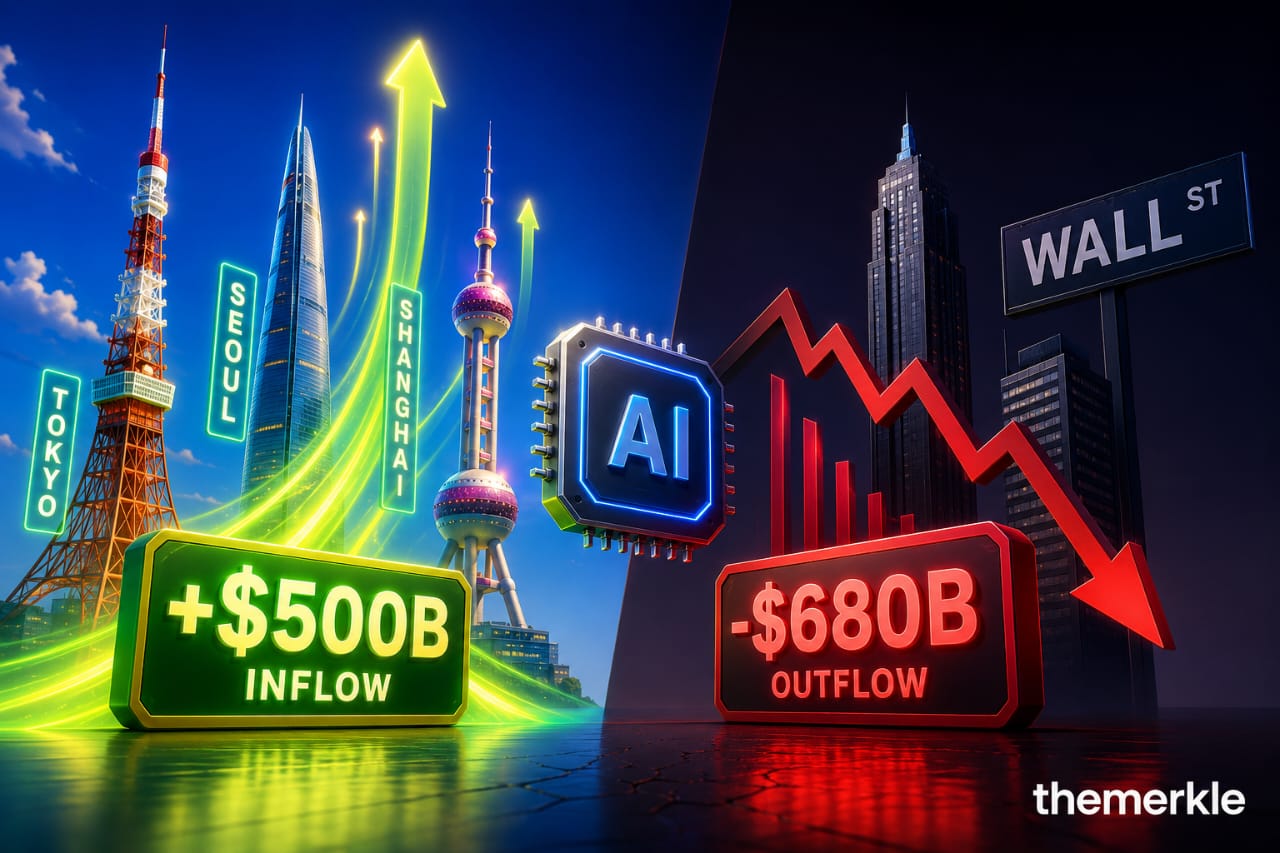
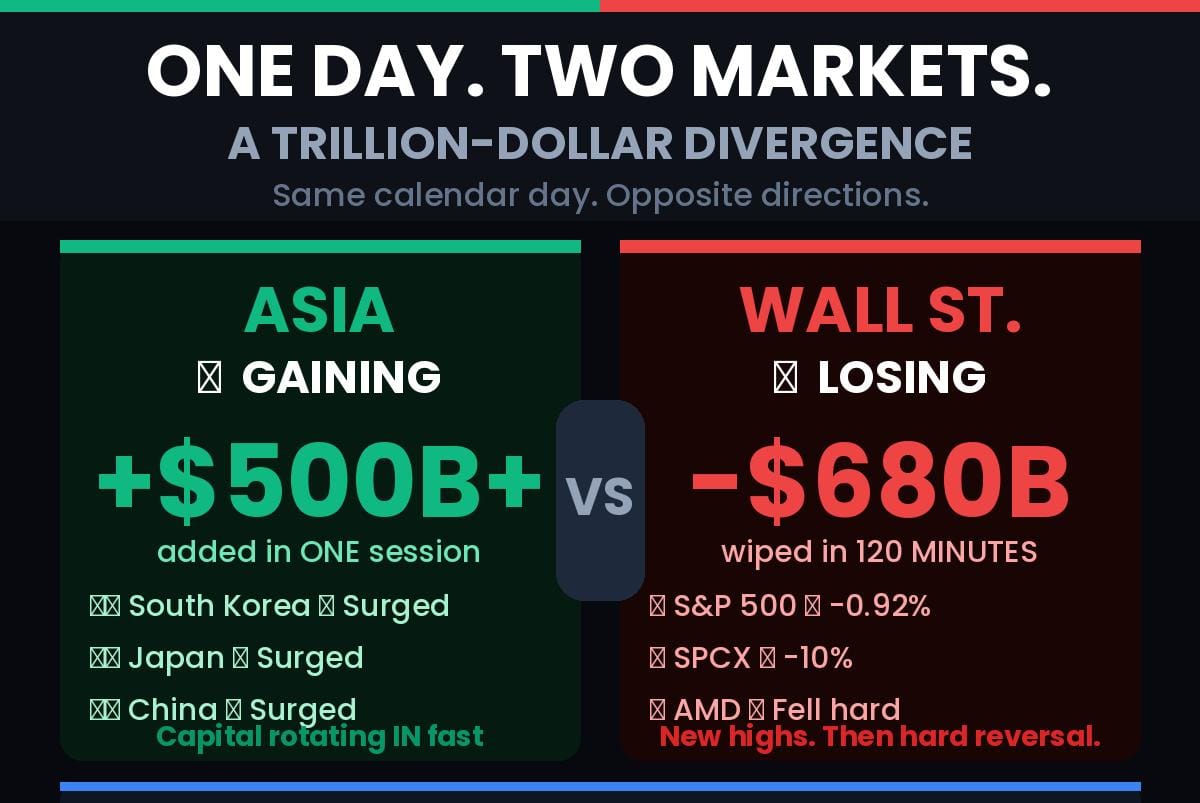
On one side of the Pacific, a powerful wave of capital flooded into Asian equities, marking one of the most significant single-session inflows in recent memory. Data circulating among financial analysts confirmed that South Korean, Japanese, and Chinese stock markets absorbed in excess of $500 billion within a matter of hours. This surge was not a gradual accumulation but a rapid movement of funds, indicating a strong conviction among investors regarding the region’s prospects. Major indices across these nations registered substantial gains, reflecting broad-based buying interest that transcended individual company performance. The timing of this robust rally, coinciding with a notable pullback in U.S. markets, suggests a potential rotation of capital, as investors reallocate funds from areas perceived as overextended to those offering clearer growth catalysts and more attractive valuations.
Underlying Catalysts for Asia’s Ascent
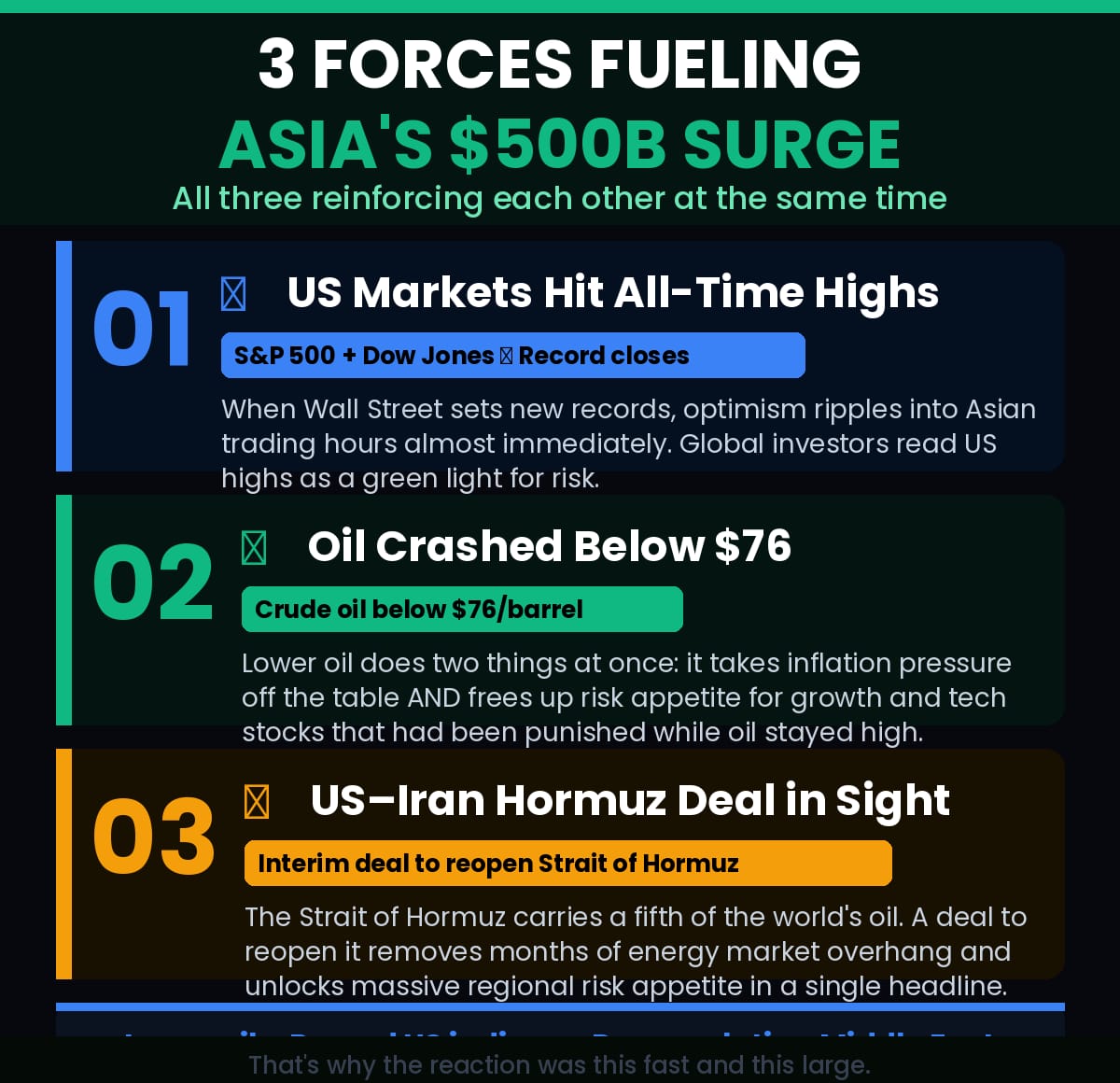
Several interconnected factors converged to fuel Asia’s impressive market performance. Foremost among these was the preceding bullish close on Wall Street, where both the S&P 500 and Dow Jones Industrial Average had reached fresh all-time highs. This positive momentum often creates a ripple effect, spilling over into Asian trading sessions as global optimism permeates investor sentiment. The psychological boost from record-setting U.S. performance frequently encourages risk-taking in other major markets.
A second, and arguably more significant, driver was a palpable de-escalation of geopolitical tensions in the Middle East. Reports emerged suggesting that the United States and Iran were nearing an interim agreement to facilitate the reopening of the Strait of Hormuz. This critical waterway is a choke point through which approximately one-fifth of the world’s total petroleum consumption, or about 21 million barrels per day, physically passes. Its potential closure has been a persistent source of anxiety for global energy markets for months, contributing to volatility and elevated crude oil prices. The prospect of an agreement signaled a reduction in supply chain risks and a potential return to stability, a powerful positive for global trade and energy-importing nations, many of which are in Asia.
The third reinforcing factor was a significant drop in crude oil prices, which plunged below the $76 per barrel mark. This decline had a dual positive impact on market sentiment. Firstly, lower oil prices directly alleviate inflationary pressures across economies worldwide, reducing input costs for businesses and increasing discretionary spending power for consumers. This broad-based disinflationary impulse is generally welcomed by central banks and investors alike, as it can temper expectations for aggressive interest rate hikes. Secondly, and perhaps more crucially for equity markets, falling oil prices tend to free up risk appetite. When energy costs are high and volatile, investors often gravitate towards defensive sectors. Conversely, a stable or declining oil price environment encourages a shift towards growth-oriented and technology names, which had previously been penalized during periods of elevated energy costs. The combination of these three forces—record U.S. optimism, geopolitical de-escalation, and falling commodity prices—created a compelling bullish case for Asian equities, leading to the rapid and substantial capital inflow observed today.
Wall Street’s Abrupt Reversal: A $680 Billion Plunge
In stark contrast to Asia’s upward trajectory, the U.S. stock market experienced a dramatic and rapid reversal. Just hours after celebrating new all-time highs, Wall Street watched as approximately $680 billion in market capitalization vanished within a two-hour trading window. The S&P 500, a benchmark for broad market performance, dropped 0.92% from its peak, signaling a violent shift in investor sentiment. This abrupt downturn served as a potent reminder that record closes do not inherently equate to unwavering conviction, and market highs can be swiftly followed by significant pullbacks.
A closer examination of the sell-off revealed that it was not a broad-based market correction but rather a highly concentrated event. The damage was primarily localized to a few specific, high-valuation stocks, particularly within the technology and AI sectors. This concentration suggests that the underlying issues driving the decline were not systemic market weaknesses but rather company-specific or sector-specific concerns that triggered a rapid re-evaluation by investors.
SpaceX and the Lockup Expiry Conundrum
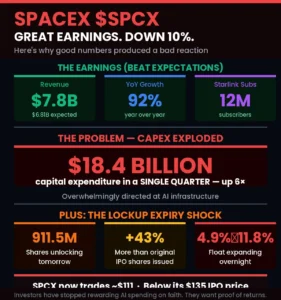
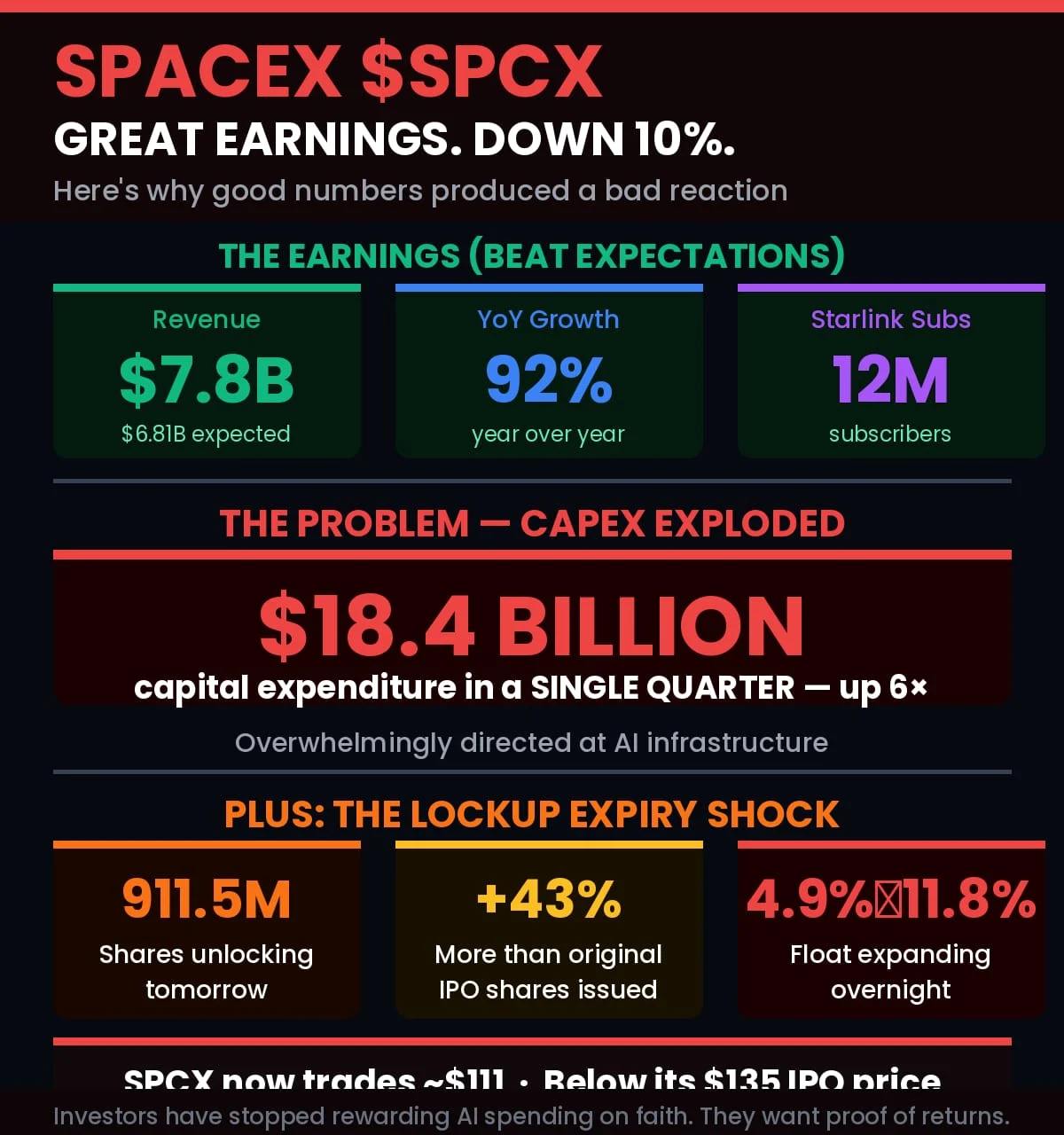
At the epicenter of Wall Street’s reversal was SpaceX, trading under the ticker $SPCX. The aerospace company, a prominent figure in the AI and advanced technology landscape, faced a unique structural challenge that many market participants had not fully anticipated. A staggering 911.5 million shares of $SPCX, primarily held by employees and early investors, were scheduled to become eligible for trading in the immediate future. This colossal influx of shares represents a 43% increase over the 638.9 million shares initially issued at its initial public offering (IPO), effectively boosting SpaceX’s free float from a mere 4.9% to 11.8% of its total outstanding shares.
Such a significant supply shock can exert immense downward pressure on a stock, particularly one that has already been subject to valuation debates. The market’s reaction underscored the critical importance of structural details like lockup expiry dates, which often get overshadowed by headline earnings figures but can have a far more profound and immediate impact on share price dynamics. This event unfolded despite what were, by many conventional measures, robust quarterly earnings. SpaceX reported revenue of $7.8 billion against an expected $6.81 billion, marking a remarkable 92% year-over-year increase. Its Starlink satellite internet service also demonstrated impressive growth, reaching 12 million subscribers. Under normal circumstances, these figures would likely be met with investor enthusiasm. However, $SPCX shares plummeted by 10% today, highlighting a stark disconnect between fundamental performance and market reaction, a disconnect primarily attributable to the impending supply overhang.
The AI Spending Bill Comes Due: Scrutiny on Capex
Beyond the lockup issue, a deeper concern emerged from SpaceX’s financial report: capital expenditure (capex). The company’s spending surged sixfold in a single quarter, reaching an eye-watering $18.4 billion, overwhelmingly directed towards AI infrastructure development. This massive outlay brought into sharp focus a nascent but critical shift in investor sentiment regarding the AI sector. For the past several years, companies that merely articulated a strategy to invest in AI, or even just mentioned AI in their earnings calls, often saw their valuations soar. The market seemed content to reward ambition and future potential.
However, today’s reaction to SpaceX’s spending, and similar dynamics observed with other AI-adjacent firms, indicates a significantly higher bar for investment. Investors are no longer content with promises of AI investment; they are now demanding tangible proof that such substantial capital expenditures will translate directly into demonstrable revenue growth and, crucially, profitability. The era of "AI spending on faith alone" appears to be waning, replaced by a more discerning approach that scrutinizes the return on investment for these costly infrastructure projects.
Elon Musk’s response to the scrutiny, doubling down on aggressive growth targets by moving SpaceX’s projected $1 trillion annual revenue milestone from 2031 to 2030, did little to assuage investor concerns. With the stock now trading around $111, below its $135 IPO price, and the looming threat of up to 20% of shares hitting the market post-lockup, the timing for such a confident, yet potentially unproven, outlook could not be worse for those hoping for a swift sentiment rebound.
A strikingly similar narrative unfolded with Advanced Micro Devices (AMD) today. Despite its strong positioning in the AI chip market, AMD also experienced a significant sell-off. While specific details might differ, the underlying investor rationale was identical: the market is increasingly questioning the immediate profitability and efficiency of AI-related capital expenditures. The collective message from Wall Street to the AI sector is clear: show us the money, not just the spending.
Broader Implications and a Market in Transition
This profound divergence in global market performance today is far more nuanced than a simple "Asia good, America bad" narrative. Instead, it signals a maturation and increased selectivity within financial markets globally. On one hand, powerful macro tailwinds—such as the easing of geopolitical tensions in a critical energy region and the consequent decline in commodity prices—are capable of lifting entire regional markets and broad indices, as evidenced by Asia’s robust performance. These are systemic factors that create a favorable operating environment for a wide array of businesses.
On the other hand, individual company stories, particularly within the previously high-flying AI sector, are being subjected to intense, granular scrutiny. Investors are moving beyond generic enthusiasm for AI and are now evaluating specific companies on a quarter-by-quarter basis, demanding concrete evidence that massive capital outlays for AI infrastructure are translating into sustainable revenue growth and, critically, improved profitability. This shift represents a significant evolution in investor behavior, moving from a growth-at-any-cost mentality to one that prioritizes efficiency, tangible returns, and robust business models.
The implications of this divergence are multifaceted. For the AI sector, it heralds a period of potentially increased volatility and a more challenging fundraising environment for companies unable to demonstrate a clear path to profitability from their AI investments. Valuations, particularly for firms with aggressive spending plans but distant revenue targets, may face sustained downward pressure. For global markets, it underscores the increasing importance of geopolitical stability and commodity price movements as fundamental drivers of regional performance. The fluidity of capital, as demonstrated by the rapid rotation observed today, highlights a dynamic landscape where investors are quick to reallocate resources based on evolving risk-reward profiles.
Moving forward, market participants will be closely monitoring not just the headline index movements on either side of the Pacific, but also the underlying drivers of these shifts. The critical distinction between macro-driven regional rallies and highly selective, fundamentals-driven company valuations will likely define market dynamics in the weeks and months to come. This period of recalibration suggests a healthier, albeit more challenging, investment environment where due diligence and a deep understanding of underlying economics will be paramount.