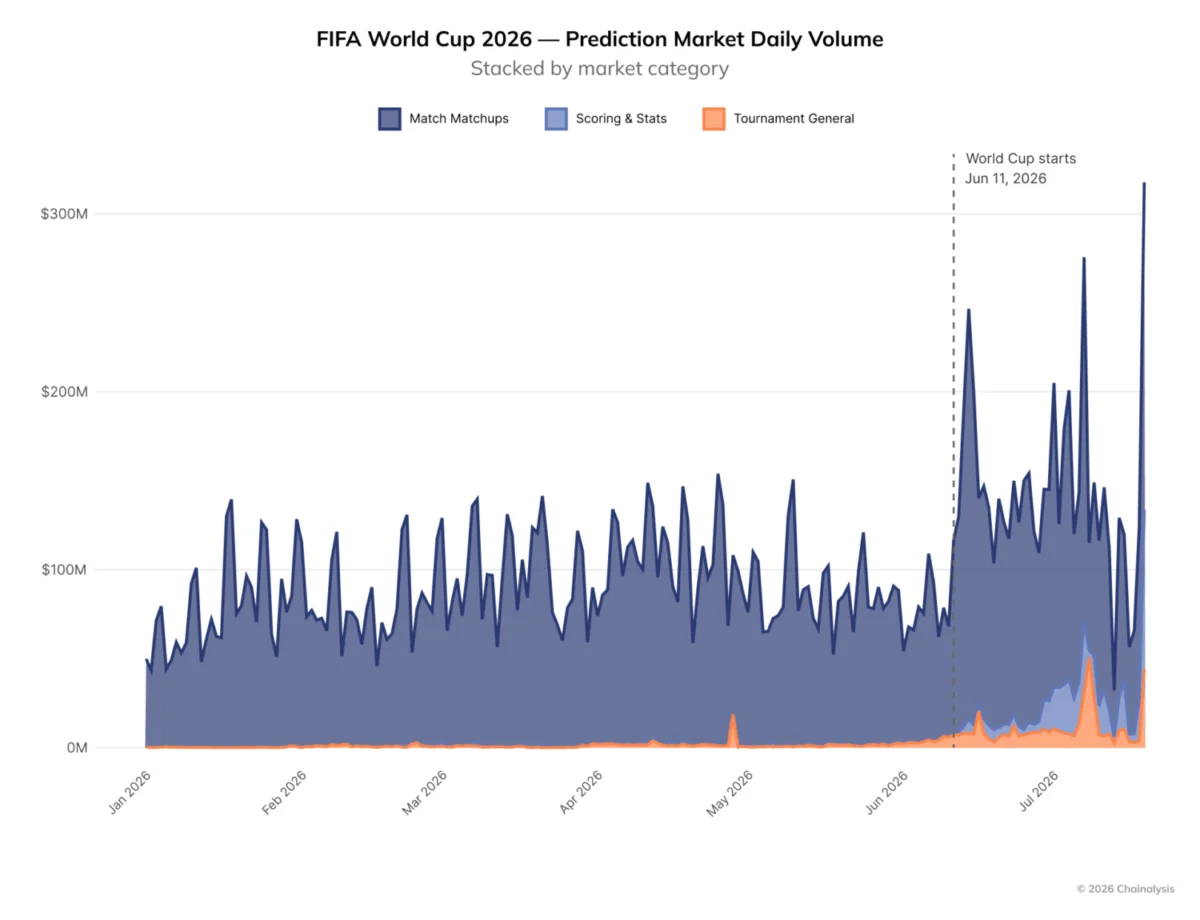
The 2026 FIFA World Cup has solidified its place in history not only as a masterclass in athletic prowess but as a transformative moment for the global digital economy. While traditional metrics of success—a record-breaking 6.8 million attendees, an unprecedented $10.5 billion in advertising spend, and a staggering 66 million viewers for the final match in the United States alone—dominated the headlines, a parallel financial narrative unfolded on the blockchain. Data recently released by Chainalysis reveals that the tournament acted as a massive catalyst for on-chain activity, generating $20 billion in prediction market volume since January 2026 and driving $24 million in digital collectible trades. This surge in decentralized finance (DeFi) and Non-Fungible Token (NFT) utility marks a pivot point where the world’s most popular sport met the burgeoning infrastructure of the "new rails" of global finance.
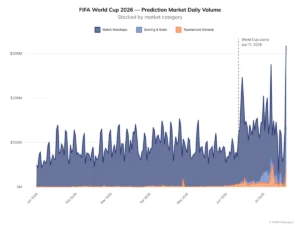
The intersection of sports and blockchain technology has often been viewed through the lens of speculation, but the 2026 World Cup provided a high-stakes environment that demonstrated practical scale and utility. Close to 400,000 unique digital wallets interacted with blockchain-based prediction markets throughout the event. Of the $20 billion in total volume tracked since the start of the year, $5.7 billion was generated during the five-week window of the tournament itself. These figures represent more than just betting; they reflect a shift in how global audiences interact with live events, moving away from centralized, region-locked bookmakers toward transparent, borderless protocols that operate 24/7.

A Chronology of Speculation: From Qualifiers to the Grand Finale
The financial momentum for the 2026 World Cup did not begin with the opening whistle on June 11. Instead, the on-chain economy began to swell as early as January 2026, coinciding with the final, high-pressure months of the qualification campaign. During this period, prediction market participants generated nearly $50 million in daily volume. These early movers focused primarily on match outcomes, group placements, and the narrow margins of qualification that determined which nations would grace the world stage.
As the tournament drew closer, the baseline of activity rose. By the time the opening ceremony concluded, daily volumes surged into the $250 million range. This heightened activity was maintained throughout the group stages and knockout rounds, tapering slightly only when the schedule slowed down in the final week. However, the final match—a historic clash where Spain bested Argentina—shattered daily records, with bettors powering over $300 million in volume on that single day. During the peak of the tournament, World Cup-related markets accounted for approximately 63% of the total global prediction market volume, illustrating the tournament’s ability to cannibalize interest from all other financial and political markets.
Beyond standard win-loss outcomes, the 2026 World Cup saw the rise of "novelty markets" that captured the cultural zeitgeist. One of the most discussed markets involved the legendary Portuguese forward Cristiano Ronaldo. Bettors were invited to speculate on whether the star would cry at the end of his final World Cup campaign. The market, which ultimately settled in the affirmative, generated $49 million in volume. This niche activity highlights a growing trend in on-chain finance: the tokenization of human emotion and narrative, providing fans with a way to "stake" their observations of the game’s dramatic arcs.

The Success of the Strategic Prognosticator
The Chainalysis report offers a fascinating glimpse into the demographics of these digital bettors. Across all markets—ranging from match statistics to player-specific outcomes—55% of participants ended the tournament in profit. This majority success rate is notably higher than traditional gambling averages and is largely attributed to the experience level of the users. Within the group of winning bettors, 79% were identified as "experienced prediction market prognosticators."
This data suggests that blockchain-based markets are attracting a sophisticated class of analysts who treat sports outcomes with the same rigor as financial traders treat equity or commodity markets. The transparency of the blockchain allows these users to verify liquidity and odds in real-time, potentially offering a more equitable environment than the opaque "house" margins found in traditional sportsbooks.
FIFA Collect: Bridging the Gap Between Digital Assets and Physical Access
While prediction markets focused on outcomes, FIFA’s official digital collectible program, "FIFA Collect," focused on utility and commemorative value. Launched on the Avalanche blockchain, the platform allowed fans to purchase and trade "digital moments"—NFTs capturing the tournament’s most iconic goals and saves. Since May 2025, this stablecoin-powered economy has generated at least $24 million in transaction volume.

However, the true innovation of FIFA Collect lay in its integration with the physical world. For the first time, digital collectibles served as a legitimate secondary path to tournament access. Collectors could redeem specific NFTs for real-world match tickets or purchase "right to buy" permissions from other fans on the secondary market. According to official FIFA Collect data, over 100,000 fans secured their seats at the stadiums through this blockchain-enabled system.
Chainalysis’s review of the smart contracts associated with the platform revealed a highly efficient revenue model for the governing body. FIFA’s primary wallet, which processed minting and secondary sales, took a 5% commission on every transaction. This resulted in at least $6 million in direct revenue for FIFA from secondary market activity alone. While $24 million is a modest sum compared to the billions spent on traditional broadcasting rights, the success of the program provides a blueprint for future sporting events to bypass traditional ticketing bottlenecks and combat fraud through the immutable ledger of the blockchain.
Mapping the Global Flow of Digital Capital
The 2026 World Cup was a truly global phenomenon, and the on-chain data reflects a wide geographic distribution of participation. Analysis of flow origins shows that every continent, excluding Antarctica, contributed significantly to the $20 billion volume. The United States and China emerged as the primary drivers of activity, followed closely by Canada, the United Kingdom, and Thailand.

The high participation rates in the U.S. and Canada are unsurprising given their roles as host nations, but the volume from China and Thailand underscores the borderless nature of blockchain technology. In regions where traditional sports betting may face heavy regulation or limited access to international markets, decentralized prediction protocols provide a gateway for fans to participate in the global sports economy.
Integrity and Illicit Activity: A Tale of Two Ecosystems
One of the most critical aspects of the Chainalysis report is the investigation into the "cleanliness" of the funds flowing through these markets. As financial infrastructure moves on-chain, the ability to trace the origin of capital becomes a vital tool for regulators and platforms alike.
In the prediction market sector, the analysis found that less than 1% of the 400,000 participating wallets had direct ties to illicit actors. However, due to the massive scale of the volume, even a small percentage represented significant sums. The largest source of "tainted" capital was traced back to Huobi/HTX, an exchange that faced sanctions from UK and EU authorities in early 2026 for allegedly facilitating Russian crypto flows. Approximately $5.4 million flowed directly from Huobi-linked wallets into World Cup betting pools. Other illicit sources identified included wallets associated with online scams, high-risk jurisdictions, and previously flagged theft incidents.

In stark contrast, the FIFA Collect NFT platform remained almost entirely free of illicit exposure. This disparity is largely attributed to the rigorous Know Your Customer (KYC) and Anti-Money Laundering (AML) protocols implemented by FIFA. To participate in the ticket-redemption program, users were required to undergo manual verification and declare their source of funds. These compliance "moats" successfully deterred bad actors, proving that while open protocols offer massive reach, permissioned systems within the blockchain can offer the security levels required by major global organizations.
Broader Impact and the Future of On-Chain Finance
The 2026 FIFA World Cup has provided a microcosm of the future of global engagement. The record-smashing volumes in prediction markets and the functional success of the FIFA Collect program suggest that the "on-chaining" of the world’s biggest stages is no longer a theoretical exercise—it is a reality.
The implications for the future are twofold. First, the success of these platforms demonstrates that stablecoins have become the preferred medium of exchange for global fan economies, offering a level of speed and settlement that traditional banking systems cannot match. Second, the event has highlighted the necessity for robust blockchain forensics. As more legitimate commerce moves to the blockchain, the ability to distinguish between a fan’s "clean" wager and a sanctioned entity’s attempt to move capital becomes paramount.

For regulators, the 2026 World Cup serves as a case study in both the promise of transparency and the challenge of oversight. For FIFA and other sports governing bodies, it proves that digital assets, when paired with real-world utility, can create new revenue streams and deepen fan loyalty. As the dust settles on the pitch in North America, the digital records left behind on the blockchain will continue to be studied as the foundational data for the next era of global finance. The tournament may have ended with Spain lifting the trophy, but the real winner in the long term may be the decentralized infrastructure that allowed the world to participate in the game like never before.