Every browser used by humans until Cloudflare’s latest release, Kitesurf, was designed around a fundamental assumption: a human is going to look at it. This foundational premise has dictated every aspect of browser development for decades, from the intuitive graphical user interfaces (GUIs) featuring tabs, themes, and smooth scrolling, to the intricate rendering engines meticulously crafted for pixel-perfect visual fidelity. These features, while indispensable for human interaction, represent significant, often superfluous, overhead for artificial intelligence agents that require programmatic access to the web. Cloudflare has challenged this entire paradigm with Kitesurf, a browser built from the ground up without human eyes or hands in mind, signaling a quietly significant infrastructure release that could reshape the landscape of AI agent development.
A New Paradigm in Web Browsing: The Agentic Cloud
Traditional web browsers, exemplified by giants like Google Chrome, Mozilla Firefox, and Apple Safari, are marvels of engineering optimized for human experience. They are designed to be visually appealing, user-friendly, and capable of handling complex interactive elements. Features such as tabbed browsing, customizable themes, browser extensions, and seamless synchronization across devices cater directly to the cognitive and operational needs of a human user. However, for an AI agent, these functionalities are not only irrelevant but actively detrimental, consuming precious computational resources—CPU cycles, memory, and network bandwidth—that directly translate into increased operational costs and reduced efficiency.
Cloudflare’s Kitesurf fundamentally redefines the concept of a browser by stripping away every human-centric element. It is described as a stateless, highly scalable web browser running entirely on Cloudflare’s Workers platform, specifically engineered for what the company terms the "Agentic Cloud." This term signifies an emerging ecosystem where AI agents are primary actors, autonomously navigating and interacting with the web. The core insight behind Kitesurf is disarmingly simple yet profound: AI doesn’t care about visual aesthetics, interactive features, or persistent sessions in the way humans do. Its priorities revolve around token count, context windows, scalability, cost-effectiveness, and the efficient extraction of structured information. Existing browser engines, like Chromium, were never built with these priorities at their core, forcing AI agents to bear the burden of unused overhead.
The rise of large language models (LLMs) and sophisticated AI agents has created an urgent demand for efficient web interaction. These agents increasingly need to browse, parse, and understand web content to perform tasks ranging from data aggregation and content summarization to dynamic market analysis and automated customer service. Relying on traditional headless browsers, which are essentially GUI-less versions of human browsers, introduces significant inefficiencies. While headless Chromium or Firefox can automate web tasks, they still carry the full weight of their underlying human-centric architecture, including rendering pipelines, JavaScript engines, and DOM manipulation capabilities designed for visual output, all of which are largely redundant for AI agents focused on data processing. Kitesurf aims to bridge this gap by offering a purpose-built solution that aligns browser architecture with AI agent requirements.
The Genesis of Kitesurf: A Convergence of Technologies
The journey to Kitesurf was not a sudden pivot but a gradual convergence of technological advancements and evolving market needs within Cloudflare. According to internal accounts, the idea of building an in-house browser had surfaced periodically within Cloudflare for years, often discussed but consistently shelved due to the perceived technical complexity outweighing the potential payoff. The sheer undertaking of developing a browser engine from scratch, even a minimalist one, is immense, typically requiring vast engineering resources and years of development.

However, a confluence of factors ultimately changed this calculus, creating a fertile ground for Kitesurf’s development. A critical enabler was the maturation of WebAssembly (Wasm) support within Cloudflare Workers. WebAssembly provides a way to run high-performance code, written in languages like Rust, C, or C++, directly within web browsers or serverless environments at near-native speeds. This capability transformed Cloudflare Workers from primarily JavaScript-driven functions into a powerful platform for executing complex, computationally intensive tasks at the edge. The ability to run core browser engine components, which are typically performance-critical, within Wasm on Workers proved to be a game-changer.
Concurrently, Cloudflare introduced new primitives that further empowered its Workers platform. Dynamic Workers offered on-demand, isolated execution environments, crucial for the security and scalability Kitesurf would require. SQLite-based Durable Objects provided a mechanism for persistent state in an otherwise stateless serverless architecture, allowing for the management of specific browser session data or other necessary contextual information without sacrificing the benefits of serverless deployment.
These internal technological advancements coincided precisely with an explosive demand for "agent-native" browsing driven by the rapid progress in AI. As LLMs became more capable, their need to interact with dynamic web content grew exponentially. This created a clear market pull for a browser that was not only efficient but also tailored to the unique operational profile of AI agents.
A particularly noteworthy detail in Kitesurf’s origin story is the role of AI itself in its development. The project began with Obscura, a Rust-based headless engine. Cloudflare leveraged an AI agent to assist in porting this engine onto the Workers platform. While initial attempts reportedly failed, the team iteratively refined the instructions and plans provided to the AI, eventually leading to a working proof of concept. This meta-aspect – a browser for AI agents substantially built with the assistance of an AI agent – underscores the transformative potential of AI not just as a consumer of web content but as a co-creator of infrastructure. This detail deserves more widespread recognition as it highlights a burgeoning trend in software development where AI moves beyond simple code generation to more complex, architectural problem-solving under human guidance.
Architectural Ingenuity: Deconstructing Kitesurf’s Core
Kitesurf’s architecture is a testament to Cloudflare’s ambition to create a genuinely different browser experience for machines. It eschews the monolithic design of traditional browsers in favor of a modular, distributed approach optimized for stateless execution and high scalability on the Workers platform. The browser is ingeniously split into three core components, each performing a specialized function and communicating seamlessly:
-
The Engine: This component is the orchestrator, responsible for handling the Chrome DevTools Protocol (CDP) and managing session state. CDP is a widely adopted protocol that allows external tools (like Puppeteer or Playwright) to inspect, debug, and control Chromium-based browsers programmatically. By speaking standard CDP, Kitesurf ensures immediate compatibility with a vast ecosystem of existing AI agent development tools, significantly lowering the barrier to adoption. While Kitesurf itself aims to be stateless, the Engine manages ephemeral session-specific data that might be required for a single browsing task, coordinating interactions between other components.
-
PageScript: This is where the heavy lifting of web content parsing and execution occurs. PageScript leverages highly optimized, Rust-based tools:
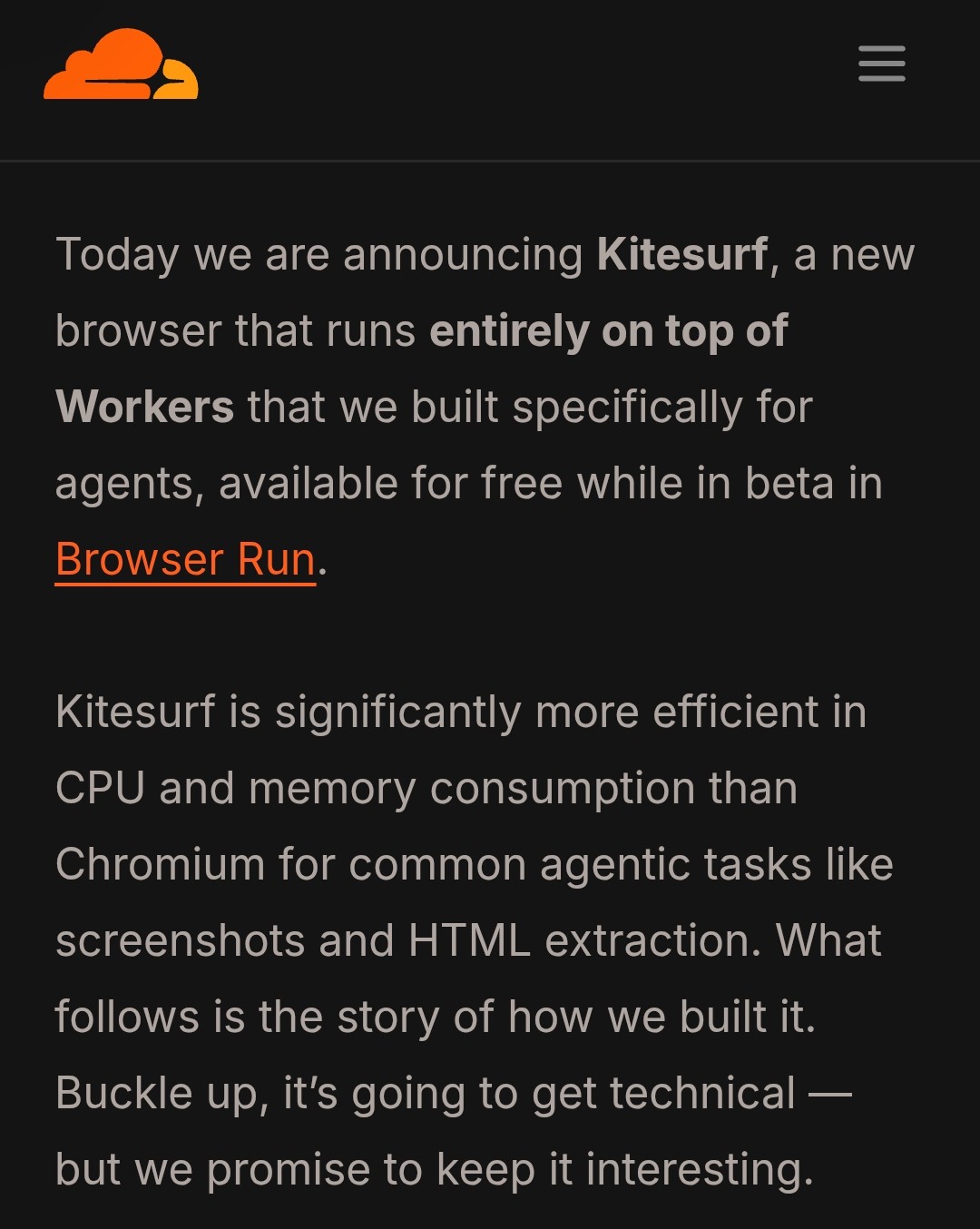
- Blitz: An HTML parser designed for speed and efficiency, capable of rapidly converting raw HTML into a structured Document Object Model (DOM).
- Stylo: Mozilla’s parallel CSS style engine, known for its performance in computing styles for web elements. Stylo’s inclusion ensures accurate and efficient application of CSS rules.
Crucially, JavaScript execution within PageScript happens inside isolated Dynamic Workers. This isolation is not merely for performance but also for security, ensuring that malicious JavaScript on one page cannot affect other browsing contexts or the underlying system. The use of Rust for Blitz and Stylo, coupled with the WebAssembly runtime in Workers, allows for highly efficient processing of web content, minimizing CPU and memory footprint compared to traditional engines.
-
PageRenderer: The final piece of the puzzle, PageRenderer, takes the parsed and styled page object generated by PageScript and transforms it into actual pixels, or more precisely, into a representation suitable for output like screenshots or PDFs. This process utilizes Workers’ built-in Remote Procedure Call (RPC) system to communicate statelessly between components. Unlike human-centric browsers that aim for real-time visual display, PageRenderer’s output is designed for programmatic consumption, focusing on accuracy and efficiency rather than interactive fluidity. This component can generate various outputs, including images (screenshots) or formatted documents (PDFs), enabling AI agents to "see" and interpret web pages in a machine-readable format.
Security by Design: Addressing AI-Specific Threats
One of Kitesurf’s most compelling differentiators lies in its security model, which is fundamentally baked into its architecture rather than being an afterthought. Cloudflare recognizes that AI browsers face a distinct set of threats compared to human-operated ones. While traditional browsers primarily defend against malware, phishing, and cross-site scripting (XSS) targeting human users, AI agents are susceptible to programmatic attacks, including sophisticated forms of prompt injection embedded within web content.
Kitesurf addresses this by treating every single page load as untrusted input by default. This zero-trust approach mandates rigorous isolation. Each component of the browser – Engine, PageScript, PageRenderer – is isolated from the others, adhering strictly to the principle of least privilege. This means no component can access resources or perform actions it doesn’t strictly need for its designated function. This compartmentalization significantly reduces the attack surface.
Furthermore, all outbound network requests from Kitesurf are routed through a single, locked-down component called SandboxOutbound. This centralized control point acts as a fortified gateway, strictly monitoring and filtering all external communications. This design is critical for several reasons: it prevents data exfiltration by malicious scripts embedded in web pages, allows for granular control over what external resources an AI agent can access, and provides a centralized point for auditing and logging network activity. For AI agents interacting with the public internet, where adversarial content is a constant threat, this isolation-first design is not merely an enhancement but a fundamental requirement, offering a genuinely considered response to the evolving threat landscape of the Agentic Cloud.
Performance Metrics and Economic Implications
Beyond its architectural elegance and robust security, Kitesurf delivers a compelling economic argument for AI agent developers. Cloudflare’s own benchmarks, conducted across a diverse 14-URL test corpus, demonstrate significant performance efficiencies when compared to a warm-pool Chromium instance – an already optimized, pre-initialized headless browser setup.
For screenshot capture tasks, Kitesurf utilized 3.1 times less CPU than Chromium. For HTML extraction, this efficiency improved even further, showing a 3.8 times reduction in CPU usage. The memory savings were even more dramatic: 4.7 times less memory for screenshots and an astounding 7.0 times less for HTML extraction. These figures are not merely technical statistics; they translate directly into tangible cost reductions for anyone operating AI agents at scale. In cloud environments, CPU and memory consumption are primary drivers of infrastructure bills. By drastically reducing these resource requirements, Kitesurf offers a powerful incentive for migrating AI web interaction workloads, potentially unlocking new levels of economic viability for agentic applications.
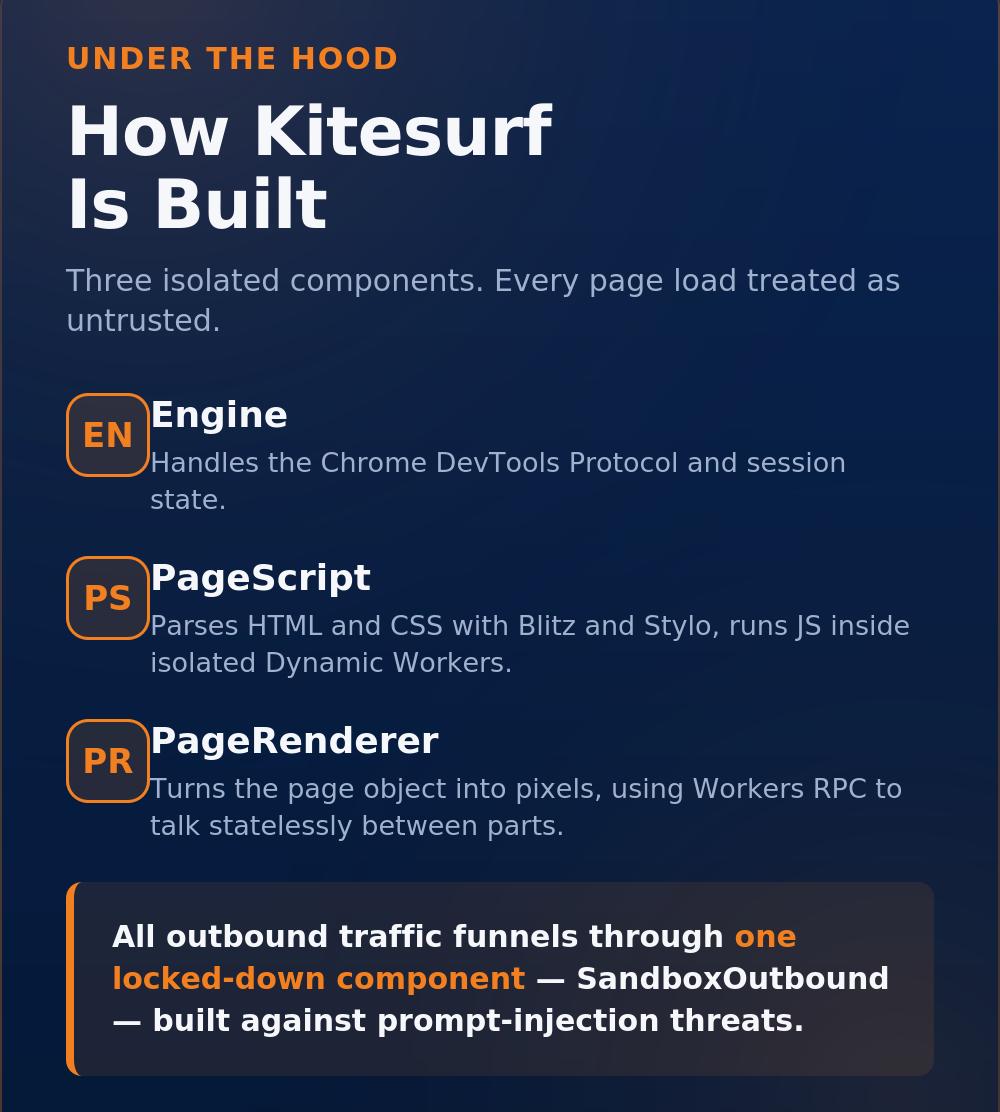
It is important to note, and Cloudflare transparently discloses this, that Kitesurf currently exhibits a trade-off in raw speed. In wall-clock time, Kitesurf took approximately 1.7 to 1.8 times longer to complete the same tasks compared to Chromium. This is largely attributable to the overhead associated with rasterization and image encoding in a cold software renderer, contrasting with Chromium’s highly mature, JIT-compiled rendering pipeline. This implies that for tasks where absolute real-time speed is paramount, or where immediate interactive feedback is crucial, a full Chromium instance might still be preferred. However, for the vast majority of AI agent tasks – such as content extraction, periodic data scraping, or generating reports – where the total cost of ownership and scalability are higher priorities than millisecond-level response times, Kitesurf’s efficiency gains likely outweigh its speed deficit.
Cloudflare also emphasizes Kitesurf’s rapid development trajectory. The browser currently passes over 215,000 Web Platform Tests, a comprehensive suite used to ensure browser compatibility and adherence to web standards. The company is adding hundreds more tests weekly, indicating a strong commitment to closing any compatibility gaps and ensuring that Kitesurf can accurately render and interact with a broad spectrum of modern web pages.
Developer Accessibility and Integration
Cloudflare has made getting started with Kitesurf remarkably low-friction, recognizing that ease of adoption is crucial for a new technology. During its beta phase, Kitesurf is available for free. For developers who wish to experiment without writing code, Cloudflare provides a public playground accessible at Kitesurf Playground. This interactive environment allows users to input any URL and observe Kitesurf rendering it live. Crucially, it integrates Chrome DevTools directly into the interface, enabling developers to inspect DOM elements, monitor console output, and even analyze WebAssembly memory usage per page. This playground serves as an invaluable tool for testing compatibility, debugging rendering issues, and understanding Kitesurf’s behavior.
For actual development use, Kitesurf seamlessly integrates with Cloudflare’s existing Browser Run product. Browser Run already offers headless Chromium instances for various automation tasks. Since Kitesurf speaks the standard Chrome DevTools Protocol (CDP), it ensures compatibility with a wide array of existing client libraries and tools that developers already use for browser automation, such as Puppeteer, Playwright, and chrome-remote-interface. This means AI agents or existing automation scripts designed to interact with Chromium via CDP can largely work with Kitesurf without significant modification. The only change required is appending a simple browser=kitesurf parameter to existing Browser Run API calls, highlighting Cloudflare’s commitment to making the transition as smooth as possible for developers.
Current Limitations and Future Outlook
Despite its impressive capabilities and strategic design, Cloudflare is commendably transparent about Kitesurf’s current limitations. The browser, in its current iteration, is not a full-featured replacement for a human-centric browser or even a comprehensive headless Chromium instance for all tasks. By Cloudflare’s own admission, Kitesurf cannot yet:
- Play video: The complex codecs, streaming protocols, and GPU acceleration required for video playback are intentionally omitted for efficiency and minimalist design.
- Render WebGL: Similar to video, advanced 3D graphics rendering, often relying on GPU acceleration, falls outside Kitesurf’s current scope.
- Negotiate bot-challenge handshakes with real TLS fingerprints: This is a crucial limitation. Sophisticated anti-bot systems often analyze minute details of a browser’s network stack, including TLS fingerprints, to detect automated access. Kitesurf, being a serverless, stateless browser, is not designed to mimic the unique characteristics of a human browser in this adversarial context. This reinforces its intended use for legitimate AI agent browsing rather than attempts to circumvent bot detection.
- Maintain long, authenticated sessions with persistent state: While Durable Objects can manage some state, Kitesurf’s stateless, serverless architecture is not optimized for prolonged, interactive, authenticated sessions that require complex cookie management and persistent state over extended periods, similar to how a human user might remain logged into a service for days.
For any of these complex tasks, Cloudflare explicitly advises developers to fall back to Browser Run’s standard Chromium-backed option. This clear-eyed approach underscores Cloudflare’s understanding of Kitesurf’s niche: it excels at one-shot, stateless tasks like content extraction, generating screenshots, and PDF creation from reasonably standard web pages. It is not yet suited for highly interactive, long-lived sessions on heavily protected or media-rich sites.
Looking ahead, Cloudflare has confirmed plans to eventually open-source the Kitesurf project. While no firm timeline has been provided, open-sourcing could significantly broaden its adoption, foster community contributions, enhance transparency, and allow customers to deploy their own instances in highly customized environments. This move would align with Cloudflare’s broader strategy of democratizing web infrastructure and empowering developers.
Strategic Implications and the Future of AI-Web Interaction
Weighing all aspects, Kitesurf represents a genuinely thoughtful and forward-looking bet on the direction of agentic browsing rather than a rushed, me-too product. Its security-first isolation model, tailored specifically for AI-specific threats like prompt injection, is a significant advancement that merits close attention from the cybersecurity community and AI developers alike. The compelling cost-efficiency, driven by drastically reduced CPU and memory consumption, presents an undeniable economic advantage for organizations deploying AI agents at scale, potentially unlocking new use cases and making existing ones more viable.
Kitesurf positions Cloudflare at the forefront of the "Agentic Cloud" infrastructure, solidifying its role beyond traditional CDN and security services. As AI agents become increasingly ubiquitous and integral to business operations, the underlying infrastructure that enables their interaction with the web will become critically important. Cloudflare, with its global network, Workers platform, and now Kitesurf, is strategically placed to become a foundational provider in this emerging domain.
The implications extend to the broader landscape of web development and AI-human collaboration. As more web interactions become automated, Kitesurf highlights the need for web standards and practices that accommodate both human and machine users. It might even influence future web design, encouraging the development of sites that are not only visually appealing but also programmatically accessible and efficient for AI agents.
In conclusion, Kitesurf is not merely another browser; it is a conceptual leap forward, purpose-built for the intelligent machines that are increasingly navigating our digital world. While it wisely acknowledges its current limitations, its core design principles and performance advantages make it a pivotal release for anyone building the next generation of AI agents, promising a future where machines browse the internet with unprecedented efficiency, security, and scalability.