
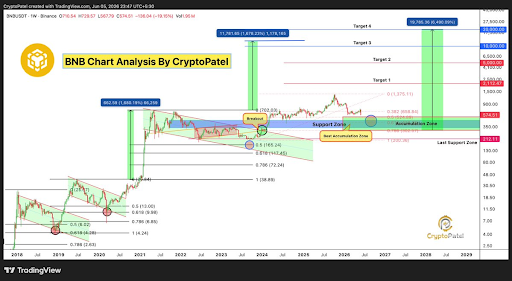
The digital asset landscape has witnessed a significant reshuffling of the top-tier cryptocurrencies as BNB, the native utility token of the Binance ecosystem, successfully reclaimed its position in the upper echelons of the market. By overtaking XRP in total market capitalization during the second quarter of 2024, BNB has re-established itself as a dominant force, trailing only Bitcoin, Ethereum, and the stablecoin USDT. However, as the token stabilizes within this elite bracket, the discourse among institutional and retail investors has shifted toward its long-term ceiling. Recent market analyses suggest that while a return to previous highs and a push toward $2,000 remains a tangible medium-term objective, the more ambitious price targets of $10,000 to $20,000 would require a fundamental transformation of the global cryptocurrency market’s total valuation.
The Mathematical Reality of a Five-Figure BNB
The primary hurdle for BNB reaching a valuation of $10,000 or higher is not merely a matter of sentiment or utility, but one of basic mathematics and liquidity. According to recent data and analysis shared by Crypto Patel, a prominent market strategist, the path to these valuations is inextricably linked to the token’s circulating supply and the broader market’s growth.
As of mid-2024, BNB holds a market capitalization of approximately $80.6 billion. Its historical peak, achieved in 2021 and approached again in late 2024 and early 2025, saw the asset reach a valuation nearing $185 billion. For the token to reach a price of $10,000, several structural changes must occur. Binance utilizes a programmatic "Auto-Burn" system designed to eventually reduce the total supply of BNB to 100 million tokens. If this target supply is reached, a $10,000 price point would equate to a $1 trillion market capitalization. To put this in perspective, a $1 trillion valuation is roughly equivalent to the entire market cap of Bitcoin during its consolidation phases in late 2023 and early 2024.
The projection becomes even more complex when considering the $20,000 target. At a supply of 100 million tokens, BNB would require a market capitalization of $2 trillion to sustain such a price. This figure currently represents the valuation of the entire cryptocurrency market combined. Analysts argue that for a single asset like BNB to command a $2 trillion valuation, the total crypto market cap would likely need to exceed $10 trillion to $15 trillion, implying massive institutional adoption and a significant influx of global capital that has yet to materialize.

Historical Performance and the XRP Flippening
To understand BNB’s current momentum, one must look at its performance relative to its closest competitors. Throughout early 2024, BNB and XRP were locked in a volatile battle for the fourth spot in market rankings (excluding stablecoins). By mid-May, BNB began to pull away decisively. This "flippening" was driven by several factors, including increased activity on the BNB Chain, the continued expansion of Binance’s Launchpool services, and a broader recovery in the DeFi sector.
Historically, BNB has shown remarkable resilience. Launched in 2017 via an Initial Coin Offering (ICO), the token was originally an ERC-20 token on the Ethereum network. It eventually migrated to its own proprietary blockchain, the Binance Chain, and later the Binance Smart Chain (BSC), which is now known simply as the BNB Chain. This transition allowed Binance to capture a significant portion of the retail DeFi market during the "DeFi Summer" of 2020 and 2021, providing a low-cost, high-speed alternative to Ethereum’s then-congested network. This utility remains the backbone of BNB’s value proposition today.
The Ethereum Rivalry: Can BNB Become the Number Two Asset?
With XRP now trailing in its wake, the next significant milestone for BNB is the "silver medal" currently held by Ethereum. While the gap between BNB and Ethereum remains substantial, it is no longer considered an impossible distance to bridge.
At current market dynamics, for BNB to match Ethereum’s market capitalization (which fluctuates around $200 billion to $400 billion depending on market cycles), BNB would need to trade between $1,500 and $2,500, assuming Ethereum’s price remains static. However, the cryptocurrency market rarely operates in a vacuum. A rising tide typically lifts all boats; if BNB pushes toward $2,000, it is highly probable that Ethereum would also be experiencing a significant rally, potentially pushing its own valuation toward the $500 billion or $1 trillion mark.
The competition between the two assets is not just about price, but about ecosystem dominance. Ethereum remains the primary hub for institutional DeFi and Non-Fungible Tokens (NFTs), particularly with the approval of Spot Ethereum ETFs in the United States. Conversely, BNB Chain dominates in terms of active daily users and transaction volume, largely due to its integration with the world’s largest exchange and its popularity in emerging markets where transaction fees are a critical barrier to entry.

Strategic Drivers: Burn Mechanisms and RWA Integration
Two primary catalysts are expected to drive BNB toward the $3,000 mark in the coming years: the deflationary burn mechanism and the growth of Real-World Assets (RWAs).
-
The Deflationary Model: Unlike many other Layer-1 tokens that have inflationary schedules, BNB is strictly deflationary. The Binance "Auto-Burn" mechanism uses a formula based on the price of BNB and the number of blocks produced on the BNB Chain during the quarter. This ensures that the burn remains consistent regardless of exchange-specific volumes. Additionally, the BEP-95 mechanism introduces a real-time burning of a portion of gas fees spent on the network. This dual-burn strategy continuously reduces supply, theoretically increasing the value of remaining tokens if demand stays constant or grows.
-
Real-World Assets (RWA): The BNB Chain has seen a surge in the tokenization of real-world assets. Recent reports indicate that the total value of RWAs on the BNB Chain has hit $3 billion. This includes tokenized treasury bills, gold, and real estate. As institutional investors look for on-chain transparency for traditional financial products, the BNB Chain’s low latency and high throughput make it an attractive destination, providing a new layer of utility for the BNB token beyond simple exchange fee discounts.
The Concentration Risk: The Binance Factor
Despite the bullish projections, analysts like Crypto Patel emphasize a critical vulnerability: the "Binance Concentration Risk." BNB’s value is deeply intertwined with the health and regulatory standing of the Binance exchange. While the BNB Chain is technically decentralized, the vast majority of the token’s utility—including trading fee discounts, participation in Launchpads, and institutional custody—is centralized within the Binance ecosystem.
In late 2023 and early 2024, Binance faced unprecedented regulatory pressure, culminating in a multi-billion dollar settlement with the U.S. Department of Justice and the departure of its founder, Changpeng Zhao (CZ), from the CEO role. While the market initially reacted with volatility, BNB’s recovery suggested that investors view the settlement as a "clearing of the air" that allows the exchange to move forward under a more compliant framework. However, any future legal challenges or systemic issues at the exchange would likely have an immediate and disproportionate impact on BNB’s price compared to more decentralized assets like Bitcoin or Ethereum.
Chronology of BNB’s Market Evolution
To project where BNB is going, it is essential to review the timeline of its development and price action:
- July 2017: BNB launches via ICO at a price of approximately $0.15.
- April 2019: Launch of the Binance Chain and the first migration of tokens.
- September 2020: Binance Smart Chain (BSC) launches, introducing smart contract functionality and sparking a DeFi explosion on the network.
- May 2021: BNB reaches a then-all-time high of $690, driven by the retail mania for "altcoins" and PancakeSwap’s growth.
- 2022-2023: BNB survives the "Crypto Winter" and the collapse of FTX better than most assets, maintaining its position in the top 5.
- May 2024: BNB officially flips XRP in market cap, reclaiming its spot as the #4 cryptocurrency.
- October 2025 (Projected/Recent Highs): BNB tests the $1,300 to $1,400 range, signaling the start of a new macro-bull cycle.
Broader Impact and Long-Term Implications
The trajectory of BNB serves as a bellwether for the broader "Exchange Token" category. If BNB can successfully decouple its price action from the immediate news cycles of the Binance exchange and transition into a truly independent Layer-1 powerhouse, it could set the stage for other tokens like OKB or Cronos to follow suit.
Furthermore, the debate over a $20,000 BNB price point highlights a growing sentiment in the industry: the expectation of a massive expansion in global liquidity. For such targets to be met by 2029—the earliest date suggested by Crypto Patel’s analysis—cryptocurrency would need to transition from a speculative asset class to a core component of the global financial system.
In conclusion, while the $10,000 and $20,000 targets remain speculative and mathematically distant in the current environment, the path to $2,000 and $3,000 appears much more grounded in current supply-demand dynamics and ecosystem growth. Investors are advised to watch the progress of the 100-million-token burn target and the continued integration of institutional RWA products as the primary indicators of BNB’s long-term value. As the analyst noted, any claims of a $20,000 price in the "near-term" should be met with skepticism, as such a move would require a total transformation of the global economy. For now, BNB’s battle remains focused on maintaining its lead over XRP and narrowing the gap with Ethereum in the quest for Layer-1 supremacy.