Tiffany Milanovich, a name now synonymous with audacious alleged cryptocurrency fraud, stands accused of orchestrating a sophisticated series of scams that drained victims of millions while, paradoxically, leaving an undeniable digital breadcrumb trail of her alleged exploits. Far from operating in the shadows, Milanovich is reported to have openly flaunted stolen funds, recorded taunts directed at her victims, and even documented her illicit gains on social media, turning her criminal enterprise into a public spectacle. This self-incriminating behavior has now seemingly caught up with her, thanks to a comprehensive investigation by the renowned on-chain detective ZachXBT, whose recent report paints a vivid picture of a "masterclass in how not to get away with it." The unfolding narrative, detailed in ZachXBT’s extensive social media threads, is not merely a chronicle of financial theft but a disturbing account of psychological manipulation and brazen disrespect for victims, some of whom were reportedly mocked even as their life savings vanished.
The Rise of Crypto Scams and the Role of On-Chain Investigators
The burgeoning world of cryptocurrency, characterized by its rapid innovation and decentralized nature, has unfortunately also become fertile ground for sophisticated scams. The pseudonymous nature of blockchain transactions, while offering privacy, also presents challenges for traditional law enforcement in tracing illicit funds and identifying perpetrators. This gap has led to the emergence of independent on-chain investigators like ZachXBT, who leverage their expertise in blockchain analytics and open-source intelligence (OSINT) to track stolen assets, expose fraudulent schemes, and identify the individuals behind them. ZachXBT has earned a formidable reputation within the crypto community for his meticulous and often groundbreaking work, which frequently precedes formal law enforcement action. His investigations, often published transparently on platforms like X (formerly Twitter), provide a crucial layer of accountability in an ecosystem still grappling with regulatory frameworks and robust security measures. The Milanovich case is a testament to the power of such independent forensics, where a perpetrator’s own hubris allegedly provided the very evidence needed for their exposure.
Tiffany Milanovich: The Alleged Architect of Deception
According to ZachXBT’s investigation, Tiffany Milanovich is identified as a US-based threat actor implicated in the theft of at least $5 million through hardware wallet and centralized exchange support impersonation scams. Her alleged role in this criminal syndicate is chillingly specific: she operated as the "caller," the individual who directly contacted victims, posing as legitimate customer support from reputable exchanges or hardware wallet providers. Through a combination of social engineering, psychological manipulation, and technical jargon, she reportedly persuaded unsuspecting individuals to grant her access to their digital assets, often under the guise of "fixing a security issue" or "verifying account details."
The insidious nature of these scams lies in their exploitation of trust and technical unfamiliarity. Victims, often older individuals or those new to the complexities of crypto, are led to believe they are interacting with legitimate helpdesks. The published audio recordings, purportedly capturing Milanovich’s calls, underscore the cold-blooded efficiency of her alleged methods. Hearing these interactions, even secondhand, transforms an abstract "crypto scam" headline into a visceral reminder of the personal vulnerability faced by anyone with digital assets. It highlights how even hardware wallets, designed for enhanced security by keeping private keys offline, can be compromised not through technical hacks but through human fallibility and sophisticated social engineering tactics.
A Chronology of Alleged Thefts and Blatant Self-Incrimination
The report meticulously details a series of alleged incidents, painting a consistent pattern of deception, theft, and astonishingly, public boasting. This chronology provides critical insight into the scale and audacity of Milanovich’s alleged operation:
-
October 2025: The Coinbase Drain ($500,000)
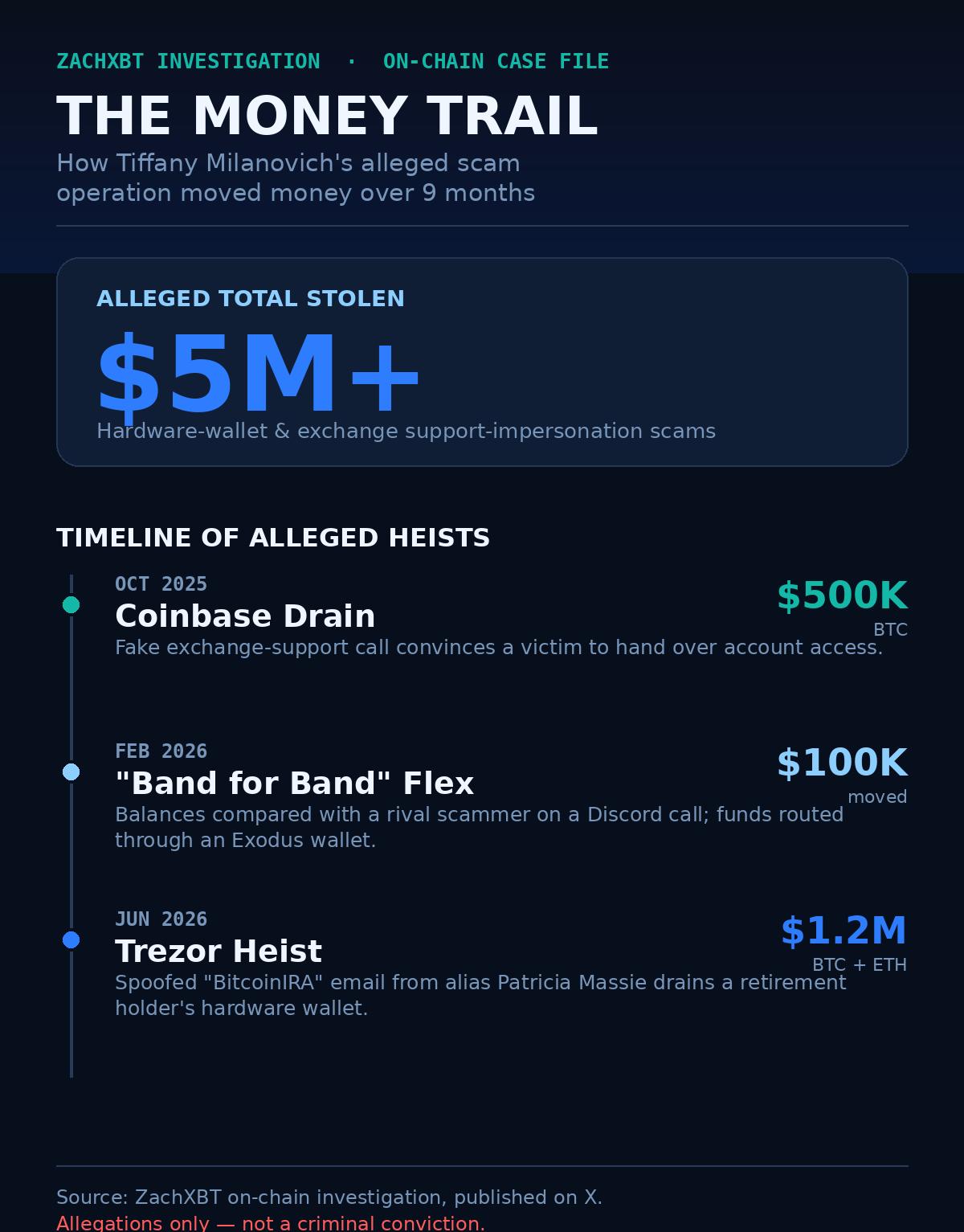
One of the earliest documented incidents in ZachXBT’s report points to an alleged theft in October 2025. Milanovich and her group reportedly siphoned approximately $500,000 in Bitcoin from a Coinbase account. This incident, like others, allegedly commenced with fake support impersonation, exploiting the victim’s trust in a major centralized exchange. What makes this case particularly notable is the aftermath: Milanovich was reportedly recorded complaining about her cut of the payout, a detail that offers a rare glimpse into the internal dynamics and alleged greed within the criminal group. Even more brazenly, she is accused of posting a screenshot of the withdrawal herself, an act of self-incrimination that defies conventional criminal logic and underscores a profound sense of impunity. This willingness to document and share evidence of her alleged crimes serves as a recurring motif throughout ZachXBT’s investigation.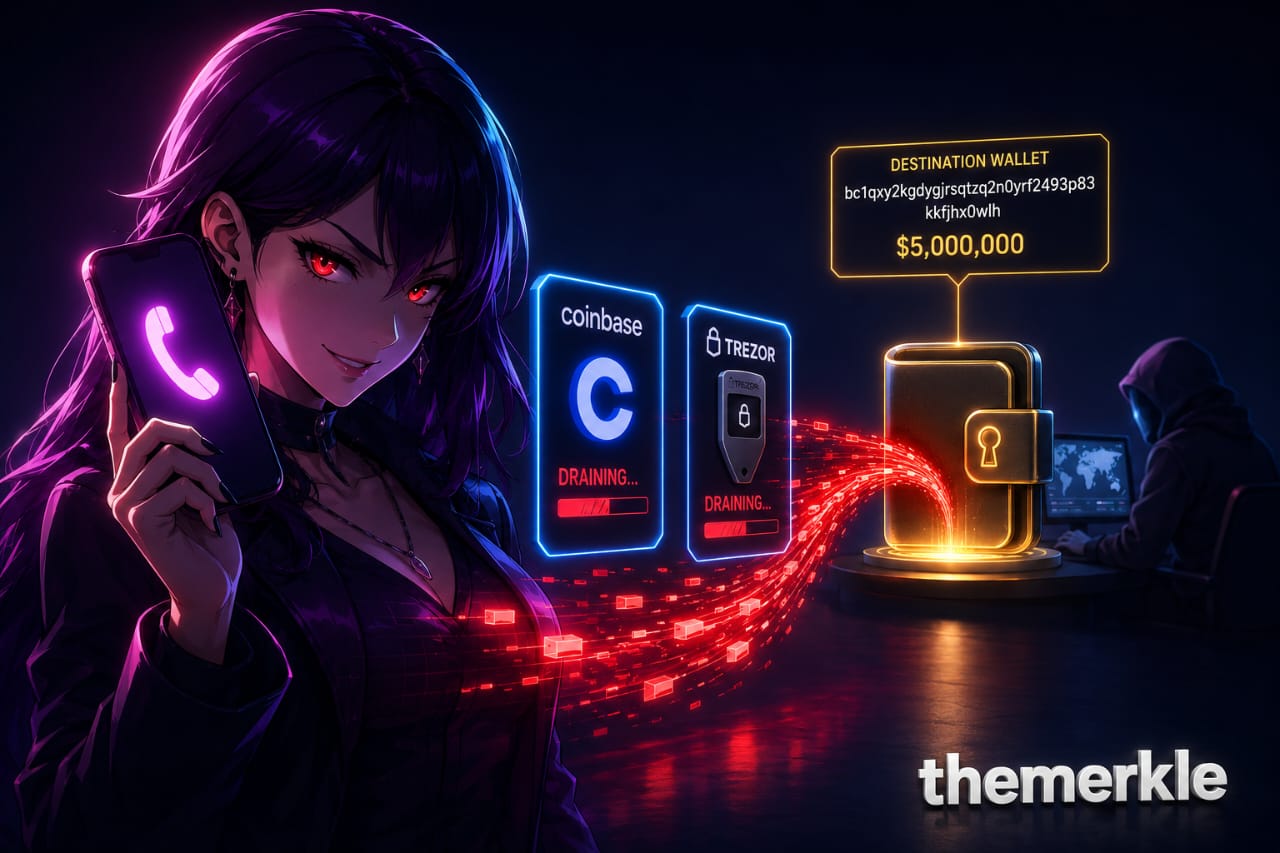
-
February 2026: The "Flex War" and Money Laundering Attempts
By early 2026, the alleged bragging had escalated into an overt competition within underground circles. ZachXBT describes a Discord call in February 2026 where Milanovich reportedly engaged in a "band for band" contest with another threat actor, overtly comparing their respective wallet balances as if in a rap battle. During this alleged display of wealth, she reportedly moved around $100,000 through an Exodus wallet. This activity, while seemingly a mere show of bravado, often aligns with common money laundering patterns used to obscure the origin of stolen funds. Investigators like ZachXBT are adept at tracing such movements, dissecting wallet addresses and transaction histories to reconstruct the flow of illicit assets, thereby unmasking attempts to "blur the trail." The public nature of this "flex war" provided further verifiable on-chain evidence for ZachXBT to follow. -
June 2026: The $1.2 Million Trezor Heist
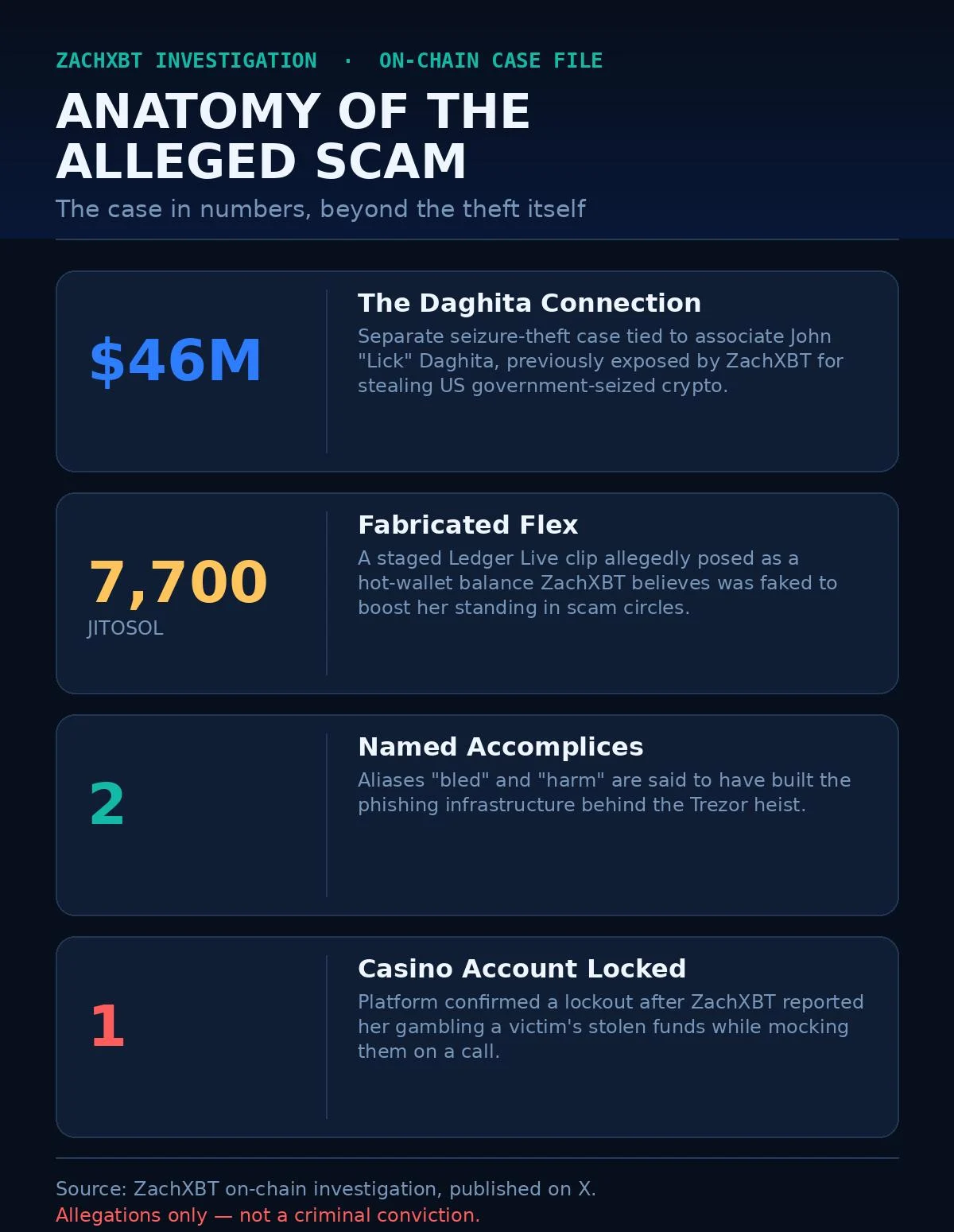
The most significant alleged theft detailed in the report occurred in June 2026, targeting a victim who lost a staggering $1.2 million in Bitcoin and Ethereum. This elaborate scheme began not with a direct technical hack, but with a highly sophisticated social engineering attack: a spoofed BitcoinIRA email sent under the alias "Patricia Massie." The email was meticulously crafted to appear legitimate, designed to deceive a retirement-savings holder into believing they were interacting with genuine support. Following this initial deception, Milanovich and her alleged group reportedly drained the victim’s Trezor hardware wallet. Hardware wallets are generally considered one of the most secure ways to store cryptocurrency, as they keep private keys offline. However, even these devices are vulnerable if a user is manipulated into revealing their seed phrase or approving malicious transactions through social engineering.The aftermath of this major heist again highlighted the alleged group’s audacious behavior. Within hours of the theft, the proceeds were reportedly flaunted within private Telegram groups. ZachXBT also identified two other alleged accomplices, known by the aliases "bled" and "harm," who are believed to have constructed the sophisticated phishing infrastructure that facilitated the scam. A critical detail from the investigation is that most of the stolen funds from this incident reportedly remain dormant on-chain. While this might appear to be a smart move to avoid immediate tracing, it also means the assets are perpetually visible to on-chain analysts and are one careless transaction away from being definitively linked and potentially seized.
The Psychology of Public Flaunting and its Downfall
The consistent pattern of flaunting stolen wealth online—luxury purchases, casino gambling, public comparisons of wallet balances—is a central theme in Milanovich’s alleged criminal activities. This behavior, while seemingly irrational for someone engaged in illicit acts, is often driven by a desire for status, recognition within criminal circles, and a misguided belief in impunity. However, in the age of digital footprints and sophisticated on-chain analytics, such ostentatious displays inevitably lead to self-incrimination.
The report details particularly egregious instances, such as Milanovich allegedly gambling a victim’s stolen funds on a casino platform while simultaneously taunting them on a call. ZachXBT’s subsequent reporting of this account to the casino platform reportedly led to its review and confirmation that the account would be locked. This rare instance of accountability, initiated by an independent investigator, underscores the potential for platforms to act when presented with compelling evidence.
Adding another layer of deceit to her self-promotion, ZachXBT also revealed that several of Milanovich’s "flex videos" appear to have been altered or staged. In one instance, she allegedly manipulated footage within a Ledger Live wallet interface to falsely claim ownership of a service’s hot wallet holding 7,700 JITOSOL. Such fabrications, while intended to inflate her standing in underground crypto circles, ironically still serve as evidence of her fraudulent intent and manipulative tactics. These doctored videos, alongside genuine records of her alleged spending, form a robust evidentiary package.
The "Lick" Connection: An Unintended Spotlight
Further complicating Milanovich’s alleged criminal narrative is her reported association with John Daghita, known online as "Lick." Daghita himself was previously exposed by ZachXBT for allegedly stealing $46 million in crypto that had been seized by the US government. The relationship between Milanovich and Daghita was reportedly close, so much so that Milanovich allegedly recorded a private call with Daghita and publicly shared it, ostensibly to embarrass him. This act, however, backfired spectacularly. Daghita reportedly retaliated by naming her on his own public Telegram channel, inadvertently pulling her further into the public spotlight she seemed to both crave and exploit. This interconnectedness within the crypto underworld often provides investigators with invaluable leads, as internal conflicts and rivalries frequently lead to mutual exposure.
Legal Implications and the Path to Accountability
It is crucial to emphasize that, as of this report, all allegations against Tiffany Milanovich remain unproven in a court of law. However, ZachXBT’s investigation has assembled a formidable body of evidence: call recordings, extensive chat logs, public social media posts, and detailed on-chain wallet activity—much of it self-published by Milanovich. This collection represents a "paper trail" that few alleged criminals leave behind so willingly.
A significant detail noted by ZachXBT is Milanovich’s alleged sharing of a screenshot depicting a search-and-seizure warrant issued against her in Connecticut, dated before several of the incidents described in the report. If accurate, this suggests she may have already been under active investigation by law enforcement while allegedly continuing her operations. In another recording, she reportedly mentions a booked flight and insists her funds remain untouched, possibly indicating an awareness of impending legal action or an attempt to evade capture.
The challenges for law enforcement in prosecuting crypto crimes are considerable, often involving cross-jurisdictional complexities and the need for specialized technical expertise. However, the depth of ZachXBT’s forensic work, combining traditional open-source intelligence with sophisticated blockchain analysis, provides a crucial foundation for potential formal charges. The case against Milanovich, built on her alleged digital footprint, underscores the increasing difficulty of operating anonymously in the crypto space, particularly when one’s criminal activities are accompanied by an irrepressible desire for public recognition.
Broader Impact and Lessons for the Crypto Community
The Tiffany Milanovich case serves as a stark reminder of several critical lessons for the broader cryptocurrency community and beyond. Firstly, it highlights the persistent threat of social engineering and impersonation scams, which often bypass even the most robust technical security measures by exploiting human trust. Users must remain vigilant, always verify the authenticity of communications, and never share sensitive information or grant remote access to their wallets, regardless of who is purportedly on the other end of the line. Organizations in the crypto space also bear a responsibility to educate their users thoroughly and implement more sophisticated methods to counter spoofing and phishing attempts.
Secondly, the case underscores the invaluable role of independent on-chain investigators like ZachXBT. Their ability to navigate the complex world of blockchain data and public digital trails is proving to be an indispensable asset in the fight against crypto crime, often leading the way for traditional law enforcement agencies.
Finally, the alleged downfall of Tiffany Milanovich, fueled by her own hubris and public displays of ill-gotten gains, reinforces an age-old maxim: showing off leaves evidence. In the interconnected digital age, every boast, every screenshot, every public transaction leaves an indelible mark. For the victims who lost their life savings, subjected to mockery and emotional distress, ZachXBT’s detailed exposure represents a critical step towards accountability, demonstrating that even in the seemingly anonymous frontiers of cryptocurrency, justice can eventually find a path, often paved by the very arrogance of the perpetrator. The ultimate question of formal charges now rests with the legal system, but the trail of evidence has been meticulously laid, a testament to the fact that even the most brazen attempts to operate with impunity are increasingly fragile in the face of persistent digital forensics.
Disclosure: This is not trading or investment advice. Always do your research before buying any cryptocurrency or investing in any services.
Follow us on Twitter @themerklehash to stay updated with the latest Crypto, NFT, AI, Cybersecurity, and Metaverse news!