
Michael Saylor, the prominent CEO of MicroStrategy, has publicly addressed recent criticisms concerning his company’s decision to divest approximately $200 million worth of Bitcoin. Saylor, a vocal advocate for Bitcoin and a figure often associated with a "Bitcoin maximalist" philosophy, found himself under scrutiny for what some perceived as a contradiction to his long-held stance against selling the cryptocurrency. His response, delivered via the social media platform X, aimed to clarify the distinction between his personal convictions and corporate financial strategies.
"My ‘never sell your bitcoin’ narrative has always been framed as advice from one individual to another, not as a rigid corporate policy," Saylor stated in his X post. He emphasized that he personally has not divested any of his own Bitcoin holdings, not even a single satoshi. This distinction, he argued, is crucial for understanding MicroStrategy’s actions as a publicly traded entity. Saylor asserted that as a public company, MicroStrategy is obligated to manage its assets in a manner that it deems most advantageous for its shareholders, which can involve strategic adjustments to its holdings based on evolving market conditions and corporate objectives.
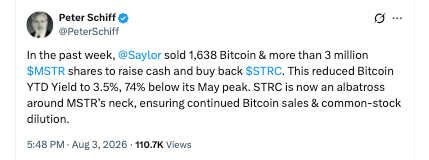
This explanation followed closely on the heels of MicroStrategy filing an 8-K report with the U.S. Securities and Exchange Commission (SEC). The filing officially disclosed the company’s sale of 1,638 Bitcoin, which occurred towards the end of the previous month. The sale was executed at an average price of approximately $63,957 per Bitcoin. The proceeds generated from this transaction were earmarked for the repurchase of the company’s Series A convertible preferred stock, ticker symbol STRC, a move that had previously drawn considerable attention and some criticism within the financial and crypto communities.

Strategic Realignment: MicroStrategy’s Evolving Bitcoin Strategy
The recent Bitcoin sale, while generating debate, was arguably anticipated by many observers familiar with MicroStrategy’s aggressive acquisition strategy. The company’s sustained and substantial investment in Bitcoin had, at times, raised concerns across the broader cryptocurrency ecosystem. Analysts, entrepreneurs, and developers had voiced apprehension regarding Saylor’s consistent use of high-yield financial instruments, particularly those tied to the STRC preferred shares, to fund these large-scale Bitcoin purchases. These instruments, often referred to as "loans" or "debt financing," had the potential to expose MicroStrategy to significant financial risks, especially in a volatile market.
Initially, Saylor appeared resolute in his commitment to doubling down on his company’s Bitcoin strategy, regardless of market fluctuations or external commentary. However, the recent divestment suggests a strategic recalibration. It indicates that Saylor and MicroStrategy have indeed taken into account the critiques from within the sector and are implementing a more balanced approach to their cryptocurrency holdings. The company has reportedly increased its dollar reserves and, as evidenced by the recent sale, has reduced its exposure to the high-yield STRC instrument.
Despite this strategic adjustment, MicroStrategy remains a dominant force in Bitcoin ownership. The company continues to hold an impressive 842,138 Bitcoin, acquired at an aggregate cost of roughly $63.5 billion. This substantial reserve solidifies MicroStrategy’s position as one of the largest institutional holders of Bitcoin globally. The average acquisition cost for these holdings is estimated to be around $75,000 per Bitcoin, a figure that, at the time of reporting, was above the prevailing market price.
The Fallout: Critics React to MicroStrategy’s Bitcoin Divestment
The news of MicroStrategy’s Bitcoin sale immediately triggered a wave of reactions from various figures within the financial and cryptocurrency spheres. Many who had been critical of Saylor’s aggressive accumulation strategy saw this move as validation of their concerns.

Peter Schiff, a well-known gold advocate and vocal critic of Bitcoin, was quick to comment on the development. In a post on X, Schiff expressed his views, stating, "MicroStrategy finally admits it can’t just keep buying Bitcoin indefinitely. The chickens have come home to roost. Saylor’s gamble is starting to unravel." Schiff has consistently argued that Bitcoin is a speculative asset with no intrinsic value and that companies heavily invested in it are exposed to unacceptable risks.
Another prominent voice from the crypto community, known by the handle @WazzCrypto on X, shared a sentiment of surprise mixed with a degree of vindication. The user tweeted, "Never thought I’d see the day Michael Saylor sells Bitcoin. This is a major signal. Is this the beginning of the end for his BTC empire?" This sentiment reflects a broader feeling among some in the crypto space that Saylor’s unwavering belief in Bitcoin’s perpetual ascent was a cornerstone of his public persona and his company’s strategy.
However, not all reactions were uniformly critical. Some individuals offered a more nuanced perspective, acknowledging the complexities of corporate financial management. One user, commenting on Saylor’s own post, wrote, "It’s important to remember that a public company has different responsibilities than an individual. Saylor is balancing risk and reward for shareholders. It’s not a betrayal of Bitcoin, it’s good business sense." This viewpoint highlights the often-debated tension between ideological investment principles and the pragmatic demands of corporate governance.
Contextualizing the Sale: A History of Aggressive Accumulation
MicroStrategy’s Bitcoin journey began in August 2020, marking a significant shift in corporate treasury management. At a time when most companies viewed Bitcoin with caution or skepticism, MicroStrategy, under Saylor’s leadership, declared its intention to use Bitcoin as its primary treasury reserve asset. This bold move was underpinned by Saylor’s conviction that Bitcoin represented a superior store of value compared to traditional assets like fiat currencies, which he argued were subject to inflation and devaluation.

The company embarked on an aggressive acquisition spree, leveraging its balance sheet and, at times, debt financing to acquire vast quantities of Bitcoin. This strategy, while lauded by many Bitcoin proponents, also attracted criticism due to the methods employed. The reliance on debt, particularly through the issuance of STRC preferred shares, raised concerns about MicroStrategy’s financial leverage and its potential vulnerability to market downturns. The average purchase price for MicroStrategy’s Bitcoin holdings, estimated to be around $75,000, placed the company in a precarious position when Bitcoin’s price experienced significant pullbacks, as it did in 2021 and 2022.
The recent sale of 1,638 Bitcoin, while seemingly small in the context of their total holdings, represents a symbolic shift. It signifies a move towards de-risking the company’s balance sheet and rebalancing its financial structure. By using the proceeds to repurchase preferred shares, MicroStrategy is effectively reducing its outstanding debt obligations and strengthening its financial foundation. This action can be interpreted as a strategic response to past criticisms and a proactive measure to ensure the company’s long-term stability in a volatile market.
Implications for the Market and Corporate Treasury Strategies
The actions of MicroStrategy and the subsequent reactions from critics and supporters offer valuable insights into the evolving landscape of corporate treasury management and the integration of digital assets.
For Bitcoin itself, the news, while potentially causing short-term price fluctuations, highlights the growing institutional acceptance and the complex integration of Bitcoin into traditional financial frameworks. While a large sale by a major holder might be perceived negatively, the underlying reason for the sale—strategic financial management and debt reduction—demonstrates a more mature approach to holding Bitcoin.
The event also underscores the ongoing debate about the role of Bitcoin in corporate treasuries. While Saylor’s vision of Bitcoin as a primary reserve asset has inspired many, his experience also serves as a cautionary tale. It emphasizes the need for careful financial planning, risk management, and a clear understanding of the unique characteristics of Bitcoin as an asset class. Companies looking to follow MicroStrategy’s path will likely pay closer attention to the financing structures and the overall economic environment.
Furthermore, the public discourse surrounding Saylor’s actions reveals the polarized views on Bitcoin. Critics like Peter Schiff remain staunchly opposed, viewing any move away from pure accumulation as a sign of weakness. Conversely, supporters often interpret such strategic adjustments as signs of maturity and adaptability within the burgeoning digital asset space.
Ultimately, Michael Saylor’s defense of MicroStrategy’s Bitcoin sale represents a pivotal moment in the company’s ongoing narrative. It signifies a transition from an aggressive, maximalist accumulation phase to a more nuanced and strategically balanced approach to managing its significant Bitcoin holdings. As MicroStrategy continues to navigate the complexities of the cryptocurrency market, its future decisions will undoubtedly be closely watched by investors, regulators, and the broader financial community. The company’s ability to successfully balance its Bitcoin strategy with its corporate financial responsibilities will be a key determinant of its long-term success and its influence on how other corporations approach digital asset adoption.