The global cryptocurrency market is currently navigating a period of intense volatility and structural realignment, as a significant majority of alternative cryptocurrencies—commonly referred to as altcoins—struggle to maintain their long-term valuation benchmarks. Recent data from market analysts, including the seasoned researcher Darkfost and platforms like CryptoQuant, indicate that the altcoin sector is in a precarious state, characterized by a sharp decoupling from Bitcoin’s relative stability and a massive flight of capital. This downturn is not occurring in a vacuum; it is deeply intertwined with broader macroeconomic tremors that have seen over $1 trillion in value evaporated from U.S. financial markets in a single day, driven largely by cooling sentiment in the artificial intelligence (AI) and semiconductor sectors.
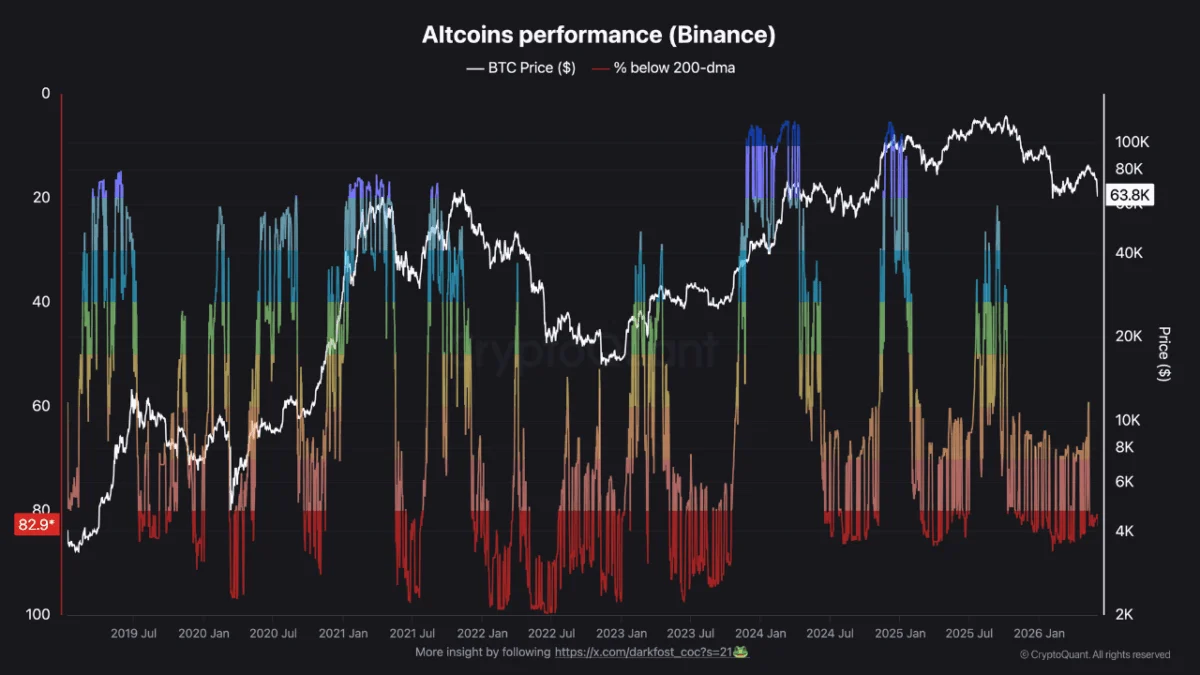
As of early February 2025, the technical health of the altcoin market has reached a nadir not seen since the previous bear cycle. The most alarming metric for investors is the revelation that 83% of all altcoins are currently trading below their 200-day moving average (200DMA). In technical analysis, the 200DMA serves as a critical "line in the sand" that separates long-term bullish trends from bearish ones. When an asset trades below this level for an extended period, it suggests a lack of buying conviction and a prevailing sentiment of distribution rather than accumulation. This widespread failure to hold the 200DMA indicates that the "altcoin season" many retail investors had anticipated for late 2024 and early 2025 has transitioned into a protracted period of underperformance.
The Macroeconomic Catalyst: A $1 Trillion Global Market Correction
The immediate catalyst for the most recent leg down in the cryptocurrency space was a massive sell-off in the traditional financial sector. On a single Friday in early February, the U.S. stock market experienced a historic contraction, with the S&P 500 shedding 2.6% and the tech-heavy Nasdaq Composite plunging by 4.7%. The primary driver was a sudden shift in sentiment regarding AI-related equities and semiconductor manufacturers, which had previously served as the engine for the 2024 market rally.
As traditional investors moved to de-risk their portfolios, the liquidity drain hit high-beta assets the hardest. Bitcoin, often viewed as a digital gold or a hedge, managed to limit its losses to approximately 4%, but the broader altcoin market was far less resilient. The interconnectedness of global liquidity means that when major institutional players face margin calls or seek safety in cash, speculative assets like altcoins are the first to be liquidated. This "risk-off" environment has effectively choked the capital flows that typically trickle down from Bitcoin into smaller-cap tokens.
Structural Weakness: The Altcoin-Bitcoin Decoupling
One of the most significant shifts in the current market cycle is the lack of correlation between Bitcoin’s price movements and the performance of the broader altcoin market. Historically, a surge in Bitcoin’s price would eventually lead to a "rotation" of profits into altcoins, sparking a general market rally. However, throughout late 2024 and into early 2025, this relationship has fractured.
According to the analysis provided by Darkfost, altcoins have consistently underperformed since December 2024. While Bitcoin has benefited from institutional inflows through Spot ETFs and corporate treasury adoptions, altcoins have faced a "liquidity vacuum." The data suggests that capital is concentrating in the most established assets, leaving the thousands of smaller projects to compete for a shrinking pool of retail liquidity. This structural weakness is evidenced by the fact that even when Bitcoin reaches new highs or consolidates, the majority of altcoins remain trapped in a downward or sideways trajectory.
Analyzing the $520 Billion Market Cap Contraction
The financial impact of this underperformance is staggering. By analyzing the TOTAL3 chart—a metric provided by TradingView that tracks the total market capitalization of all cryptocurrencies excluding Bitcoin and Ethereum—analysts have identified a massive loss of value. From its local peak in late 2024, the TOTAL3 valuation has plummeted by approximately $520 billion.
At its height, the altcoin market (excluding the top two assets) was valued at over $1.19 trillion. Currently, that figure has retracted to approximately $670 billion. This contraction has effectively erased months of gains, returning the market to valuation levels last seen in November 2024. This "round trip" in price action has left many retail investors who entered the market during the mid-2024 hype cycles in a state of significant unrealized loss. The sharp decline underscores the volatility inherent in alternative assets and the speed at which market sentiment can shift from euphoria to extreme pessimism.
Technical Indicators: The Significance of the 200DMA
The 200-day moving average is widely considered one of the most reliable indicators of an asset’s long-term health. It is calculated by averaging the closing prices of an asset over the last 200 trading days, providing a smoothed line that filters out short-term noise.

In the current context, the fact that 83% of altcoins are below this line is a historic anomaly. Darkfost notes that since 2022, the percentage of altcoins trading below their 200DMA has fluctuated between 60% and 90%. However, the current reading of 83% is among the weakest of the present cycle. When nearly the entire market is below this trendline, it acts as a dynamic resistance level. Every attempt at a price recovery is met with selling pressure from "trapped" investors looking to break even, further suppressing the possibility of a sustained breakout.
Conversely, periods where the majority of the market is above the 200DMA are rare and usually signal the peak of a bubble. For instance, in March and December 2024, nearly 90% of altcoins were trading above their 200DMA. These periods coincided with peak retail FOMO (fear of missing out) and were, in hindsight, the most dangerous times to enter the market.
Chronology of the Decline: From Euphoria to Despair
The path to the current market state can be traced through several key phases over the last year:
- Q1-Q2 2024: The ETF-Driven Surge: The approval of Spot Bitcoin ETFs led to a broad market lift. Altcoins benefited from the general optimism, with many reaching yearly highs in March 2024. At this point, the 200DMA metric showed nearly 90% of assets in a bullish posture.
- Q3 2024: The Summer Stagnation: As the initial ETF excitement cooled, Bitcoin began to consolidate. Altcoins, however, started to show signs of fatigue as the "rotation" failed to materialize in a meaningful way.
- October – December 2024: The False Breakout: There was a brief period of renewed hope toward the end of the year, with the TOTAL3 index reaching a significant peak. This was driven by speculation around regulatory changes and potential new ETF filings for assets like Solana and XRP.
- January – February 2025: The Macro Reality Check: The combination of weak AI earnings in the stock market and a lack of fresh retail capital in crypto led to the current $520 billion wipeout. This phase has been characterized by the 83% 200DMA failure and a definitive shift to bearish sentiment.
Institutional Response and Market Sentiment
Institutional observers and hedge fund managers have largely remained cautious regarding altcoins during this period. While institutional interest in Bitcoin and Ethereum remains robust due to the availability of regulated investment vehicles, the "long tail" of the crypto market lacks the same infrastructure.
Market sentiment, as measured by the Crypto Fear & Greed Index, has frequently dipped into the "Fear" or "Extreme Fear" categories over the past few weeks. Analyst commentary suggests that the market is currently undergoing a "cleansing" phase. Many projects that launched with high valuations but little utility are being revalued by the market. This process, while painful for holders, is often seen as a necessary precursor to a more sustainable growth phase.

The Contrarian View: Is This a Generational Opportunity?
Despite the grim statistics, some analysts argue that extreme pessimism is a contrarian indicator of a market bottom. Darkfost highlights that historically, the best time to accumulate assets for the long term is when the market breadth is at its lowest. When 83% of the market is "underwater" relative to the 200DMA, the downside risk is often considered to be more limited than when the market is overextended.
The breadth expansion seen in 2017 and 2021 was preceded by similar periods of stagnation and capitulation. For investors with a multi-year horizon, the current $520 billion loss in market cap represents a "reset" that could provide entry points at valuations not seen in years. However, this perspective requires a high tolerance for risk and the belief that the altcoin market will eventually recover its correlation with Bitcoin.
Conclusion and Future Outlook
The altcoin market is currently facing a "perfect storm" of internal structural weakness and external macroeconomic pressure. The loss of $520 billion in market value and the fact that 83% of assets are failing to hold long-term support levels suggest that a rapid recovery is unlikely without a significant shift in global liquidity or a major catalyst within the crypto ecosystem.
As we move further into 2025, the focus for many investors has shifted from speculative "moonshots" to quality and survival. The projects that manage to maintain development and community engagement during this period of extreme underperformance are likely to be the leaders of the next cycle. For now, the data remains clear: the altcoin market is in a defensive crouch, waiting for the broader financial clouds to clear and for capital to once again find its way back into the more adventurous corners of the digital asset world.