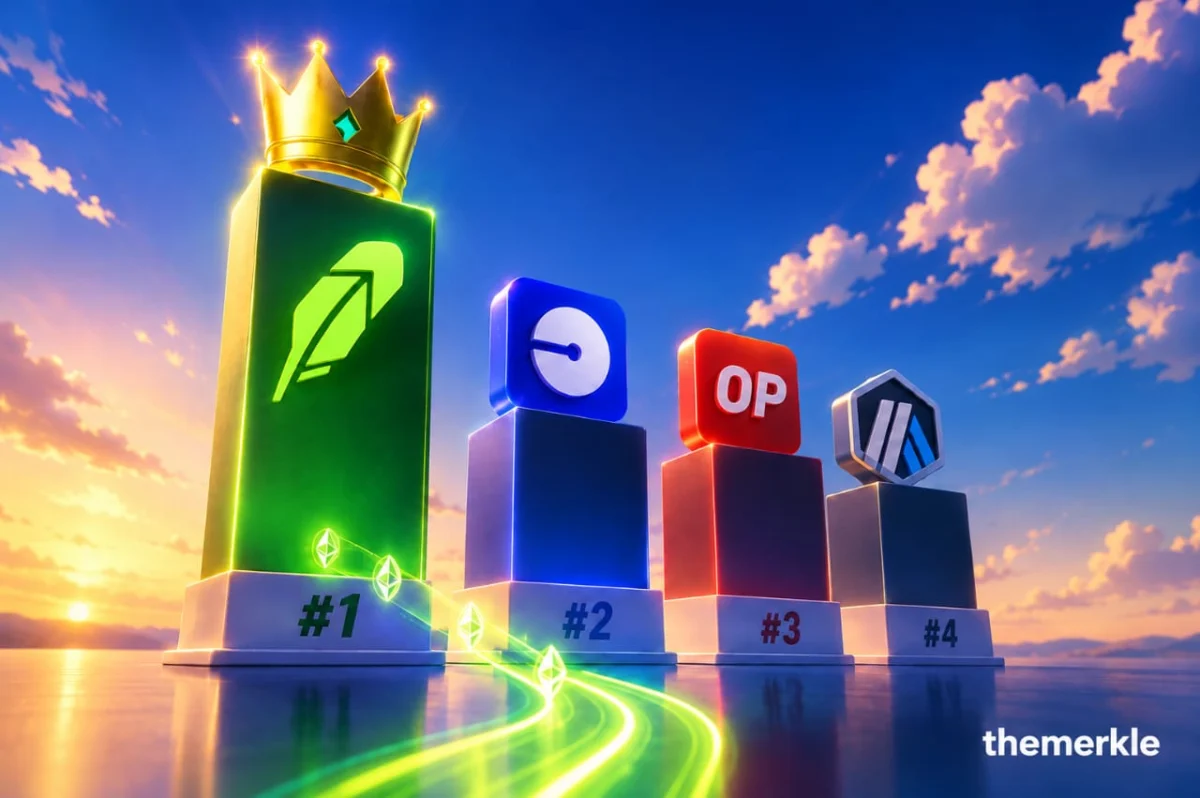
The cryptocurrency landscape, often characterized by rapid innovation and unexpected shifts, has recently witnessed a development that has sent ripples of surprise through the Ethereum ecosystem. In a remarkably short span of just six weeks, a retail brokerage application’s proprietary blockchain, Robinhood Chain, has eclipsed every established Ethereum Layer 2 (L2) network in a pivotal metric: fees paid back to the Ethereum mainnet. This achievement signifies not merely a competitive gain but a potentially transformative shift in how new blockchain networks achieve economic significance and integrate with the broader digital economy. Networks like Base, Optimism, and the various chains within the Arbitrum ecosystem, which have spent years cultivating their user bases and developer communities, now find themselves trailing behind a newcomer that barely existed two months prior. The speed and nature of this ascent have genuinely surprised industry observers, challenging conventional wisdom regarding L2 growth trajectories.
The Unprecedented Numbers: Robinhood Chain’s Dominance in Economic Contribution
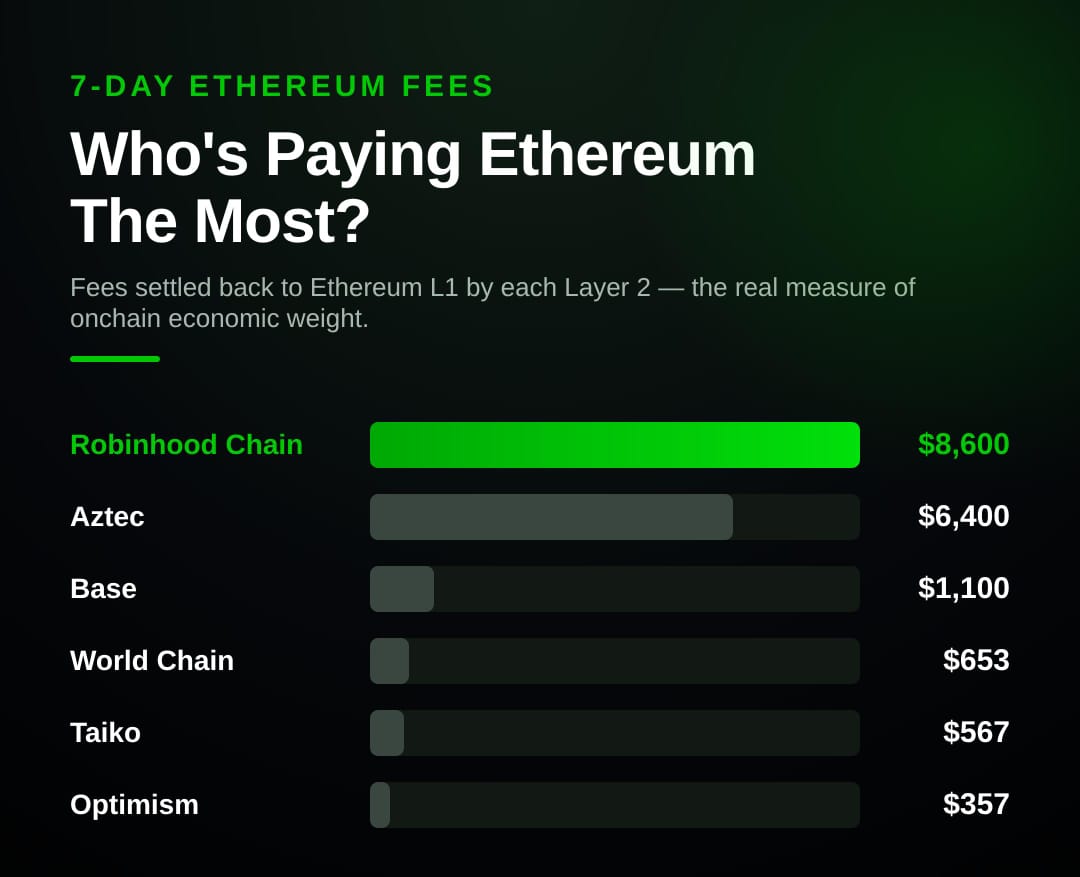
The stark reality of Robinhood Chain’s rapid rise is best illustrated by the hard data. According to an analysis shared by ETH Daily, covering a recent seven-day period, Robinhood Chain contributed an impressive $8,600 in fees directly back to the Ethereum mainnet. This figure places it definitively at the top of all tracked Layer 2 networks, a position traditionally held by more mature and widely adopted solutions.
To put this into perspective, its closest competitor in this metric, Aztec, recorded $6,400 in fees. More strikingly, long-standing players lagged significantly: Base, a network backed by Coinbase and boasting one of Ethereum’s largest L2 ecosystems, registered a distant third with just $1,100. Other established and emerging L2s trailed further, including World Chain ($653), Taiko ($567), X Layer ($459), Lighter ($368), Optimism ($357), Unichain ($329), and Polygon ($251). The sheer magnitude of this gap is what truly underscores the significance of Robinhood Chain’s performance. Its contribution to Ethereum’s security and data availability budget is nearly eight times higher than that of Base, a network that has benefited from extensive development, marketing, and a multi-year head start. This is not a marginal lead; it represents a fundamental reordering of economic contribution within the L2 space by a network that was barely out of its infancy.
Understanding Economic Weight: Why Fees Paid to Ethereum Matter Profoundly
In the complex architecture of blockchain scalability, the metric of "fees paid back to Ethereum" transcends mere bragging rights; it serves as a critical indicator of genuine, economically significant activity on a Layer 2. To understand why, it’s essential to grasp the fundamental relationship between Ethereum L2s and the mainnet, often referred to as Layer 1 (L1).
Ethereum Layer 2 solutions are designed to process transactions off-chain, thereby increasing throughput and reducing costs, but they do not operate in isolation. Crucially, L2s periodically "settle" their aggregated transaction data and cryptographic proofs back to the Ethereum mainnet. This process ensures that the security, decentralization, and finality of Ethereum are inherited by the L2. When an L2 posts this data to L1, it incurs a transaction fee, denominated in Ether (ETH), payable to the Ethereum network. This fee compensates Ethereum validators for processing and permanently recording the L2’s state transitions, ensuring the integrity and availability of the L2’s data.
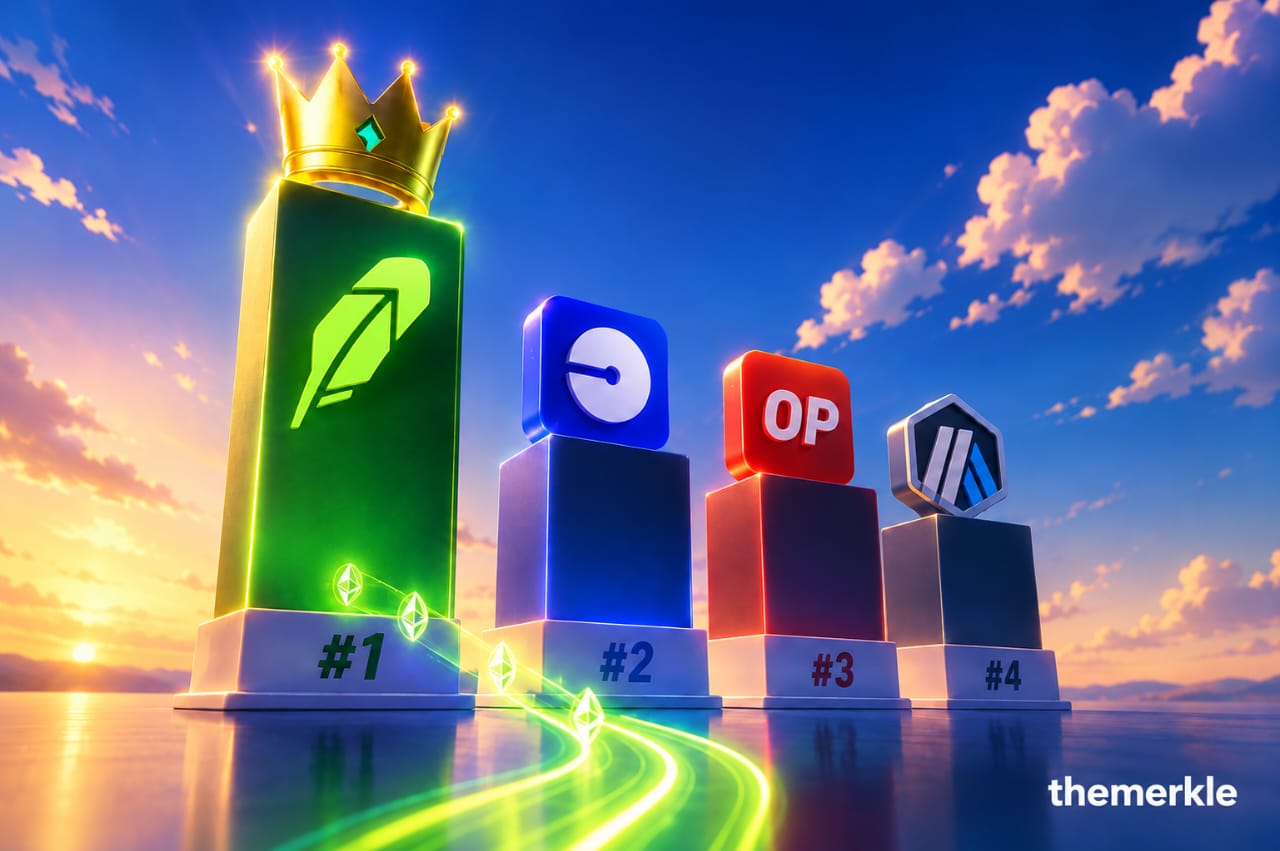
Therefore, the volume of fees an L2 pays to Ethereum directly correlates with the amount of real economic activity it is processing and securing. A Layer 2 that generates high internal transaction counts but pays minimal fees to the mainnet might be indicative of subsidized activity, low-value transactions, or simply an inefficient settlement mechanism. Conversely, an L2 like Robinhood Chain, which is paying substantially more in fees, is demonstrably handling a significant volume of valuable transactions that require robust L1 security and data availability guarantees. This distinction is vital for analysts tracking not just the competitive landscape of L2s, but also the overall economic health and sustainability of the Ethereum ecosystem itself. As the Ethereum Institute aptly articulated in their analysis of this shift, Robinhood Chain’s burgeoning activity isn’t just about competing for users and revenue among L2s; it’s actively bolstering Ethereum’s foundational economic layer, a distinction that has far-reaching implications for the entire Web3 paradigm.
The Genesis of a Disruptor: Robinhood Chain’s Strategic Launch and Design
Robinhood Chain’s explosive growth is not an accidental byproduct but the result of a deliberate and ambitious strategic initiative. The network officially launched its public mainnet on July 1, 2026, during Robinhood’s high-profile "The World is Flat" keynote event held in London. This launch was framed not as a tentative foray into blockchain, but as the company’s most direct and significant bet on integrating traditional brokerage infrastructure with the nascent world of onchain finance.
Technically, Robinhood Chain is engineered as a permissionless, AI-native Ethereum Layer 2, built leveraging the robust and proven Arbitrum stack. The choice of the Arbitrum stack is strategic, offering a battle-tested and developer-friendly environment known for its efficiency and scalability. The network was purpose-built with a clear vision: to facilitate tokenized real-world assets (RWAs), enable 24/7 global settlement, and offer a new suite of onchain financial services. This focus immediately set it apart from many L2s that initially target decentralized finance (DeFi) primitives or gaming applications.
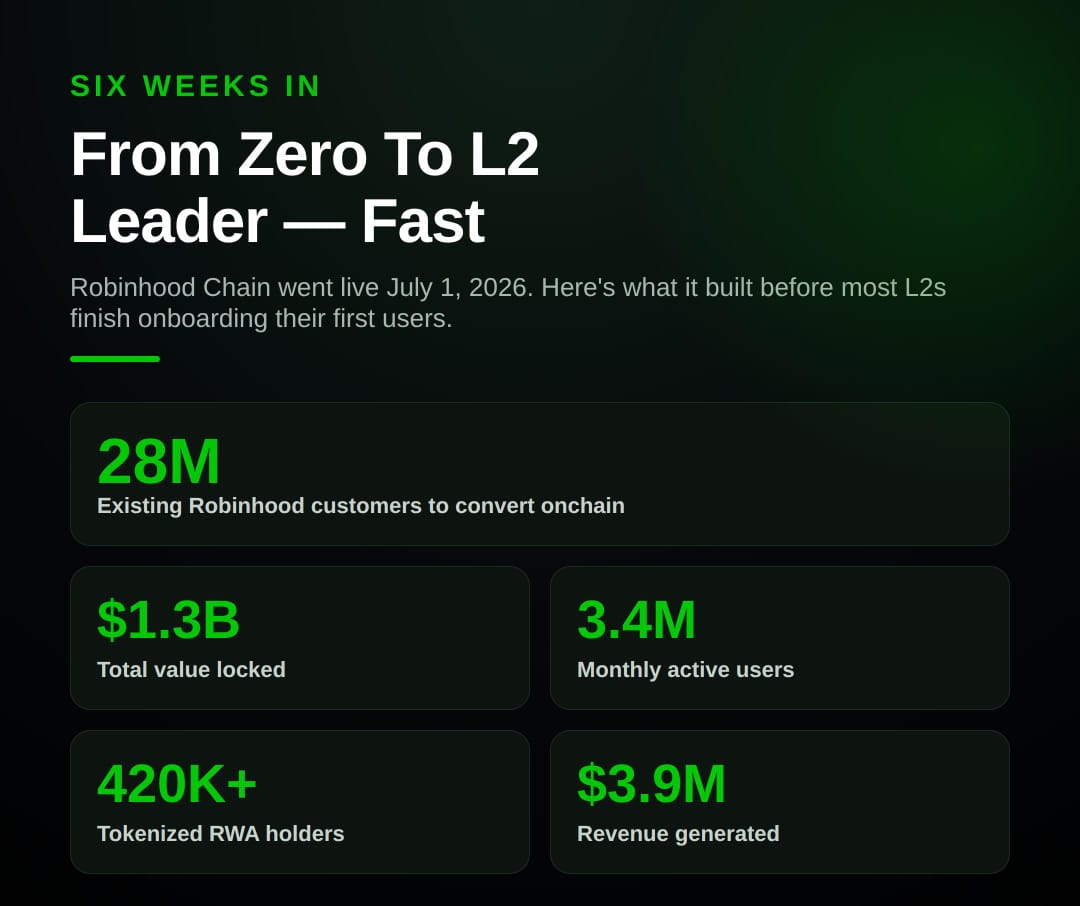
Crucially, Robinhood Chain did not embark on this journey from a standing start, as most new L2s are forced to do. Robinhood, the parent company, already commands an immense user base of 28 million existing customers. This provided an unparalleled advantage: rather than needing to bootstrap an audience from scratch, Robinhood’s primary challenge was to effectively convert a segment of its existing, massive retail clientele onto its new blockchain rails. The numbers from its first six weeks unequivocally suggest that this conversion has occurred with remarkable speed and efficacy. The company’s official launch announcement, detailing its global expansion, the mainnet launch, stock tokens, agentic trading, and new DeFi products, painted a clear picture of its comprehensive strategy to bridge TradFi and Web3.
Beyond Fees: A Holistic View of Robinhood Chain’s Early Success Metrics
While fees paid to Ethereum serve as a crucial economic indicator, Robinhood Chain’s broader performance metrics from its initial six weeks paint a comprehensive picture of its unprecedented traction:
- RWA Holders: The network quickly attracted over 420,000 holders of tokenized real-world assets. This figure highlights the success of its core strategy to onboard users through familiar financial instruments.
- Total Value Locked (TVL): Robinhood Chain accumulated an impressive $1.3 billion in Total Value Locked. TVL represents the total value of assets currently staked or locked within the network, indicating significant user confidence and capital flow.
- Monthly Active Users (MAU): The network recorded 3.4 million monthly active users. This user engagement metric rivals, and in many cases surpasses, that of much older L2s, demonstrating active participation and utilization.
- Revenue: Robinhood Chain generated $3.9 million in revenue within this initial period. This financial performance underscores the network’s economic viability and the value being transacted on its platform.
- Median Transaction Fee: Users experienced a remarkably low median transaction fee of just $0.00669. This cost-efficiency is a critical factor for attracting and retaining retail users, who are highly sensitive to transaction costs in traditional finance.
These statistics collectively indicate that Robinhood Chain is not merely generating speculative activity but fostering genuine economic engagement. The high number of RWA holders, coupled with substantial TVL and active users, suggests a robust and rapidly maturing ecosystem, far beyond what is typically observed for a blockchain network in its nascent stages.
A Paradigm Shift in L2 Growth Strategies: Retail Onramp Effect
The most compelling aspect of Robinhood Chain’s success lies in its fundamentally divergent growth model compared to established Ethereum Layer 2s. For years, the dominant strategy for new L2s, including many of those now trailing Robinhood Chain, has revolved around:
- Token Incentive Programs: Distributing native tokens to incentivize early adoption, liquidity provision, and developer engagement.
- Liquidity Mining: Offering rewards for users who provide liquidity to decentralized exchanges or lending protocols on the L2.
- Airdrop Farming: Users performing specific actions in anticipation of a future token airdrop, often leading to a surge in speculative activity.
These strategies, while effective in manufacturing initial activity and bootstrapping liquidity, often attract "crypto-native" users who are already deeply embedded in the Web3 ecosystem. They are designed to create an artificial demand before organic growth takes hold, sometimes leading to "vampire attacks" where users migrate to the next incentivized chain.
Robinhood Chain, strikingly, operates without a native token. Its early TVL and transaction growth are instead almost entirely propelled by the direct adoption of tokenized real-world assets. This includes digital representations of traditional financial instruments like stock tokens for blue-chip companies such as NVIDIA, Google, and Apple. Furthermore, the network launched with integrations from established DeFi protocols like Uniswap and Morpho, which joined as key partners, providing immediate utility and liquidity.
This approach represents a "retail onramp effect." Robinhood is directly funneling its massive existing brokerage user base onto its onchain rails. The key innovation here is that users who were already accustomed to trading stocks on the Robinhood app are now simply holding and potentially trading tokenized versions of those same stocks on the blockchain. Crucially, many of these users may not even need to understand the underlying blockchain technology, the concept of a Layer 2, or the intricacies of self-custody. The user experience is designed to be seamless, mirroring their existing interactions with the brokerage app, thereby lowering the barrier to entry for millions of non-crypto-native individuals. This model bypasses the typical crypto-native user acquisition struggle, tapping directly into a pre-existing, massive market.
Broader Implications for Ethereum and the Digital Economy
The meteoric rise of Robinhood Chain is more than just a new entry on the L2 leaderboard; it represents a genuinely new category of L2 growth story with profound implications for the entire Ethereum ecosystem and the broader digital economy.
First, it fundamentally alters the landscape of L2 competition. Most chains vying for L2 dominance have historically focused on attracting the same relatively narrow pool of crypto-native users, developers, and liquidity. Robinhood Chain, however, is pulling in an entirely separate, vastly larger population: mainstream retail brokerage customers who may have never engaged with DeFi or even understood the concept of a blockchain before. By converting a meaningful segment of this audience into active, fee-generating onchain users within weeks, it has demonstrated an unprecedented model for mainstream adoption.
Second, this development significantly bolsters Ethereum’s long-term economic health and security. As Robinhood Chain continues to scale and contribute substantial fees to the mainnet, it diversifies and strengthens the economic base layer of Ethereum. This is a critical factor for the network’s sustainability and its ability to maintain robust security through staking rewards for validators. It demonstrates that L2s can not only scale Ethereum’s transaction capacity but also meaningfully contribute to its economic vitality by bringing entirely new user segments into the fold.
Third, Robinhood Chain’s success in tokenized real-world assets serves as a powerful validation for the convergence of traditional finance (TradFi) and blockchain technology. The ability to seamlessly trade tokenized stocks and other financial instruments on a blockchain, with 24/7 settlement and transparent ownership, could unlock trillions of dollars in value currently locked in legacy financial systems. This could accelerate institutional interest and participation in the tokenized asset space, driving further innovation and adoption.
Finally, this shift challenges the prevailing narratives around blockchain adoption. For years, the Ethereum ecosystem has debated how to onboard the "next billion users" and achieve mainstream acceptance. Robinhood Chain has provided a compelling answer: by leveraging existing user bases from trusted brands and integrating blockchain technology invisibly into familiar applications, the path to mass adoption may lie less in educating users about crypto and more in abstracting away its complexities.
While the long-term trajectory of Robinhood Chain and its impact remain to be fully realized, its initial six weeks have undeniably carved out a new path for Layer 2 growth. It underscores that innovation in the blockchain space is not solely about technological breakthroughs but also about strategic user acquisition and seamless integration with existing financial paradigms. For an ecosystem that has spent years wrestling with the challenge of bringing the mainstream into Web3, watching a retail brokerage app quietly achieve significant economic contribution to Ethereum, and outpace established L2s in doing so, is a development that demands close and continued attention.
Disclosure: This is not trading or investment advice. Always do your research before buying any cryptocurrency or investing in any services.