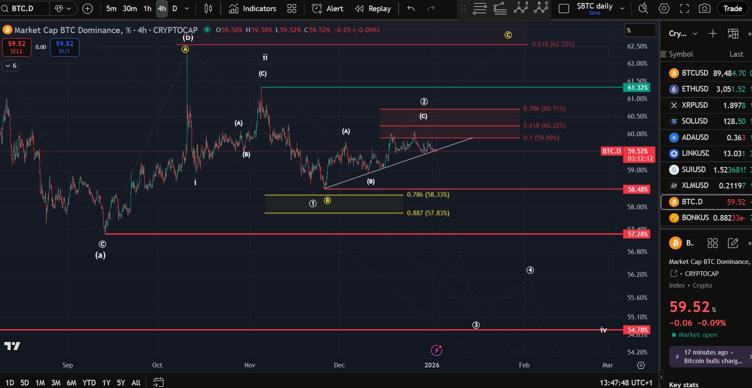
The digital asset market is currently witnessing a significant transformation in capital distribution as Bitcoin, the world’s largest cryptocurrency by market capitalization, struggles to maintain its upward trajectory above critical technical thresholds. Market analyst Justcryptopays recently highlighted that Bitcoin’s breach of a primary ascending trendline serves as a pivotal indicator that the market’s internal dynamics are shifting. This technical breakdown suggests that the period of absolute Bitcoin dominance may be yielding to a more diversified market environment, characterized by a strategic rotation of liquidity into the altcoin sector. As investors navigate the opening weeks of 2026, the focus has increasingly turned toward whether the "Altseason" narrative will finally materialize after a challenging period of market contraction throughout much of the previous year.
The Technical Breakdown of Bitcoin and the $90,000 Threshold
Bitcoin has long functioned as the primary barometer for the health of the broader cryptocurrency ecosystem. Its price movements typically dictate the sentiment of the entire sector, often leading the market into bull cycles or dragging it into prolonged corrections. However, recent data indicates a decoupling of sorts. The failure of Bitcoin to decisively hold the psychological and technical support level of $90,000 has introduced a layer of caution among institutional and retail traders alike.
Trading at approximately $90,525, Bitcoin remains in a precarious position. The $90,000 mark is not merely a round number; it represents a zone of high liquidity where buyers and sellers have historically clashed. When an asset struggles to maintain such a high-profile benchmark, it often signals a "cooling off" period. According to technical analysis provided by market observers, the break below the established trendline indicates that the momentum that propelled Bitcoin to its recent highs is exhausting. This exhaustion does not necessarily portend a market-wide crash, but rather a redistribution of wealth. As Bitcoin enters a phase of consolidation or minor correction, capital tends to seek higher-beta opportunities—assets that offer greater percentage returns on smaller capital inflows.
Understanding the Mechanics of Capital Rotation
Capital rotation is a fundamental concept in financial markets, and in the cryptocurrency space, it follows a relatively predictable "waterfall" pattern. Historically, a market cycle begins with Bitcoin leading the charge, absorbing the majority of new fiat inflows. Once Bitcoin reaches a valuation perceived as "expensive" or hits a significant resistance level, investors begin to take profits. These profits are rarely exited into fiat currency immediately; instead, they are frequently reinvested into large-cap altcoins like Ethereum (ETH) and Solana (SOL).
The current market landscape mirrors this historical precedent. With Bitcoin’s dominance showing signs of erosion, the "altcoin awakening" is becoming a central theme for the 2026 fiscal year. This rotation is driven by the search for alpha—returns that exceed the market benchmark. For many investors, the prospect of Bitcoin doubling from $90,000 to $180,000 requires a massive influx of capital, whereas smaller-cap assets can achieve similar percentage gains with significantly less liquidity.
A Chronology of Market Sentiment: From the 2025 Slump to 2026 Recovery
To understand the current shift, one must look at the broader timeline of the digital asset market over the last eighteen months. The year 2025 was largely defined by a "bearish momentum" that saw many projects struggle to maintain their valuations amidst regulatory uncertainty and a tightening of global liquidity.

- Mid-2025: The market faced a series of corrections as initial excitement over institutional adoption hit a plateau. Bitcoin remained the only asset with significant "safe haven" status, while altcoins bled value against their BTC trading pairs.
- Q4 2025: Bitcoin rallied to test the $90,000 to $100,000 range, driven by spot ETF inflows and corporate treasury adoption. However, this rally was "top-heavy," with altcoins failing to keep pace.
- January 2026: As the new year commenced, Bitcoin’s inability to break the $100,000 barrier led to a technical breakdown of its primary support trendline.
- Present: Capital has begun flowing into ecosystem leaders. Ethereum and Solana have started to outperform Bitcoin on a weekly basis, signaling the potential start of a broad-based altcoin rally.
This chronology suggests that the current movement is not an isolated event but a necessary rebalancing of the market after a year of Bitcoin-centric growth.
Spotlight on Ecosystem Leaders: ETH, SOL, XRP, and ADA
As the rotation gains steam, several key assets are positioned to benefit most from the shifting tides. Ethereum, the second-largest cryptocurrency, remains the primary beneficiary of any move away from Bitcoin. As the backbone of decentralized finance (DeFi) and the non-fungible token (NFT) markets, Ethereum’s utility provides a fundamental floor for its valuation. Analysts note that Ether is often the "gateway" for capital entering the altcoin market.
Solana (SOL) has also emerged as a formidable contender for capital. Known for its high throughput and low transaction costs, Solana has captured a significant portion of the retail trading volume, particularly in the memecoin and decentralized exchange (DEX) sectors. Its ability to maintain network stability during periods of high volatility has restored investor confidence, making it a top choice for those looking to diversify away from Bitcoin.
Other legacy assets like XRP and Cardano (ADA) are also showing signs of life. XRP’s performance is often tied to its ongoing utility in cross-border payments and the resolution of long-standing regulatory hurdles. Cardano, while often criticized for its slow development pace, continues to attract investors who value its peer-reviewed approach to blockchain scalability. The inclusion of these assets in the rotation narrative suggests that the current rally is inclusive of both "new-age" high-performance chains and "old-guard" utility tokens.
The Role of Technical Indicators: Moving Averages and Volume
Beyond price action, technical indicators provide a clearer picture of the burgeoning altcoin strength. One notable metric is the 21-day Moving Average (MA). In recent weeks, several mid-cap altcoins, including Chainlink (LINK), have successfully broken above their 21-day MA. In technical analysis, holding above this short-term average often precedes a sustained upward run.
Furthermore, trading volume across altcoin-specific exchanges has seen a marked increase. While Bitcoin’s volume has stayed relatively flat or slightly declined during its consolidation, the volume for the "Top 50" altcoins has risen by an average of 15-20% over the last fortnight. This divergence in volume is a classic signal that the "smart money" is positioning itself for a change in market leadership.
Institutional Perspectives and Binance Research Insights
Binance Research, the analytical arm of the world’s largest cryptocurrency exchange, has frequently suggested that an altcoin rally might be in sight when certain macro and micro conditions align. Their research points to the "Altcoin Season Index," which measures the percentage of the top 50 coins that have outperformed Bitcoin over the last 90 days. When this index crosses the 75% threshold, an "Altseason" is officially declared.
Institutional analysts argue that the current shift is also fueled by the maturation of the market. Unlike previous cycles driven purely by speculation, the 2026 rotation is supported by tangible developments in Web3 infrastructure and real-world asset (RWA) tokenization. Institutions are no longer just looking at Bitcoin as "digital gold"; they are looking at Ethereum, Solana, and Chainlink as the "digital rails" of the future financial system.
Broader Economic Implications and Market Stability
The shift toward a more balanced market—where Bitcoin and altcoins share the spotlight—is generally viewed as a sign of a maturing asset class. A market that is overly dependent on a single asset is prone to extreme volatility and systemic risk. By diversifying capital across various protocols and use cases, the cryptocurrency ecosystem becomes more resilient.
Furthermore, the macro-economic environment of 2026 plays a crucial role. If global central banks signal a shift toward more accommodative monetary policies, high-growth assets like altcoins typically outperform. Conversely, if inflation remains sticky, the rotation might be more selective, favoring assets with clear revenue-generating models over purely speculative tokens.
Strategic Opportunities for Investors
For traders and long-term investors, this transition period presents a variety of strategic opportunities. The "Bitcoin break" provides a window to rebalance portfolios that may have become too heavily weighted in the flagship currency during its 2025 run.
- Short-Term Gains: Traders are looking at "catch-up" trades, identifying high-quality altcoins that have not yet mirrored Bitcoin’s recent gains.
- Long-Term Positioning: For those with a multi-year horizon, the rotation offers a chance to accumulate foundational Web3 assets at valuations that are still significantly below their all-time highs.
- Risk Management: The struggle at the $90,000 level serves as a reminder to set stop-losses and take profits. Market dynamics can shift rapidly, and while the altcoin outlook is positive, volatility remains a constant companion in the digital asset space.
Conclusion: The Road Ahead for the Altcoin Awakening
As Bitcoin continues to test the resolve of bulls at the $90,000 mark, the broader market is preparing for what could be one of the most significant capital rotations in recent years. The break below the key trendline noted by Justcryptopays is more than just a technical glitch; it is a signal of evolving investor sentiment.
While the "bearish momentum" of 2025 left many cautious, the early data from 2026 suggests a revitalized interest in the utility and diversity of the altcoin market. Whether this leads to a full-blown Altseason or a more measured period of growth remains to be seen. However, the shift in capital flows is undeniable. Investors who remain vigilant and adapt to these changing dynamics are likely to find themselves well-positioned to capitalize on the next chapter of the digital asset evolution. The market is moving toward a more balanced, multi-polar state, and in this new environment, the "alternatives" may finally take center stage.