


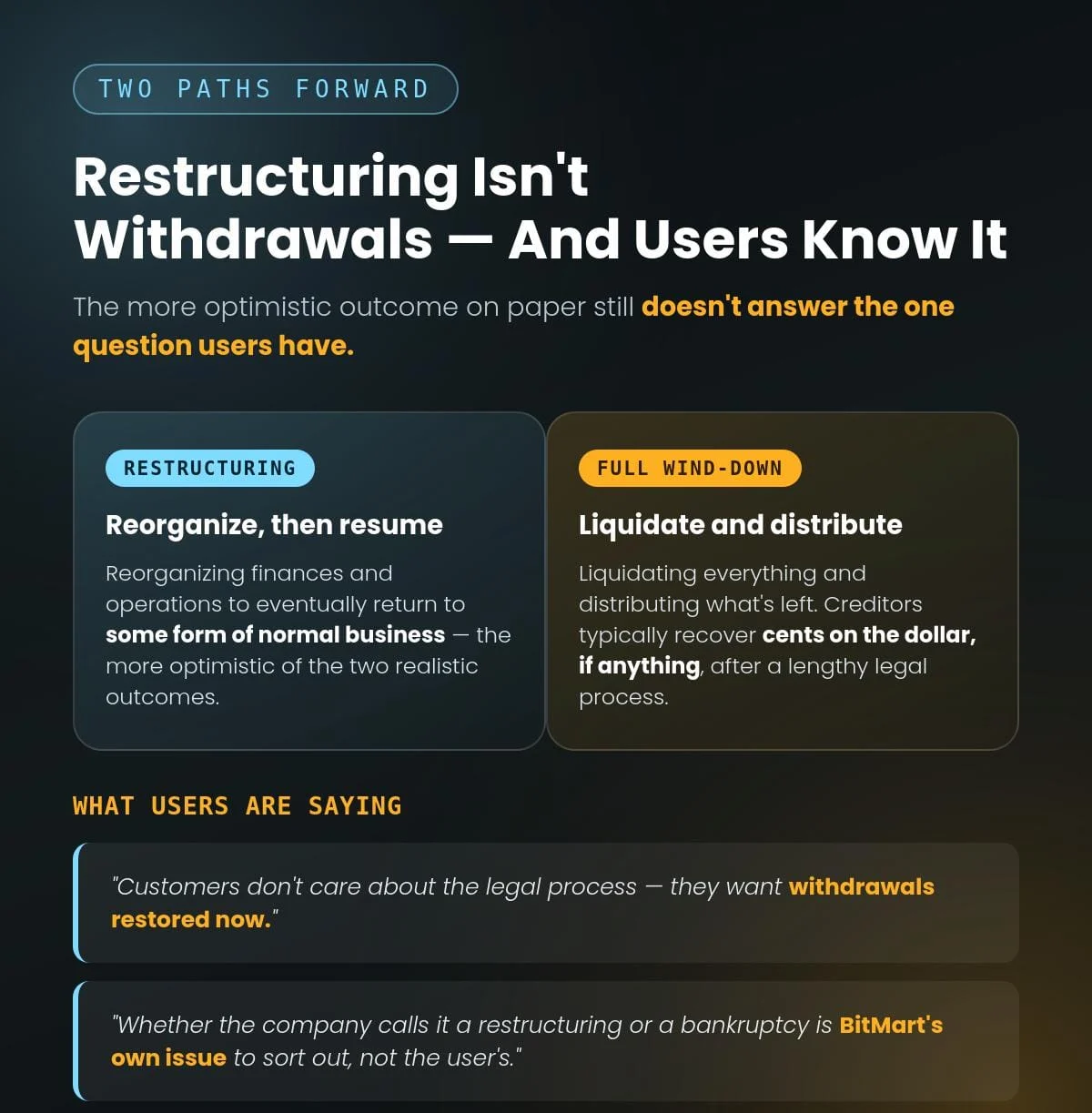
The cryptocurrency exchange BitMart has announced a significant pivot in its strategy, moving away from a potential full wind-down towards exploring a restructuring plan, a development that brings a cautious glimmer of hope for users with frozen funds but fails to address the immediate and pressing demand for reinstated withdrawals. This latest update, issued as a follow-up to an initial announcement on July 26, 2026, underscores the persistent challenges facing the platform and its user base, who remain in limbo regarding access to their assets. While BitMart has outlined its intent to develop a phased resumption of operations and distributions to creditors, the conspicuous absence of a timeline for withdrawals has ignited a fresh wave of frustration among its community.
Background to the Crisis: The Initial Freeze
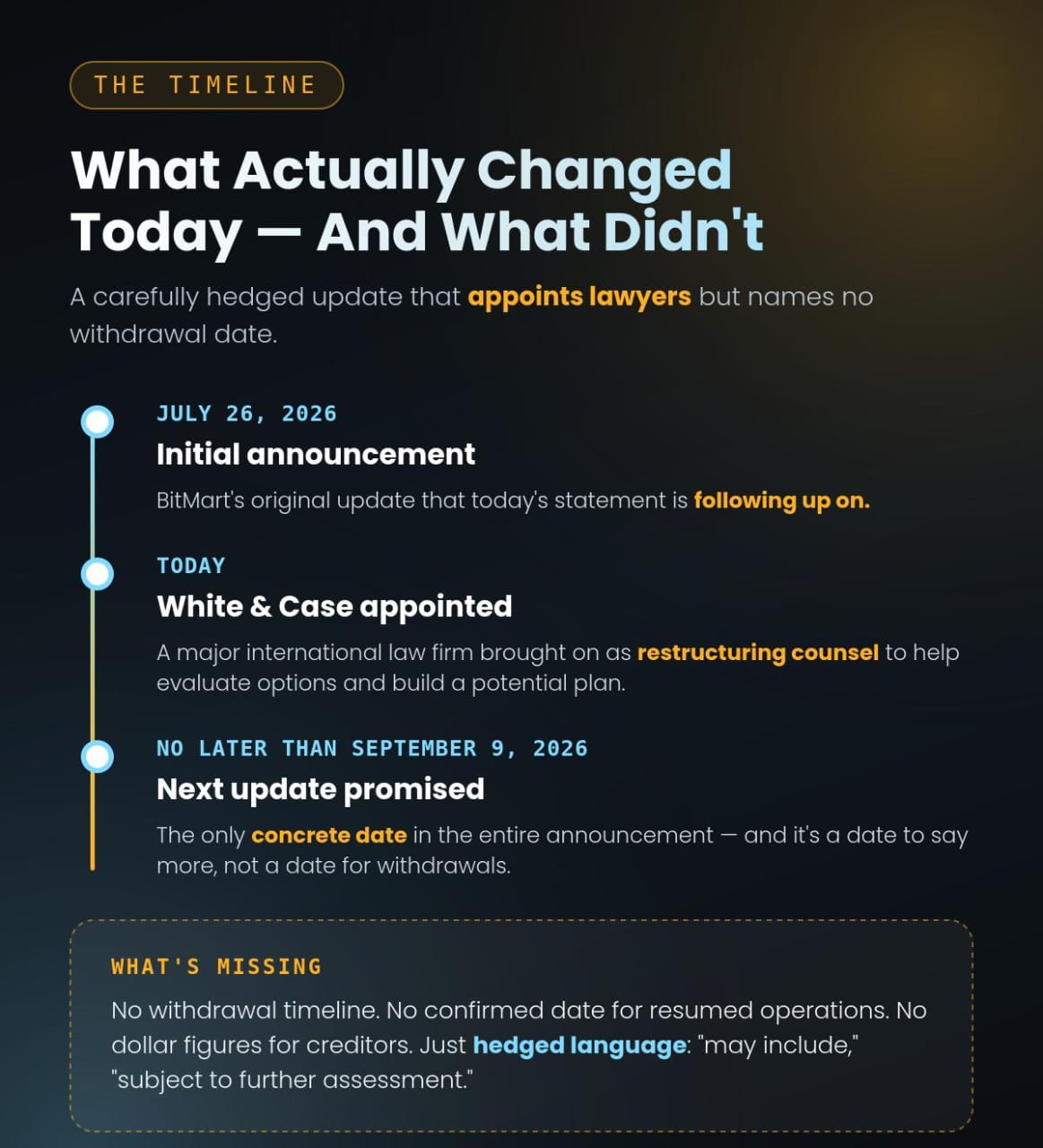
The current predicament for BitMart users began on July 26, 2026, when the exchange first announced a halt to withdrawals, citing unspecified operational or liquidity challenges. This initial declaration plunged thousands of users into uncertainty, reminiscent of similar situations that have plagued the broader cryptocurrency market in recent years. Such freezes typically occur when an exchange faces an acute shortage of liquid assets to meet withdrawal demands, often triggered by a significant market downturn, an unexpected security breach, or internal mismanagement. The immediate consequence is a complete cessation of user access to their funds, transforming digital assets into inaccessible ledger entries. The initial announcement by BitMart reportedly contemplated a full wind-down, a process that usually involves the liquidation of all assets and a distribution to creditors, often resulting in users recovering only a fraction of their holdings after lengthy legal proceedings. This grim prospect has loomed over BitMart’s user base for weeks, creating a climate of anxiety and financial distress.
The Latest Development: A Shift Towards Restructuring
In its most recent communication, BitMart conveyed a strategic shift, indicating it is now developing a "potential restructuring plan" as an alternative to a complete wind-down. According to the exchange, this plan "could include a phased resumption of certain operations carried out in an orderly manner, alongside distributions to creditors." However, the statement was meticulously hedged with caveats, noting that any such plan remains "subject to further legal, financial, operational, and regulatory assessment." This cautious language, while legally prudent for a company in distress, offered little immediate solace to users desperate for concrete answers.
To spearhead this complex process, BitMart confirmed the formal appointment of White & Case, a prominent international law firm renowned for its expertise in restructuring and insolvency cases, as its restructuring counsel. White & Case will reportedly collaborate with BitMart’s existing professional advisers to evaluate available options and construct the restructuring framework, including a potential blueprint for a phased return of operations. BitMart has committed to providing a further update on this roadmap no later than September 9, 2026, setting the next critical checkpoint for its embattled users.
Deconstructing the Language: Promises and Ambiguity
A meticulous reading of BitMart’s statement reveals a deliberate use of cautious, non-committal language. Phrases such as "developing a potential plan," "may include," and "subject to further assessment" permeate the update. While such legal hedging is standard practice for companies navigating financial distress and regulatory scrutiny, it effectively means that, for users, nothing has concretely changed. There is no confirmed timeline for withdrawals, no definitive date for resumed operations, and no specific figures on what creditors might ultimately recover. The announcement primarily confirms the engagement of a high-profile legal firm and sets a future date for another update.

This ambiguity creates a chasm between the corporate legal process and the lived reality of individual users. While BitMart operates within the confines of legal and financial due diligence, its users face immediate financial constraints and emotional strain due to inaccessible funds. The choice of White & Case, a firm with a global reputation, signals BitMart’s intent to navigate this crisis with professional legal guidance, potentially aiming for a resolution that minimizes liquidation and maximizes the chances of business continuity, albeit in a reorganized form.
Understanding "Restructuring" in the Crypto Context
It is crucial for users to understand the precise implications of "restructuring" versus other outcomes like bankruptcy or liquidation. In this context, restructuring typically signifies an attempt by the exchange to reorganize its financial obligations, operational models, and potentially its debt, in order to return to a viable, albeit potentially altered, business state. The goal is to avoid a complete collapse and liquidation, which often results in creditors (including users with locked funds) recovering only a minimal percentage of their assets, if any, after a protracted legal battle.
A successful restructuring might involve several components:
- Debt Reprofiling: Renegotiating terms with creditors to extend payment deadlines or reduce principal amounts.
- Operational Streamlining: Cutting costs, divesting non-core assets, or changing business models to improve profitability.
- Capital Injection: Seeking new investment to shore up liquidity.
- Phased Resumption: Gradually restoring services, starting with less risky operations and eventually, potentially, withdrawals.
While restructuring offers a more optimistic pathway than immediate liquidation, it is a lengthy and complex process. It does not equate to immediate withdrawal resumption. Instead, it is a strategic maneuver designed to buy time, assess the financial situation comprehensively, and propose a viable path forward that satisfies creditors to the extent possible, while attempting to preserve the entity. For users, this means continued patience and the acceptance that their funds will likely remain inaccessible for an extended period, pending the outcome of these complex negotiations and assessments.
User Outcry: Patience Wears Thin
The gap between BitMart’s careful corporate tone and its users’ urgent need for access to their funds manifested almost immediately in a torrent of critical reactions. Social media channels, where BitMart posted its update, became forums for intense frustration and anger. One user articulated a common sentiment, accusing the exchange of "stalling for time" rather than addressing the core issue of blocked withdrawals. This user explicitly stated that customers are not interested in the intricacies of the legal process but rather in the immediate restoration of their ability to withdraw assets, further declaring an unwillingness to continue doing business with BitMart until this fundamental issue is resolved.
Another commenter escalated the criticism, pointing out that regardless of the legal firm engaged, the sustained inability to process withdrawals inherently signals a "liquidity problem." This user argued that whether BitMart labels its situation a "restructuring" or a "bankruptcy" is ultimately an internal distinction that does not alleviate the user’s financial distress. Demonstrating the depth of this frustration, the commenter threatened to pursue direct legal action against BitMart’s CEO, underscoring the dwindling patience and the readiness of some users to explore all available avenues for recourse. These reactions collectively illustrate a severe erosion of trust and a growing demand for accountability beyond corporate platitudes.
The Broader Implications for Exchange Trust and Regulation
BitMart’s ongoing crisis is not an isolated incident; it reflects a recurring pattern within the nascent and often volatile cryptocurrency industry. The scenario—an exchange freezing withdrawals, citing nebulous operational or liquidity issues, engaging professional advisers, and appealing for user patience—has played out repeatedly across various platforms. This pattern severely damages user confidence, not just in the affected exchange but in the broader ecosystem. Each such event highlights the inherent risks of centralized cryptocurrency exchanges, particularly the "not your keys, not your crypto" adage, which warns against entrusting assets to third-party custodians.
The cumulative effect of these crises is increased scrutiny from regulatory bodies worldwide. Governments and financial authorities are increasingly pressured to implement stricter oversight, consumer protection measures, and transparency requirements for crypto exchanges. The BitMart situation will likely contribute to this regulatory push, potentially leading to more stringent capital requirements, proof-of-reserves mandates, and clearer legal frameworks for handling user assets during periods of financial distress. For the crypto industry to mature and gain mainstream acceptance, it must address these fundamental issues of trust, liquidity management, and user protection.
Navigating the Interim: Between Now and September 9, 2026
For BitMart users, the immediate future is defined by a period of enforced waiting. The September 9, 2026, deadline for the next update is the most concrete point on the horizon. What that update will bring remains highly uncertain: it could be a detailed withdrawal timeline, a formal filing for restructuring, or another round of cautiously worded statements promising further details. The unpredictability exacerbates user anxiety.
During this critical window, BitMart has echoed a vital warning that applies to all users affected by exchange crises: extreme caution regarding scams. Such periods are fertile ground for malicious actors who prey on desperate and anxious users. Phishing attempts, fraudulent "recovery services," and fake links promising expedited withdrawals are common tactics. BitMart explicitly advised users to rely exclusively on its official website, mobile app, and verified social channels for information, and to treat any unsolicited offers to "help" recover funds with deep suspicion. Adhering to this advice is paramount to avoid further financial loss.
Conclusion: The Enduring Challenge of Trust
BitMart’s decision to pursue restructuring over a full wind-down is, from a purely financial recovery perspective, generally considered the more favorable outcome for creditors, as it theoretically offers a better chance of recovering a greater percentage of assets than a liquidation. However, the chasm between "more likely to eventually work out" and "acceptable right now" is vast. For users who have had their funds inaccessible for weeks, a professionally worded update about legal frameworks and phased assessments, devoid of concrete timelines for withdrawals, is a difficult pill to swallow.
The situation with BitMart serves as a stark reminder of the fragile trust underpinning the centralized cryptocurrency exchange model. While exchanges strive to provide efficient trading platforms, the ultimate responsibility for safeguarding user assets often falls into a legal and operational gray area during crises. As the crypto industry continues its journey towards mainstream adoption, the ability of exchanges to manage liquidity transparently, communicate effectively during distress, and prioritize user protection will be paramount in building enduring confidence and securing a sustainable future. The coming weeks, leading up to the September 9, 2026, update, will be crucial in determining BitMart’s path forward and, more broadly, in shaping the narrative of trust within the digital asset landscape.














