The 2026 FIFA World Cup has solidified its place in history not only as a premier sporting event but as a transformative moment for the integration of blockchain technology into global consumer culture. By nearly every traditional metric, the tournament was a staggering success, drawing 6.8 million attendees to stadiums across North America and generating a record-breaking $10.5 billion in advertising spend. Television viewership in the United States alone reached an unprecedented 66 million for the final match. However, beneath the surface of these traditional figures lies a burgeoning digital economy that operated entirely on-chain. According to comprehensive research from Chainalysis, the tournament served as a catalyst for over $20 billion in prediction market volume and tens of millions of dollars in digital collectible trades, signaling a shift in how fans engage with global spectacles.
The Surge of Decentralized Prediction Markets
The most significant driver of on-chain activity during the 2026 World Cup was the explosion of decentralized prediction markets. These platforms, which allow users to trade on the outcome of future events using cryptocurrency, saw a massive influx of capital beginning as early as January 2026. Over the course of the qualification rounds and the tournament itself, the total volume reached $20 billion. Within the five-week window of the tournament, roughly 400,000 unique digital wallets interacted with these markets, generating $5.7 billion in volume during the event alone.

While the primary interest remained fixed on match outcomes—specifically who would advance through the group stages and eventually hoist the trophy—the 2026 tournament saw a rise in "novelty" or niche markets. One of the most talked-about markets involved the legendary Portuguese forward Cristiano Ronaldo. Bettors traded $49 million on the question of whether the star, appearing in his final World Cup, would be seen crying at the conclusion of his team’s campaign. When Portugal was eventually eliminated, the market settled in the affirmative, marking a unique intersection of emotional sports narratives and financial speculation.
Data analysis reveals that the ecosystem was not merely driven by speculative mania but by a sophisticated class of participants. Approximately 55% of all bettors finished the tournament in profit. Of those who came out ahead, nearly 79% were identified as "experienced prognosticators"—users with a history of activity in prediction markets prior to the World Cup. This suggests that the 2026 event attracted a high-signal demographic that utilized data-driven strategies to navigate the volatility of sports betting.
A Chronology of On-Chain Capital Flows
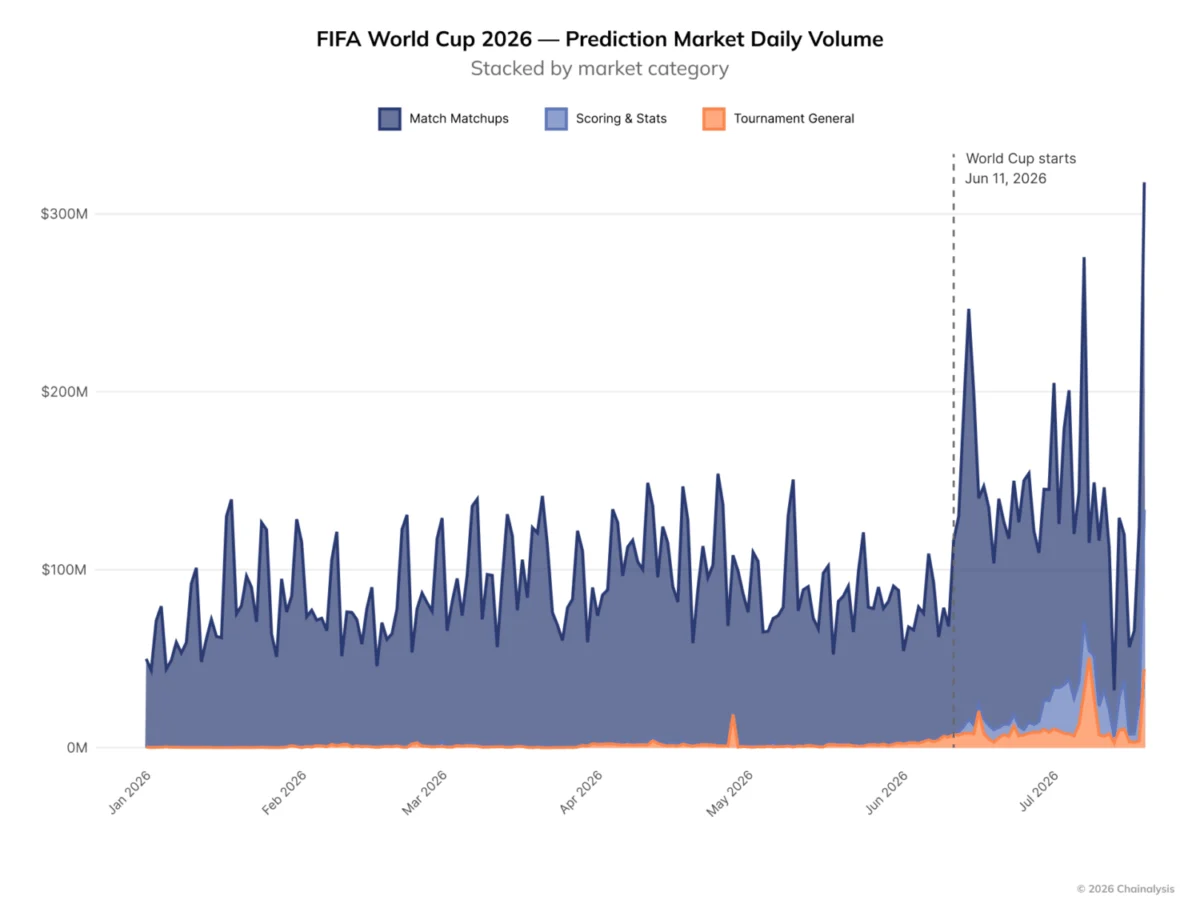
The movement of money followed the rhythm of the tournament’s progression. In the months leading up to the opening whistle, from January to May 2026, prediction markets maintained a steady baseline of approximately $50 million in daily volume. This activity was largely centered on the final rounds of continental qualifications and group placement speculations. As the qualifying window closed in March, volumes occasionally spiked above $100 million as excitement for the main event built.

The true inflection point occurred on June 11, 2026, the day of the opening match. Almost immediately, daily volumes surged to the $250 million range. This level of activity was sustained throughout the group stages as fans across the globe reacted to upsets and emerging storylines in real-time. As the tournament progressed into the knockout rounds, the frequency of matches decreased, leading to a temporary tapering of volume. However, this was merely the "quiet before the storm."
The final match between Spain and Argentina served as a financial crescendo. As Spain eventually bested Argentina to claim the title, bettors powered over $300 million in volume on that single day. During the height of the action, World Cup-related markets accounted for a staggering 63% of the total global prediction market volume, overshadowing political, economic, and other sporting markets combined.
Global Participation and Geographic Hotspots
The 2026 World Cup was a truly global phenomenon, with blockchain data showing participation from every continent except Antarctica. Chainalysis utilized proprietary geolocation methodology to trace the origin of these flows, revealing a complex map of digital engagement. Despite varying regulatory environments, the United States and China emerged as the primary leaders in total volume.

In the United States, the convergence of a home-turf tournament and an increasingly regulated crypto-betting landscape drove massive participation. In China, despite the country’s historical crackdowns on certain crypto activities, the volume remained high, likely facilitated by the use of virtual private networks (VPNs) and decentralized protocols that bypass centralized gatekeepers. Other major contributors included Canada, the United Kingdom, and Thailand.
The geographic data suggests that the "on-chaining" of sports betting is not limited to tech-heavy Western nations but is a decentralized global trend. Countries that qualified for the tournament showed a significantly higher propensity for on-chain spending, contributing $17.6 million to the FIFA Collect platform alone, compared to $6.6 million from the rest of the world.
FIFA Collect: The Evolution of Digital Souvenirs
Beyond the betting markets, FIFA’s official foray into digital collectibles, "FIFA Collect," demonstrated a maturing approach to Non-Fungible Tokens (NFTs). Launched on the Avalanche blockchain, the program allowed fans to purchase "digital moments"—commemorative clips and images of goals, saves, and celebrations. However, unlike the speculative NFT craze of previous years, FIFA Collect focused heavily on utility.

The platform provided a "right to buy" mechanism, allowing collectors to bypass traditional, highly competitive ticket lotteries. By owning certain digital assets, fans could secure the opportunity to purchase real-world tickets to the games. FIFA reported that over 100,000 fans successfully secured match attendance through this digital pipeline.
From a financial perspective, the FIFA Collect ecosystem was robust but modest compared to the betting markets. Between May 2025 and the end of the tournament, the primary wallet associated with the platform received $24 million in stablecoin payments. FIFA maintained a 5% commission on secondary market trades, ultimately collecting at least $6 million in revenue from these transactions. The analysis shows that while many users were "crypto-natives" with existing on-chain histories, the platform did succeed in onboarding a small but notable percentage of new users who were drawn in by the practical necessity of securing tickets.
Integrity and the Shadow of Illicit Activity
As with any large-scale financial ecosystem, the World Cup’s digital economy was not entirely free of controversy. Chainalysis’s review of over 400,000 wallets identified approximately 3,700 addresses—less than 1% of the total—with direct ties to illicit actors.

The most prominent source of "tainted" capital was the international exchange Huobi (now HTX). In late May 2026, the exchange was sanctioned by United Kingdom and European Union authorities for allegedly facilitating Russian crypto flows in evasion of trade blockades. Despite these sanctions, at least $5.4 million in volume flowed directly from Huobi-linked wallets into World Cup prediction markets. Other illicit sources identified included wallets linked to online scams, digital thefts, and other sanctioned entities.
Interestingly, the FIFA Collect platform remained largely insulated from these illicit flows. This is attributed to the platform’s rigorous "Know Your Customer" (KYC) and Anti-Money Laundering (AML) protocols. Users seeking to redeem digital assets for tickets were required to undergo manual verification and declare their source of funds. This high barrier to entry acted as a deterrent for bad actors, illustrating that when robust compliance measures are integrated into blockchain platforms, the risk of criminal exploitation is significantly mitigated.
Analysis: The Institutionalization of On-Chain Sports
The data from the 2026 World Cup points toward a future where the world’s major financial and cultural events increasingly migrate to "on-chain" rails. The disparity between the $20 billion in prediction markets and the $24 million in official NFT sales highlights a critical insight: fans currently value the "openness" and liquidity of decentralized markets more than the "curated" experiences offered by official bodies.

For FIFA and other global sporting organizations, the success of the 2026 tournament provides a roadmap for the future. The "utility-first" NFT model proved that digital assets can solve real-world problems, such as ticket distribution and fan loyalty. However, the massive volume in prediction markets also highlights a regulatory challenge. As billions of dollars flow through decentralized protocols, the need for advanced monitoring tools and international cooperation to follow the money becomes paramount.
The 2026 World Cup has proven that the "crypto winter" of previous years did not dampen the appetite for digital finance; rather, it refined it. The world now watches as these on-chain economies continue to scale, potentially redefining the financial infrastructure of the 2030 World Cup and beyond. The ability to trace these flows in real-time is no longer just a technical curiosity—it is a fundamental requirement for the integrity of global sports and the safety of the fans who participate in them.