


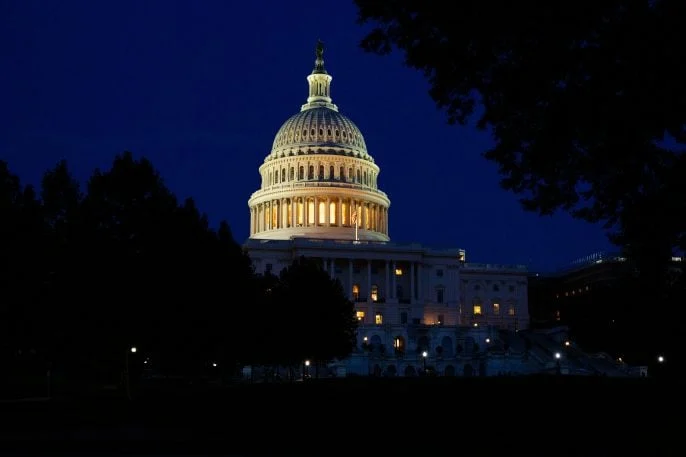
The United States Senate’s momentum toward establishing a comprehensive regulatory framework for digital assets has encountered a significant procedural and political impasse following the rejection of specific ethics language by Democratic lawmakers. The Clarity Act, a centerpiece of bipartisan efforts to regulate the burgeoning stablecoin and digital asset markets, is currently stalled as negotiators grapple with provisions aimed at governing the financial conduct of high-ranking federal officials, most notably President Donald Trump. This legislative friction, reported initially on Thursday, highlights a deep-seated philosophical divide regarding enforcement authority and the intersection of private enterprise and public office in the age of decentralized finance.
At the heart of the disagreement is a suite of ethics rules released on Wednesday as part of an updated version of the Clarity Act. These provisions were designed to prohibit the President, Vice President, and other senior federal officials from issuing, sponsoring, or maintaining direct ownership stakes in digital assets while serving in office. While both parties ostensibly agree on the need for such guardrails—particularly in light of President Trump’s public involvement in crypto-related ventures—the mechanism for enforcing these rules has become a non-negotiable sticking point. The current proposal, heavily influenced by the White House and Republican Senators Cynthia Lummis and Bernie Moreno, grants the Department of Justice (DOJ) exclusive authority to investigate and prosecute violations of these ethics rules. Democrats, led by Senator Ruben Gallego, have dismissed this framework as fundamentally flawed, arguing that centralizing enforcement within the executive branch creates an inherent conflict of interest and lacks the necessary checks and balances provided by state-level oversight.
The Evolution of the Clarity Act and the Ethics Mandate
The Clarity Act was originally conceived as a bipartisan solution to the regulatory "gray zone" inhabited by stablecoins—digital assets pegged to the value of a fiat currency, such as the U.S. dollar. For years, federal regulators including the Securities and Exchange Commission (SEC) and the Commodity Futures Trading Commission (CFTC) have sparred over jurisdictional boundaries, leaving issuers like Circle (USDC) and Tether (USDT) to operate under a patchwork of state-level money transmitter licenses. The Act seeks to establish federal standards for reserves, transparency, and operational security, effectively bringing stablecoin issuers into the fold of the traditional financial system.
However, the bill’s scope expanded significantly during the 2024 legislative session. As digital assets became a more prominent fixture in the national political discourse, lawmakers recognized that the existing Ethics in Government Act of 1978 was ill-equipped to handle the nuances of blockchain-based assets. The emergence of "celebrity coins," non-fungible tokens (NFTs), and decentralized finance (DeFi) platforms associated with political figures necessitated a more robust ethical framework.
The specific focus on the presidency intensified following President Trump’s pivot toward the crypto industry. Unlike previous administrations that maintained a skeptical distance from digital assets, the current administration has actively engaged with the sector. Trump’s involvement in various NFT collections and his reported links to "World Liberty Financial," a crypto-lending platform, have raised concerns among ethics watchdogs regarding potential "pay-to-play" scenarios or the use of executive power to influence the market value of personal holdings.
Chronology of the Legislative Stumble
The path to the current stalemate can be traced through a series of high-stakes negotiations over the early summer months:
- May 2024: Senators Cynthia Lummis (R-WY) and Kirsten Gillibrand (D-NY) re-introduce core components of their landmark crypto bill, focusing on stablecoin reserve requirements.
- June 2024: The White House enters the fray, signaling that any bill reaching the President’s desk must include stringent ethics provisions to prevent conflicts of interest within the executive branch.
- Early July 2024: Senators Lummis and Bernie Moreno (R-OH) begin private consultations with White House legal counsel to draft the ethics language. This "Gang of Three" approach aims to create a gold standard for presidential ethics in the digital age.
- July 22, 2024: The updated Clarity Act is circulated among members of the Senate Banking Committee. The language includes the "DOJ-only" enforcement clause.
- July 23, 2024: Senator Ruben Gallego (D-AZ) publicly denounces the proposal. Negotiations break down over the exclusion of State Attorneys General from the enforcement process.
- July 24, 2024: Senate Majority Leader John Thune (R-SD) acknowledges the delay, indicating that a vote before the August recess is now unlikely.
The Enforcement Debate: Federalism vs. Executive Control
The primary catalyst for the current deadlock is the role of State Attorneys General. In traditional consumer protection and financial fraud cases, state-level officials often act as a secondary layer of enforcement, providing a "cop on the beat" when federal agencies are either stretched thin or politically constrained. Senator Gallego and his Democratic colleagues argue that by giving the DOJ exclusive authority, the bill effectively allows an administration to police itself.
"The proposal in its current form is a piece of shit," Gallego reportedly told colleagues, expressing frustration that months of bipartisan labor were discarded in favor of a White House-dictated mandate. His argument rests on the principle that the DOJ is an executive agency headed by a political appointee—the Attorney General. If a President were to violate the Clarity Act’s ethics rules, the decision to prosecute would rest with their own subordinate, creating a structural barrier to accountability.
Conversely, Senator Lummis has defended the White House-backed language as a historic step forward. She maintains that the proposed rules are the "toughest ever applied to the presidency" and that centralized federal enforcement ensures a uniform application of the law, preventing a "patchwork" of politically motivated lawsuits from various state capitals. Lummis argued that Trump is "voluntarily embracing" these standards, which go beyond current legal requirements for divesting assets.
Supporting Data: The Scale of the Digital Asset Market
The urgency of the Clarity Act is underscored by the sheer scale of the assets it seeks to regulate. According to data from CoinMarketCap and Glassnode, the total market capitalization of stablecoins exceeds $160 billion as of mid-2024. Tether (USDT) remains the dominant player with a market cap of approximately $112 billion, followed by Circle’s USDC at $33 billion.
The lack of a federal framework has several measurable impacts:
- Capital Flight: Industry analysts estimate that approximately 20% of crypto-related venture capital has shifted toward the European Union following the implementation of the Markets in Crypto-Assets (MiCA) regulation.
- Banking Fragility: Without federal oversight, stablecoin issuers often struggle to maintain stable banking relationships, leading to the type of liquidity "de-pegging" events seen during the Silicon Valley Bank collapse in early 2023.
- Consumer Risk: The CFTC reports that crypto-related scams and fraudulent schemes resulted in over $4 billion in losses for American consumers in the previous fiscal year, a figure that advocates of the Clarity Act believe would decrease with clearer regulatory oversight.
Bipartisan Counterproposals and the Path Forward
Despite the heated rhetoric, some senators are attempting to find a middle ground. Senator Thom Tillis (R-NC), a member of the Senate Banking Committee, has emerged as a key mediator. While he described the White House-backed proposal as a "positive starting point," he acknowledged that the bill cannot pass without Democratic support in a chamber that requires 60 votes to overcome a filibuster.
Tillis is currently working with Gallego and a small group of Republican senators to draft a counterproposal. This revised language is expected to include a "shared enforcement" model, where the DOJ retains primary jurisdiction but State Attorneys General are granted the right to intervene if federal authorities fail to act within a specific timeframe. This "backstop" provision is common in other financial regulations, such as the Dodd-Frank Act, and could serve as the bridge needed to secure a bipartisan majority.
However, the timeline is working against the bill’s proponents. Senate Majority Leader John Thune’s admission that the bill will likely miss the August recess means the legislation will face the "lame duck" period following the November elections. During this time, legislative priorities often shift, and the political appetite for complex regulatory reform may wane.
Analysis of Implications for the Digital Asset Industry
The delay in passing the Clarity Act has broader implications for the U.S. economy and the global standing of the dollar. As other jurisdictions—including Hong Kong, Singapore, and the United Kingdom—solidify their crypto regulations, the U.S. risks losing its influence over the technical standards of the next generation of financial infrastructure.
Furthermore, the specific focus on presidential ethics highlights a growing trend in American governance: the "financialization" of political influence. If the Clarity Act fails to address these concerns effectively, it could set a precedent where future leaders leverage decentralized platforms to bypass traditional financial disclosures and conflict-of-interest laws.
For the crypto industry, the stalemate is a double-edged sword. On one hand, many firms are eager for the legitimacy that federal regulation provides. On the other, the inclusion of highly politicized ethics provisions threatens to turn a technical financial bill into a partisan proxy war. Industry lobbyists from groups like the Blockchain Association and the Chamber of Digital Commerce have urged lawmakers to decouple the ethics language from the core stablecoin provisions, though such a move seems unlikely given the White House’s insistence on the current package.
Conclusion
The standoff over the Clarity Act represents a microcosm of the broader challenges facing the 118th Congress. What began as a technical effort to stabilize a volatile financial sector has been subsumed by the complexities of executive ethics and the ongoing tension between federal and state power. As Senator Tillis and Senator Gallego attempt to bridge the gap, the eyes of the digital asset world remain fixed on Washington. The outcome of these negotiations will not only determine how stablecoins are regulated in the United States but will also define the ethical boundaries for the highest office in the land in an increasingly digitized economy. Without a compromise that satisfies the 60-vote threshold, the "clarity" sought by the industry may remain elusive for another legislative cycle.














