
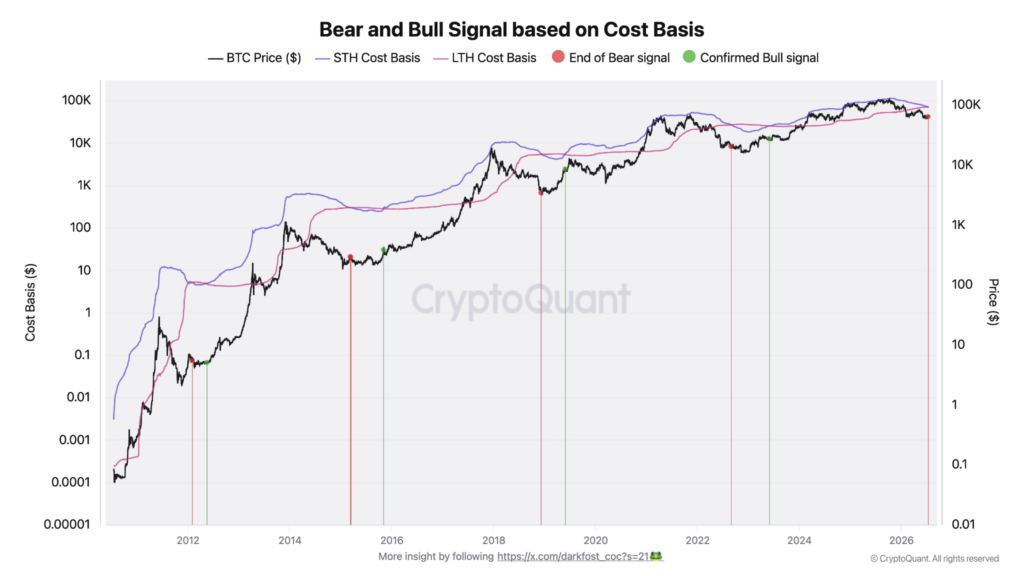
On-chain indicators are pointing towards a potential turning point for Bitcoin, suggesting that the prolonged nine-month bear market may be approaching its conclusion. A prominent crypto analyst, known as Darkfost, recently highlighted a significant development observed through on-chain data: a downward crossover of the cost basis between Short-Term Holders (STH) and Long-Term Holders (LTH). This event, confirmed over a reliable three-day period, is being interpreted by some as a strong signal for the end of the current bearish cycle.
Darkfost elaborated on this crucial observation in a recent social media post, stating, "The end-of-bear-market signal has just flashed. This signal is defined by the downward crossover of the STH/LTH cost basis (with a 3-day confirmation window to validate the signal)." This technical event, when analyzed within the context of Bitcoin’s historical market cycles, carries considerable weight among cryptocurrency market watchers.
Understanding the Short-Term Holder (STH) and Long-Term Holder (LTH) Cost Basis
To fully appreciate the significance of this signal, it is essential to understand the metrics involved. The cost basis for both Short-Term Holders (STH) and Long-Term Holders (LTH) represents the average price at which these respective groups acquired their Bitcoin.
- Short-Term Holders (STH): These are investors who have held their Bitcoin for less than 155 days. Their behavior is often considered more reactive to market sentiment and short-term price fluctuations. When the STH cost basis falls, it indicates that newer market participants are buying Bitcoin at lower average prices, potentially absorbing selling pressure.
- Long-Term Holders (LTH): These are investors who have held their Bitcoin for longer than 155 days. Their acquisition costs are generally higher due to longer holding periods, and their selling behavior is often seen as more indicative of conviction in the long-term value of Bitcoin. When the LTH cost basis is stable or rising, it suggests holders are less inclined to sell at current prices.
The crossover of these two metrics is a key area of focus for analysts. A downward crossover of the STH cost basis below the LTH cost basis signifies that recent buyers are acquiring Bitcoin at prices lower than the average acquisition price of long-term holders. This can indicate capitulation by earlier investors or a strategic entry point for new participants, effectively lowering the overall average cost for a significant portion of the market.
The Significance of the Recent Crossover
The graph shared by Darkfost illustrates a dramatic shift in the STH cost basis. According to the data presented, the STH cost basis has seen a substantial decline, plummeting from a peak of approximately $112,500 to around $69,000. This significant drop suggests that a considerable number of investors who entered the market more recently have done so at substantially lower prices.
This downward trend in the STH cost basis, culminating in its overlap with the LTH cost basis, is a pivotal moment. It implies that the average buying price of recent market participants has fallen below that of those who have held Bitcoin for a longer duration. The graph even suggests that the STH cost basis could potentially dip further below the LTH cost basis in the coming months, a scenario that has historically preceded significant market recoveries.

The overlap between the cost bases of LTHs and STHs is not an immediate indicator of the bear market’s end, but rather its "terminal phase." This suggests that the conditions are becoming ripe for a potential bottoming out. It signals that the intense selling pressure characteristic of a bear market might be abating, and the market is entering a phase where accumulation could begin to outweigh distribution.
Historical Context and Market Cycles
Bitcoin’s price action has historically exhibited cyclical behavior, often influenced by events such as halving halvings (which reduce the rate of new Bitcoin creation) and shifts in macroeconomic sentiment. The current nine-month bear market began after Bitcoin reached its all-time high in late 2021. The subsequent period has been characterized by significant price corrections, driven by factors including rising inflation, aggressive interest rate hikes by central banks, and broader concerns about the global economic outlook.
Previous bear markets have seen similar on-chain metrics flash bullish signals, often preceding sustained upward trends. The STH/LTH cost basis crossover is one such metric that analysts closely monitor for signs of a potential trend reversal. While past performance is not indicative of future results, the historical correlation between such on-chain events and subsequent bull runs provides a degree of confidence for some investors.
For instance, during the bear market of 2018-2019, a similar convergence and eventual divergence of these cost bases preceded the significant rally in 2020. The current situation, with the STH cost basis falling to $69,000, suggests that new entrants are acquiring Bitcoin at prices that were previously considered historical support levels.
The Role of Dollar Cost Averaging (DCA)
The current market conditions, characterized by the terminal phase of the bear market and the potential for price stabilization, are also seen as favorable for Dollar Cost Averaging (DCA) strategies. DCA involves investing a fixed amount of money at regular intervals, regardless of the asset’s price. This approach can help mitigate risk by averaging out the purchase price over time, especially in volatile markets.
With the STH cost basis indicating that lower entry points are available, a DCA strategy could allow new and existing investors to gradually build their positions at a more favorable average cost. This disciplined approach to accumulation can be particularly effective during periods of uncertainty and potential price consolidation.
Future Outlook and Potential Scenarios
Looking ahead, analysts anticipate that Bitcoin will likely establish a bottom in the near future and then consolidate around that level. There is a divergence of opinion regarding the possibility of further significant price drops. Some market participants believe that the current lows around $58.5k are unlikely to be breached, while others argue that further downside may be necessary before a definitive bottom can be declared.
The STH and LTH cost levels are expected to remain closely aligned for a period. A subsequent upward crossover, where the STH cost basis once again rises above the LTH cost basis, would serve as a strong confirmation of a new bull market’s onset. However, this confirmation is not expected to be immediate. Historical data suggests that such a divergence could take months, or even over a year, to materialize.
Market Maturation and Cyclical Behavior
Despite the ongoing debate about Bitcoin’s long-term price trajectory, the current on-chain signals underscore the asset’s growing maturity. The cyclical investor behavior, a hallmark of Bitcoin’s history, appears to be enduring. While some critics have posited that the traditional four-year market cycles, often linked to Bitcoin’s halving events, are becoming obsolete, the current metrics suggest that these fundamental rhythms may still be at play.
The fact that the STH cost basis has fallen so significantly, and is now intersecting with the LTH cost basis, indicates that even during a prolonged downturn, the core principles of supply and demand, investor psychology, and accumulation strategies continue to shape the market. The current signals, if they lead to a sustained recovery, would reinforce the notion that Bitcoin, despite its volatility and the evolving regulatory landscape, remains subject to observable market dynamics.
The potential for a shift from a bearish to a bullish trend is a critical development for investors and the broader cryptocurrency ecosystem. The coming months will be crucial in observing whether these on-chain indicators translate into a tangible recovery for Bitcoin’s price and a renewed period of growth for the digital asset market. The focus will remain on these key metrics, alongside broader market sentiment and macroeconomic factors, to ascertain the true end of the current bear market and the dawn of the next bull cycle.