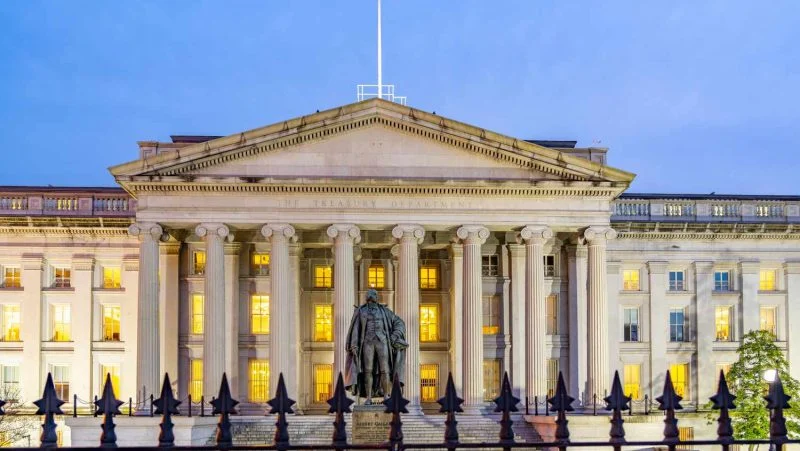
The United States Department of the Treasury has officially unveiled a detailed set of proposed regulations aimed at clarifying the oversight of the rapidly evolving stablecoin market, marking a significant milestone in the federal government’s effort to integrate digital assets into the national financial system. Released on Monday, the Notice of Proposed Rulemaking (NPRM) provides the first granular look at how the Treasury intends to enforce Section 3 of the "Generating Enhanced National Infrastructure and United States Security" (GENIUS) Act. This legislative framework, which was signed into law in July 2025, seeks to bring transparency, stability, and federal oversight to payment stablecoins—digital assets designed to maintain a stable value relative to the U.S. dollar.
The newly proposed rules focus specifically on defining the jurisdictional boundaries of the GENIUS Act, articulating the precise conditions under which a payment stablecoin is considered to be "issued in the United States" and identifying when a digital asset platform is deemed to be "offering or selling" such assets to domestic users. By establishing these definitions, the Treasury aims to close regulatory loopholes that have historically allowed offshore entities to operate within the U.S. market without adhering to federal safety and soundness standards. The proposal is slated for formal publication in the Federal Register on August 18, triggering a 60-day public comment period during which industry stakeholders, legal experts, and the public can provide feedback on the technical and economic implications of the framework.
Defining Domestic Issuance and Jurisdictional Reach
At the heart of the Treasury’s proposal is a rigorous definition of what constitutes domestic activity in the decentralized world of crypto-assets. Under the proposed rules, a stablecoin is generally classified as being issued in the United States if the issuing entity is physically located within the country at the time of the token’s creation. For individual issuers, the Treasury will rely on physical presence as the primary determinant. For corporate entities, the criteria include U.S. incorporation or the maintenance of a principal place of business within the United States.
However, the proposal extends its reach beyond just the location of the issuer. A stablecoin will also be considered "issued in the U.S." if it is issued to any person or entity located within the country, regardless of where the issuer’s headquarters are situated. This "recipient-based" jurisdiction ensures that foreign companies cannot circumvent U.S. laws simply by operating from offshore jurisdictions while actively servicing the American market.
To provide a degree of regulatory clarity for legitimate international operations, the Treasury has included a "safe harbor" provision for foreign issuers. An offshore entity can avoid being classified as a U.S. issuer if it meets three specific criteria: first, it must maintain a "reasonable belief" that its recipients are located outside the United States; second, it must implement and maintain robust internal controls—such as geofencing and identity verification—designed to prevent issuance to U.S. persons; and third, it must refrain from targeting U.S. users through advertising, social media campaigns, or direct solicitation.
The Role of Digital Asset Service Providers (DASPs)
The Treasury’s proposal also places a significant compliance burden on Digital Asset Service Providers (DASPs), a category that includes centralized exchanges, brokerage firms, and certain liquidity providers. Starting July 18, 2028, these platforms will be strictly prohibited from offering or selling stablecoins to U.S.-based customers unless the tokens are issued by a "permitted payment stablecoin issuer" or a "qualifying foreign issuer."
A "permitted issuer" is defined as an entity that has received specific authorization under the federal or state regulatory frameworks established by the GENIUS Act. This requirement effectively mandates that exchanges act as gatekeepers, ensuring that only regulated, reserve-backed stablecoins are accessible to the American public. To assist platforms in navigating these rules, the Treasury’s proposal outlines several examples of activities that would constitute "offering or selling" in the U.S. These include:
- Directly soliciting U.S. users via email or targeted digital ads.
- Explicitly stating in promotional materials that a stablecoin is available for U.S. residents.
- Responding to purchase inquiries or providing customer support to individuals located in the country.
- Providing tools or instructions that help users bypass location-based restrictions, such as Virtual Private Networks (VPNs) or IP address obfuscation techniques.
Similar to the rules for issuers, DASPs can receive protection from enforcement actions if they can demonstrate that they reasonably believed a customer was outside the U.S. and maintained diligent controls to prevent domestic sales.
Reserve Requirements and the GENIUS Act Foundation
The GENIUS Act itself, which serves as the statutory foundation for these rules, was born out of a multi-year effort by Congress to prevent the kind of systemic instability seen during the 2022 collapse of various algorithmic stablecoins. The law requires all permitted payment stablecoins to maintain reserves backing their outstanding tokens on a strict one-to-one basis.
To ensure liquidity and safety, the Act limits eligible reserve assets to high-quality, liquid instruments. These include physical U.S. currency, insured bank deposits, and short-term Treasury securities. By mandating these specific assets, the law aims to eliminate the "run risk" associated with stablecoins backed by riskier corporate debt or other volatile cryptocurrencies. The Treasury’s new proposal reinforces these requirements by ensuring that any entity—domestic or foreign—wishing to access the U.S. market must prove their technological and financial capability to maintain these reserves and comply with lawful U.S. orders, including asset freezes or seizures mandated by the judicial system.
A Chronology of Implementation
The implementation of the GENIUS Act is structured as a multi-stage rollout to allow the industry time to transition to the new standards. The timeline is as follows:
- July 2025: The GENIUS Act is signed into law, establishing the legal requirement for one-to-one reserves.
- April 2026: The Treasury, the Financial Crimes Enforcement Network (FinCEN), and the Office of Foreign Assets Control (OFAC) propose initial rules regarding Anti-Money Laundering (AML) and sanctions compliance for stablecoin issuers.
- August 18, 2026: The current Notice of Proposed Rulemaking regarding Section 3 is published in the Federal Register.
- October 2026: The 60-day public comment period for the Section 3 rules concludes.
- January 18, 2027: The GENIUS Act takes full effect. From this date, unauthorized issuance of payment stablecoins in the U.S. becomes illegal.
- July 18, 2028: The prohibition on DASPs offering non-compliant stablecoins to U.S. users goes into effect, marking the final phase of the transition.
Exemptions and Technical Nuances
Recognizing the decentralized nature of blockchain technology, the Treasury has carved out certain exemptions to ensure that the rules do not inadvertently stifle innovation or infringe on personal financial privacy. The proposal exempts direct, peer-to-peer transfers between individuals that do not involve an intermediary service provider. Furthermore, transactions involving "self-custody wallets"—where users maintain total control over their private keys—are generally exempt from the Section 3 prohibitions, provided they are not part of a commercial offering or sale by a regulated entity.
However, the Treasury remains cautious about more complex decentralized finance (DeFi) mechanisms. The department is actively seeking industry feedback on how the framework should apply to several technical areas that remain in a "gray zone," including:
- Airdrops: The distribution of free tokens to wallet holders.
- Stablecoin Buybacks: Programs where issuers purchase their own tokens from the secondary market.
- Wrapped Tokens: Assets that represent a stablecoin on a different blockchain (e.g., Wrapped USDC).
- Blockchain Bridges: Protocols that allow assets to move between disparate networks.
- Market Makers: Entities that provide liquidity to exchanges and may inadvertently facilitate sales to U.S. users.
Analysis of Market Implications and Official Responses
The Treasury’s proposal has already begun to draw reactions from both the financial sector and the digital asset industry. Proponents of the rules argue that the clarity provided by the GENIUS Act will finally allow institutional investors, such as pension funds and insurance companies, to enter the stablecoin space with confidence. By codifying what it means to be a "permitted issuer," the government is essentially creating a "blue-chip" class of digital assets that are as safe as traditional money market funds.
"This is the ‘rules of the road’ moment the industry has been waiting for," noted one senior policy analyst. "By defining the perimeter of U.S. jurisdiction so clearly, the Treasury is telling the world that if you want to touch the U.S. financial system, you must play by U.S. rules. It effectively ends the era of ‘regulation by enforcement’ and replaces it with a predictable statutory framework."
Conversely, some critics within the crypto community express concern that the requirements for foreign issuers to have the "technological capability to comply with lawful U.S. orders" could compromise the censorship-resistant nature of decentralized protocols. There are also fears that the 2028 deadline for service providers could lead to a "great delisting," where popular but non-compliant stablecoins are purged from U.S. exchanges, potentially causing short-term liquidity shocks.
The broader impact of these rules is expected to be a consolidation of the stablecoin market. Currently dominated by a few major players like Tether (USDT) and Circle (USDC), the market may see a shift toward issuers that can most easily demonstrate compliance with the Treasury’s reserve and jurisdictional requirements. For foreign-based issuers, the choice will be stark: either implement rigorous geofencing to block U.S. users entirely or undergo the rigorous process of becoming a "qualifying foreign issuer" subject to U.S. oversight.
As the August 18 publication date approaches, the digital asset industry is preparing for a period of intense legal and technical scrutiny. The Treasury’s move represents one of the most ambitious attempts by any global superpower to bring the "Wild West" of stablecoins under the umbrella of federal law, ensuring that the future of digital payments is built on a foundation of transparency and consumer protection.