


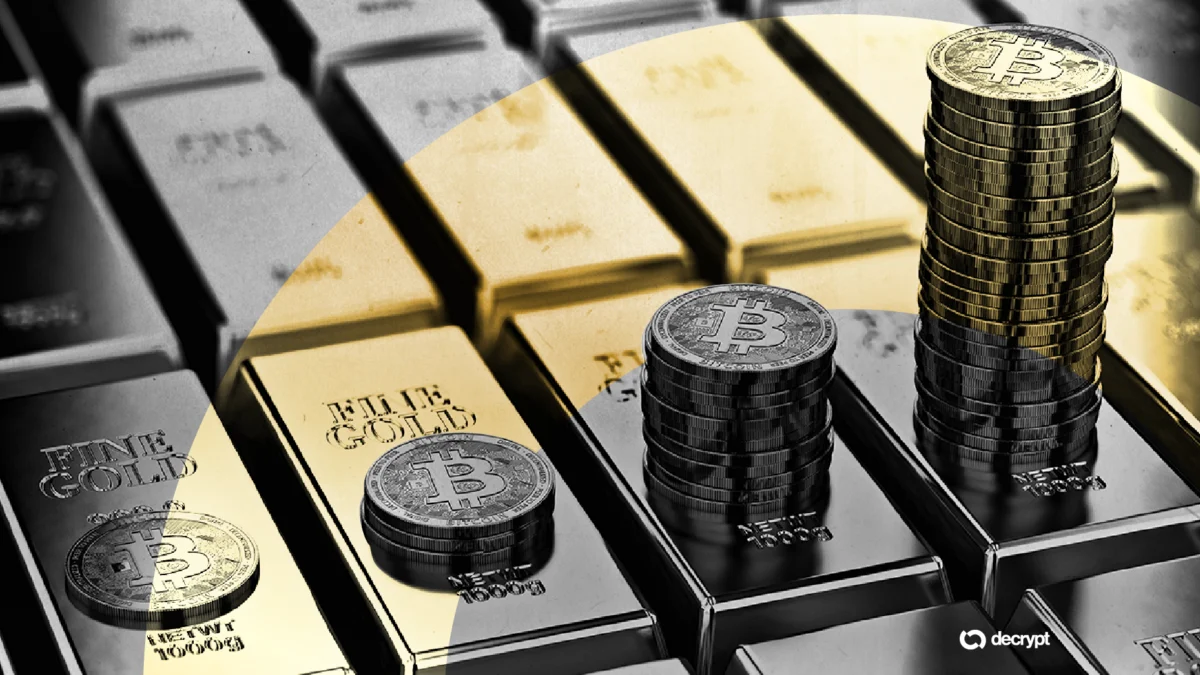
Gold prices surged to a three-month high on Tuesday, extending a robust August rally that has seen the precious metal reclaim significant ground. Simultaneously, Bitcoin experienced a parallel ascent, breaking above the $80,000 mark for the first time since mid-May. This dual rally in both traditional and digital "hard assets" is largely attributed to a weakening U.S. dollar and a decline in Treasury yields, macroeconomic factors that have historically bolstered demand for store-of-value assets amidst growing market uncertainty.
The Gold Resurgence: A Deep Dive into Market Dynamics
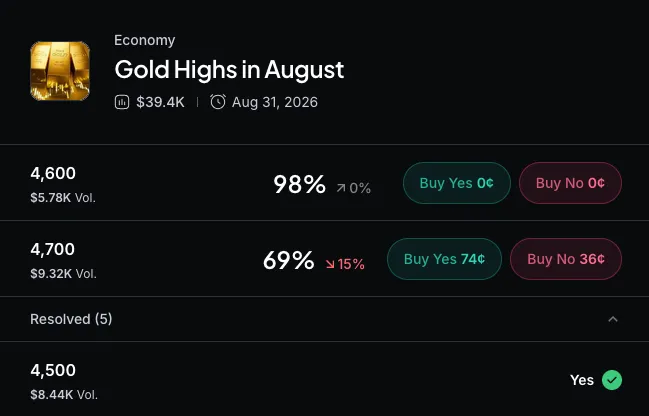
Spot gold reached an impressive $4,696.18 per ounce, marking its highest valuation since May 14 before experiencing a slight pullback. This upward trajectory represents a significant turnaround for gold, which had faced headwinds earlier in the year. The resurgence is rooted in a confluence of macroeconomic developments that have collectively enhanced gold’s appeal as a safe haven and inflation hedge.
Macroeconomic Tailwinds: The Dollar and Yields
At the core of gold’s rally are the movements in the U.S. dollar and Treasury yields. A weaker dollar makes gold, which is priced in the U.S. currency, more affordable for international buyers holding other currencies, thereby stimulating demand. The dollar’s recent depreciation has been a direct consequence of shifting expectations regarding the Federal Reserve’s monetary policy and broader economic indicators. Markets are increasingly pricing out the likelihood of further interest rate hikes by the Fed, particularly a September increase, as incoming economic data, albeit influenced by seasonal factors and significant global events like the World Cup, has shown signs of softening. This softer data eases concerns about aggressive monetary tightening, which typically strengthens the dollar and weighs on gold.
Furthermore, falling Treasury yields reduce the opportunity cost of holding non-yielding assets like gold. When bond yields are high, investors can earn attractive returns from fixed-income securities, making gold less appealing. However, as yields decline, the relative attractiveness of gold as a store of value increases. The recent drop in yields has made gold a more competitive investment, especially for those seeking protection against currency debasement or inflation.
The Treasury’s Role: Bond Buybacks and Their Impact
A significant catalyst for gold’s recent surge was the U.S. Treasury Department’s expansion of bond buybacks last week. Bond buybacks, where the Treasury repurchases its own debt from the open market, are typically conducted to improve market liquidity and manage the maturity profile of outstanding debt. However, an expansion of such programs can also be interpreted by markets as a form of quantitative easing, signaling a potentially more accommodative fiscal stance. This action tends to inject liquidity into the financial system, putting downward pressure on bond yields and, consequently, on the dollar.
Following the Treasury’s announcement, gold experienced a notable jump of 3%, according to a recent report by the World Gold Council (WGC). This immediate reaction underscores the market’s sensitivity to government fiscal policy and its implications for currency strength and interest rates. The WGC report further highlighted that "Commodity Trading Advisor (CTA) positioning in Treasury futures is still very short, and a reversal could reinforce downward pressure on yields and an already softer dollar—adding further support to the nascent recovery in gold since the beginning of the month." This indicates that if these large speculative traders begin to unwind their short positions, the downward pressure on yields and the dollar could intensify, providing additional impetus for gold prices.
Investor Sentiment: The Reversal in Gold ETFs
Beyond the immediate macroeconomic shifts, investor sentiment towards gold has demonstrably improved. The World Gold Council reported that global gold-backed exchange-traded funds (ETFs) recorded a substantial $3 billion in net inflows during July. This marked a crucial reversal after two consecutive months of outflows, signaling renewed investor confidence in the precious metal.
The detailed breakdown of these inflows reveals a broad-based recovery in demand:
- Holdings increased by 23 metric tons, bringing the total to 4,068 tons globally.
- Assets under management (AUM) rose by 1% to $530 billion.
- European funds led the charge with $2 billion in inflows, indicating strong institutional and retail interest across the continent.
- Asian funds followed with $616 million in inflows, reflecting robust regional demand.
- North American funds also contributed positively with $71 million in inflows, albeit at a more modest pace.
This widespread return of investors to gold ETFs suggests a collective belief that the asset’s four-month losing streak, which ended in July with a roughly 2% gain, is now firmly behind it. The rally further accelerated in August, fueled not only by the aforementioned fiscal policy changes but also by heightened geopolitical tensions, specifically cited as "the end of the U.S.-Iran ceasefire," which added to global uncertainty and enhanced gold’s traditional role as a safe haven.
Bitcoin’s Parallel Ascent: A Digital Hedge Emerges
In a striking parallel to gold’s performance, Bitcoin also experienced a significant rally, climbing above $80,000 for the first time since mid-May and briefly touching $81,237 before consolidating some of its gains. This synchronized movement with gold underscores an evolving narrative around Bitcoin, increasingly positioning it as a "digital gold" or an alternative hedge against traditional financial instability.
Breaking Resistance: Bitcoin’s Milestone
Bitcoin’s breach of the $80,000 psychological barrier is a critical technical and sentiment milestone. After a period of consolidation and volatility, this surge signals renewed bullish momentum and potentially a broader market acceptance of cryptocurrency as a legitimate asset class. The rally mirrors gold’s trajectory, benefiting from similar macroeconomic drivers, particularly the weakening dollar.
The Digital Gold Narrative: Shared Drivers, Distinct Characteristics
While gold has historically served as a haven during periods of economic and geopolitical uncertainty, Bitcoin is increasingly being traded as an alternative to government-issued fiat currencies. Both assets are seen as hedges against inflation and currency debasement, but they appeal to slightly different investor demographics and risk appetites. Gold’s millennia-long history as a store of value offers unparalleled stability, while Bitcoin, despite its volatility, offers decentralization, a fixed supply, and ease of digital transfer, characteristics that resonate strongly with a new generation of investors.
The correlation observed between gold and Bitcoin in the current market environment suggests that investors are increasingly viewing both as viable options for preserving wealth when traditional currencies and government bonds appear less attractive. This trend highlights a growing convergence in how certain market participants perceive the roles of these fundamentally different assets.
The "Hard Asset" Correlation: Expert Insights and Nuances
The simultaneous rise of gold and Bitcoin amidst a weakening dollar presents an intriguing dynamic that financial analysts are closely examining. Jake Kennis, a senior research analyst at Nansen, offered valuable insight into this phenomenon, stating, "BTC and gold rising together while the dollar weakens is consistent with debasement and fiscal-credibility concerns, i.e., the classic ‘hard asset’ hedge trade."
Kennis’s observation points to a core tenet of macroeconomics: when investors lose confidence in the purchasing power of fiat currencies (debasement) or the stability of government finances (fiscal-credibility concerns), they often turn to assets with intrinsic value or limited supply. Gold, with its finite nature and historical track record, is the quintessential hard asset. Bitcoin, with its programmed scarcity and decentralized structure, embodies many of these same characteristics in the digital realm.
However, Kennis also added a crucial nuance, cautioning that "a weaker dollar alongside elevated yields can also reflect higher term premium, inflation uncertainty, or changing growth expectations rather than a pure loss of faith in Treasuries, so the correlation is suggestive rather than proof as of now." This highlights the complexity of interpreting market movements. While the "hard asset" hedge theory is compelling, other factors could be at play. A higher term premium, for example, could indicate that investors demand greater compensation for holding long-term bonds due to future inflation expectations or economic uncertainty. Changing growth expectations might lead investors to rotate out of certain asset classes, affecting both the dollar and yields. Therefore, while the correlation between gold and Bitcoin is strong and indicative, it is part of a broader, multi-faceted market narrative.
Broader Implications and Future Outlook
The current rallies in gold and Bitcoin carry significant implications for investors, market analysts, and policymakers.
Investment Strategy Shifts: The synchronized ascent of these assets could prompt a re-evaluation of diversification strategies. Investors looking for hedges against inflation, currency volatility, and geopolitical risks may increasingly allocate portions of their portfolios to both traditional and digital hard assets. This trend reinforces the idea that in an increasingly uncertain global economic landscape, a diversified approach that includes both established safe havens and emerging digital alternatives could offer enhanced resilience.
Geopolitical and Fiscal Uncertainty: The World Gold Council explicitly linked the August rally’s acceleration to "the end of the U.S.-Iran ceasefire" and "expanded U.S. Treasury bond buybacks." These events underscore how geopolitical tensions and government fiscal policies directly feed into market uncertainty, driving demand for assets perceived as stable stores of value. The ongoing geopolitical instability in various regions, combined with burgeoning national debts and expansionary fiscal policies in major economies, could sustain this demand in the foreseeable future.
The Federal Reserve’s Balancing Act: The market’s anticipation of the Federal Reserve largely "pricing out a September Fed hike" is a critical factor. The Fed’s future decisions on interest rates and quantitative easing (or tightening) will continue to heavily influence the dollar’s strength and Treasury yields, thereby dictating much of the near-term trajectory for gold and Bitcoin. Any unexpected shift in the Fed’s stance could trigger significant market reactions, potentially reversing current trends. The delicate balancing act between controlling inflation, supporting economic growth, and maintaining financial stability will remain a central theme for global markets.
Challenges and Volatility: While the current rallies are impressive, both gold and Bitcoin remain subject to market volatility. Gold’s price can be influenced by mining supply, industrial demand, and central bank purchases, in addition to investment demand. Bitcoin, as a newer asset class, carries inherent risks related to regulatory scrutiny, technological developments, and broader market sentiment swings. Investors must remain cognizant that past performance is not indicative of future results and that significant pullbacks can occur even during periods of strong rallies.
In conclusion, the simultaneous surge of gold and Bitcoin to multi-month highs is a compelling narrative of financial markets adapting to an era of shifting macroeconomic paradigms. Driven by a weaker U.S. dollar, falling Treasury yields, and heightened geopolitical and fiscal uncertainties, investors are increasingly turning to both traditional and digital "hard assets" as reliable hedges. While the fundamental drivers and investor profiles for each asset retain distinct characteristics, their synchronized performance suggests a growing recognition of their shared role in preserving wealth amidst a complex and evolving global economic environment. The ongoing interplay between central bank policies, government fiscal actions, and global events will continue to shape the trajectory of these pivotal assets in the months to come.














