
Bitcoin (BTC) is exhibiting resilience, trading with notable strength after achieving a recent high and consolidating its gains. Over the preceding seven days, the world’s largest cryptocurrency by market capitalization has surged by approximately 25%, climbing from the $62,700 mark to touch $79,500. This sharp rebound has surprised many market participants and analysts, prompting a closer examination of the underlying factors driving this upward momentum.
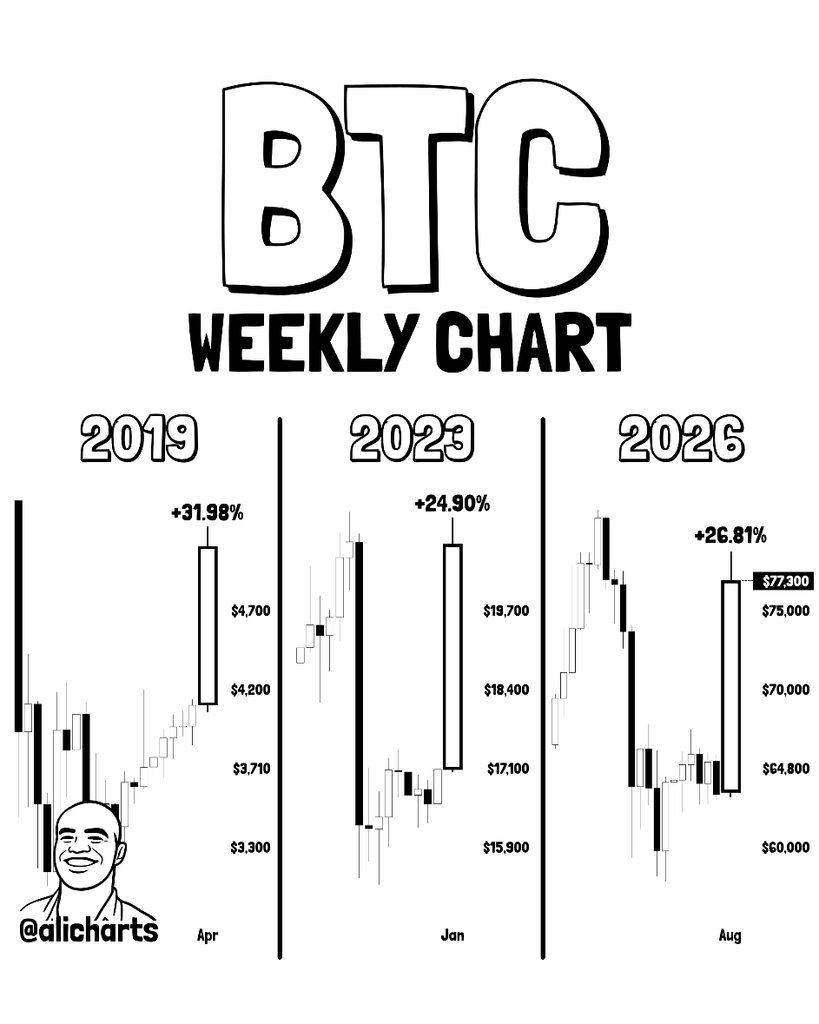
The magnitude and velocity of this recent ascent have drawn parallels to significant market cycles in Bitcoin’s history. Analyst Ali Martinez, a prominent voice in the cryptocurrency space, has highlighted two prior instances where substantial weekly rallies occurred near the conclusion of major bear markets. In 2019, Bitcoin experienced a weekly gain of around 32% as the market began to pivot away from a prolonged downturn. A similar pattern emerged in January 2023, when Bitcoin posted a nearly 25% increase within a single week, a surge that followed the dramatic collapse of the FTX exchange and a period of widespread pessimism across the crypto landscape.
Martinez suggests that Bitcoin’s latest weekly increase of 26.81% could represent a recurrence of this phenomenon. He posits that aggressive short positioning among traders may have played a crucial role in fueling the rally. As prices rose, bearish traders who had bet on a decline were compelled to close their losing positions by buying Bitcoin, thereby adding further buying pressure to the market and accelerating the upward trajectory.

"If history repeats, this type of powerful weekly reversal could be an early sign that BTC has entered a new bullish cycle," Martinez stated in a recent analysis shared on social media. This perspective is significant as it implies that the current price action might not be a mere temporary bounce but a foundational move for a sustained uptrend.
Historical Precedents and Market Cycles
The cryptocurrency market is often characterized by its cyclical nature, with periods of intense bull markets followed by prolonged bear markets. The "four-year cycle," often linked to Bitcoin’s halving events (scheduled reductions in the rate at which new bitcoins are created), has historically served as a significant indicator for market tops and bottoms. However, the current rally has defied some expectations of a delayed bottom formation later in the year. Instead of consolidating at lower levels or forming a traditional bottoming pattern, Bitcoin has executed a decisive breakout from the $62,700 level, reaching an impressive $79,500.
The 2019 rally, occurring in the aftermath of a substantial bear market that followed the 2017 all-time highs, saw Bitcoin climb from approximately $3,200 to over $13,000 in a matter of months. While the current rally is within a different context, the pattern of a strong weekly surge preceding a broader recovery is a compelling point of comparison. Similarly, the January 2023 rally, which saw Bitcoin rise from around $16,000 to over $20,000 in a week, occurred when the market was still reeling from the FTX implosion and facing significant regulatory uncertainty. This demonstrated the market’s capacity for sharp recoveries even in the face of overwhelming negative sentiment.
Technical Indicators and Market Structure
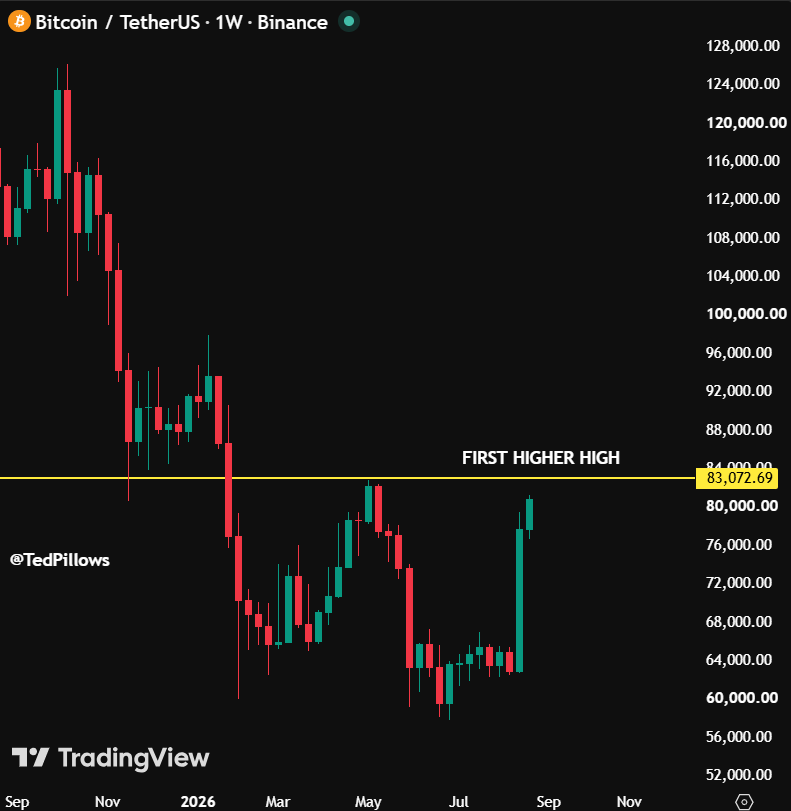
Beyond historical analogies, current technical indicators and market structure analysis also suggest a strengthening bullish case for Bitcoin. Analyst Ted Pillows pointed out that Bitcoin is now in close proximity to establishing a new higher high. This is a critical technical milestone, as breaching previous highs often signals a confirmation of a new bull trend and can attract further investment.

Pillows noted that Bitcoin was only approximately $2,200 away from this significant psychological and technical level. A successful breakout above this point, he argued, could substantially bolster the market’s structure. Furthermore, he suggested that if this higher high materializes, Bitcoin might avoid revisiting the $60,000 level, indicating a potentially robust and sustained upward movement. The establishment of higher highs and higher lows is a fundamental characteristic of an uptrend in technical analysis, and Bitcoin appears to be on the cusp of confirming such a pattern.
The concept of a "higher high" is crucial in determining trend strength. In a bull market, each successive peak in price should be higher than the previous one, and each trough should be higher than the previous one. If Bitcoin can decisively surpass its previous all-time high (or a significant recent high if the absolute all-time high is far off), it would invalidate bearish arguments and attract a new wave of buyers, potentially including institutional investors who may have been waiting for such a signal.
Advanced Elliott Wave Analysis and Future Targets
Adding another layer to the optimistic outlook, analyst Celal Kucuker has offered an even more ambitious projection based on Elliott Wave Theory. This technical analysis framework suggests that market prices move in predictable wave patterns. Kucuker’s analysis indicates that Bitcoin’s current chart structure might signify the conclusion of a fourth wave, which is typically a corrective phase. If this interpretation is accurate, it sets the stage for the commencement of a fifth wave, which is often the strongest and final impulse wave in a bullish sequence.
Kucuker has set a potential target of $144,000 for Bitcoin, suggesting that such a significant move could materialize sooner than many market participants anticipate. This target, if reached, would represent a substantial increase from current levels and would place Bitcoin in uncharted territory, far surpassing its previous all-time highs. The Elliott Wave Theory, while complex and subjective, has a track record of identifying potential turning points and price objectives. A projected fifth wave typically follows a period of consolidation and often exhibits strong momentum, aligning with the recent price surge.
Underlying Drivers and Potential Catalysts
While technical analysis and historical patterns offer valuable insights, several fundamental factors could be contributing to Bitcoin’s current strength and its potential to sustain a bull run.
1. Institutional Adoption and Inflows: The approval of spot Bitcoin Exchange-Traded Funds (ETFs) in the United States earlier this year marked a significant milestone, opening the doors for broader institutional and retail investor access. Since their inception, these ETFs have witnessed substantial net inflows, indicating sustained demand from a wide array of investors. These inflows represent real capital entering the Bitcoin ecosystem, providing a fundamental basis for price appreciation. The continued positive sentiment surrounding these financial products, coupled with potential future approvals in other jurisdictions, could further fuel demand.
2. Halving Event Impact: Bitcoin’s fourth halving event occurred in April 2024, reducing the block reward for miners from 6.25 BTC to 3.125 BTC. Historically, halving events have been followed by significant bull markets due to the reduced supply of new Bitcoin entering circulation. While the immediate impact might be debated, the long-term effect of a diminished new supply, when coupled with consistent or increasing demand, is inherently inflationary for the asset. The current rally could be an early indicator of the post-halving bull cycle taking hold.
3. Macroeconomic Environment and Inflation Hedge Narrative: In an environment characterized by persistent inflation concerns and geopolitical uncertainties in various parts of the world, Bitcoin continues to be viewed by some investors as a potential store of value and an inflation hedge, akin to digital gold. As central banks grapple with managing inflation, investors may allocate a portion of their portfolios to assets perceived as capable of preserving wealth. This narrative, though often debated, can drive demand during periods of economic uncertainty.
Broader Market Implications and Future Outlook
The current price action and the optimistic analyses from market watchers suggest a potentially bullish outlook for Bitcoin. If the cryptocurrency can successfully break through its previous highs and sustain momentum, it could trigger a broader crypto market rally. Altcoins often follow Bitcoin’s lead, experiencing amplified gains during bull markets.
However, it is crucial to acknowledge the inherent volatility of the cryptocurrency market. While the current indicators are positive, unforeseen regulatory developments, macroeconomic shocks, or shifts in investor sentiment could still lead to significant price corrections. The market remains sensitive to news flow, and any negative developments could quickly reverse the current positive trend.
The successful establishment of a new higher high would be a strong confirmation of the bullish narrative. It would likely attract more speculative capital and reinforce the confidence of long-term holders. Conversely, a failure to break through resistance levels and a subsequent decline could signal a deeper correction or a prolonged period of sideways consolidation.
At the time of this report, Bitcoin was trading at approximately $78,814, representing a robust 13.32% increase over the past seven days. This figure underscores the strong recent performance and the continued upward pressure on the asset. The coming weeks and months will be critical in determining whether Bitcoin can solidify its position in a new bull market or if the current surge is a temporary anomaly within a broader consolidation phase. The interplay of institutional flows, macroeconomic conditions, and investor sentiment will be key determinants of Bitcoin’s trajectory.