Polymarket, a prominent player in the decentralized prediction market space, has found itself at the center of a prolonged and increasingly ambiguous saga surrounding the potential launch of its native token, $POLY. What began as a chorus of loud promises from its leadership has gradually devolved into a near-total silence, leaving a trail of digital breadcrumbs that strongly suggest internal legal pressures have muzzled what was once an aggressive marketing campaign. This shift from vocal commitments to subdued communication, punctuated by a junior engineer briefly shouldering the entire public relations burden, offers a compelling case study in the complexities of crypto token launches amidst an evolving regulatory landscape.
Background: Polymarket and the Prediction Market Landscape
Polymarket operates as a decentralized information market where users can bet on the outcomes of future events, ranging from political elections and scientific breakthroughs to market trends and pop culture phenomena. By allowing users to trade on probabilistic outcomes, these platforms aim to aggregate collective intelligence and potentially offer more accurate forecasts than traditional polling or expert opinions. In the broader cryptocurrency ecosystem, prediction markets represent a fascinating intersection of finance, data science, and decentralized governance, often attracting a highly engaged and speculative user base.
The concept of launching a native token, often accompanied by an "airdrop" distribution to early users, has become a ubiquitous growth strategy for crypto projects. Airdrops serve multiple purposes: decentralizing governance by distributing voting power, incentivizing early adoption and liquidity provision, and creating a loyal community around the project’s ecosystem. For a platform like Polymarket, a token could unlock advanced functionalities, reward active participants, or serve as a medium of exchange for fees, thus deepening user engagement and fostering a more robust, decentralized network. However, the legal classification of such tokens, particularly in jurisdictions like the United States, has become a significant hurdle, with regulators scrutinizing whether these digital assets constitute unregistered securities.
The Genesis of $POLY Hype: A Detailed Chronology
The journey of $POLY began not with a whisper, but with a series of increasingly confident declarations, painting a picture of a company fully committed to its token vision.
November 2024: The Earliest In-App Tease
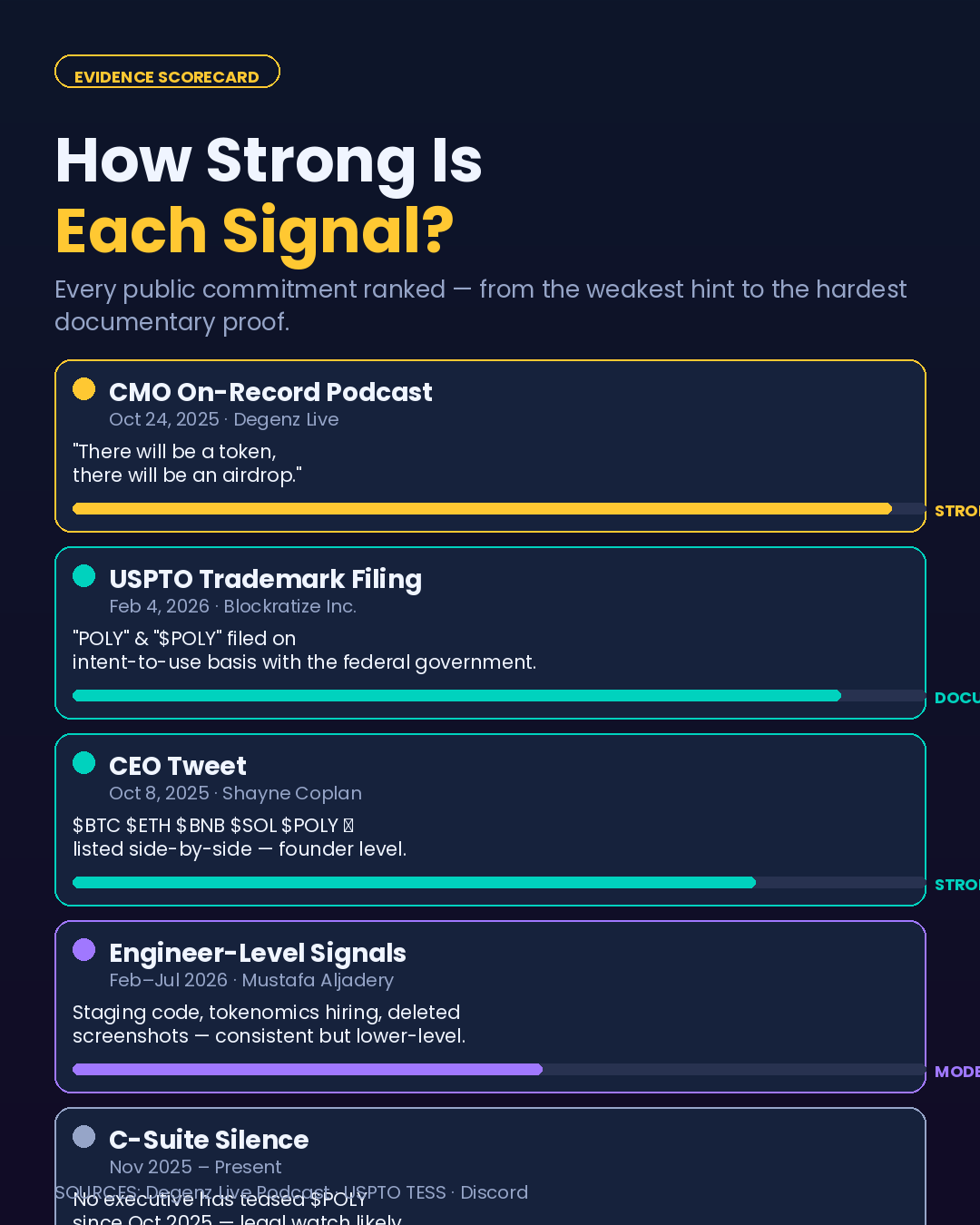
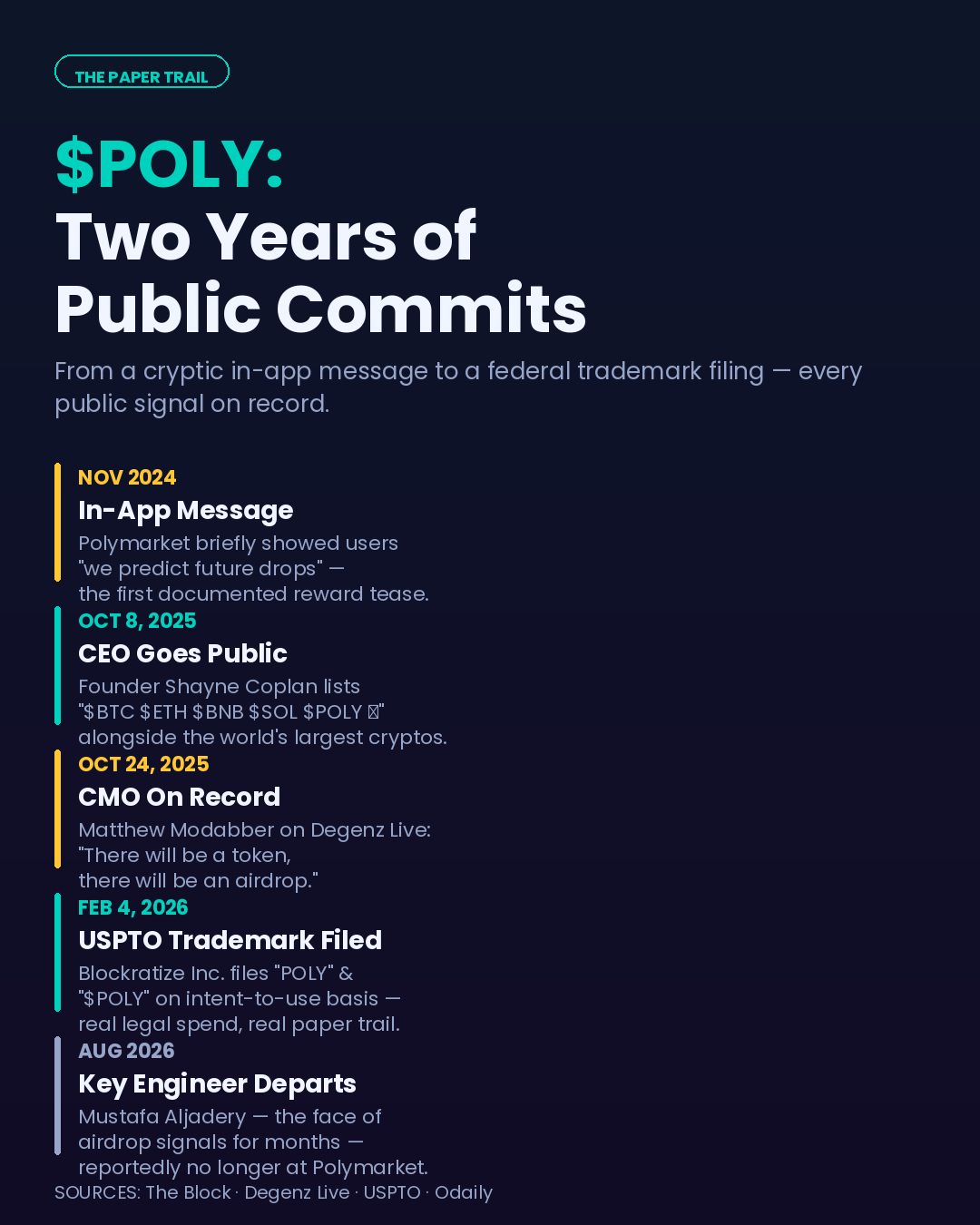
The first documented hint of a native token surfaced in November 2024, a period marked by heightened activity on Polymarket following the intensely debated results of the U.S. presidential election. Amidst the chaos and fervent user engagement, Polymarket briefly displayed an enigmatic in-app message: "we predict future drops." While fleeting and lacking specific details, this internal teaser, later reported by The Block, signaled an early consideration of rewarding its burgeoning user base. At the time, Polymarket had already been discussing fundraising rounds and the possibility of a token, setting the stage for future announcements. This initial, subtle hint, though not publicly shareable via social media, served as the foundational layer for subsequent, more overt declarations.
October 8, 2025: CEO Shayne Coplan’s Bold Statement
The teasing went unequivocally public on October 8, 2025, when Polymarket founder and CEO Shayne Coplan posted a now-infamous message on social media. In a declarative statement that resonated widely within the crypto community, Coplan listed "$BTC $ETH$BNB $SOL$POLY ðŸ”", strategically placing "$POLY" directly alongside the ticker symbols of the world’s largest and most established cryptocurrencies. This was more than a mere suggestion; it was a public endorsement from the highest echelon of the company, signaling a clear intention to elevate $POLY to the status of a major digital asset. The implication was clear: Polymarket saw its future token as a cornerstone of the crypto economy, a bold projection that instantly amplified community expectations.
October 24, 2025: CMO Matthew Modabber’s Unambiguous Confirmation
Just weeks later, on October 24, 2025, the commitment to $POLY reached its zenith with what remains the single strongest corporate confirmation on record. Polymarket’s Chief Marketing Officer (CMO), Matthew Modabber, appeared on the popular Degenz Live podcast and stated plainly, leaving no room for misinterpretation: "There will be a token, there will be an airdrop." Modabber elaborated on the team’s vision, emphasizing the desire for the token to possess "true utility" and "longevity," indicating a thoughtful approach to its design rather than a mere speculative instrument. He also linked the token’s launch to the completion of Polymarket’s U.S. relaunch, implying a strategic sequencing of corporate milestones. This on-the-record declaration from a senior executive represented an unambiguous corporate commitment, setting a high bar for community expectations and firming up the belief that $POLY was not just a possibility, but an imminent reality.

The Pivot to Silence: Legal Scrutiny Takes Center Stage
Following the potent double-hit of Coplan’s social media post and Modabber’s podcast confirmation in October 2025, a palpable shift occurred in Polymarket’s public communication strategy. C-level executives, who had previously been vocal proponents of $POLY, largely retreated from public discussions about the token. The signals, however, did not cease entirely; they merely moved down the organizational chart, hinting at an internal re-evaluation of communication protocols.
November 2025: Growth Lead William LeGate Steps In
As executive leadership became conspicuously silent, William LeGate, Polymarket’s growth lead, emerged as the primary, albeit unofficial, voice for airdrop-related communications. His role quickly shifted to managing community expectations and preempting potential exploitation. In November 2025, LeGate directly addressed user concerns regarding "sybil attacks" – attempts by malicious actors to game airdrop allocations through fake engagement or multiple accounts. He explicitly warned that sybil-flagged comments would not contribute to airdrop eligibility, asserting that such efforts would be a waste of time. This intervention underscored two critical points: first, that an airdrop was still very much on the company’s radar, and second, that Polymarket was actively working on mechanisms to ensure fair distribution, further solidifying the community’s belief in the token’s eventual arrival.
February 4, 2026: The Critical Trademark Filings
The most legally consequential development occurred on February 4, 2026, when Blockratize Inc., Polymarket’s parent company, took a decisive step by filing U.S. trademark applications for both "POLY" and "$POLY" with the United States Patent and Trademark Office (USPTO). These filings were made on an "intent to use" basis, a legal designation that signifies a genuine, good-faith intention to use the marks in commerce. Crucially, the applications explicitly described the marks in connection with providing a digital currency for an online community, alongside broader categories encompassing cryptocurrency trading and financial platform services.
These trademark filings, which remain publicly viewable on the USPTO’s system, represent a far more significant commitment than any social media post or podcast statement. Unlike ephemeral online content, a trademark application involves legal fees, requires formal legal sign-off, and creates a durable, official paper trail. It unequivocally demonstrates that Polymarket had advanced beyond mere conceptual discussions and was actively laying the legal and operational groundwork for a token launch. This move strongly suggested that internal token development was genuinely underway, regardless of the newfound public reticence from leadership. The shift indicated a maturation of the project, where legal and regulatory considerations began to heavily influence public communication.
The Mustafa Era: An Engineer’s Unofficial Role
From early 2026 onward, with C-level executives largely silent and legal frameworks being established, the public signaling for $POLY remarkably coalesced around a single individual: Mustafa Aljadery, a Polymarket engineer who humorously described himself online as the company’s "senior intern." For months, Mustafa became the de facto, albeit unofficial, face of $POLY token communication, sustaining the narrative through his personal social media presence.
February – May 2026: Coding Snippets and Public Teases
In February 2026, Mustafa briefly posted and then quickly deleted a screenshot of a coding session. This image, according to reports from crypto news outlets like Odaily and Bitget News, depicted a task instruction to migrate the platform’s fee collection mechanism from USDC.e to POLY on a staging branch. Such an internal development task is a strong indicator of active integration work for the token. Around the same time, he publicly responded to a prominent Polymarket trader with the tantalizing promise: "1m markets and $POLY next." In March 2026, Mustafa further fueled speculation by teasing a "big announcement" for an upcoming Monday, accompanied by a coin emoji. Throughout this period, screenshots and photos linked to his desk and laptop continued to circulate within the community, maintaining the token narrative through these informal, yet highly anticipated, breadcrumbs. This period highlighted the immense community interest and the reliance on unofficial channels when official ones went silent.
July 6, 2026: Operational Inquiries and Departure
By July 6, 2026, Mustafa’s public posts took a distinctly more operational turn. He openly sought expertise, posting a public query asking who was "the best in the world at building tokenomic models," inviting direct messages. This request transcended casual teasing, reading much more like an active recruitment effort for critical token infrastructure development, suggesting Polymarket was indeed progressing with the technical design of $POLY.
However, as abruptly as he became the public face of $POLY, Mustafa vanished from the narrative. As of August 2026, he was reportedly no longer with Polymarket. The circumstances of his departure remain publicly unclear, with neither Mustafa nor Polymarket issuing any official statement. His sudden absence further complicated the $POLY narrative, removing the last consistent, albeit unofficial, source of information for the eager community.
Unpacking the Silence: Regulatory Pressures and Strategic Shifts
The most plausible interpretation of Polymarket’s communication trajectory is not a loss of interest in $POLY, but rather the increasing involvement and caution of its legal team as the trademark process advanced and the broader regulatory environment for cryptocurrencies intensified.
The Evolving Regulatory Landscape
The period spanning 2025-2026 witnessed a significant hardening of regulatory stances, particularly in the United States. The Securities and Exchange Commission (SEC), under Chairman Gary Gensler, repeatedly emphasized its view that many cryptocurrencies, especially those launched through initial coin offerings (ICOs) or airdrops, could be classified as unregistered securities. This classification carries immense legal ramifications, including stringent disclosure requirements, potential fines, and even legal action against companies and their executives. Projects like Ripple (XRP) and others faced prolonged legal battles, creating a chilling effect across the industry. For a company like Polymarket, actively seeking to operate within the U.S. and engaging with traditional financial systems, navigating these legal minefields became paramount.
Internal Legal Counsel and Risk Mitigation
Mustafa himself reportedly admitted on Discord that he had to remove certain posts due to legal guidance, which aligns perfectly with the pattern of deleted or quietly re-uploaded content from his account. This internal directive underscores the sensitivity surrounding public statements about potential tokens. A company that has formally filed "intent to use" trademarks with a federal government agency has clearly moved past the stage where its executives can casually tweet ticker symbols without triggering serious securities and disclosure concerns. Such a shift would naturally lead to a tightening of communication, with public statements carefully vetted by legal counsel to mitigate risk. The potential liability for misleading statements or for inadvertently creating an unregistered security is too high for a well-funded, ambitious project to ignore.
The Strategic Playbook: Why the Initial Hype?
Despite the subsequent silence, Polymarket’s aggressive initial teasing of $POLY was a well-understood growth tactic within the crypto space. Constant airdrop hints are highly effective in incentivizing user acquisition, driving trading volume, and fostering platform engagement.
User Acquisition and Engagement
The promise of a future airdrop creates a powerful incentive for users to actively participate on a platform, hoping to qualify for a share of the token distribution. This strategy generates significant "pre-revenue" engagement, attracting new users, increasing transaction volume, and boosting overall platform metrics. For Polymarket, this hype cycle would have been invaluable in scaling its user base and strengthening its position ahead of its U.S. relaunch and subsequent fundraising rounds. The anticipation of $POLY likely contributed to a surge in market creation and participation, providing critical liquidity and network effects.
Capital Raising and Market Positioning
Robust user engagement and a strong narrative around a future token can also significantly enhance a project’s attractiveness to investors. High activity metrics and a passionate community are compelling selling points for venture capitalists and institutional investors. The explicit commitment to a token by Polymarket’s leadership could have been instrumental in securing funding and positioning the company as a forward-thinking, decentralized entity, even if the actual token launch was subject to regulatory delays.
Once Polymarket had captured a significant portion of the desired engagement and secured its market position, the marginal benefit of continuing to tease publicly would naturally decline. Concurrently, the increasing legal scrutiny and associated costs of every additional hint would make continued public discussion counterproductive.
Implications for Traders and the Broader Ecosystem
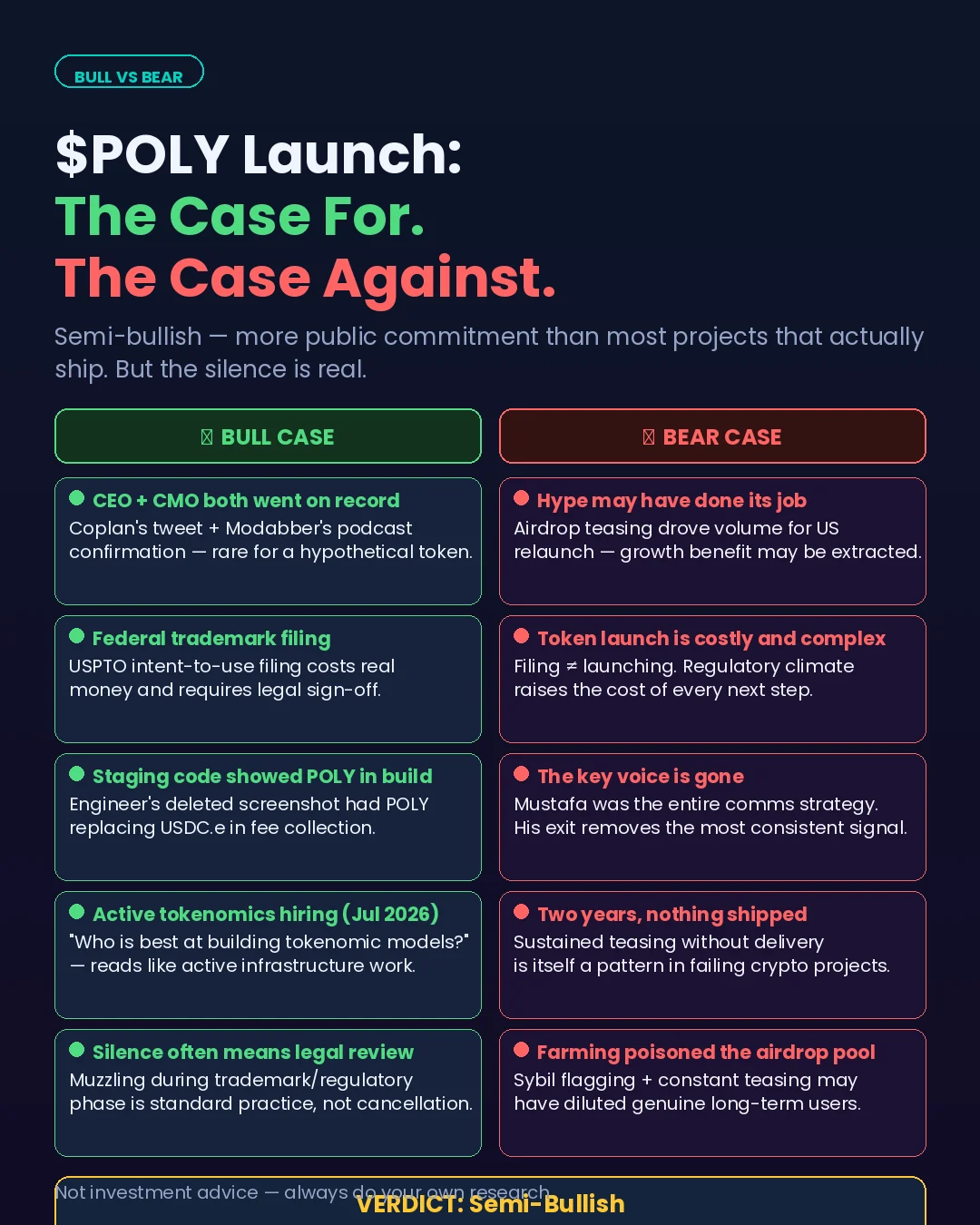
For the countless traders and crypto enthusiasts who have followed the $POLY saga, the situation presents a complex picture. The case for $POLY’s eventual launch can be described as semi-bullish, resting on a foundation of persistent intent rather than outright certainty.
The Bullish Case: Persistent Intent
The strongest argument in favor of $POLY’s eventual launch lies in the depth and persistence of Polymarket’s public commitments. A sitting CEO and CMO both went on record, unequivocally stating the token’s impending arrival. This was followed by tangible legal action in the form of federal trademark filings, indicating that the groundwork was genuinely being laid, not merely discussed. It would be a significant miscalculation to assume the project quietly died simply because public teasing ceased. Large-scale token launches, especially those from well-funded and regulated entities, routinely go quiet during the critical phases of legal and technical development. The internal migration of fee collection mechanisms to $POLY on staging branches, as revealed by Mustafa, further supports the notion that development was active.
The Bearish Case: Diminished Incentives and Regulatory Hurdles
Conversely, a strong argument against launching stems from the strategic utility of aggressive airdrop teasing itself. If the primary goal was simply to reward a loyal community, a two-year, high-profile teasing campaign is arguably counterproductive. Such aggressive, repeated hints are precisely what attract "short-term farmers" – users primarily interested in maximizing their airdrop allocation, often diluting the rewards intended for genuine, long-term users. There is a real possibility that Polymarket successfully extracted most of the growth and engagement benefits it desired from the hype cycle alone. As such, the incentive to actually follow through with a costly, legally complex, and potentially risky token launch may have diminished, particularly with the engineer who had become the face of the teasing no longer at the company. The departure of Mustafa, who was the last consistent public voice for $POLY, further weakens the immediate prospects for a launch.
Community Sentiment and "Airdrop Farming"
The prolonged anticipation has undoubtedly created a segment of the Polymarket community primarily engaged in "airdrop farming," optimizing their activity to meet potential eligibility criteria. This phenomenon is common in the crypto space, where users dedicate significant time and resources to interact with protocols in hopes of receiving a lucrative token allocation. Should $POLY never materialize, or if its launch is significantly delayed, it could lead to widespread community disillusionment, potentially impacting Polymarket’s long-term user retention and reputation.
Conclusion
Polymarket’s journey with $POLY stands as an unusually rich case study in the volatile intersection of crypto innovation, community engagement, and regulatory realities. Between a CEO’s bold pronouncements, a CMO’s explicit confirmations, a federal trademark filing, and two years of granular, engineer-level breadcrumbs, Polymarket has left behind an extensive public commitment to its native token. This paper trail is arguably more substantial than that of many projects that have successfully shipped tokens.
What happens next will likely depend less on community sentiment or market speculation and more on confidential decisions being made behind closed doors, heavily influenced by Polymarket’s legal counsel. The resolution of the $POLY saga will offer valuable insights not only into Polymarket’s strategic direction but also into the evolving legal and operational challenges faced by decentralized projects attempting to navigate the intricate and often ambiguous regulatory landscape of the global cryptocurrency market. The quiet rooms of legal deliberation, rather than the bustling public forums of social media, now hold the key to $POLY’s future.
Disclosure: This is not trading or investment advice. Always do your research before buying any cryptocurrency or investing in any services.
Follow us on Twitter @themerklehash to stay updated with the latest Crypto, NFT, AI, Cybersecurity, and Metaverse news!