The cryptocurrency landscape witnessed a remarkable entry recently as Biscotti, an AI-powered animatronic robot dog, did not merely launch; it erupted onto the scene. Foregoing a quiet debut, Biscotti burst forth on a brand-new platform, intricately linked to its physical robot counterpart, and swiftly achieved an astonishing $15 million market capitalization. This meteoric rise occurred before many within the broader crypto community had even fully processed the initial announcement tweet, immediately capturing significant attention and sparking discussions across various digital forums.
This event is notable not solely for the rapid appreciation in its token value, nor for the subsequent market correction that often follows such high-velocity launches. Instead, Biscotti has emerged as a critical proof of concept for a much larger, more ambitious undertaking: Emblem Vault. This project, an established cross-chain infrastructure solution with a foundational history spanning nearly a decade, has now decisively planted its flag on Robinhood’s nascent blockchain, choosing an AI-driven animatronic dog as its groundbreaking emissary. The implications extend far beyond a typical token launch, hinting at a strategic maneuver by a seasoned player in the decentralized finance space.
The Phenomenon of Biscotti’s Immediate Market Impact
Biscotti, conceived as an AI animatronic dog – a tangible, robotic companion imbued with artificial intelligence capabilities – marked its debut as the inaugural token launched via Emblem Vault’s new Launchpad on Robinhood Chain. The project’s founder, known by the handle @okpasquale on the social media platform X, personally announced and championed the initiative, drawing immediate community engagement.
The initial financial metrics surrounding Biscotti’s launch were nothing short of spectacular. The token experienced an almost instantaneous surge, propelling its market capitalization to $15 million. This explosive growth, however, was followed by a characteristic cooldown, a pattern frequently observed in high-energy memecoin launches. As the initial wave of speculative buying pressure subsided and early investors began to realize profits, the token’s market cap stabilized to just under $6 million. This trajectory, while typical for speculative assets, also sets the stage for a more "sustainable," or at least more transparent, trading range as the market digests the initial hype.
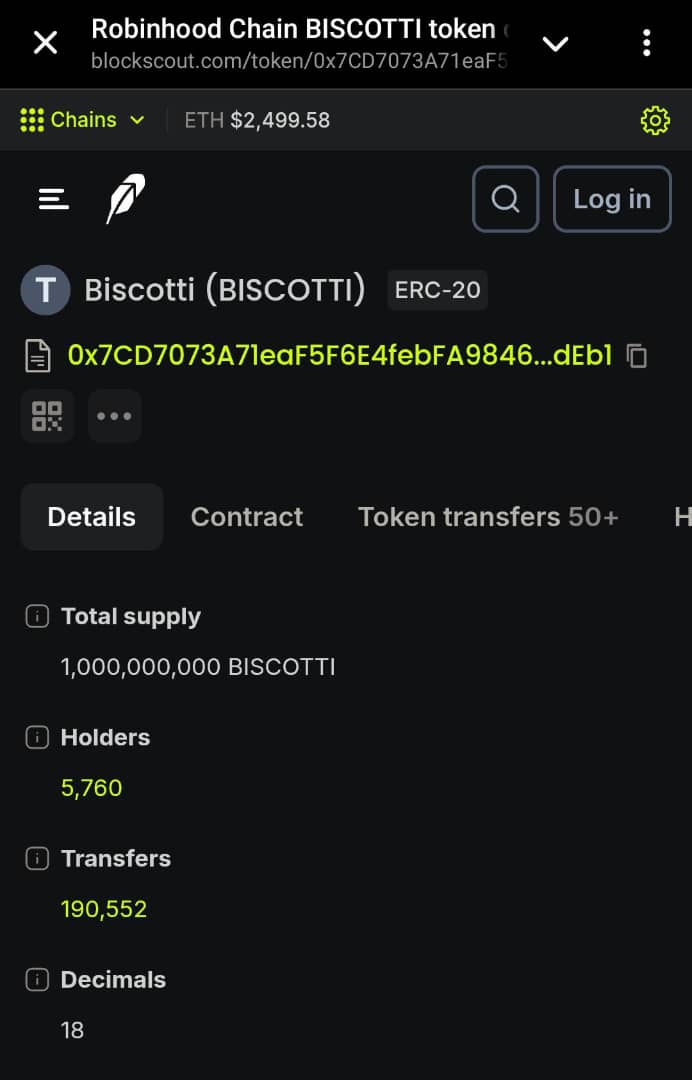
Beyond the volatile market cap, other indicators suggest a robust and genuine level of interest. As of the latest available data, Biscotti’s associated wallet holds a modest sum of approximately $2,424, primarily denominated in Ethereum (ETH). More compelling are the community engagement statistics: within hours of its launch, Biscotti accumulated 5,760 unique holders and recorded an impressive 190,552 transactions. These figures are crucial, as they strongly indicate authentic trading activity and widespread participation, rather than the artificial inflation of interest through a limited number of wallets shuffling tokens amongst themselves. This significant organic traction underscores the project’s ability to capture the attention and participation of a broad segment of the crypto community, distinguishing it from many purely speculative ventures.
Emblem Vault: A Legacy of Cross-Chain Infrastructure
To truly grasp the significance of Biscotti, one must understand the foundation upon which it launched: Emblem Vault. This is not a hastily assembled platform designed to capitalize on the latest memecoin frenzy. Instead, Emblem Vault represents a robust piece of cross-chain infrastructure with a profound lineage tracing back to October 2016. According to its official documentation, the project’s roots extend to the team’s earlier endeavors, which involved rebranding an existing token project into "Circuits of Value" on the Counterparty protocol. This foundational work laid critical technical and philosophical groundwork, shaping the vision for what was to become Emblem Vault.
The Emblem Vault product itself, a pioneering mechanism that encapsulates assets from diverse blockchains into a single, tradable NFT-based vault, officially went live in September 2020. This innovative solution was built directly upon the extensive groundwork established years prior. Regardless of whether one considers the 2016 founding or the 2020 product launch as its genesis, the core takeaway is clear: this is a development team that has diligently built and iterated through multiple complete cryptocurrency market cycles. Their trajectory contrasts sharply with projects that emerge overnight, solely aiming to ride a fleeting market wave.
The track record of Emblem Vault speaks volumes about its resilience and technical prowess. Historically, the platform has facilitated over $150 million in cumulative transaction volume and has seen the creation of more than 90,000 unique vaults. Furthermore, its infrastructure boasts compatibility across more than 15 distinct blockchains, demonstrating a commitment to interoperability and a deep understanding of the fragmented blockchain ecosystem. These impressive statistics are the culmination of years of persistent development, navigating the tumultuous waters of bull markets, punishing bear markets, and every phase in between. Therefore, when a project of this caliber and infrastructural pedigree opts to launch a new token platform on Robinhood Chain, choosing an AI animatronic dog as its inaugural offering, it warrants a level of scrutiny and credit that far surpasses what a typical, fledgling memecoin launchpad might receive. This is not just another launch; it is a strategic declaration from an established entity.
Robinhood Chain: The Emerging Battleground for Web3 Innovation
The choice of Robinhood Chain as the venue for Emblem Vault’s expansion is itself a pivotal element of this story. Robinhood Chain, the brokerage giant’s Ethereum-based Layer 2 network, has rapidly solidified its position as one of the most hotly contested and strategically important pieces of digital real estate within the crypto sphere since its mainnet went live.

The network has successfully attracted a genuinely diverse and high-profile array of infrastructure partners, a testament to its potential and strategic importance. These include industry titans such as Chainlink for reliable oracle data, Uniswap serving as its primary decentralized trading venue, Alchemy and LayerZero providing essential node infrastructure and cross-chain messaging capabilities, and BitGo for institutional-grade custody solutions. This level of backing and integration from established players is an advantage most nascent blockchain networks simply do not possess at their inception.
This robust infrastructure has, in turn, drawn a growing multitude of launchpads, all vying for attention and market share on the same chain. This competitive landscape features everything from velocity-focused meme launchers, designed for rapid deployment and quick speculative gains, to more rigorously vetted, due-diligence-heavy platforms catering to projects intended to endure beyond a single hype cycle. Emblem Vault’s entry into this crowded space carries a distinctly different weight. It is not starting from scratch but rather bringing nearly a decade of sophisticated cross-chain plumbing experience into a nascent ecosystem that is still actively defining which platforms are built for longevity and which are merely designed for fleeting pumps before vanishing. Emblem Vault’s move is a significant endorsement of Robinhood Chain’s potential and a calculated bid to shape its future.
Chronology of Key Developments and Strategic Milestones
The narrative of Biscotti and Emblem Vault on Robinhood Chain unfolds across several key chronological points, illustrating a long-term strategic vision culminating in the recent high-profile launch:
- October 2016: The foundational work for Emblem Vault begins with the team’s rebranding of an existing token project into "Circuits of Value" on the Counterparty protocol, laying the technical and philosophical groundwork for future cross-chain innovation.
- September 2020: The Emblem Vault product, an innovative NFT-based mechanism for wrapping assets from multiple blockchains into a single tradable vault, officially goes live, building directly upon the team’s earlier developments.
- Recent Past (Pre-Biscotti Launch): Robinhood Chain’s mainnet goes live, rapidly attracting a consortium of major infrastructure partners and establishing itself as a significant Layer 2 network.
- Approximately 20 Hours Prior to Article Publication: Biscotti, the AI animatronic dog token, is launched as the inaugural project on Emblem Vault’s new Launchpad on Robinhood Chain.
- Immediately Post-Launch: Biscotti experiences an explosive market surge, rocketing its market capitalization to a peak of $15 million within a very short timeframe.
- Subsequent Hours: The initial speculative buying pressure cools down, and Biscotti’s market capitalization settles to just under $6 million, entering a more stable trading range. Concurrently, the token garners significant organic interest, accumulating 5,760 holders and over 190,000 transactions.
- Contemporaneous with Launch: Jake Gallen, founder of Emblem Vault, personally announces the platform’s arrival on Robinhood Chain and confirms a live X Space alongside @okpasquale, Biscotti’s founder, to discuss the project and the new launchpad.
This timeline highlights a carefully orchestrated entry, leveraging a decade of development and a strategic partnership with a new, high-potential blockchain.
Inferred Statements and Community Reactions
While direct quotes beyond the initial announcements are not provided, the actions and context allow for several logical inferences regarding statements and reactions from related parties:
- Jake Gallen, Founder of Emblem Vault: His personal involvement in announcing the launchpad’s debut on X and his commitment to co-hosting an X Space with Biscotti’s founder suggest a deep, strategic investment in this inaugural project. Gallen likely views Biscotti not merely as a test case, but as a critical "opening statement" for Emblem Vault’s broader ambitions on Robinhood Chain. His inferred message would emphasize the culmination of years of infrastructure development now bringing tangible innovation to a new, high-growth ecosystem, underscoring the platform’s ability to bridge advanced technology with engaging, novel applications like AI robot dogs.
- @okpasquale, Founder of Biscotti: The very nature of Biscotti—a physical, AI-powered robot dog tied to a blockchain token—indicates a vision extending beyond pure digital speculation. @okpasquale’s inferred statements would likely highlight the innovative convergence of AI, robotics, and blockchain, positioning Biscotti as a pioneer in the "phygital" (physical + digital) realm. He would likely express enthusiasm for the partnership with Emblem Vault, leveraging its robust cross-chain capabilities to potentially integrate Biscotti into a wider ecosystem of digital assets and utility.
- Robinhood Chain Developers and Community: The arrival of a well-established and technically sophisticated project like Emblem Vault, with its decade-long track record, would likely be met with significant enthusiasm within the Robinhood Chain ecosystem. It signals validation for the chain’s potential and its ability to attract serious, long-term builders. The inferred reaction would be one of welcome and anticipation for the advanced cross-chain functionalities Emblem Vault brings, which could significantly enhance the chain’s overall utility and appeal.
- Broader Crypto Community: Initial reactions would likely be a mix of excitement over the rapid price action (typical for meme coin-like launches) and curiosity regarding the underlying technology. As more information emerges about Emblem Vault’s history and infrastructure, the community’s perspective would likely shift towards a more analytical appreciation of the strategic depth behind the launch, distinguishing it from purely speculative, short-lived projects.
Broader Implications and Future Outlook for Emblem’s Launchpad Ambitions
The trajectory of Biscotti over the coming weeks will likely serve as a more significant barometer for Emblem Vault’s new launchpad than for the token itself. The initial cooldown from a $15 million peak to just under $6 million in market capitalization, while a notable adjustment, is not inherently a red flag. This pattern aligns closely with the standard market shape observed in numerous high-attention memecoin launches throughout the current cycle. The more pertinent and intriguing question centers on whether Emblem Vault will leverage its established cross-chain infrastructure to endow Biscotti, and subsequent projects launched through its platform, with something that most meme launches never achieve: genuine, sustained utility directly integrated into a vault system backed by nearly a decade of operational history.
The potential for integrating physical AI objects with blockchain tokens, wrapped in cross-chain vaults, presents a fascinating new frontier. If Biscotti can evolve beyond a speculative asset into a functional component of Emblem Vault’s broader asset-wrapping infrastructure, its current wallet balance and its growth in the coming weeks will become crucial indicators of its long-term viability and the sincerity of its utility claims. A significant increase in assets held within the treasury, and the implementation of specific use cases tied to Emblem Vault’s mechanics, would powerfully signal real substance behind the launch.
The broader landscape of Layer 2 solutions and the intense competition among launchpads underscore the strategic importance of Emblem Vault’s move. By bringing a proven, long-standing infrastructure to Robinhood Chain, Emblem Vault is not just launching tokens; it is aiming to establish itself as a cornerstone for projects that seek longevity and multi-chain functionality. Its success could set a new standard for what a launchpad can offer, moving beyond simple token issuance to complex asset management and cross-chain interoperability for "phygital" assets.
In conclusion, Biscotti’s launch has unequivocally achieved its immediate objective: it captured widespread attention, stimulated significant trading activity, and initiated direct communication between its founder and the platform’s creator. Whether Biscotti ultimately solidifies its position as a genuine flagship project for Emblem Vault’s ambitious plans on Robinhood Chain, or if it remains primarily an opening curiosity, will largely depend on the unfolding activity of its holders, the growth of its treasury, and the insights revealed during the upcoming founders’ Space. The event has undeniably set a precedent, merging the speculative fervor of new token launches with the deep-seated infrastructure of a seasoned cross-chain pioneer, heralding a potentially transformative phase for the integration of AI, physical assets, and blockchain technology.
Disclosure: This is not trading or investment advice. Always do your research before buying any cryptocurrency or investing in any services.