
The global landscape of cryptocurrency mining has undergone a seismic shift following the successful execution of the Ethereum Merge, an event that transitioned the world’s second-largest blockchain from a Proof-of-Work (PoW) consensus mechanism to Proof-of-Stake (PoS). While the transition was hailed as a monumental achievement for environmental sustainability—reducing the network’s energy consumption by more than 99.9%—it has simultaneously triggered a financial crisis for the millions of miners who previously secured the network. As displaced miners migrate their hardware to alternative PoW chains, the resulting explosion in network difficulty has sent mining profitability into a downward spiral, with many popular tokens now yielding negative returns for the first time in years.
The End of an Era: Contextualizing the Ethereum Merge
For nearly a decade, Ethereum served as the primary destination for GPU (Graphics Processing Unit) mining. Unlike Bitcoin, which transitioned to specialized ASIC (Application-Specific Integrated Circuit) hardware years ago, Ethereum’s Ethash algorithm remained accessible to consumer-grade graphics cards. This created a multi-billion dollar industry of home-based and industrial-scale GPU farms.
The "Merge," which integrated the Ethereum Mainnet with the Beacon Chain on September 15, 2022, effectively fired these miners overnight. Under the new Proof-of-Stake model, the network is secured by validators who "stake" their ETH holdings rather than by hardware performing complex mathematical calculations. This left a massive fleet of high-end hardware—estimated to represent billions of dollars in investment—without its primary source of revenue. The immediate aftermath has seen a desperate scramble for "homeless" hashrate to find a new residence, leading to an unprecedented saturation of smaller blockchain networks.
The Mechanics of the Profitability Crash
The sudden migration of miners is governed by the fundamental relationship between hashrate and mining difficulty. In a PoW system, the "hashrate" represents the total computational power being used to mine and process transactions. To ensure that blocks are produced at a consistent interval, networks utilize a "difficulty adjustment" algorithm. When more miners join a network, the difficulty increases, making it harder to earn rewards.

Before the Merge, Ethereum’s hashrate was magnitudes larger than all other GPU-minable coins combined. When that massive wave of computational power flooded into smaller networks like Ethereum Classic (ETC), Ravencoin (RVN), and Ergo (ERG), the difficulty adjustments responded with extreme spikes. Because these smaller coins have significantly lower market capitalizations and daily issuance values compared to the pre-Merge Ethereum, they are incapable of providing enough block rewards to sustain the massive influx of hardware.
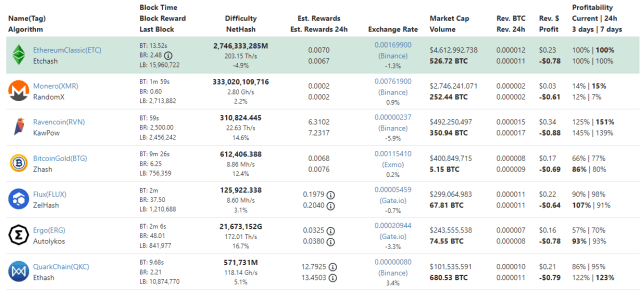
Data from mining profitability calculators, such as WhatToMine, paints a grim picture of the current economic reality. For a miner utilizing a mid-range setup of three AMD RX 480 graphics cards—a staple of the mining community for years—the estimated daily profit on Ethereum Classic has plummeted to -$0.78 per hour. This calculation accounts for an average electricity cost of $0.10 per kilowatt-hour (kWh). Even miners equipped with the most powerful consumer hardware available, such as the NVIDIA GeForce RTX 3090 Ti, are seeing hourly losses of approximately -$0.50.
A Timeline of the Transition and Its Immediate Impact
The road to this profitability crisis was paved by years of development and several key milestones:
- December 2020: The launch of the Beacon Chain, the foundation of Ethereum’s PoS future, which ran in parallel with the PoW chain.
- August 2021: The London Hard Fork (EIP-1559), which began burning a portion of transaction fees, reducing the total revenue available to miners even before the Merge.
- August 2022: The Goerli testnet successfully completes its merge, signaling that the mainnet transition is imminent.
- September 6, 2022: The Bellatrix upgrade is activated, the final step before the Merge.
- September 15, 2022: The Merge is completed at a Total Terminal Difficulty of 58,750,000,000,000,000,000,000. Mining on Ethereum officially ends.
- September 16–20, 2022: Hashrates on Ethereum Classic, Ravencoin, and Ergo surge by 300% to 600%, leading to the current collapse in profitability.
Supporting Data: The Disparity Between Supply and Demand
The primary issue is the "reward-to-hashrate" ratio. Before the Merge, Ethereum provided approximately $20 million to $25 million in daily rewards to its miners. In contrast, the total daily reward pool for all other GPU-minable coins combined was estimated to be less than $2 million.
When the 800+ Terahashes per second (TH/s) of Ethereum’s hashrate attempted to squeeze into the roughly 100 TH/s capacity of the rest of the market, the economics broke.

- Ethereum Classic (ETC): Seen as the most logical successor, its hashrate jumped from approximately 60 TH/s to over 300 TH/s within 24 hours of the Merge.
- Ravencoin (RVN): Experienced a similar surge, with difficulty levels reaching all-time highs that made it unprofitable for all but those with near-zero electricity costs.
- Ergo (ERG): A favorite for its "Autolykos" algorithm, Ergo saw its hashrate increase fivefold, leading to a massive backlog in difficulty adjustments that eventually rendered the coin unminable for profit.
Industry Reactions and Miner Sentiment
The reaction within the mining community has been a mixture of resignation, frustration, and strategic pivoting. Many industrial-scale mining operations had prepared for this event by diversifying into high-performance computing (HPC) or data center services. Others have chosen to shut down their machines entirely, waiting for a potential "shakeout" where high electricity costs force enough miners off the network to allow difficulty to drop.
"We knew the Merge was coming, but the speed at which the floor fell out of the market is still shocking," noted one mid-scale mining farm operator. "We are currently paying more in electricity than we are earning in coin value. It is essentially a war of attrition now. Only those with the most efficient hardware and the cheapest power contracts will survive this winter."
Hardware manufacturers like NVIDIA and AMD are also feeling the ripple effects. The secondary market is currently being flooded with used graphics cards as hobbyist miners attempt to recoup their initial investments. This has led to a sharp decline in GPU prices, which had already been softening due to the broader economic downturn and the end of the COVID-19-era supply chain constraints.
Fact-Based Analysis of Broader Implications
The current state of negative profitability has several long-term implications for the cryptocurrency ecosystem:
1. Network Security and Decentralization
With mining profits in the negative, there is a risk that hashrate will become overly concentrated. If only large-scale operations with access to subsidized or renewable energy can afford to stay online, the "decentralized" nature of these PoW chains may be compromised. Conversely, if too many miners leave, the cost to perform a 51% attack on these smaller networks decreases significantly, making them more vulnerable to bad actors.
2. The Shift to Proof-of-Stake Dominance
The Ethereum Merge may mark the beginning of the end for GPU mining as a mainstream investment. As the industry moves toward more energy-efficient models, the "environmental, social, and governance" (ESG) pressure on PoW coins increases. Institutional investors are increasingly favoring PoS networks, which could further suppress the market cap—and thus the mining rewards—of the remaining PoW chains.
3. Hardware Repurposing
The "Great GPU Shakeout" is forcing a massive reallocation of resources. Beyond the secondary gaming market, there is a growing movement to repurpose mining rigs for Artificial Intelligence (AI) training, 3D rendering, and decentralized cloud computing. Projects like Render Network and Akash are often cited as potential alternatives for GPU owners, though these require different software configurations and technical expertise compared to traditional mining.
Future Outlook: Can PoW Mining Recover?
For GPU mining to return to profitability, one of three things must happen:
- Price Appreciation: The market value of coins like ETC or RVN must increase significantly to offset the high difficulty.
- Miner Capitulation: A large percentage of current miners must turn off their machines, allowing the network difficulty to reset to a level where the remaining miners can profit.
- New Innovations: The emergence of a new, highly profitable "Asic-resistant" coin that captures the market’s attention and provides a new outlet for hashrate.
As of late September 2022, the situation remains dire. With ETH prices hovering around $1,400 and showing a 6% decline over the past week, the broader market sentiment remains bearish. The "Merge" has successfully achieved its technical goals for the Ethereum network, but it has left the PoW mining sector in a state of existential crisis. For now, the era of "easy" GPU mining profits appears to have concluded, replaced by a harsh economic reality where only the most efficient and well-capitalized participants can hope to break even.