The global cryptocurrency market is currently navigating one of its most turbulent periods in recent history, as altcoins—cryptocurrencies other than Bitcoin—struggle to maintain their footing against a backdrop of macroeconomic instability and shifting investor priorities. According to a comprehensive analysis by seasoned market analyst Darkfost, the altcoin sector has entered a precarious state characterized by deep structural weakness and a significant decoupling from Bitcoin’s price action. This downturn was exacerbated by a massive sell-off in the United States financial markets, which saw over $1 trillion in market capitalization evaporate in a single day. The decline, primarily driven by a cooling of the artificial intelligence (AI) and semiconductor sectors, has sent shockwaves through both traditional and digital asset classes, leaving the majority of the altcoin market in a state of sustained underperformance.
The Macroeconomic Catalyst: A Trillion-Dollar Liquidation
The immediate catalyst for the recent crypto market volatility originated in the traditional equity markets. On a Friday that many analysts are labeling a "risk-off" reset, the U.S. stock market experienced a staggering $1 trillion loss. This liquidation was fueled by weakening sentiment surrounding the high-growth AI and semiconductor industries, which have been the primary drivers of the stock market’s record highs over the past year.
The fallout was widespread: the S&P 500 fell by 2.6%, while the tech-heavy Nasdaq Composite plunged 4.7%. As institutional investors scrambled to reduce exposure to volatile assets, the cryptocurrency market was not spared. Bitcoin, often viewed as a "digital gold" or a hedge against traditional market instability, saw a 4% decline. However, the impact on altcoins was far more severe, revealing a deepening "rust" within the sector that has been accumulating for months. The correlation between Bitcoin and altcoins, which historically move in tandem during bullish cycles, has weakened significantly, leaving smaller-cap assets vulnerable to downward pressure even when Bitcoin shows signs of relative stability.
The 200-Day Moving Average: A Metric of Market Decay
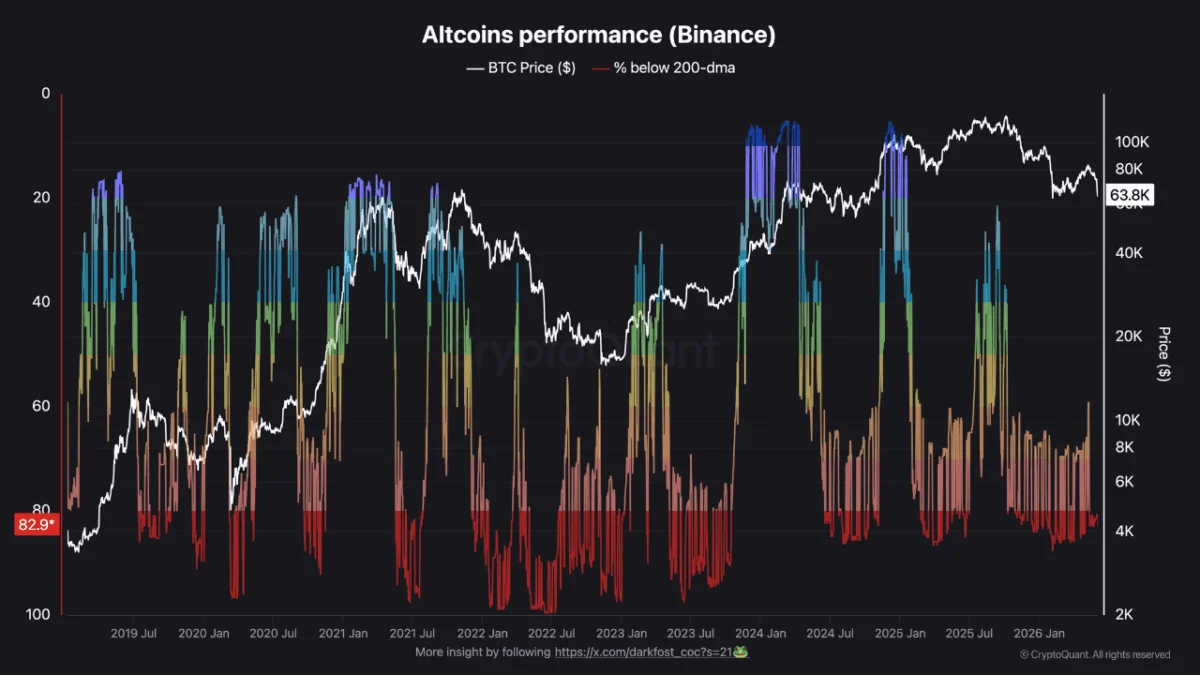
A critical component of Darkfost’s analysis is the health of altcoins relative to their 200-day moving average (200DMA). In technical analysis, the 200DMA is considered a vital "line in the sand" that separates long-term bullish trends from bearish ones. It represents the average closing price of an asset over the previous 200 trading days, serving as a dynamic level of support or resistance.
Current data paints a grim picture: 83% of all altcoins are currently trading below their 200DMA. This suggests that the vast majority of the market is in a long-term downtrend, with investor sentiment remaining overwhelmingly bearish. According to Darkfost, this reading is among the weakest recorded in the current market cycle. Historically, since 2002, the percentage of assets trading below this moving average has fluctuated between 60% and 90% during bear phases. The current 83% figure indicates that the market is nearing a point of maximum exhaustion, where structural weakness is the dominant theme rather than a temporary correction.
This lack of price strength is a direct reflection of capital concentration. As market uncertainty persists, investors are increasingly funneling their capital into Bitcoin or exiting the crypto ecosystem entirely, rather than taking risks on smaller, more volatile "alternative" projects.
The $520 Billion Valuation Wipeout
The financial toll of this underperformance is staggering. Data from the TOTAL3 chart—a metric provided by TradingView that tracks the combined market capitalization of all cryptocurrencies excluding Bitcoin and Ethereum—reveals a massive contraction in value. From its peak in October, the TOTAL3 valuation has shed approximately $520 billion. This decline has brought the total market cap of these assets down to roughly $670 billion, effectively erasing nearly half a year of gains.
This contraction means that the broader altcoin market has returned to valuation levels last seen in November 2024. For investors who entered the market during the late-2024 hype cycle, the current environment is one of significant unrealized losses. The sharp flight of capital from these assets underscores a fundamental shift in market psychology: the "altcoin season" that many anticipated in early 2025 has been replaced by a "flight to quality," where only the most established assets are seen as viable holdings.
Chronology of the Altcoin Decline
To understand the current crisis, it is essential to look at the timeline of the altcoin market’s performance over the last 14 months:

- March 2024: The market experiences a period of extreme optimism. Nearly 90% of altcoins trade above their 200DMA. This period is characterized by "breadth expansion," where almost every sector of the crypto market—from DeFi to Memecoins—sees significant inflows.
- April – September 2024: A period of stagnation begins. While Bitcoin reaches new highs, altcoins begin to diverge, failing to reclaim their previous peaks.
- October 2024: A brief rally occurs, pushing the TOTAL3 market cap to its recent peak. However, this rally is short-lived as macroeconomic headwinds from the U.S. begin to mount.
- December 2024: Another attempt at a market-wide rally fails to gain momentum. Analysts note that altcoins are showing "rust," struggling to appreciate despite Bitcoin’s relative strength.
- February 2025: The "Friday Wipeout" occurs. $1 trillion leaves U.S. markets, and the altcoin market loses $520 billion from its October peak. 83% of assets fall below their long-term moving averages.
Institutional Sentiment and the "Bitcoin First" Strategy
The current market structure is heavily influenced by the entrance of institutional players through Spot Bitcoin ETFs. Unlike previous cycles where retail investors would often "pump" altcoins after a Bitcoin rally, the current influx of capital is highly professional and focused. Institutional investors are primarily interested in Bitcoin as a regulated financial product, showing little appetite for the unproven utility or high volatility of the broader altcoin market.
This institutional focus has created a "vortex" effect. Bitcoin absorbs the majority of the liquidity entering the space, while altcoins are left to fight for a shrinking pool of retail capital. Furthermore, many altcoin projects that launched during the 2021-2022 period are now facing "token unlocks"—the release of previously restricted coins into the market—which adds constant sell pressure to assets that already lack sufficient buying demand.
A Contrarian Silver Lining: Is the Bottom Near?
Despite the prevailing gloom, Darkfost argues that periods of extreme pessimism and structural weakness often precede the most lucrative opportunities for long-term investors. The analyst points out a historical irony: when nearly 90% of altcoins were trading above their 200DMA in March and December 2024, the market was actually at its most dangerous point, as optimism was at its peak and upside potential was exhausted.
Conversely, when 83% of the market is trading below its long-term average, the "froth" has been removed. This level of underperformance often indicates that the market is in a capitulation phase, where weak hands have exited and assets are being transferred to long-term "diamond hand" holders. The breadth expansion seen in late 2017 and early 2024—the strongest since the 2017 bull run—suggests that while the current correction is deep, it is part of a larger cycle of market maturation.
Broader Implications for the Blockchain Ecosystem
The sustained underperformance of altcoins has real-world consequences for the development of the blockchain ecosystem. Many decentralized finance (DeFi) protocols and Web3 startups rely on the value of their native tokens to fund operations, pay developers, and incentivize liquidity. A $520 billion wipeout in market cap translates to a significant reduction in the "war chests" of these projects.

If the bearish trend continues, the industry may see a wave of consolidations or project closures. However, some analysts view this as a necessary "cleansing" of the market. During the 2024 rally, hundreds of new tokens were launched daily, many with little to no underlying utility. A prolonged downturn forces the market to prioritize projects with actual revenue, users, and sustainable economic models, potentially leading to a healthier ecosystem in the long run.
Conclusion: Navigating a Fractured Market
The altcoin market currently stands at a crossroads. The data provided by Darkfost and TradingView highlights a sector that is struggling to find its identity in a Bitcoin-centric world. With 83% of assets trading below their 200-day moving average and over half a trillion dollars in value erased, the road to recovery appears long and arduous.
For investors, the current environment requires a shift from speculative "moon-shot" chasing to a more disciplined, fundamental approach. The decoupling of altcoins from Bitcoin suggests that the "rising tide lifts all boats" era may be over. Instead, the next phase of the market will likely be defined by selectivity, where only the projects capable of surviving this period of extreme structural weakness will emerge to lead the next cycle. As the global financial landscape remains volatile, the crypto market’s ability to absorb these shocks will be the ultimate test of its maturity and long-term viability.