
On-chain indicators are flashing a critical signal suggesting that Bitcoin’s protracted nine-month bear market may be entering its final stages. Popular crypto analyst Darkfost recently detailed this development, highlighting a significant downward crossover between the cost basis of Short-Term Holders (STH) and Long-Term Holders (LTH). This technical event, confirmed over a three-day period, is being interpreted by some as a precursor to a potential market bottom and the eventual commencement of a new bull cycle.
The analysis, shared by Darkfost, points to a fundamental shift in the behavior of different investor cohorts within the Bitcoin ecosystem. The cost basis represents the average price at which a group of investors acquired their holdings. When the cost basis of short-term holders, typically defined as those holding Bitcoin for less than 155 days, falls below that of long-term holders, it signifies that newer market participants are entering at significantly lower prices than those who have held for an extended period. This dynamic can create conditions conducive to price recovery as the selling pressure from recent buyers diminishes, and the market potentially finds a new equilibrium.
Darkfost’s observation, "The end-of-bear-market signal has just flashed. This signal is defined by the downward crossover of the STH/LTH cost basis (with a 3-day confirmation window to validate the signal)," underscores the technical nature of this indicator. The three-day confirmation period adds a layer of robustness to the signal, aiming to filter out short-lived fluctuations and confirm a more persistent trend. This cautious approach is vital in the volatile cryptocurrency market, where rapid price swings can often lead to false signals.
A Deeper Dive into Holder Metrics
To fully appreciate the significance of this STH/LTH cost basis crossover, it’s essential to understand the distinct roles these two investor groups play in market dynamics. Long-Term Holders (LTHs) are generally considered more resilient to market downturns. Their conviction is often rooted in a belief in Bitcoin’s long-term value proposition, making them less susceptible to panic selling during periods of price depreciation. They tend to accumulate during bear markets and hold through volatility, often adding to their positions at lower prices. Their cost basis, therefore, tends to represent a more entrenched and higher entry point, reflecting their earlier participation in the market, often at higher historical price levels.
Short-Term Holders (STHs), on the other hand, are more reactive to market sentiment and price action. They are more likely to enter the market when prices are rising and exit when prices fall, seeking to capitalize on short-term gains or cut losses quickly. During a prolonged bear market, STHs often incur losses as they are frequently forced to sell at prices below their entry points. The significant drop in the STH cost basis, as reported by Darkfost, suggests that a substantial number of these short-term participants have either sold their holdings at a loss or have acquired new Bitcoin at substantially lower prices, effectively lowering the average entry point for this cohort.

The accompanying graph, shared by Darkfost, visually illustrates this shift. It depicts the STH cost basis plummeting from an approximate $112,500 to $69,000. This dramatic decline is a key factor in the crossover event. It implies that the average purchase price for recent market entrants has fallen significantly. When this average acquisition cost dips below that of long-term holders, it suggests that the market may have absorbed much of the selling pressure from those who entered at higher price points during the preceding bull run. This can create a psychological and technical foundation for a potential price rebound.
Historical Precedents and Market Cycles
The STH/LTH cost basis crossover is not a new phenomenon in Bitcoin’s history. Analysts often refer to historical data to identify patterns and potential future market behavior. While past performance is never a guarantee of future results, studying these crossovers in previous market cycles can provide valuable context.
During past Bitcoin bull markets, the STH cost basis has typically been higher than the LTH cost basis, reflecting the influx of new investors drawn by rising prices. Conversely, during bear markets, the STH cost basis often falls below the LTH cost basis, indicating capitulation and the exit of less committed investors. The confirmation of this downward crossover is therefore viewed as a critical indicator that the "painful" phase of the bear market, characterized by persistent selling and declining prices, may be drawing to a close.
The current nine-month bear market has been a significant test for investors following the record highs of late 2021. Bitcoin reached an all-time high of approximately $69,000 in November 2021. Since then, the cryptocurrency has experienced a sustained downturn, driven by a confluence of factors including macroeconomic headwinds, rising interest rates, regulatory scrutiny, and the collapse of several prominent crypto firms. This period of decline has seen Bitcoin’s price fall to lows around $15,500 in late 2022 before staging a partial recovery. The current analysis suggests that the market may be nearing a point where the selling pressure is abating, and conditions are becoming more favorable for accumulation.
The Implications for Investment Strategies
The observed STH/LTH cost basis crossover, while not an immediate signal of a market bottom, suggests that conditions are becoming "ripe for a viable Dollar Cost Averaging (DCA) strategy." DCA is an investment technique where an investor invests a fixed amount of money at regular intervals, regardless of the asset’s price. This strategy helps to mitigate the risk of investing a large sum at a market peak and can be particularly effective during periods of price uncertainty or decline. By consistently investing, individuals can accumulate more units of an asset when prices are low, thereby lowering their average purchase price over time.
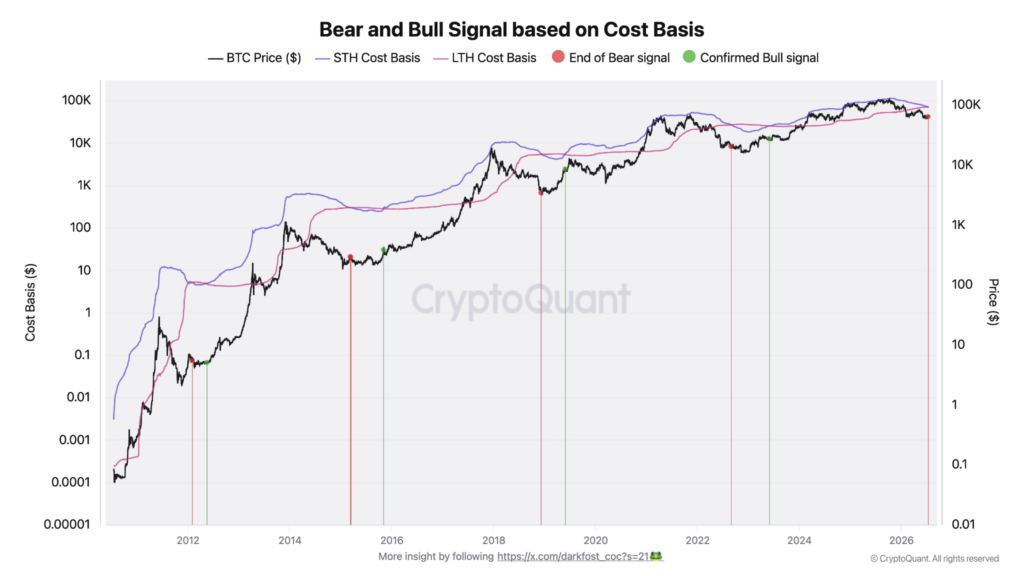
The current environment, characterized by the STH cost basis falling to $69,000 and potentially dipping below the LTH cost basis, presents an opportunity for investors to begin or continue DCA strategies. The rationale is that the market has likely absorbed much of the downward pressure, and any subsequent recovery could lead to significant gains for those who have accumulated assets at these lower levels.
Looking Ahead: The Path to Recovery
While the downward crossover of the STH/LTH cost basis is a positive sign, analysts caution that it marks the "beginning of the end" rather than the definitive end of the bear market. The market still needs to confirm a sustained upward trend.
The future trajectory of Bitcoin’s price will depend on several factors, including the eventual divergence of the STH and LTH cost bases in an upward direction. A subsequent upward crossover would serve as a stronger confirmation of a new bull market’s onset. However, the timeline for such a development remains uncertain. Analysts suggest it could take months or even over a year for this confirmation to occur.
Furthermore, the debate continues regarding the exact bottoming process. Some proponents believe that Bitcoin has already seen its lowest point, citing the current price levels as unsustainable for further declines. Others argue that additional pain might be necessary before a clear market bottom can be definitively declared. The current low of around $58.5k is a point of reference, but market participants are divided on whether this level will hold or if further downside is inevitable.
Despite the cyclical nature of the crypto market, some observers believe that Bitcoin’s maturation as an asset class might be influencing its traditional four-year market cycles. While the notion of the "dead" four-year cycle is a recurring debate, the enduring investor behavior and cyclical patterns within the market, at least for Bitcoin, appear to be holding for now. This suggests that even as the market evolves, fundamental principles of supply, demand, and investor psychology continue to play a significant role in shaping its trajectory. The current on-chain data, particularly the STH/LTH cost basis crossover, offers a glimmer of hope for investors navigating the challenging terrain of the cryptocurrency market, signaling a potential turning point after a prolonged period of bearish sentiment.