The 2026 FIFA World Cup has concluded not only as a record-breaking sporting event but as a transformative moment for the integration of blockchain technology into global mainstream culture. While traditional benchmarks such as a total attendance of 6.8 million fans, an unprecedented advertising spend of $10.5 billion, and a staggering 66 million US viewers for the final alone dominated headlines, a parallel economy was thriving on the blockchain. According to a comprehensive analysis by Chainalysis, the tournament served as a massive catalyst for on-chain activity, generating $20 billion in prediction market volume and signaling a shift in how fans interact with global events.
This digital surge was characterized by two primary pillars: decentralized prediction markets, which allowed for global speculative engagement on everything from match results to individual player behavior, and "FIFA Collect," an official digital collectible program that successfully utilized Non-Fungible Tokens (NFTs) to provide real-world utility, including match ticketing. The data suggests that while the tournament took place in physical stadiums across North America, a significant portion of the "fan experience" has permanently migrated to the blockchain, creating a transparent, albeit complex, financial ecosystem.

A New Era of Fan Engagement: The $20 Billion Surge
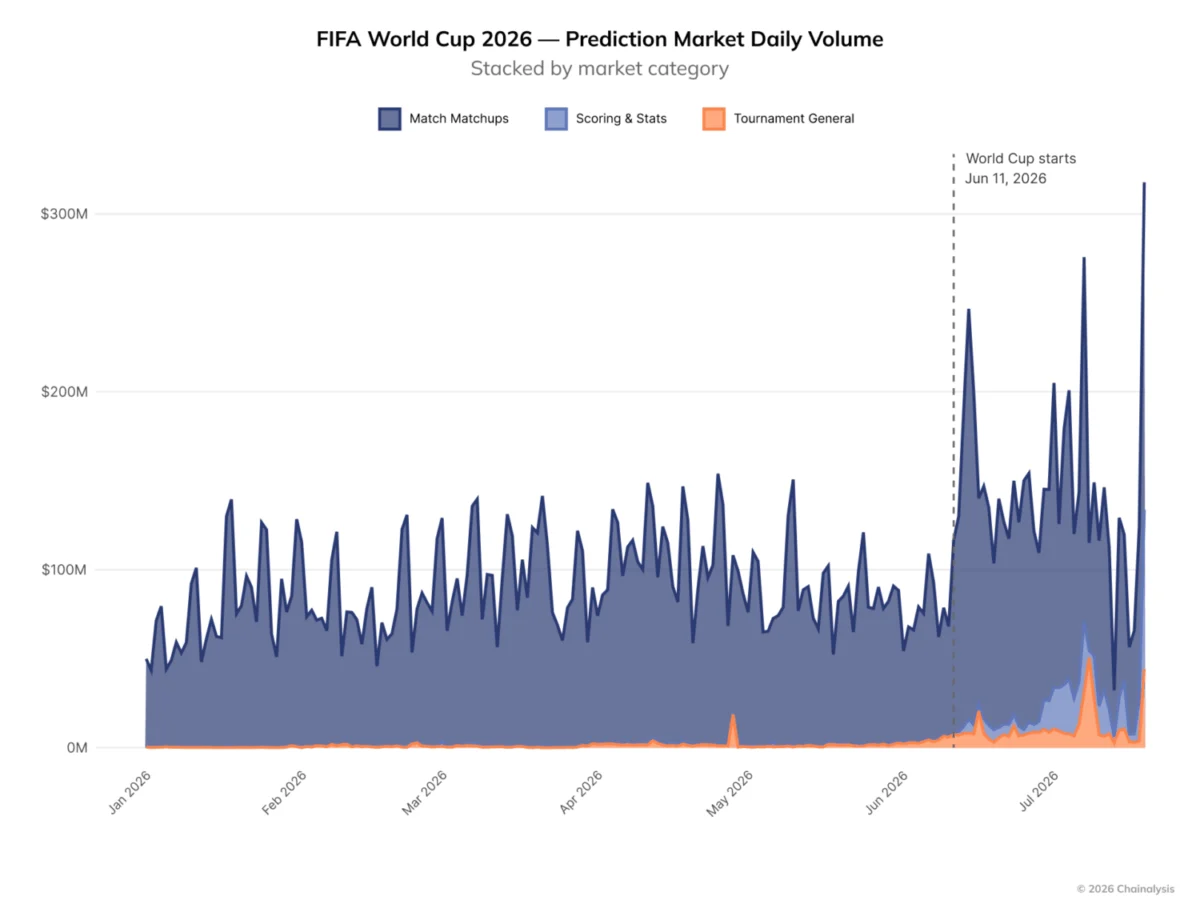
The sheer scale of the 2026 World Cup’s on-chain footprint is a testament to the maturation of decentralized finance (DeFi) tools. Between January 2026 and the end of the tournament in July, prediction markets saw a cumulative volume of $20 billion. Of this, $5.7 billion was generated during the five-week window of the tournament itself. Prediction markets, which allow users to trade shares in the outcome of future events, have evolved from niche crypto experiments into high-liquidity platforms capable of handling billions in volume.
During the tournament, FIFA-related markets accounted for approximately 63% of the total global prediction market volume. While the primary drivers were standard "match-winner" bets, the flexibility of smart contracts allowed for the creation of "novelty markets" that captured the public imagination. One notable market centered on whether the legendary Portuguese forward Cristiano Ronaldo would be seen crying at the conclusion of his final World Cup campaign. The market concluded in the affirmative, generating $49 million in trading volume as bettors speculated on the emotional climax of a storied career.
The demographic breakdown of these participants reveals a sophisticated user base. Of the nearly 400,000 unique wallets that interacted with these markets, 55% of bettors ended the tournament in profit. Crucially, 79% of those who came out ahead were identified as "experienced prognosticators"—users with a history of on-chain betting—suggesting that these markets are increasingly being used as tools for informed speculation rather than mere gambling.

Chronology of the On-Chain Campaign
The financial momentum for the 2026 World Cup did not begin with the opening whistle in June; rather, it was a slow build that mirrored the multi-year qualification process. Chainalysis traced the activity back to January 2026, when the final stages of the qualification rounds were still underway.
Pre-Tournament Build-up (January – May 2026)
Throughout the first quarter of 2026, prediction markets maintained a steady daily volume of approximately $50 million. These early bets focused on which nations would secure the final qualifying spots and initial group-stage placements. As the qualification matches concluded in March, daily volumes occasionally spiked above $100 million, reflecting the heightened stakes for nations on the brink of elimination.
The Group Stages and Knockout Rounds (June 2026)
When the tournament officially commenced on June 11, the on-chain economy entered a phase of hyper-growth. Daily volumes immediately jumped to the $250 million range. The frequency of matches during the group stages provided a constant stream of opportunities for bettors, keeping liquidity high across a variety of decentralized platforms.

The Final and the Spain-Argentina Showdown (July 2026)
As the field narrowed, the concentration of capital increased. Despite fewer matches being played in the final weeks, the volume per match surged. The final, which saw Spain triumph over Argentina, became the single largest on-chain betting event in sports history, with over $300 million in volume recorded for that match alone. The final’s success offset the natural tapering of activity that usually occurs as teams are eliminated.
Global Distribution and Regional Leaders
The borderless nature of blockchain technology allowed for truly global participation, though certain regions emerged as clear leaders in the 2026 on-chain economy. Analysis of geolocation data, despite the challenges posed by VPNs and privacy tools, shows that the United States and China led the world in total prediction market volume.
North American participation was likely bolstered by the fact that the tournament was hosted across the United States, Canada, and Mexico, creating a localized frenzy for engagement. Canada, the United Kingdom, and Thailand also featured prominently in the top tier of contributing nations. The high volume from China is particularly noteworthy given the country’s complex regulatory stance on digital assets, suggesting that decentralized prediction markets remain a popular, albeit unofficial, outlet for speculative activity in the region.

FIFA Collect: Bridging Digital Assets and Physical Access
Beyond the speculative world of prediction markets, FIFA’s foray into digital collectibles provided a case study in the practical application of NFTs. The "FIFA Collect" platform, built on the Avalanche blockchain, generated $24 million in transaction volume from May 2025 through the end of the tournament.
Unlike the speculative NFT craze of previous years, FIFA Collect focused on utility. Fans could purchase "digital moments" or commemorative assets that granted them the "right to buy" tickets for the World Cup. This served as a vital alternative for fans who were unsuccessful in the traditional, highly competitive ticket lotteries. According to FIFA Collect data, over 100,000 fans secured their entry to the stadiums through this blockchain-powered secondary market.
The economic structure of FIFA Collect also provided a new revenue stream for the organization. FIFA implemented a 5% royalty on all secondary market transactions. Chainalysis identified a key wallet managing these flows, which indicated that FIFA earned at least $6 million from secondary sales alone. This "stablecoin-powered economy" allowed for seamless international transactions, as fans from qualified nations contributed $17.6 million to the platform, while the rest of the world added another $6.6 million.

Security, Compliance, and Illicit Flows
As with any financial ecosystem of this scale, the 2026 World Cup on-chain activity was not entirely free of illicit actors. However, the data reveals a stark contrast between the unregulated prediction markets and the strictly governed FIFA Collect platform.
In the prediction market sector, Chainalysis identified approximately 3,700 wallets—less than 1% of the total—with ties to illicit activity. The single largest source of "tainted" capital was the exchange Huobi (now HTX), which was sanctioned by the UK and EU in May 2026 for allegedly facilitating Russian crypto flows. Approximately $5.4 million in volume flowed directly from HTX-linked wallets into World Cup betting pools. Other minor links to scams and theft were also detected, highlighting the ongoing challenge of policing decentralized protocols.
In contrast, FIFA Collect showed "negligible" exposure to illicit flows. This success is attributed to FIFA’s robust Know Your Customer (KYC) protocols. To access the "right to buy" tickets, users were required to undergo manual verification and declare their source of funds. This rigorous vetting process effectively deterred bad actors, demonstrating that when sports organizations implement traditional financial safeguards on the blockchain, they can successfully mitigate the risks associated with digital assets.

Broader Implications for the Future of Sports Finance
The 2026 FIFA World Cup has provided a blueprint for how the world’s largest events will operate in an increasingly digitized financial landscape. The $20 billion in prediction market volume suggests that the "wisdom of the crowd" is becoming a formalized asset class, providing real-time data on public sentiment and event probabilities that often rival traditional bookmakers in accuracy.
For sports governing bodies, the success of FIFA Collect proves that NFTs are most effective when tied to tangible rewards, such as tournament access and exclusive physical experiences. The move toward "on-chain rails" for ticketing could eventually solve long-standing issues with fraud and price gouging in the secondary market, provided that the platforms maintain the high compliance standards seen during this tournament.
As more of the world’s financial infrastructure moves on-chain, the ability to trace and analyze these flows will become a requirement for regulators and organizers alike. The 2026 World Cup was a microcosm of this transition—a high-stakes environment where legitimate fan passion and sophisticated digital finance collided. The lessons learned here will likely shape the digital strategies for the 2028 Olympic Games and beyond, as the boundary between the physical stadium and the digital wallet continues to disappear.