No hack has been officially claimed by Memecore, nor has any exploit been publicly disclosed. Yet, the on-chain evidence, meticulously scrutinized by blockchain security experts, paints a stark picture of unauthorized or unexplained token generation. The project’s delayed and ultimately uninformative response, limited to a cryptic teaser rather than a detailed explanation, has only amplified skepticism and fueled speculation across the crypto community.
The Unexplained Genesis of a Billion Tokens
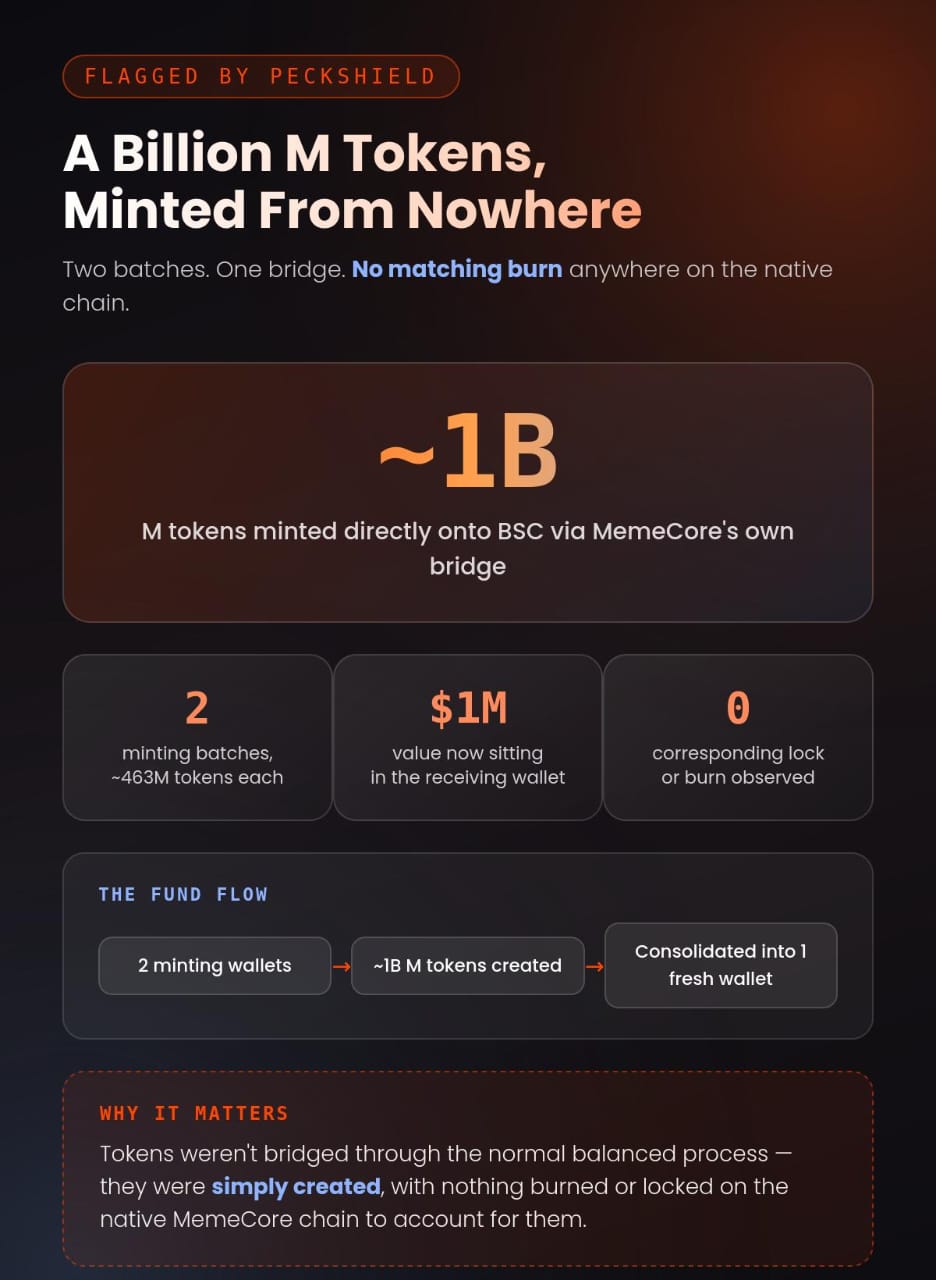
The core of the controversy lies in the sudden creation of roughly one billion M tokens. According to detailed findings published by the prominent blockchain security firm PeckShield, this massive influx of tokens occurred through Memecore’s own cross-chain bridge. Cross-chain bridges are vital infrastructure in the multi-chain cryptocurrency ecosystem, designed to facilitate the transfer of assets between different blockchain networks. In a standard, legitimate bridging operation, tokens are typically "locked" or "burned" on the originating chain before an equivalent amount is "minted" on the destination chain, ensuring a balanced supply and preventing inflation.
PeckShield’s analysis, however, revealed a critical deviation from this standard protocol. Two distinct batches of M tokens, each amounting to approximately 463 million units, were minted. These tokens originated from wallets identified as 0xfdea...447a7BF and 0x4388...C919dd7 and were subsequently consolidated into a single, previously unknown address: 0x69cB...F6FF4681. This new address is now observed to hold a significant, though considerably reduced, value of roughly $1 million in M tokens, reflecting the asset’s precipitous decline since earlier valuations.
Crucially, PeckShield explicitly noted that no corresponding lock or burn event was observed on Memecore’s native blockchain. This absence is the linchpin of the entire controversy. It indicates that the tokens were not merely moved from one chain to another in a balanced transaction, but were rather created anew without any corresponding reduction in supply elsewhere in the ecosystem. Such an event, if not properly accounted for and justified, represents an inflationary action that directly dilutes the value of existing tokens and undermines the trust placed in the project’s tokenomics.
Distinguishing From an External Attack: The "Inside Job" Hypothesis
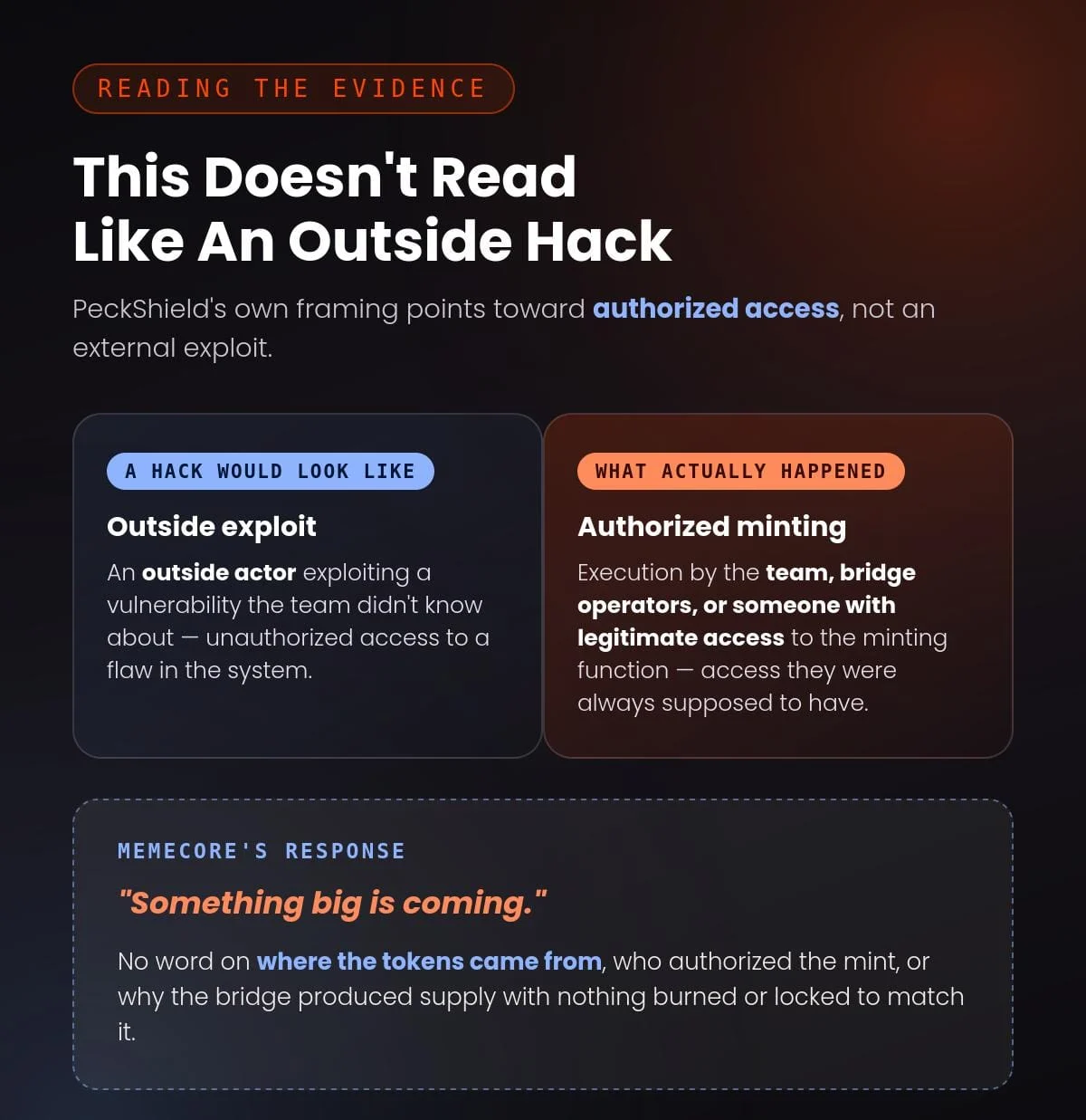
The mechanism of this token generation event leads blockchain security experts, including PeckShield, to a particularly troubling conclusion: this does not appear to be a typical external hack. In a conventional cyberattack on a blockchain project, an unauthorized external actor exploits a vulnerability in the code or infrastructure to illicitly gain access to funds or mint tokens. Such events are often accompanied by public claims from the hackers, ransom demands, or clear evidence of an external breach.
Instead, the evidence surrounding the Memecore incident strongly suggests that the tokens were minted through authorized access to the project’s cross-chain bridge. PeckShield’s assessment points towards execution by the project’s development team, the bridge operators, or another entity possessing legitimate administrative control over the minting function. This distinction is profoundly significant. It shifts the narrative from a system vulnerability exploited by an outside adversary to a potential misuse of internal controls by an authorized party.
If confirmed, this scenario raises fundamental questions about governance, accountability, and ethical conduct within the Memecore project. It implies that individuals with trusted access to the project’s core functionalities may have used that access in a manner that created new tokens without the transparency and corresponding supply management expected by the community. This would represent a severe breach of trust, far more damaging than an external hack, as it points to a potential failure of internal checks and balances or, worse, deliberate malfeasance.
A Troubling Echo: ZachXBT’s Prior Warnings and a History of Scrutiny
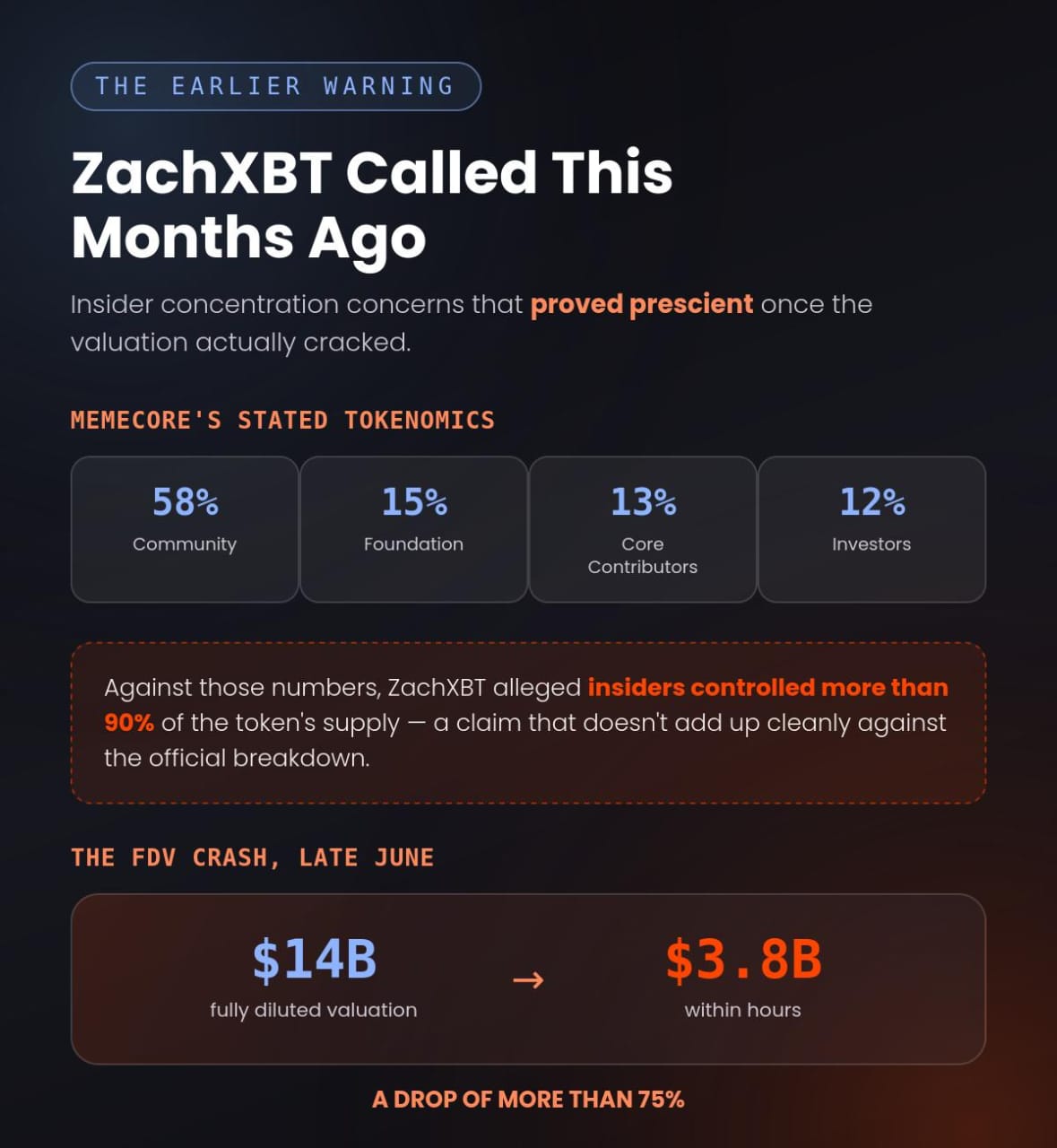
This week’s minting event does not occur in a vacuum; it resonates with a history of serious concerns previously raised about Memecore’s tokenomics and insider control. Months prior to this incident, the widely respected on-chain detective and crypto investigator ZachXBT publicly challenged Memecore’s multi-billion dollar valuation. His allegations were stark: ZachXBT claimed that insiders controlled an astonishing proportion—more than 90%—of the M token’s total supply.
ZachXBT’s warnings were not casual observations. They emerged shortly after the collapse of RaveDAO’s token, which plummeted by over 90% in what he described as a suspected pump-and-dump scheme. In a detailed exposé, ZachXBT highlighted that Memecore exhibited similar warning signs: a dangerously thin circulating float artificially propping up an enormous fully diluted valuation (FDV). The project’s stated tokenomics—58% for the community, 15% for the foundation, 13% for core contributors, and 12% for investors—did not, according to ZachXBT’s analysis, reconcile cleanly with his claim of over 90% insider concentration. Such a disparity suggests that the publicly available tokens represent only a fraction of the actual supply, with the vast majority held by a select few, granting them immense control over market movements.
The prescience of ZachXBT’s concerns became painfully evident by late June. Within a matter of hours, M’s fully diluted valuation crashed dramatically, plummeting from approximately $14 billion to $3.8 billion—a drop exceeding 75%. Following this devastating downturn, ZachXBT again pressed major cryptocurrency exchanges, including Binance and Bybit, to provide explanations for how a token with such minimal verifiable liquidity could have been listed with multi-billion-dollar valuations in the first place. These past events underscore a pattern of opacity and vulnerability to large-scale price manipulation, making the current unexplained token minting all the more alarming.
Timeline of Suspicion: From Insider Claims to Unexplained Minting
To fully grasp the gravity of the current situation, it is crucial to establish a chronological context:
- Months Prior (Early to Mid-2024): ZachXBT publicly raises significant concerns about Memecore’s M token. He alleges that over 90% of the token supply is controlled by insiders, pointing to a dangerously thin circulating float and an inflated Fully Diluted Valuation (FDV). He draws parallels to the suspected pump-and-dump collapse of RaveDAO, urging caution.
- Late June 2024: ZachXBT’s warnings prove distressingly accurate. M token’s FDV crashes by over 75%, falling from an estimated $14 billion to $3.8 billion within a short period. ZachXBT publicly questions exchanges like Binance and Bybit regarding their listing criteria for a token with such evident liquidity issues.
- This Week (Specific Date Noted by PeckShield): Approximately one billion M tokens are minted through Memecore’s cross-chain bridge onto the Binance Smart Chain (BSC). These tokens are consolidated into a new, previously unseen wallet. Crucially, PeckShield confirms that no corresponding lock or burn event occurred on Memecore’s native chain, indicating a net increase in supply rather than a cross-chain transfer.
- Following the Minting Event: No official explanation is issued by Memecore. The project’s social media channels remain silent on the specific incident.
- Later This Week: Memecore’s official account posts a cryptic teaser, stating "something big is coming," without addressing the on-chain anomalies.
- Present: The crypto community, led by PeckShield and other analysts, demands a direct and transparent explanation from Memecore regarding the source and authorization of the newly minted tokens. The value of M tokens in the newly minted wallet is estimated to be around $1 million, a stark contrast to the initial "billion dollars materialized" figure, indicating a massive price devaluation.
This sequence of events paints a picture of recurring issues, where concerns about insider control and supply manipulation have now culminated in a direct, unexplained creation of a vast number of tokens.
Memecore’s Cryptic Response: A Teaser, Not an Explanation
In the face of undeniable on-chain evidence of a billion freshly minted tokens and a documented history of insider concentration concerns, Memecore’s official communication has been notably deficient. Rather than issuing an immediate, comprehensive statement addressing the technical specifics of the minting event, the project’s official account posted a vague message on social media: "something big is coming."
This response, widely perceived as tone-deaf and dismissive, has done little to assuage fears or provide clarity. For a community grappling with the implications of a massive, unexplained token issuance, a marketing teaser about future announcements is antithetical to the urgent need for transparency. Investors and analysts are not seeking marketing hype; they are demanding answers to fundamental questions: Where did these tokens originate? Who authorized their minting? Why did the project’s own bridge facilitate the creation of supply that does not reconcile with any corresponding burn or lock on the native chain?
The absence of a direct, technical explanation exacerbates the project’s credibility crisis. It suggests either an inability to explain the situation, a deliberate attempt to obfuscate, or a severe misjudgment of the community’s immediate concerns. In the high-stakes world of cryptocurrency, where trust is paramount and rumors can swiftly trigger market panic, such an evasive response can be more damaging than outright silence.
Broader Implications for Market Integrity and Investor Trust
The Memecore incident extends beyond the specifics of a single project; it casts a long shadow over the broader cryptocurrency ecosystem, particularly concerning the integrity of cross-chain bridges and the transparency of tokenomics. Cross-chain bridges are essential for interoperability, but their security and proper functioning are critical. An event where a bridge can mint tokens without proper safeguards or corresponding burns highlights a systemic risk that could be exploited by malicious actors or even misused by project insiders.
For anyone currently holding M tokens or observing this unfolding drama, the implications are dire. PeckShield’s independently verifiable on-chain findings represent the most reliable information available. Until Memecore provides a transparent and technically sound explanation for the origin and authorization of these tokens, the asset remains under a cloud of deep suspicion. The history of ZachXBT’s prior warnings, which proved directionally accurate with the subsequent crash in M’s FDV, further compounds the precariousness of the situation. For existing token holders, "wait and see" is unlikely to be a comfortable or financially prudent position.
Moreover, this incident reinforces the ongoing debate about regulatory oversight in the crypto space. Events of this nature, where significant value is seemingly created ex nihilo without clear accountability, are precisely the types of scenarios that attract the attention of financial regulators worldwide. The lack of transparency and the potential for market manipulation could lead to calls for stricter rules regarding token issuance, bridge operations, and insider trading within decentralized projects.
The Memecore situation also serves as a stark reminder of the inherent risks in projects with concentrated ownership and thin liquidity. While the allure of quick gains in meme coins is powerful, the underlying mechanics often leave retail investors vulnerable to the actions of large holders or project teams. The ability to mint a billion tokens without explanation fundamentally alters the supply dynamics and severely impacts the trust model that underpins any cryptocurrency.
Conclusion: An Unresolved Crisis of Trust
The Memecore M token incident represents a critical juncture for the project and a significant point of concern for the wider crypto industry. The unexplained minting of approximately one billion tokens through its own cross-chain bridge, devoid of any corresponding burn on the native chain, constitutes a severe anomaly. Coupled with a history of insider concentration allegations from ZachXBT and a prior devastating price crash, the project’s current silence and evasive communication strategy are profoundly damaging.
The crypto community, armed with the verifiable data provided by blockchain security firms like PeckShield, demands a full, transparent, and technical explanation. Until Memecore addresses precisely how these tokens were created, who authorized the transaction, and why their own bridging mechanism allowed for such an inflationary event without proper checks, the project’s credibility will remain severely compromised. This event underscores the paramount importance of robust security, transparent tokenomics, and unwavering accountability from project teams in maintaining the integrity and fostering trust within the rapidly evolving landscape of decentralized finance. The resolution of this crisis will likely serve as a case study for how projects navigate profound challenges to their foundational principles.