
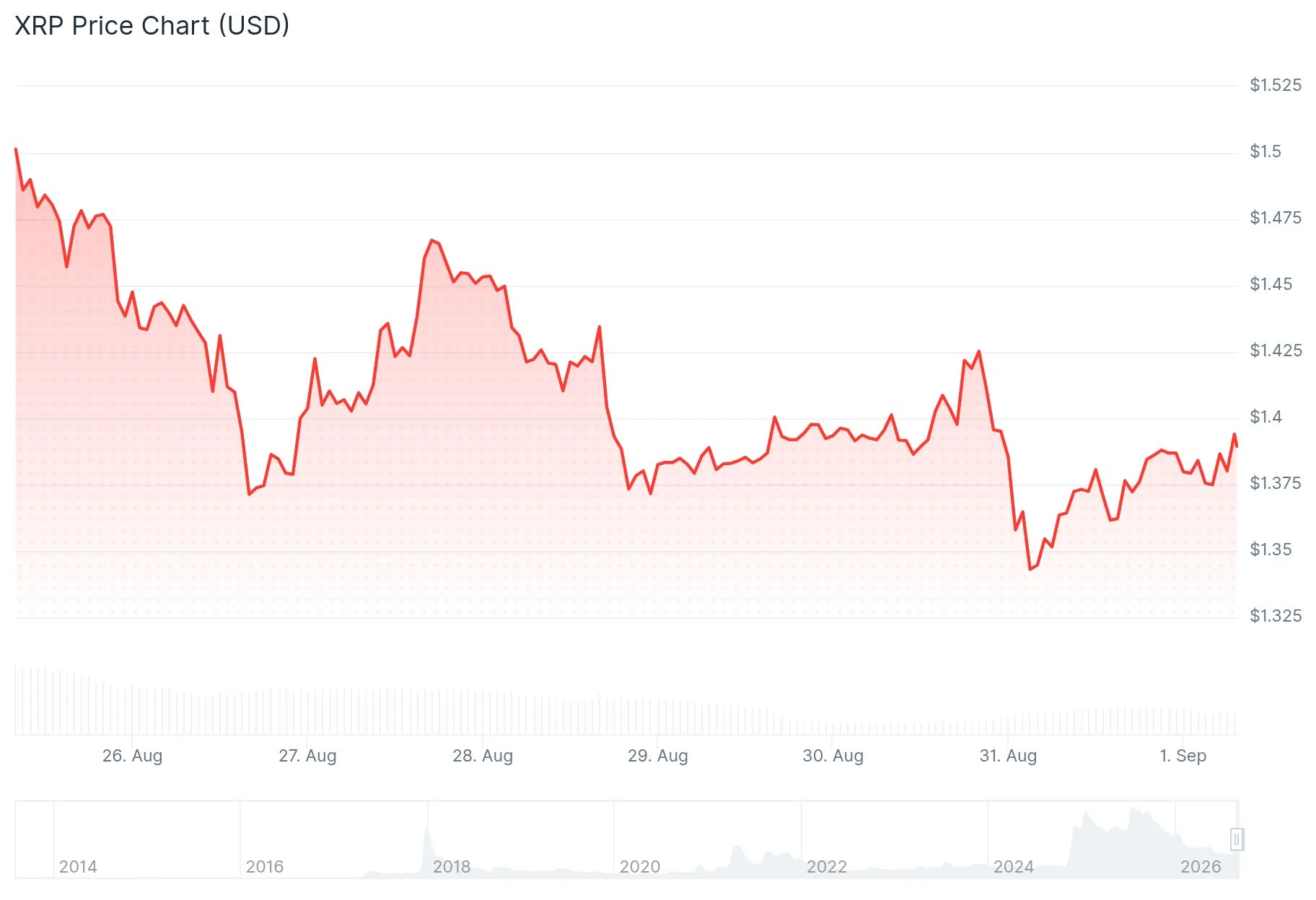
As of August 31, the digital asset XRP was trading around $1.37, experiencing a modest 2% pullback over the preceding 24-hour period. However, the market’s attention is firmly fixed on an upcoming Senate procedural vote scheduled for September 15, which holds significant potential to influence XRP’s near-term price trajectory and, more broadly, the regulatory landscape for cryptocurrencies in the United States. This pivotal vote pertains to the Digital Asset Market Clarity Act, widely known as the CLARITY Act, a piece of legislation aimed at providing much-needed regulatory definitions for digital assets.
The CLARITY Act: A Quest for Regulatory Certainty
The CLARITY Act represents a significant legislative effort to establish clear guidelines for the classification and regulation of digital assets within the United States. Its primary objective is to differentiate between digital assets that function as securities and those that operate as commodities, a distinction that has been a persistent source of ambiguity and contention for the industry. This lack of clarity has been a major impediment to innovation and investment, leading to a patchwork of enforcement actions and conflicting interpretations from various regulatory bodies, most notably the Securities and Exchange Commission (SEC) and the Commodity Futures Trading Commission (CFTC). For XRP, specifically, the outcome of the CLARITY Act is particularly relevant given Ripple Labs’ ongoing legal battle with the SEC, which centers on whether XRP should be classified as an unregistered security. The Act, if passed, could provide legislative backing to classify certain digital assets as commodities, potentially offering a clearer path forward for projects like XRP that have faced scrutiny.
The upcoming September 15 vote in the Senate is a procedural step known as a cloture motion. For the CLARITY Act to advance to a full Senate debate, it must garner a 60-vote threshold. It is crucial to understand that achieving this threshold would merely allow the legislation to proceed to further discussion and potential amendments; it does not guarantee its ultimate approval or passage into law. The legislative journey of the CLARITY Act has been protracted and complex. The lower chamber, the House of Representatives, successfully approved its version of the measure by a substantial margin of 294–134 in July 2025. This bipartisan support was notable, with 78 Democratic representatives crossing the aisle to vote in favor. Following this, the Senate Banking Committee advanced a companion bill with a 15–9 vote in May 2026. However, a more comprehensive version of the bill, which aimed to address a broader range of digital asset issues, subsequently lost momentum, leading to the current focus on this more targeted procedural vote.
Evolving Legislative Outlook and Political Dynamics
The prospects for the CLARITY Act have seen dramatic shifts in forecasting platforms. Current probability estimates for its passage during 2026 have plummeted to approximately 14%, a stark contrast to the 82% recorded in February of the same year. This significant decline in confidence reflects the mounting political hurdles and divergent views within Congress. A primary sticking point has been the insistence by Democratic lawmakers on the inclusion of enhanced provisions specifically addressing political officials’ cryptocurrency dealings. These provisions aim to mitigate potential conflicts of interest and increase transparency regarding digital asset holdings and transactions by elected officials and government employees. Without such assurances, a substantial bloc of Democratic support remains elusive, complicating the path to the required 60 votes.
Adding another layer of complexity to the regulatory landscape, CFTC Chair Michael Selig has publicly affirmed that the commission believes it possesses adequate authority to oversee cryptocurrency markets under existing statutory frameworks. This assertion suggests a potential overlap or even redundancy in regulatory oversight, raising questions about the necessity and scope of new legislation. Furthermore, on August 18, the SEC introduced its own "Regulation Crypto Assets" framework. This framework incorporates several definitional elements that appear to align, at least in part, with the principles espoused by the CLARITY Act. The existence of these separate, yet potentially converging, regulatory initiatives from both the CFTC and SEC creates a nuanced environment where legislative action must carefully navigate existing agency mandates.
Crypto analyst XrpArab provided commentary on August 31, noting that CFTC Chair Michael Selig appears optimistic regarding the outcome of the September 15 Senate proceeding. However, the analyst also highlighted that despite this optimism, there remain unresolved complications requiring immediate attention. XrpArab further discussed the potential consequences should the cloture motion fail, particularly in the context of the impending October election recess. A failure to advance the bill before the recess could effectively push legislative action on crypto clarity well into the next congressional session, potentially prolonging the current state of regulatory uncertainty. This timeline adds an element of urgency to the September 15 vote, as legislative bandwidth for complex issues typically shrinks significantly during an election cycle.

Unprecedented ETF Capital Flows Reflect Growing Institutional Appetite
Despite the ongoing regulatory uncertainties and the fluctuating legislative outlook, the market for XRP-backed exchange-traded funds (ETFs) has demonstrated remarkable resilience and growth. These investment vehicles have documented their highest weekly capital inflows on record, totaling an impressive $110.49 million. This surge in interest underscores a burgeoning institutional appetite for XRP, signaling confidence in its long-term potential regardless of short-term regulatory ambiguities.
A closer look at the daily figures reveals the intensity of this institutional engagement. August 28 alone witnessed substantial net contributions of $26.20 million, a clear indicator of strong buying pressure from institutional investors. These significant daily and weekly inflows have propelled the cumulative net inflows into XRP ETF vehicles to an astounding $1.66 billion. This cumulative figure highlights a consistent and growing commitment from sophisticated investors to allocate capital to XRP through regulated investment products.
Among the various firms offering XRP ETFs, Bitwise emerged as the dominant player in this period, attracting $15.40 million in inflows. Trailing Bitwise were Canary, which secured $5.12 million, and Franklin, with $2.99 million in net contributions. The aggregated net assets held within all XRP ETF vehicles have now reached a substantial $1.44 billion. This expansion in ETF capital flows is a crucial barometer of institutional adoption, indicating a maturation of the market infrastructure around XRP and an increasing comfort level among large-scale investors to gain exposure to the digital asset through regulated and easily accessible channels. The demand for these products suggests that institutions are positioning themselves for potential future clarity, or are comfortable with the existing legal precedents established in cases like the SEC vs. Ripple ruling which partially clarified XRP’s status.
CME Derivatives Market Share Expands Amidst Overall Leverage Contraction
Another significant development in the XRP market is the notable expansion of open interest in CME XRP futures. Between August 17 and August 31, open interest in these regulated futures contracts grew from 284 million tokens to 387 million tokens, representing an approximate 36% increase. This surge in CME activity is particularly noteworthy as it signifies a growing preference among institutional traders for regulated platforms to gain exposure to XRP.
The increasing institutional engagement on CME has also led to a substantial rise in its market share within the broader XRP futures landscape. CME’s share of total XRP futures exposure climbed to roughly 17%, a significant increase from its 10% share observed in mid-August. This trend suggests a migration of institutional capital towards highly regulated and transparent exchanges, potentially seeking reduced counterparty risk and enhanced regulatory oversight.
Interestingly, this expansion in CME’s market share occurred even as the aggregate XRP open interest across all trading platforms experienced a contraction. Throughout the same timeframe, total XRP open interest declined from 2.77 billion to 2.34 billion tokens. This decline in overall leverage in the market, despite a nearly 40% price appreciation for XRP during the period, indicates a nuanced market dynamic. It suggests that while institutional interest on regulated platforms is growing, there might be a simultaneous reduction in speculative or retail-driven leverage on unregulated or less regulated exchanges. This could be interpreted as a deleveraging event in some segments of the market, even as professional investors increase their exposure via more controlled avenues.
Further insights into institutional positioning come from CFTC positioning data covering the period through August 25. This data revealed that leveraged funds significantly increased their net short positions, holding the equivalent of approximately 116 million XRP. This figure more than doubled the previous week’s 57 million XRP, indicating a growing bearish sentiment or hedging activity among this cohort of sophisticated investors. Conversely, dealer participants increased their net-long holdings by roughly 60 million XRP, suggesting a more bullish stance or perhaps market-making activities. Asset manager positions also grew, albeit more modestly, by around 28 million tokens. The divergence in positioning among these different institutional categories highlights a complex interplay of market strategies, potentially reflecting varied interpretations of regulatory outcomes, market liquidity, and future price expectations.
Technical Analysis and Market Outlook
Amidst these fundamental and regulatory developments, XRP’s price action has shown signs of consolidation. XRP-focused analyst account XRP Update observed on X that XRP is currently consolidating within a narrow triangle formation around the $1.38 mark. This consolidation follows a robust 56% rally, indicating a period of equilibrium after significant upward movement. Should this pattern resolve to the upside, a projected upside target approaching $2.17 has been identified, suggesting substantial potential for further gains if bullish momentum resumes.
From a technical indicator perspective, the Relative Strength Index (RSI), a momentum oscillator, has moderated to 43. This reading suggests that XRP is neither overbought nor oversold, providing room for movement in either direction without immediate concerns of extreme price action. Key primary support zones for XRP are identified between $1.35 and $1.38, which align closely with the current consolidation range. These levels are crucial for maintaining bullish sentiment. On the other hand, overhead resistance is clustered between $1.53 and $1.55. A decisive break above this resistance would be a strong technical signal for a continuation of the upward trend, potentially validating the analyst’s target of $2.17. The interplay of these technical levels with the fundamental developments surrounding the CLARITY Act and institutional inflows will likely dictate XRP’s price trajectory in the coming weeks.
Broader Implications and The Road Ahead
The September 15 Senate vote on the CLARITY Act is more than just a procedural hurdle for a single piece of legislation; it is a critical moment for the broader cryptocurrency industry in the United States. For XRP, a positive outcome – even if only advancing the bill to full debate – could instill greater confidence among investors and potentially provide a clearer regulatory pathway that mitigates future legal risks. Conversely, a failure to pass the cloture motion could prolong the existing regulatory ambiguity, casting a shadow over the digital asset market and potentially dampening investor enthusiasm.
The ongoing efforts by the CFTC and SEC to assert their regulatory authority, alongside Congress’s attempts to legislate, highlight a fragmented approach to digital asset governance in the US. This lack of a unified, comprehensive framework has been consistently cited by industry leaders as a major barrier to innovation and competitive growth compared to other jurisdictions that have adopted more forward-thinking regulatory stances. The CLARITY Act, even in its current, more limited form, represents an opportunity to take a step towards greater harmonization and predictability.
The unprecedented institutional inflows into XRP ETFs and the increased activity on regulated derivatives platforms like CME underscore a growing demand from professional investors for clear and regulated access to digital assets. This institutional maturation is happening concurrently with the political machinations in Washington, creating a dynamic environment where market forces are pushing for clarity while legislative processes struggle to keep pace. As the October election recess looms, the pressure on lawmakers to address these critical issues intensifies. The outcome of the September 15 vote will therefore not only impact XRP but will also serve as a barometer for the US’s commitment to fostering a clear and competitive environment for the burgeoning digital asset economy. The industry, investors, and regulators alike will be closely watching as this pivotal moment unfolds.