Foundry, the digital asset infrastructure giant and operator of the world’s most dominant Bitcoin mining pool, has officially announced its strategic expansion into the Zcash ecosystem with the scheduled launch of a dedicated institutional-grade mining pool in April 2026. This move represents a significant pivot for the Rochester-based firm, as it seeks to apply its proven North American mining model to the privacy-preserving cryptocurrency sector. By bridging the gap between sophisticated financial institutions and the decentralized privacy protocols of Zcash, Foundry aims to provide a regulated, transparent, and high-performance gateway for public companies and large-scale enterprises to participate in Zcash (ZEC) network security and reward mechanisms.
The announcement comes at a pivotal moment for Foundry Digital LLC, a subsidiary of Digital Currency Group (DCG). Having already established Foundry USA as the undisputed leader in the Bitcoin mining space—often accounting for nearly 30% of the total global Bitcoin hashrate—the company is now looking to diversify its portfolio. The decision to target Zcash is rooted in the belief that while the asset has matured into a liquid, institutional-grade commodity, the underlying mining infrastructure has remained fragmented and largely inaccessible to entities requiring strict compliance and operational excellence.
The Strategic Shift Toward Zcash Infrastructure
Zcash, launched in 2016 by the Electric Coin Company and currently supported by the Swiss-based Shielded Labs, has long been regarded as the "gold standard" of privacy coins. Unlike Bitcoin, which operates on a transparent ledger where transaction amounts and addresses are visible to any observer, Zcash utilizes Zero-Knowledge Succinct Non-Interactive Arguments of Knowledge (zk-SNARKs). This mathematical framework allows users to prove the validity of a transaction without revealing the sender, receiver, or the amount involved.
Despite its technological sophistication, Zcash mining has historically been dominated by smaller, decentralized pools or regions with less regulatory oversight. Mike Colyer, CEO of Foundry, highlighted this discrepancy in a recent statement, noting that Zcash has matured into an institutional-grade asset, yet the mining infrastructure supporting it has failed to keep pace. By launching a pool specifically designed for the needs of public companies and institutional miners, Foundry is positioning itself as the primary architect for the next generation of privacy-centric financial infrastructure.

The upcoming pool will be operated out of North America, mirroring the successful blueprint of the Foundry USA pool. This geographic focus is critical for institutional participants who require certainty regarding the jurisdictional origin of their rewards and the legal compliance of their service providers.
A Chronology of Zcash and the Path to 2026
To understand the significance of Foundry’s entry, one must look at the evolution of the Zcash protocol and the broader mining landscape. Zcash was built on a codebase derived from Bitcoin, inheriting its most fundamental economic principles, including a hard cap of 21 million tokens and a "halving" mechanism that reduces block rewards by 50% approximately every four years.
- 2016: Zcash is launched, introducing zk-SNARKs to the mainstream crypto market.
- 2020: The first Zcash halving occurs, coinciding with the establishment of the Major Grants fund to decentralize development.
- 2023–2024: The Zcash network experiences a significant surge in hashrate, driven by the release of more efficient ASIC (Application-Specific Integrated Circuit) mining hardware, such as Bitmain’s Antminer Z-series.
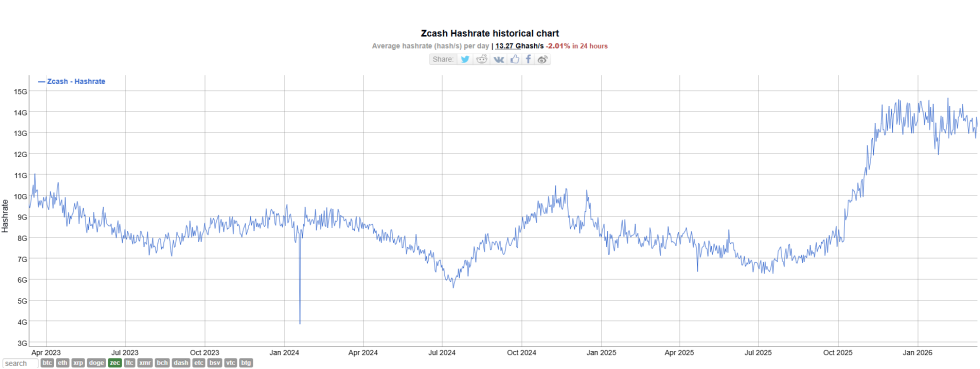
- October 2025: Network hashrate begins a dramatic ascent, climbing from under 8 Ghash/s to over 13 Ghash/s in a matter of months, signaling a renewed interest in the security and profitability of the chain.
- March 2026: Foundry officially announces its institutional pool.
- April 2026: The scheduled launch of the Foundry Zcash mining pool.
This timeline illustrates a project that has survived multiple market cycles and is now entering a phase of industrialization. The entry of a player as large as Foundry suggests that the "professionalization" of privacy coin mining is no longer a theoretical concept but a commercial reality.
Analyzing the Hashrate Boom and Network Security
The data supporting Foundry’s expansion is compelling. According to recent metrics from BitInfoCharts, the computing power—or hashrate—connected to the Zcash blockchain has seen a parabolic increase. In late 2025, the hashrate hovered around 7.5 to 8 Ghash/s. By the first quarter of 2026, it had stabilized above 13 Ghash/s.
A rising hashrate is generally a bullish indicator for a Proof-of-Work (PoW) network for several reasons. First, it increases the cost of a "51% attack," making the network more resilient against malicious actors. Second, it indicates that miners are investing heavily in new hardware, suggesting a long-term confidence in the asset’s value and the network’s longevity. For Foundry, this surge in hashrate represents a growing market of miners who need a reliable, institutional-grade partner to aggregate their computing power and smooth out the variance of block rewards.

In a mining pool, participants combine their resources to solve cryptographic puzzles more frequently than they could individually. When a block is successfully mined, the rewards are distributed among the participants proportional to the hashrate they contributed. Foundry’s entry into this space for ZEC means that large-scale operations can now move their hashrate to a provider that offers the same level of reporting, auditability, and payout stability that they have grown accustomed to in the Bitcoin market.
Institutional Perspectives and Industry Reactions
The reaction from the Zcash community has been overwhelmingly positive. Zooko Wilcox, the founder of Zcash and currently the Chief Product Officer at Shielded Labs, expressed enthusiasm for the partnership. He noted that having the world’s largest Bitcoin mining pool operator establish a presence in the Zcash ecosystem is a testament to the coin’s enduring value proposition. Wilcox emphasized that the move by a North American-based enterprise like Foundry reinforces the idea that financial privacy and compliant digital infrastructure are not mutually exclusive.
From a regulatory perspective, the launch is also a bold statement. Privacy coins have often faced scrutiny from global regulators concerned about the potential for illicit use. However, the Zcash protocol includes "view keys," which allow users to selectively disclose transaction details to third parties for auditing or tax purposes. Foundry’s involvement suggests a belief that the "compliance-friendly" features of Zcash are sufficient to satisfy the rigorous standards of public companies and institutional investors.
Shielded Labs, the independent support organization based in Switzerland, has played a crucial role in facilitating this transition. By providing a neutral ground for protocol development and ecosystem support, Shielded Labs has helped Zcash navigate the complex waters of global finance, making it an attractive target for Foundry’s expansion.
Broader Implications for the Privacy Coin Market
The launch of the Foundry Zcash pool in April 2026 is likely to have several far-reaching implications for the cryptocurrency industry.
- Validation of Privacy Technology: When a major infrastructure provider like Foundry invests in a privacy-centric asset, it signals to the broader market that privacy is a legitimate and necessary component of the digital financial stack. This could lead to increased interest in other privacy-preserving technologies and protocols.
- Shift in Mining Power: Currently, much of the Zcash hashrate is concentrated in pools that may not offer the transparency required by Western institutions. Foundry’s entry could see a significant migration of hashrate toward North America, potentially leading to a more geographically distributed and resilient network.
- Price Discovery and Liquidity: Institutional involvement in mining often leads to more sophisticated treasury management by miners. Rather than selling all rewards immediately to cover costs, institutional miners may hold ZEC as a long-term asset, potentially reducing sell-side pressure and aiding in price stability.
- Hardware Innovation: A dedicated institutional pool may encourage hardware manufacturers to develop even more efficient Zcash-specific ASICs, further driving the hashrate and security of the network.
Current Market Performance and Outlook
At the time of the announcement, Zcash (ZEC) was trading at approximately $209. While the token has experienced a weekly retracement of roughly 11%, the long-term trend reflects the broader recovery of the privacy sector. Analysts suggest that the price volatility is a natural correction following the recent hashrate surge and that the entry of institutional miners could provide a "floor" for the asset’s value in the coming years.
The 21-million-unit supply cap remains one of ZEC’s most attractive features for investors looking for a "digital gold" alternative with enhanced privacy. As the April 2026 launch date approaches, market participants will be closely watching for further technical updates and potential partnerships between Foundry and large-scale energy providers or data centers looking to diversify their mining operations.
In conclusion, Foundry’s decision to launch an institutional-grade Zcash mining pool is a landmark event that marries the world of high-finance compliance with the cutting-edge privacy of zero-knowledge proofs. By providing a robust, US-based infrastructure for ZEC, Foundry is not only expanding its own business horizon but is also fortifying the foundations of a more private and secure decentralized financial future. The move underscores a growing consensus: in the digital age, financial privacy is not a luxury but a fundamental requirement for a functioning, global, and institutional-grade economy.