


The trajectory of Polymarket’s anticipated $POLY token has unfolded as a compelling case study in crypto market hype, strategic communication, and the tightening grip of regulatory caution. What began with emphatic pronouncements from top leadership, positioning a nascent digital asset alongside industry giants, gradually receded into a perplexing silence, leaving a trail of breadcrumbs primarily maintained by a junior engineer before his own disappearance from the narrative. This detailed examination pieces together nearly two years of public statements, official filings, and internal communications to decipher whether the elusive $POLY token is still on the horizon or a casualty of shifting market dynamics and an increasingly complex legal landscape.
Polymarket, a prominent decentralized prediction market platform, operates at the nexus of finance, information, and blockchain technology. Prediction markets allow users to wager on the outcomes of future events, ranging from political elections and economic indicators to sports results and scientific breakthroughs. Participants buy and sell shares corresponding to different outcomes, with prices fluctuating based on collective belief and information. The final price of a share reflects the probability of that outcome occurring, and successful predictions yield financial returns. In the burgeoning decentralized finance (DeFi) ecosystem, native tokens often serve multifaceted roles, including governance, utility, staking rewards, and facilitating liquidity. For a platform like Polymarket, a token could empower its community with voting rights on market listings or platform upgrades, offer reduced trading fees, or serve as a medium for incentivizing liquidity provision, thereby deepening user engagement and decentralizing control. The promise of an airdrop – a free distribution of tokens to early users – has historically proven to be a potent growth mechanism in the crypto space, driving significant user acquisition and platform activity in anticipation of future rewards. This inherent potential for community empowerment and market growth formed the initial backdrop against which Polymarket’s $POLY narrative first emerged.
The Genesis of Hype: Polymarket’s Loud Years (Late 2024 – Mid 2025)
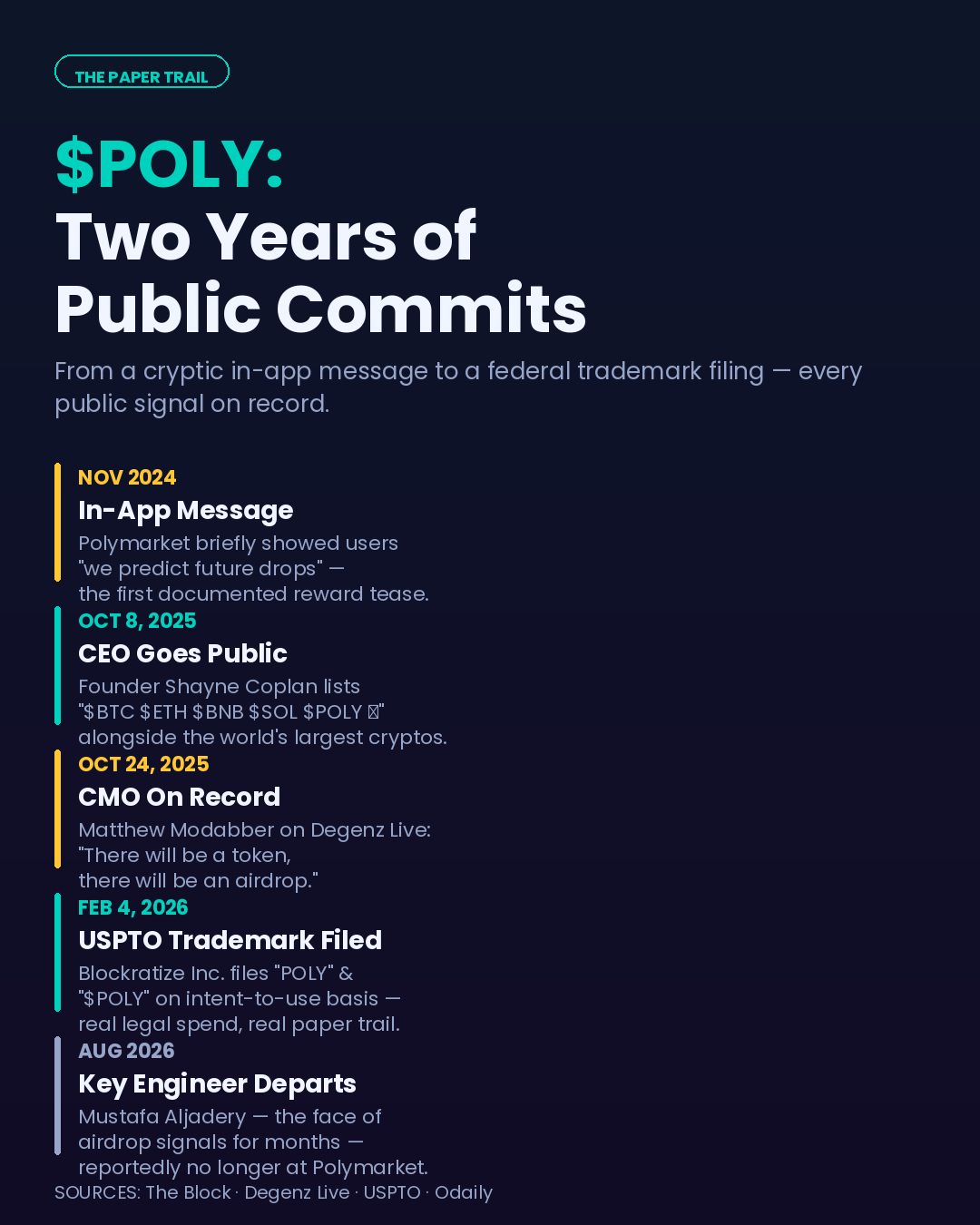
The earliest documented hint of a native token for Polymarket surfaced discreetly in November 2024. In the immediate aftermath of Donald Trump’s unexpected election victory, a period marked by heightened volatility and intense public interest in prediction markets, Polymarket briefly displayed an in-app message to its users stating, "we predict future drops." While no public record or social media post of this specific message survives, its existence was reported by industry outlets like The Block, which noted Polymarket’s earlier discussions about fundraising and potential token launches, albeit without firm commitments. This internal tease, visible only to active users, represented the first embryonic signal of an intent to reward its loyal user base, laying a subtle foundation for future expectations.
The teasing escalated dramatically and publicly on October 8, 2025, when Polymarket founder and CEO, Shayne Coplan, posted a now-widely-referenced message on social media. In a move that garnered significant attention, Coplan listed "$BTC $ETH$BNB $SOL$POLY 🤔", conspicuously placing his platform’s yet-to-be-launched token ticker, $POLY, directly alongside the symbols for Bitcoin, Ethereum, Binance Coin, and Solana – four of the world’s largest and most established cryptocurrencies. This highly visible declaration from the company’s chief executive was interpreted by many as an unambiguous statement of intent, signaling not just the existence of a future token but its aspirational stature within the broader crypto market. Such a bold pronouncement from a founder typically carries substantial weight, especially in an industry where social media pronouncements often dictate sentiment and expectations.
The single strongest confirmation of $POLY’s impending arrival came just weeks later, on October 24, 2025. Matthew Modabber, Polymarket’s Chief Marketing Officer (CMO), appeared as a guest on the popular Degenz Live podcast. During the interview, Modabber unequivocally stated, "There will be a token, there will be an airdrop." He further elaborated on the team’s vision, emphasizing the desire for the token to possess "true utility" and "longevity," rather than being a mere speculative asset. Modabber also linked the token’s launch timeline to the completion of Polymarket’s strategic US relaunch, suggesting a carefully planned rollout rather than an impulsive decision. This on-the-record declaration from a senior executive, detailing both the certainty of a token and its underlying strategic objectives, stood as the closest a crypto company could come to a formal corporate commitment without issuing a whitepaper or official press release. The market sentiment during this period was generally buoyant, with many projects leveraging token launches and airdrops to foster communities and expand their ecosystems, making Polymarket’s overt signaling align with prevailing industry trends.

A Shift in Strategy: The Quiet Turn and Legal Oversight (Late 2025 – Early 2026)
Following the emphatic double-hit of Coplan’s tweet and Modabber’s podcast confirmation in October 2025, a noticeable shift occurred in Polymarket’s public communication strategy regarding $POLY. C-level executives, who had previously been vocal proponents, largely ceased public discussion of the token. However, the signals did not entirely disappear; instead, they migrated lower down the organizational hierarchy, indicating a possible internal recalibration of communication protocols, likely influenced by burgeoning legal considerations.
In November 2025, William LeGate, Polymarket’s growth lead, became the primary public face addressing token-related discussions. His interventions focused on more operational aspects, specifically warning users against "sybil farming" – the practice of creating multiple fake accounts or engaging in artificial activities to game potential airdrop allocations. LeGate explicitly stated that such efforts would not lead to airdrop eligibility, asserting that those pursuing this route were "wasting their time." This shift from high-level strategic announcements to granular, anti-gaming advisories from a growth specialist suggested a company attempting to manage community expectations and ensure genuine engagement, even as its senior leadership adopted a more reserved stance.
The most legally significant development in the $POLY saga unfolded on February 4, 2026. Blockratize Inc., Polymarket’s parent company, took the concrete step of filing "intent to use" trademark applications for both "POLY" and "$POLY" with the United States Patent and Trademark Office (USPTO). These filings, which remain publicly accessible on the USPTO’s system, explicitly describe the marks in connection with "providing a digital currency for an online community," alongside broader categories encompassing cryptocurrency trading and financial platform services. Unlike ephemeral social media posts, a trademark application represents a formal, legally binding action. It incurs significant legal fees, requires careful legal review and sign-off, and establishes a clear paper trail of corporate intent. This action served as robust documentary evidence that internal work on the token was genuinely underway, transcending mere public rhetoric, regardless of the evolving public silence from leadership. The decision to file trademarks underscored a serious commitment to the token’s development and intellectual property protection, signaling a phase where legal infrastructure was actively being built. This period also coincided with increasing regulatory scrutiny globally, particularly from the U.S. Securities and Exchange Commission (SEC), which was intensifying its focus on the classification of digital assets as securities. Such an environment would naturally compel companies to adopt a more cautious and legally compliant approach to public announcements.
The Mustafa Era: Unofficial Communication and Abrupt Disappearance (February – August 2026)
From early 2026 onward, the public communication strategy surrounding $POLY became almost entirely concentrated on a single individual: Mustafa Aljadery, a Polymarket engineer who humorously referred to himself online as the company’s "senior intern." While other team members, including senior leadership, maintained their silence on the token, Mustafa became the unexpected, albeit unofficial, conduit for $POLY-related updates and teasers, creating a unique and somewhat precarious communication channel.
In February 2026, Mustafa posted, then swiftly deleted, a screenshot of a coding session. This screenshot reportedly depicted a task instruction to migrate Polymarket’s fee collection mechanism from USDC.e (a stablecoin) to POLY on the platform’s staging branch. As reported by crypto news outlets like Odaily and Bitget News, this brief glimpse into the development pipeline offered tangible evidence of internal technical work progressing on the $POLY token’s integration, suggesting that its functionality was actively being built into the platform’s core operations. Around the same time, Mustafa publicly responded to a prominent Polymarket trader with the phrase "1m markets and $POLY next," further fueling speculation and maintaining community engagement. In March 2026, he teased a "big announcement" coming that Monday, tagging it with a coin emoji, a clear nod to the anticipated token. Throughout this period, screenshots and photos linked to his desk and laptop continued to circulate within the Polymarket community, keeping the $POLY narrative alive almost exclusively through his personal social media presence, rather than through any coordinated corporate messaging.
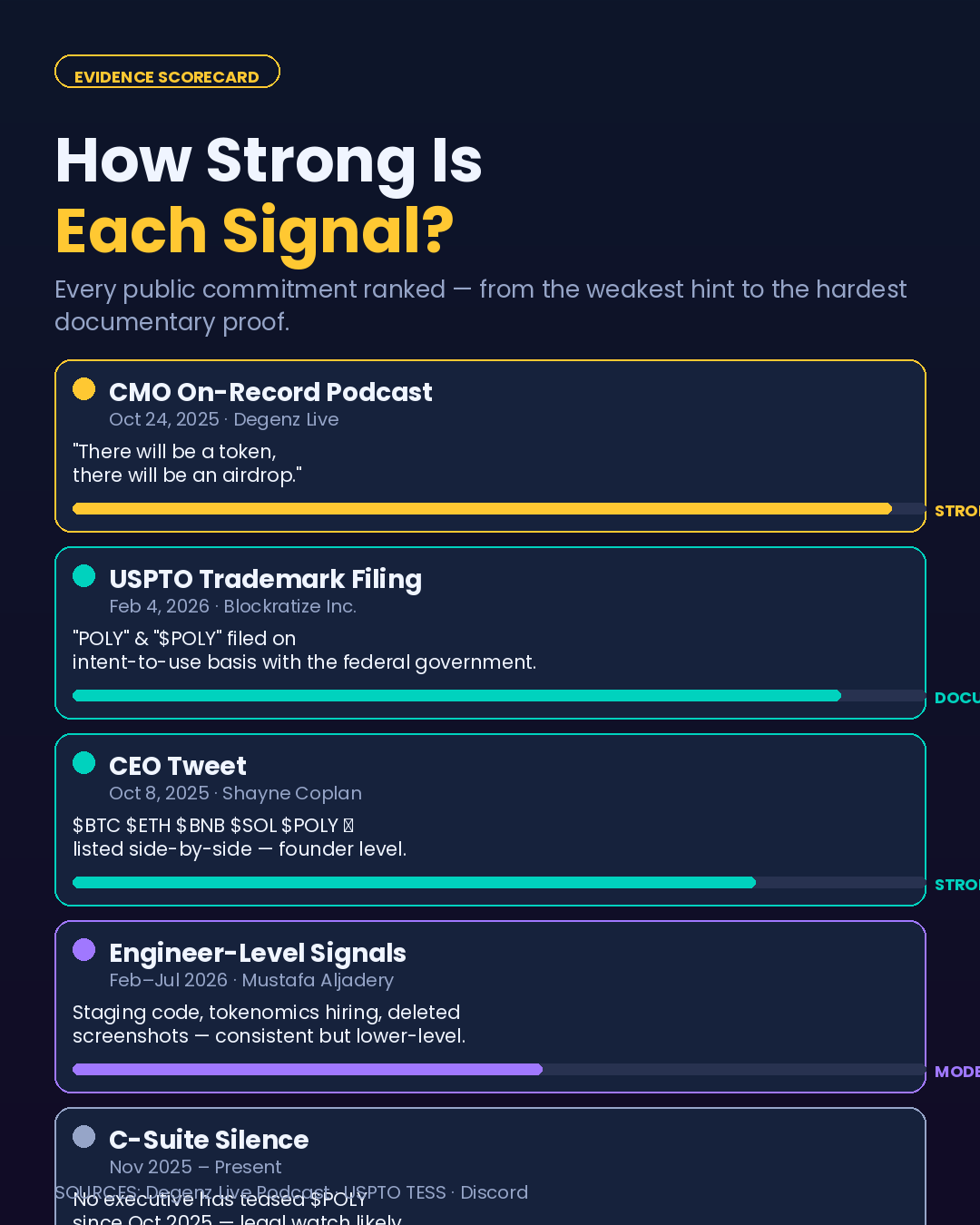
By July 6, 2026, Mustafa’s public posts took a notably more operational and serious turn. He publicly solicited expertise, asking who was "the best in the world at building tokenomic models" and inviting direct messages. This request transcended casual teasing; it read as an active recruitment effort for critical token infrastructure development, indicating that the project was moving beyond conceptualization into the detailed design of its economic model. The design of tokenomics is a complex and crucial phase, determining how a token will be distributed, its supply, utility, and incentive mechanisms – all foundational elements for a successful and sustainable digital asset.
However, this unique and somewhat unconventional communication strategy abruptly ceased. As of August 2026, Mustafa Aljadery was reportedly no longer affiliated with Polymarket. The circumstances of his departure remain publicly unclear, with neither Mustafa nor Polymarket issuing any official statement addressing his employment status. His sudden absence effectively silenced the primary public channel for $POLY updates, leaving the community once again in the dark and raising questions about the token’s future.
Analysis: The Unseen Hand of Legal Counsel and Strategic Maneuvering
The most plausible interpretation of this entire timeline, characterized by initial fanfare followed by executive silence and then a junior engineer’s sporadic updates before his departure, is that Polymarket did not lose interest in $POLY, but rather that its legal team became increasingly involved and cautious as the project matured and the broader regulatory environment for cryptocurrencies tightened significantly. Mustafa himself has reportedly admitted on Discord that he had to remove certain posts specifically due to legal guidance, which aligns perfectly with the observed pattern of deleted and quietly reuploaded content tied to his account. A company that formally files "intent to use" trademarks with the federal government for a digital asset has unequivocally moved past the stage where its executives can casually tweet ticker symbols without triggering serious securities and disclosure concerns. This precise shift would logically explain why the initial loud C-level teasing gave way to quieter, lower-level signals, and eventually to a near-complete public silence.
The regulatory landscape for cryptocurrencies, particularly in the United States, underwent a dramatic transformation during this period. The SEC, under Chairman Gary Gensler, adopted an aggressive stance, frequently reiterating its view that many cryptocurrencies constitute unregistered securities. This increased scrutiny, coupled with high-profile enforcement actions against other crypto entities, would naturally instill a profound sense of caution in any company contemplating a token launch. Public statements, especially from senior executives, could be misconstrued as offers of unregistered securities, exposing the company to substantial legal and financial risks. In such an environment, the advice of legal counsel would almost certainly prioritize silence and circumspection over continued public teasing.
It is also crucial to acknowledge the strategic logic behind Polymarket’s initial aggressive teasing. Constant airdrop hints are a well-established growth tactic in the crypto space. They effectively incentivize precisely the kind of trading volume and platform engagement that Polymarket desired, particularly as it prepared for its US relaunch and subsequent fundraising rounds. By generating significant hype and promising future rewards, Polymarket could attract a larger user base, boost liquidity on its platform, and demonstrate strong growth metrics to potential investors. Once that initial surge of engagement had been captured, the marginal benefit of continuing to tease publicly would naturally diminish, especially as the legal risks and costs associated with every additional hint escalated. This could explain a strategic shift from aggressive marketing to a more subdued, internally focused development process, while still keeping the option open.
Implications for $POLY Holders and Hopefuls: A Semibullish Outlook
For the community of Polymarket users, traders, and crypto enthusiasts hoping for the $POLY token, the accumulated evidence presents a mixed but arguably semi-bullish picture, rather than a definitive lock or a lost cause.
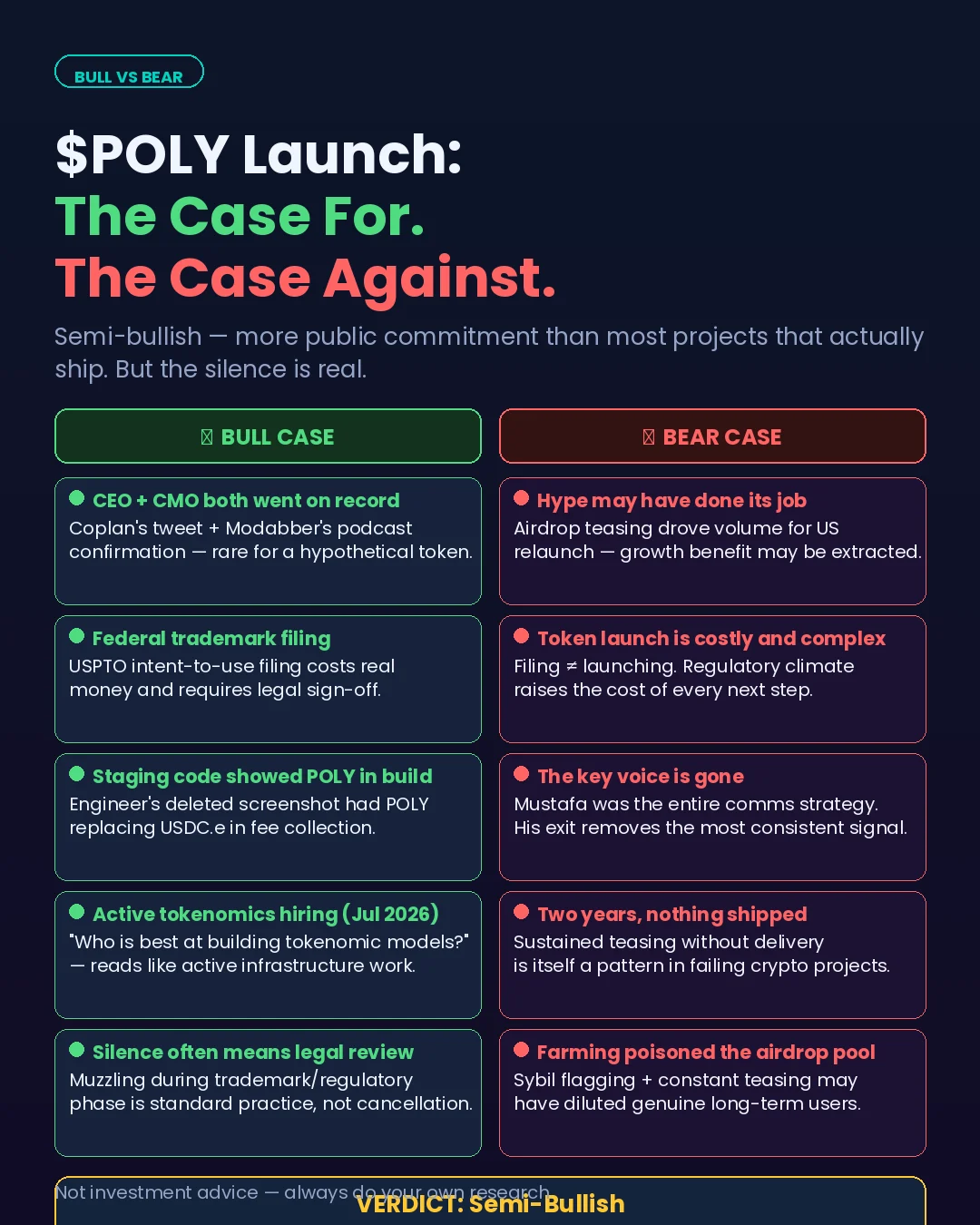
The strongest arguments in favor of a future $POLY launch are rooted in the formal and high-level commitments made during the "loud years." A sitting CEO and a CMO both went on record, unequivocally confirming the token and an airdrop. Crucially, these public statements were followed by tangible legal action: a federal "intent to use" trademark filing, which costs money, requires legal sign-off, and establishes a clear paper trail of corporate intent. This is not merely idle speculation; it demonstrates that the legal and foundational groundwork for a token was actively being laid. Furthermore, the technical breadcrumbs dropped by Mustafa Aljadery, showing fee migration plans and active recruitment for tokenomics expertise, suggest that development was genuinely underway. Large, complex token launches, especially those navigating stringent regulatory environments, routinely experience extended periods of public silence precisely during the critical phases where legal, technical, and compliance work is being meticulously executed. To assume the project quietly died simply because the public teasing cooled off for a few months would be a mistake, given the depth of prior commitment.
Conversely, strong arguments against the launch, or at least for its significantly diminished likelihood, are structural and strategic. If the primary goal were simply to reward a loyal community, a two-year period of aggressive, repeated airdrop teasing is arguably counterproductive. Such sustained hype often attracts "short-term farmers" or "sybil attackers" who aim to game the system for quick profits, thereby diluting the allocation intended for genuine, long-term users. There is a tangible possibility that Polymarket already extracted most of the growth and engagement benefits it desired from the initial hype cycle itself. In such a scenario, the incentive to actually follow through with a costly, legally complex, and potentially risky token launch might have diminished, particularly if the platform achieved its desired user acquisition and liquidity targets through the anticipation alone. The departure of Mustafa, the engineer who had become the public face of the teasing, further complicates the narrative, removing a key internal advocate and communication channel.
Ultimately, the paper trail left by Polymarket for $POLY is unusually rich and extensive for a crypto project that has yet to launch a token. Between a CEO’s public post, a CMO’s on-record podcast confirmation, a federal trademark filing, and two years of engineer-level breadcrumbs detailing technical progress, Polymarket has provided more public commitment and tangible evidence of development for $POLY than many projects that have successfully shipped tokens. What happens next is likely to depend less on fluctuating community sentiment or public speculation and more on confidential decisions being made behind closed doors, in the strategic and legal discussions currently occupying Polymarket’s executive and advisory teams. Navigating the treacherous waters of crypto regulation, particularly for a project with such a high profile and a history of public pronouncements, demands a level of discretion that often clashes with the open, community-driven ethos of the blockchain space. The silence, therefore, might not be an indication of abandonment, but rather a testament to the intense internal work required to bring a complex digital asset to market in a compliant and sustainable manner.
Disclosure: This is not trading or investment advice. Always do your research before buying any cryptocurrency or investing in any services.
Follow us on Twitter @themerklehash to stay updated with the latest Crypto, NFT, AI, Cybersecurity, and Metaverse news!














