
Bitcoin (BTC) has demonstrated remarkable resilience, trading mostly sideways on Wednesday after reaching a recent peak, and crucially, retaining the majority of its significant gains. This consolidation follows an impressive seven-day period where the world’s largest cryptocurrency by market capitalization surged by nearly 25%, climbing from approximately $62,700 to a high of $79,500. This sharp rebound has caught many market participants by surprise, prompting a deeper examination of the underlying drivers and potential implications for the ongoing bull market narrative.
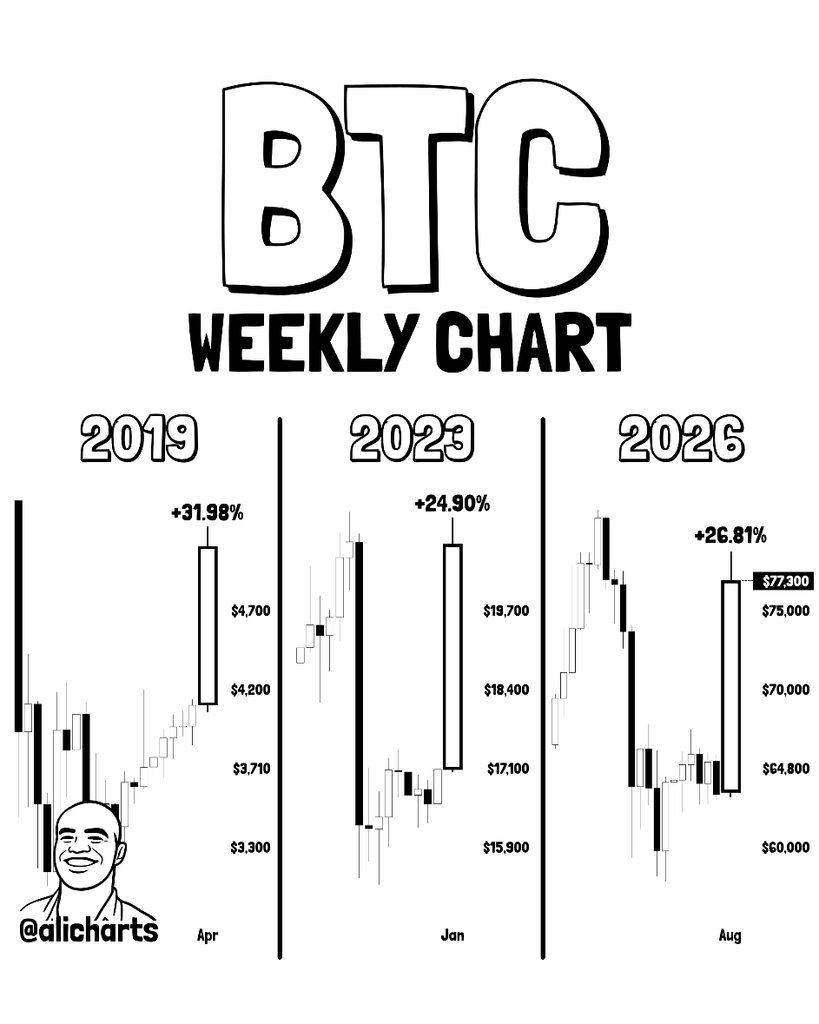
The velocity and magnitude of this recent ascent have drawn comparisons to historical Bitcoin market cycles. Popular on-chain analyst Ali Martinez has highlighted two prior instances where significant weekly rallies materialized near the conclusion of major bear markets. The first notable event occurred in 2019, when Bitcoin experienced a weekly gain of approximately 32% as the market began to pivot away from a prolonged bearish trend. A similar pattern emerged in January 2023, following the collapse of FTX and a period of widespread pessimism across the cryptocurrency landscape. During that week, Bitcoin saw a jump of nearly 25%.
Martinez suggests that Bitcoin’s latest weekly increase of 26.81% could be another manifestation of this recurring phenomenon. He posits that aggressive short positioning may have played a significant role in fueling this rally. As prices began to climb, bearish traders who had bet against Bitcoin were compelled to close their losing positions. This forced liquidation creates a cascading effect, generating additional buying pressure as these traders re-enter the market to cover their shorts, thereby exacerbating the upward price movement.

Historical Parallels and the Spectre of Short Squeezes
The pattern observed in 2019 and January 2023 provides a compelling historical framework for understanding Bitcoin’s recent price action. In 2019, after a protracted bear market that saw Bitcoin prices fall significantly from their 2017 all-time highs, a series of sharp rallies emerged. While the broader market sentiment remained cautious, these upward spikes indicated underlying demand and a potential shift in momentum. The rally in January 2023 was particularly significant as it occurred in the shadow of major industry failures, such as the FTX exchange collapse, which had instilled a deep sense of fear and uncertainty. The unexpected strength of Bitcoin during this period suggested a potential decoupling from negative sentiment and a resilience driven by fundamental factors or technical dynamics.
The current surge, therefore, resonates with these historical precedents. The concept of a "short squeeze" is a well-documented phenomenon in financial markets, where a rapid increase in an asset’s price forces short sellers to buy back the asset to limit their losses. This buying pressure can create a self-reinforcing upward spiral. In the context of Bitcoin, a highly liquid and volatile asset, such squeezes can be particularly pronounced. The sheer volume of leveraged short positions that may have accumulated during a period of sideways or slightly declining prices can become a potent catalyst for a sharp, unexpected rally when market sentiment begins to shift, or when technical levels are breached.
Martinez’s analysis, shared via his X (formerly Twitter) platform, stated: "If history repeats, this type of powerful weekly reversal could be an early sign that BTC has entered a new bullish cycle." This statement underscores the potential for the current price action to signal a more significant trend change, moving beyond a mere temporary bounce. The implication is that the market may be transitioning from a phase of consolidation or bearish sentiment to a renewed period of sustained growth.
Challenging Traditional Cycle Narratives
The recent price action also presents an interesting divergence from some traditional market cycle expectations. While many analysts anticipated Bitcoin might establish a major bottom later in the year, aligning with the typical four-year halving cycle, BTC has instead made a decisive upward move. This break from $62,700 to $79,500 suggests that either the market is moving faster than anticipated, or that other factors are overriding the traditional cyclical influences.

The four-year cycle, often linked to Bitcoin’s halving events (where the reward for mining new blocks is cut in half), has historically been a significant driver of bull and bear markets. These cycles typically involve a period of accumulation, a sharp bull run, a period of distribution, and then a bear market. However, the increasing institutional adoption, the advent of Bitcoin-specific Exchange Traded Funds (ETFs), and the growing integration of Bitcoin into global financial systems may be altering the dynamics of these cycles. The current surge could indicate that the market is entering a new phase of growth driven by these evolving factors, rather than strictly adhering to the established four-year rhythm.
Proximity to a New Higher High and Market Structure Strength
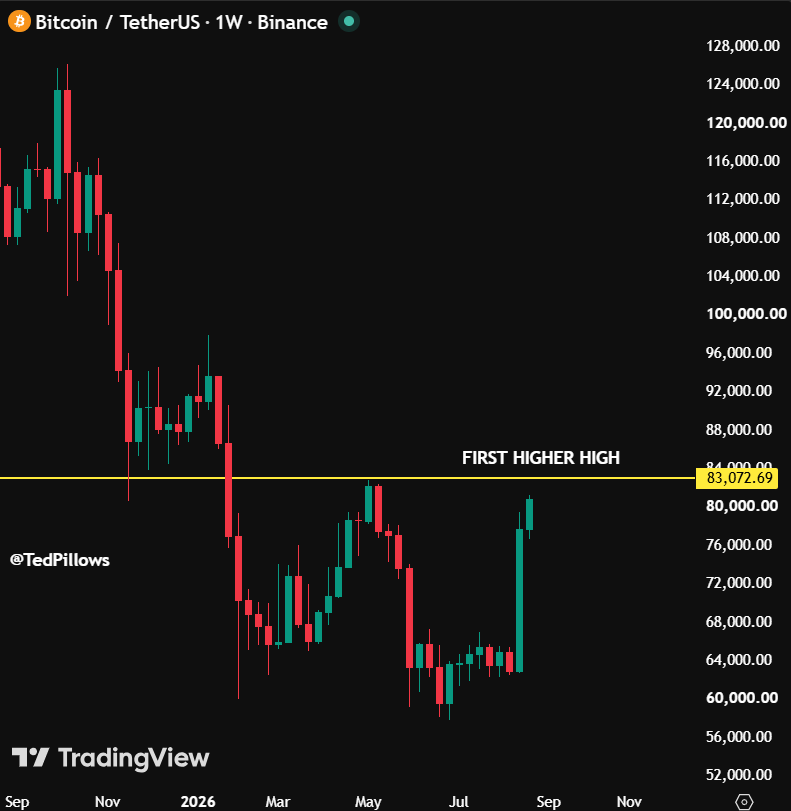
Adding to the bullish sentiment, analyst Ted Pillows has pointed to Bitcoin’s proximity to establishing a new higher high. According to his analysis, Bitcoin was trading only approximately $2,200 away from this critical technical milestone. A successful breakout above this level would not only represent a significant psychological victory but would also fundamentally strengthen the market structure.
A higher high, in technical analysis, signifies a continuation of an uptrend. It indicates that the price has surpassed its previous peak, suggesting that the buying pressure is sufficient to overcome previous resistance levels. Pillows further suggested that a confirmed higher high could mean that Bitcoin might not revisit the $60,000 level, implying a significant shift in support and resistance dynamics. This would imply that the $60,000 range, which previously acted as a crucial support level, could now be considered a firmly established floor for the cryptocurrency.
The implications of breaking a new higher high are substantial. It can trigger a fresh wave of buying from both retail and institutional investors who may have been waiting for confirmation of a new uptrend. It also signals to short-term traders and algorithmic trading systems that the prevailing trend is upward, leading to increased trading activity and potentially further price appreciation. The psychological impact of surpassing previous all-time highs or significant previous peaks cannot be overstated, as it often fuels renewed optimism and confidence in the asset’s future prospects.
An Ambitious Outlook: The Potential for a Fifth Wave
Offering an even more optimistic perspective, analyst Celal Kucuker has posited that Bitcoin’s current chart structure suggests the conclusion of a fourth wave in an Elliott Wave pattern, potentially paving the way for a fifth wave. The Elliott Wave Theory is a form of technical analysis that suggests that market prices move in specific, repeating wave patterns. In this theory, a five-wave pattern typically consists of three impulsive waves (moving in the direction of the trend) and two corrective waves (moving against the trend).
Kucuker’s projection, shared on X, sets a potential target of $144,000 for Bitcoin. He further suggests that such a significant move could materialize sooner than many market participants currently anticipate. This ambitious target implies a substantial upward movement from current levels, reflecting a belief in the strong underlying momentum and the potential for a parabolic price increase.
The concept of a fifth wave in Elliott Wave Theory often represents the final and most powerful leg of an uptrend. If Kucuker’s analysis holds true, it would indicate that Bitcoin is poised for a significant and rapid ascent, potentially surpassing previous expectations for this market cycle. This perspective suggests that the recent surge is not merely a cyclical event but part of a larger, more potent upward trend driven by fundamental shifts in market dynamics and investor sentiment. The target of $144,000, if achieved, would represent a new all-time high for Bitcoin by a considerable margin, underscoring the potential for explosive growth under this scenario.
Broader Market Context and Future Implications
At the time of writing, BTC was trading at approximately $78,814, marking a 13.32% increase over the preceding seven days. This sustained upward momentum, coupled with the diverse analyses from market experts, paints a picture of a cryptocurrency market potentially on the cusp of a significant expansion.
The factors contributing to this surge are multifaceted:
- Short Squeeze Dynamics: The forced liquidation of bearish positions is a powerful, albeit often temporary, catalyst for price increases. It suggests that bearish sentiment may have become overextended, creating fertile ground for a sharp reversal.
- Technical Breakouts: The proximity to a new higher high is a critical technical indicator that can unlock further buying interest and strengthen the overall market structure.
- Cycle Analysis: While traditional cycle expectations are being challenged, the possibility of a new bullish cycle, or a faster-than-expected progression through existing cycles, cannot be dismissed.
- Fundamental Undercurrents: While not explicitly detailed in the provided snippets, the underlying fundamental drivers for Bitcoin, such as its increasing adoption as a store of value, its role in a diversifying investment portfolio, and the ongoing development of its ecosystem, continue to provide a supportive backdrop for potential price appreciation.
The implications of these developments are far-reaching. For existing Bitcoin holders, a sustained rally could lead to significant portfolio growth. For potential new investors, the current price action presents a complex decision-making scenario: the fear of missing out (FOMO) on potential gains versus the risk of entering at a potentially elevated price point.
The narrative around Bitcoin continues to evolve, moving beyond simple speculative trading to its integration into broader financial strategies. As institutional interest grows and regulatory clarity improves in various jurisdictions, the cryptocurrency market is likely to experience continued volatility, punctuated by periods of sharp upward movement. The coming weeks and months will be crucial in determining whether the current surge represents a sustainable new bull phase or a significant but ultimately corrective move within a broader market cycle. The interplay of technical indicators, historical patterns, and evolving market fundamentals will shape Bitcoin’s trajectory, making it a closely watched asset in the global financial landscape.