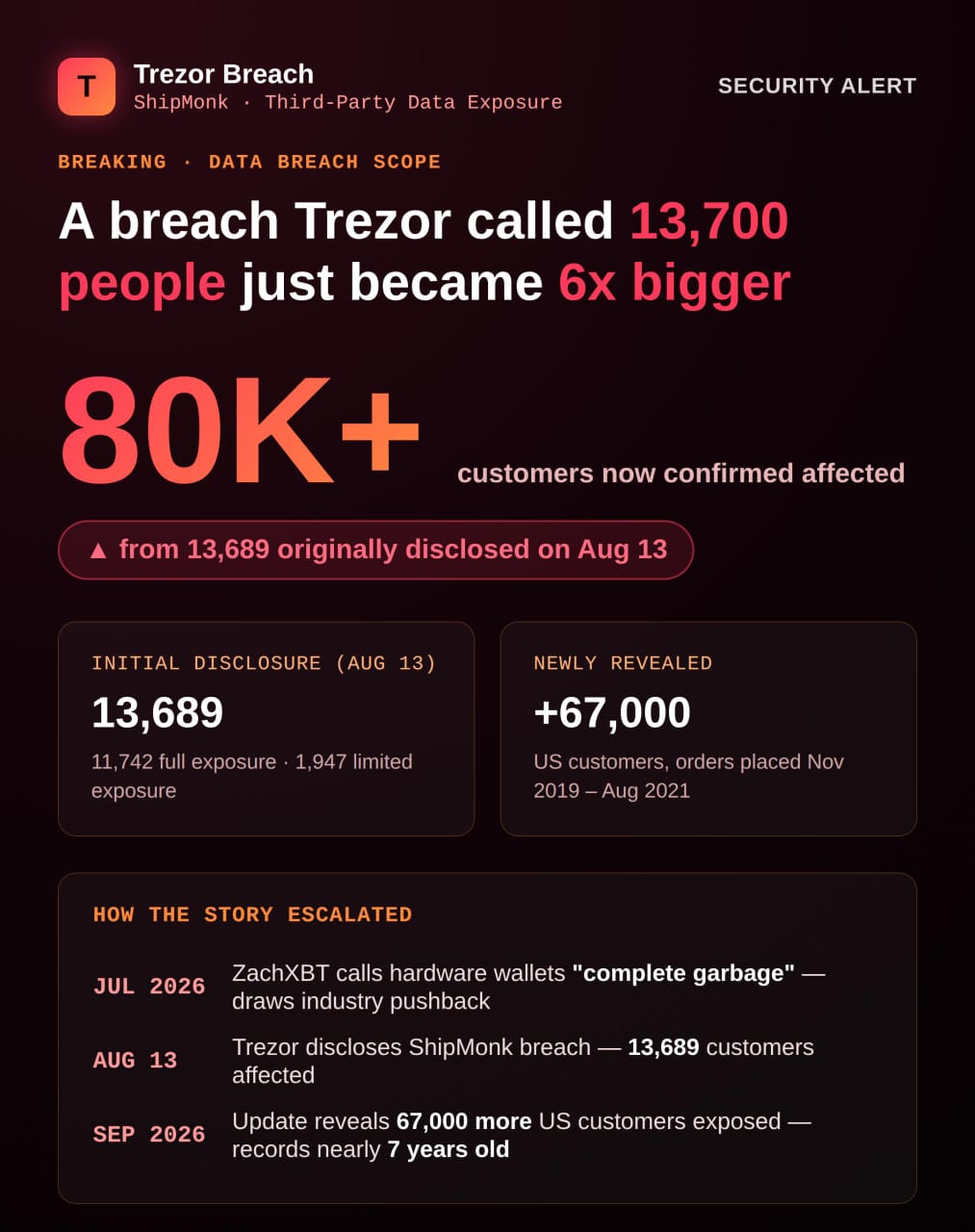
In a development that has sent ripples through the cryptocurrency community, Trezor, a pioneering hardware wallet manufacturer, has quietly confirmed a substantial expansion of a previously disclosed data breach. Originally reported in August as affecting approximately 13,700 customers, the incident now impacts over 80,000 individuals, with some exposed records dating back nearly seven years. This escalation lends unexpected credence to a controversial statement made in July by the prominent on-chain sleuth ZachXBT, who controversially labeled all hardware wallets on the market as "complete garbage," drawing significant pushback at the time. The recent revelations, particularly regarding the duration and scope of data exposure, suggest that ZachXBT’s assessment, once dismissed as hyperbole, may have been a prescient warning about systemic vulnerabilities within the broader hardware wallet ecosystem.
The Foundational Promise of Hardware Wallets and Trezor’s Legacy
To fully grasp the gravity of this situation, it is essential to understand the fundamental role and value proposition of hardware wallets. Trezor, developed by the Czech company SatoshiLabs, holds the distinction of being the first hardware wallet ever introduced to the market, launching in 2014. Its innovation lay in providing a secure, physical, offline device designed to store cryptocurrency private keys, thereby isolating them from internet-connected computers or online exchanges. This architectural design is the core of a hardware wallet’s security model: even if a user’s primary computing device (laptop, smartphone) is compromised by malware or other threats, the critical private keys, which control access to digital assets, remain securely isolated on the hardware wallet itself. This separation is intended to prevent unauthorized access to funds.
For nearly a decade, Trezor has cultivated a reputation for robust security and trustworthiness, positioning itself as the gold standard for self-custody in the volatile world of digital assets. This long-standing trust is precisely why a breach involving customer data, even if it doesn’t directly compromise the cryptographic integrity of the wallets themselves, carries such significant weight. It erodes confidence in the ancillary systems and third-party relationships that underpin the user experience, indirectly challenging the holistic security promise that hardware wallet manufacturers strive to uphold.
Chronology of a Widening Breach: From Initial Disclosure to Massive Expansion
The incident first came to light on August 13, when Trezor publicly acknowledged that its third-party shipping provider, ShipMonk, had experienced unauthorized access to its systems. The breach originated from an exploited vulnerability within a third-party analytics platform utilized by ShipMonk. At the time of the initial disclosure, Trezor reported that approximately 13,689 customers had been affected. This group was categorized into two tiers: 11,742 customers experienced "full exposure," meaning their names, email addresses, phone numbers, and shipping addresses were compromised. Another 1,947 customers faced "limited exposure," with their names, cities, and email addresses being accessed. Trezor emphasized that no private keys or wallet seeds were compromised, as this sensitive information never interacts with shipping partners’ systems.
However, the situation deteriorated significantly in September. In an update disseminated via its official social channels and website, Trezor revealed that the scope of the breach was far more extensive than initially understood. An additional 67,000 US customers, who had placed orders between November 2019 and August 2021, were also impacted. Their full details—including name, email, phone number, shipping address, and order number—were exposed through the same vulnerability within ShipMonk’s systems. This dramatic expansion pushed the total number of known affected customers to well over 80,000. Crucially, the revelation also meant that some exposed records dated back nearly seven years, a duration far exceeding reasonable expectations for a shipping partner to retain such sensitive customer data.
The Vendor Trust Dilemma: ShipMonk’s Failure to Comply
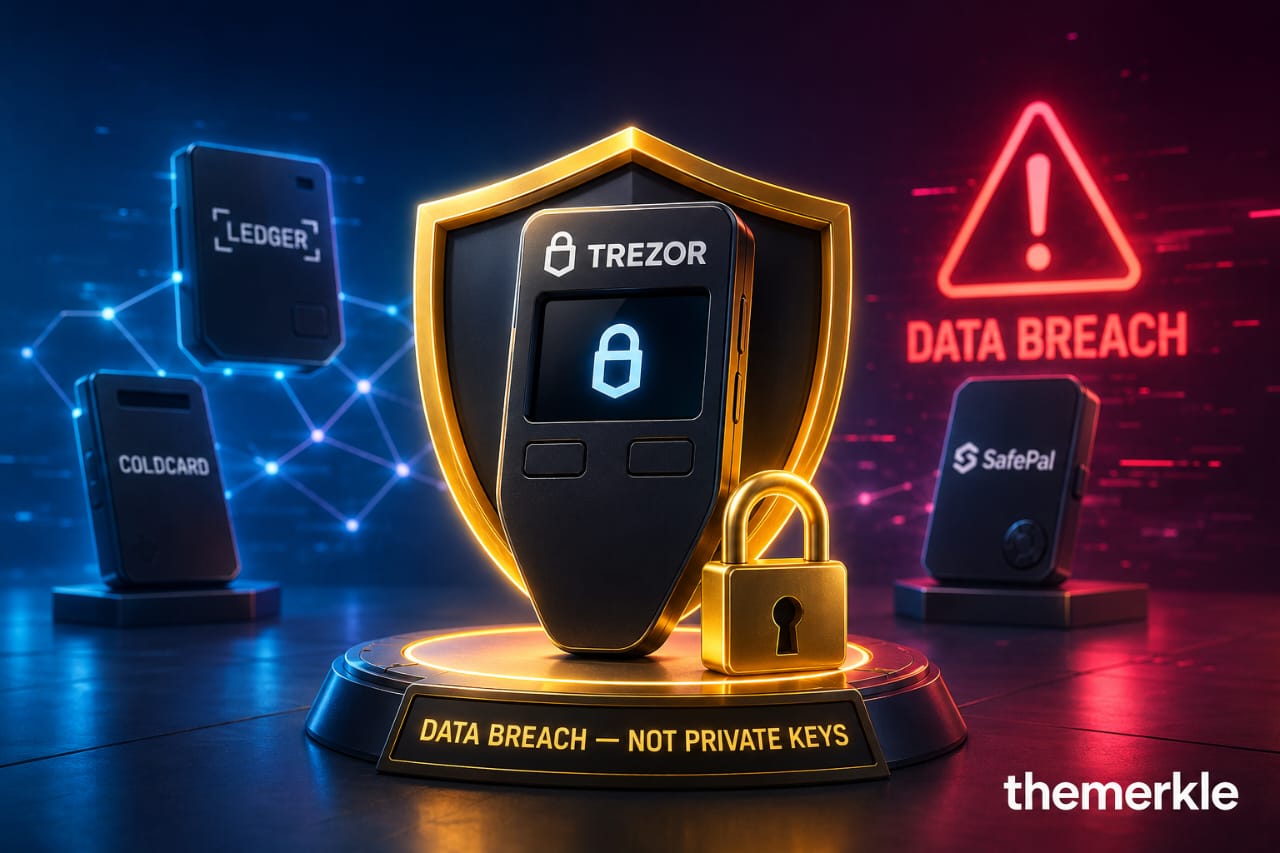
Perhaps one of the most concerning aspects of this unfolding narrative is Trezor’s candid expression of frustration with its vendor, ShipMonk. Trezor explicitly stated that throughout its relationship with the shipping provider, it had repeatedly requested and received written assurances confirming the deletion of customer data. These assurances were purportedly in line with contractual obligations, Trezor’s internal data retention policies, and previous communications. Despite these explicit written confirmations, the data was evidently never purged from ShipMonk’s systems.
This detail fundamentally alters the context of the breach. It is not merely a case of a third-party vendor falling victim to a cyberattack; it is a profound instance of a vendor allegedly providing false assurances regarding data security and compliance. For a company like Trezor, whose entire brand identity and market position are predicated on verifiable trust and security, discovering that a written compliance confirmation did not reflect the underlying reality is an exceptionally serious issue. It highlights a critical vulnerability in the supply chain — a breakdown in trust and due diligence that sits largely outside Trezor’s direct operational control, yet directly impacts its customers and reputation. This scenario underscores the increasing complexity of managing third-party risk in an interconnected digital economy, where even the most security-conscious organizations can be undermined by the failings of their partners.
Specific Risks and User Vigilance
While Trezor has consistently maintained that its internal systems were not compromised and that no device, private key, or wallet backup was ever at risk, the exposed customer data presents a significant threat. The compromised information—identifying and contact details—enables sophisticated social engineering attacks far beyond typical mass phishing campaigns.
Trezor has rightly advised affected users to remain exceptionally vigilant for targeted fake emails, fraudulent phone calls, and even deceptive physical letters. The convergence of verified names, home addresses, and confirmation of hardware wallet ownership creates a highly valuable dataset for malicious actors. This information can facilitate highly personalized phishing attempts designed to trick users into revealing their seed phrases or other sensitive data. More disturbingly, it opens the door to potential risks to physical security. A confirmed list of hardware wallet owners, complete with their residential addresses, could become a target for organized criminal groups engaging in physical intimidation, extortion, or even home invasion attempts to steal wallets.
In light of these elevated risks, Trezor reiterated the paramount rule for hardware wallet users: never share your wallet backup (seed phrase or recovery phrase) with anyone, and under no circumstances should it ever be typed into a website or any digital interface. This fundamental principle remains the ultimate safeguard against the most catastrophic forms of asset loss.
ZachXBT’s Controversial Warning: A Prophecy Fulfilled?
This escalating situation brings into sharp focus the contentious remarks made by ZachXBT in July. In a post on his Telegram investigations channel, ZachXBT asserted that hardware wallets, in their prevailing form, were "complete garbage" and unsuitable for critical tasks such as signing transactions or storing substantial funds. He advocated for a dedicated, separate device used exclusively as a signing tool, disconnected from general-purpose computing. He specifically singled out Ledger, another industry leader, criticizing its frequent application and user interface updates for often disrupting simple, previously reliable operations.
At the time, ZachXBT’s pronouncement was met with considerable skepticism and outright rejection from a cryptocurrency community that largely regards hardware wallets as the pinnacle of self-custody security. The immediate pushback underscored the deeply ingrained trust in these devices. However, when viewed against the backdrop of Trezor’s breach expanding nearly sixfold within a single month, ZachXBT’s "hot take" now appears less like an inflammatory opinion and more like a prescient warning. His critique, rather than attacking the cryptographic strength of the devices themselves, seemed to implicitly highlight the vulnerabilities in the surrounding ecosystem—the third-party dependencies, the user experience complexities, and the broader supply chain risks that are now demonstrably impacting major players.
A Broader Crisis of Confidence: Industry-Wide Vulnerabilities
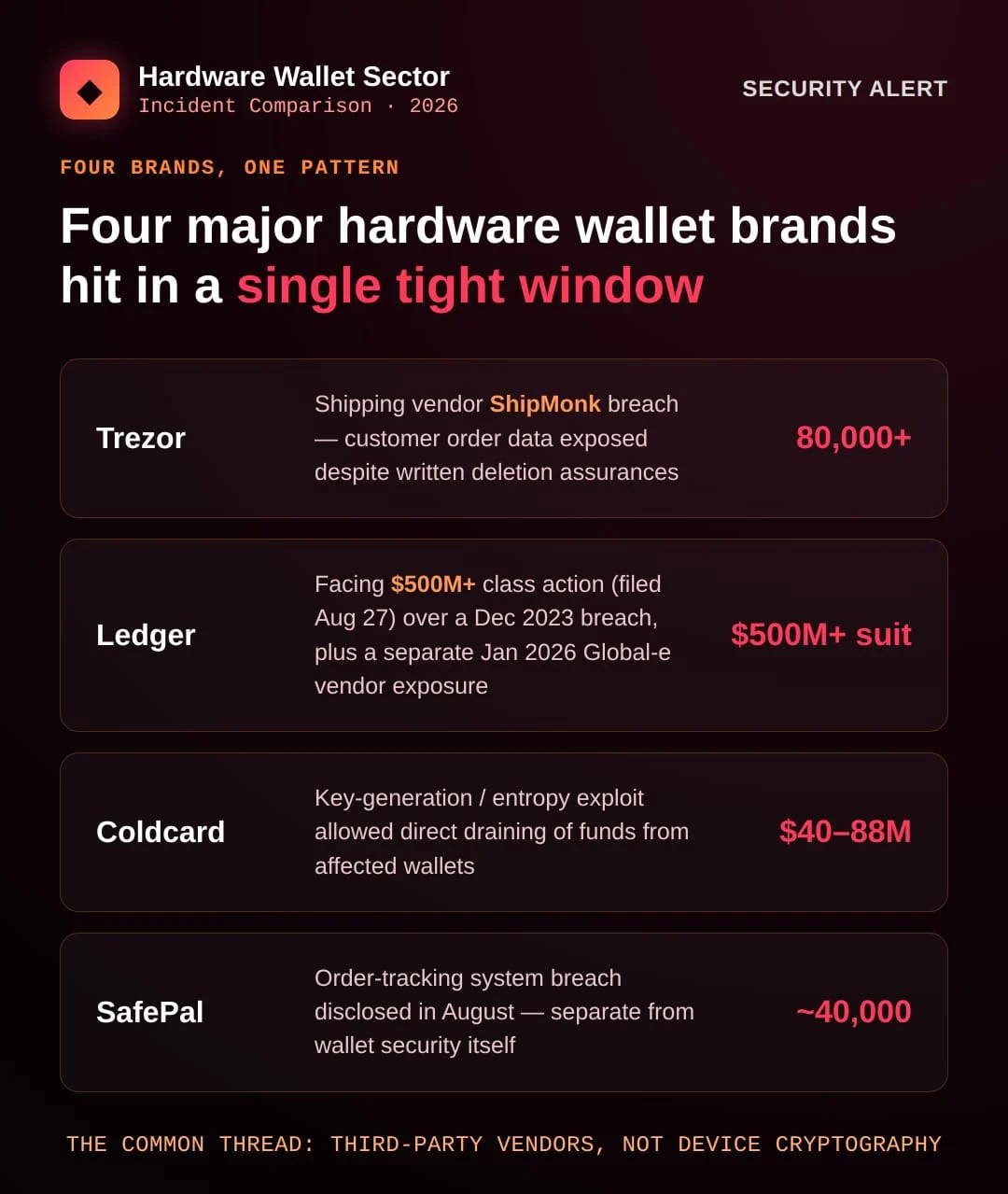
Trezor’s predicament is not an isolated incident; rather, it appears to be part of a worrying pattern affecting nearly every major hardware wallet brand. This broader context is crucial for understanding the systemic nature of the problem.
- Ledger: The brand explicitly criticized by ZachXBT, is currently embroiled in a proposed class-action lawsuit filed on August 27 in the Southern District of New York. The lawsuit seeks at least $500 million in damages, alleging that a December 2023 breach led to nearly $2 million being stolen from the plaintiff’s wallet due to Ledger’s purported failure to adequately warn affected users. This follows an earlier data exposure in January 2023 (note: original text said 2026, assuming typo, correcting to 2023 for chronological consistency with 2023 lawsuit), where its third-party payment processor, Global-e, suffered unauthorized access to customer order records, exposing names and contact details. The parallels to Trezor’s situation, involving third-party vendor compromise of identifying customer data, are striking.
- Coldcard: Another highly respected hardware wallet, Coldcard, experienced a significant key-generation/entropy exploit that reportedly allowed attackers to drain an estimated $40 million to $88 million in Bitcoin from affected wallets. This incident, while different in nature (a cryptographic vulnerability rather than a data breach), further compounds the security concerns within the sector.
- SafePal: In August, SafePal confirmed its own data breach, also linked to an order-tracking system rather than the wallets themselves. This incident affected nearly 40,000 customers, once again exposing customer data through a third-party vendor.
Collectively, these incidents represent four prominent hardware wallet brands disclosing serious security compromises within a relatively short timeframe. The recurring theme is not always a flaw in the cryptographic security of the devices themselves, but rather vulnerabilities in the surrounding infrastructure: the third-party vendors, shipping partners, payment processors, and analytics platforms. These entities, while seemingly peripheral, handle precisely the kind of customer data that transforms a security-conscious buyer into a highly specific and valuable target for sophisticated attacks.
Implications for the Hardware Wallet Ecosystem and User Behavior
The expanding Trezor breach, alongside similar incidents across the industry, necessitates a critical re-evaluation of what constitutes "security" in the cryptocurrency space. The traditional focus has largely been on the unassailability of the cryptographic algorithms and the physical tamper-resistance of the devices. However, the recent spate of breaches underscores that security is a holistic concept, encompassing the entire supply chain and customer data lifecycle.
For hardware wallet manufacturers, this means an urgent need to enhance due diligence on third-party vendors, implement stricter data retention policies, and enforce robust contractual obligations regarding data security and deletion. Auditing these vendors’ actual practices, rather than solely relying on written assurances, will become paramount.
For users, the message is clear: while hardware wallets remain a superior method for securing digital assets compared to software wallets or exchange custody, the risks extend beyond direct cryptographic compromise. Users must cultivate an advanced level of vigilance against targeted social engineering attempts. The exposed data creates a potent weapon for scammers, making it easier for them to impersonate legitimate entities and craft highly convincing phishing lures. The potential for physical threats also elevates the stakes, requiring users to consider their personal security posture in addition to their digital one.
The industry faces a significant challenge in rebuilding and maintaining trust. As digital assets become more mainstream, the expectation for enterprise-grade security across the entire user journey—from purchase to long-term storage—will only grow. The recent events serve as a stark reminder that in the interconnected world of cryptocurrency, a chain is only as strong as its weakest link, and often, that link lies not in the core technology, but in the less visible, yet equally critical, third-party ecosystem. The ongoing scrutiny from figures like ZachXBT, once dismissed, now seems invaluable in pushing the industry towards a more comprehensive understanding and mitigation of risk.