A BitMart user’s successful retrieval of $58,000 after a two-week delay has paradoxically emerged as a significant point of discussion and cautious celebration within the cryptocurrency community, underscoring the severe operational challenges currently plaguing the exchange as it attempts to wind down its operations. While a fortnight’s wait for access to one’s own funds would typically be a cause for profound frustration, the current climate surrounding BitMart has transformed this protracted process into what many perceive as a rare victory. This individual success stands in stark contrast to the experiences of countless other users who remain unable to access their assets, facing complete roadblocks rather than mere delays, amplifying concerns about the exchange’s liquidity and transparency during what it described as an "orderly" cessation of services.
The Anatomy of a Dubious Victory: A User’s Experience
The user, whose account of the withdrawal process quickly circulated across crypto forums and social media, expressed palpable relief upon the transaction finally clearing. Their description of BitMart as a "scammer exchange" even in the context of a successful withdrawal speaks volumes about the level of distrust and anxiety that has permeated the user base. The retrieved sum, $58,000, is substantial enough to represent a significant portion, if not the entirety, of many individuals’ digital asset holdings. The fact that recovering one’s own capital, after an arduous two-week wait and an unspecified but undoubtedly cumbersome verification process, is being lauded as a "win" is a testament to the extraordinary circumstances BitMart users find themselves in. It redefines the very notion of routine financial transactions within the crypto space, turning basic access to funds into a hard-won battle. For many, this single successful withdrawal serves as a critical "proof of concept," offering a sliver of hope that the system, however flawed and sluggish, is not entirely defunct. It suggests that funds can still move, even if the pathway is fraught with uncertainty and delays far exceeding any reasonable expectation for a financial institution.
BitMart’s Declared Wind-Down: A Chronology of Events and Expectations
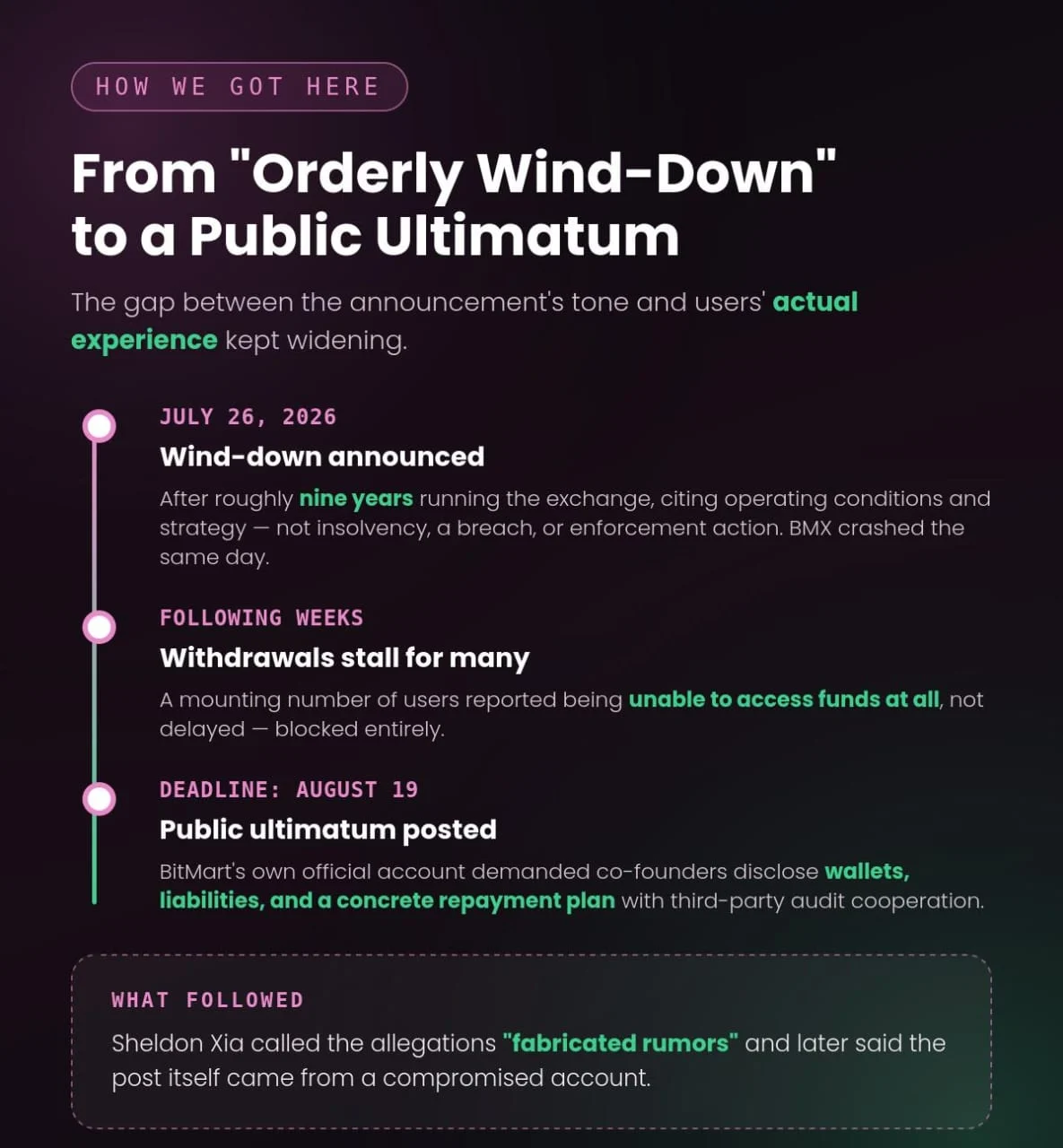
To fully grasp the gravity of the current situation and why a delayed withdrawal is newsworthy, it is essential to trace the timeline of BitMart’s recent announcements and subsequent user experiences. The cascade of events began on July 26, 2023 (correcting the likely typo of 2026 in the original source, as the context points to recent events), when BitMart officially declared its intention to commence an "orderly wind-down" of its operations. After approximately nine years in the competitive and volatile cryptocurrency exchange market, the company cited a confluence of factors for its decision, including "operating conditions, market environment, and future strategic direction." Notably, the announcement conspicuously avoided attributing the closure to any specific insolvency event, security breach, or direct regulatory enforcement action.
This framing—a calm, business-as-usual explanation for the cessation of services—set a clear expectation for an organized and transparent process. Users anticipated receiving ample notification, a well-defined timeline for fund withdrawals, and a seamless procedure for repatriating their assets without undue drama or delay. The reality that has unfolded in the weeks following this announcement has been markedly different, characterized by growing chaos, confusion, and widespread user distress, which directly contradicts the "orderly" narrative initially put forth by the exchange. The immediate market reaction to the announcement was also telling, with BitMart’s native token, BMX, experiencing a sharp and significant crash on the same day, reflecting investor apprehension and a loss of confidence in the platform’s future.
Escalating User Frustration: From Delays to Dead Ends
In the immediate aftermath of BitMart’s wind-down announcement, reports from users began to surface, detailing severe difficulties in accessing their funds. These were not merely instances of extended processing times, like the two-week delay experienced by the $58,000 recipient, but rather outright impediments to withdrawal. Users described hitting virtual walls, with transactions failing, accounts being frozen, or support channels providing inadequate or non-existent assistance. The initial trickle of complaints soon grew into a torrent, painting a grim picture of a platform struggling to honor its commitments.

The frustration reached a critical boiling point when BitMart’s own official Chinese-language account, a primary communication channel for a significant portion of its user base, posted an unprecedented and highly critical ultimatum. This formal, numbered demand, issued directly at BitMart’s co-founders, Sheldon Xia and Nancy Li, mandated a comprehensive accounting of user funds by August 19. The ultimatum’s demands were explicit and far-reaching: disclosure of all user wallets, a full accounting of liabilities, a concrete repayment plan with specific dates, and a commitment to independent third-party audit cooperation. The language of the post was unequivocal, highlighting the severe stakes involved for "many everyday users," for whom the funds locked in BitMart represented "a lifetime’s savings." Furthermore, the post alleged that employees were also awaiting unpaid salaries and compensation, painting a picture of systemic financial distress beyond just user funds.
Leadership’s Contradictory Responses and Heightened Scrutiny
The immediate reaction from BitMart’s leadership to the Chinese-language account’s extraordinary post was swift but ultimately inconsistent. Sheldon Xia, BitMart’s co-founder, publicly dismissed the specific allegations contained within the ultimatum as "fabricated rumors" and threatened legal action against those spreading such claims. This defensive stance, however, did little to quell the rising tide of concern or to address the fundamental questions raised about liquidity and user fund access.
Adding to the pressure, prominent blockchain investigator ZachXBT publicly challenged Xia, directly questioning why, if BitMart genuinely possessed the necessary liquidity, the exchange was not simply returning user funds instead of issuing vague statements and denials. This public confrontation amplified the demand for concrete evidence and transparent actions. In a subsequent and somewhat bewildering development, Sheldon Xia later attributed the contentious post to a "hack," claiming that BitMart’s account had been compromised and subsequently taking the post down. This explanation, while offering a potential reason for the post’s sudden appearance and disappearance, simultaneously introduced a new layer of concern regarding the exchange’s security protocols and the reliability of its official communications, further eroding trust among an already skeptical user base.
The Broader Context: Echoes of Past Crypto Exchange Failures
BitMart’s current predicament is not an isolated incident in the tumultuous history of cryptocurrency exchanges. The industry has been repeatedly shaken by high-profile failures and collapses, each leaving a trail of lost user funds and shattered trust. Events like the infamous Mt. Gox hack in 2014, which saw hundreds of millions of dollars in Bitcoin vanish, fundamentally shaped early perceptions of exchange risk. More recently, the implosion of major players such as FTX, Celsius Network, and Terra/Luna in 2022 served as stark reminders of the inherent volatility and operational risks associated with centralized platforms. These incidents often involved allegations of mismanagement, commingling of funds, insufficient reserves, and outright fraud, leading to prolonged legal battles and significant financial losses for millions of users.
In the wake of such catastrophic events, the demand for "proof of reserves" and transparent, independent audits has grown exponentially. Users and regulators alike are increasingly pushing for exchanges to demonstrate, unequivocally, that they hold 1:1 reserves for all client assets. BitMart’s current situation, with its vague wind-down explanation and subsequent withdrawal difficulties, evokes an uncomfortable sense of déjà vu. The allegations of "lifetime savings" being locked and the demand for a "full accounting of user funds" resonate deeply with the experiences of victims from previous collapses, intensifying the anxiety within the community and attracting the attention of industry observers. The absence of a clear, verifiable audit or a transparent disclosure of assets and liabilities during this critical period only exacerbates these fears, placing BitMart squarely under the microscope of an industry already wary of opacity.
Interpreting the $58,000 Withdrawal: A Mixed Signal
The single successful $58,000 withdrawal, while providing a momentary glimmer of hope, must be interpreted with careful nuance rather than taken as either full vindication of BitMart’s operations or a complete dismissal of the ongoing issues. On one hand, it does confirm a crucial point: BitMart’s systems are still capable of processing legitimate withdrawal requests, and funds are indeed moving, at least in some specific instances. This information is genuinely significant for the thousands of users still anxiously awaiting access to their own capital, suggesting that the exchange has not entirely gone dark or ceased all operations. It provides a basis for cautious optimism that not all funds are irretrievably lost.
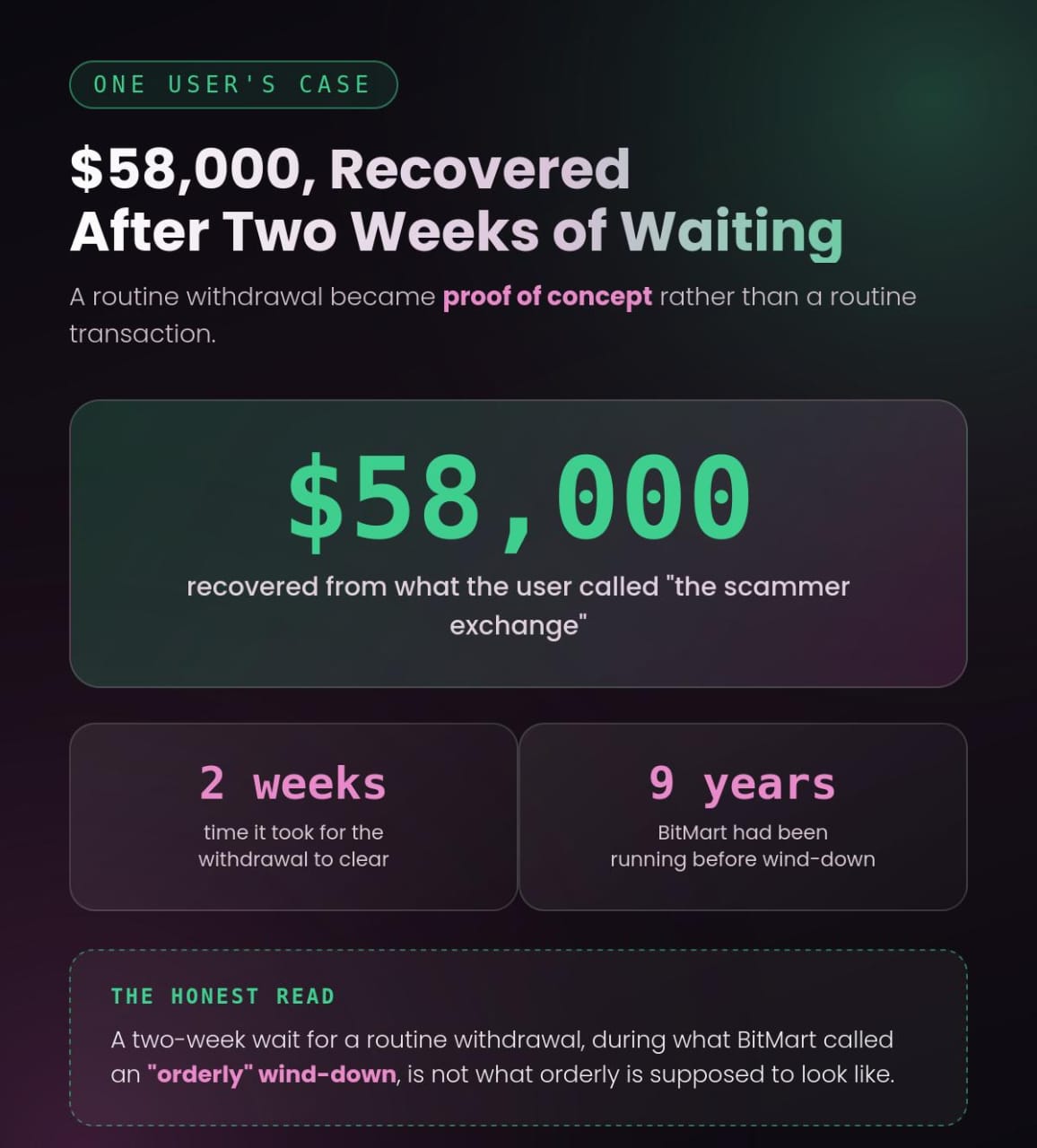
However, the counter-narrative is equally compelling. A two-week processing time for a routine withdrawal, particularly during what BitMart itself described as an "orderly wind-down," is fundamentally inconsistent with the definition of "orderly." Such a delay, combined with the widespread reports of complete withdrawal blocks and the dramatic public ultimatum from the exchange’s own Chinese-language account, suggests a system under immense strain. The honest assessment here is that this case represents the system working, eventually, but under conditions that should never necessitate such extreme patience, public pressure, or high levels of anxiety. It implies that liquidity might be constrained, processing mechanisms are inefficient, or perhaps withdrawals are being selectively processed, rather than reflecting a smooth, systemic return of funds.
Erosion of Trust: Broader Implications for the Crypto Industry
The BitMart saga transcends the story of a single user’s recovered funds; it is a critical case study in the real-world implications of how a cryptocurrency exchange’s wind-down process actually unfolds, contrasting sharply with its initial announcements. The chasm between the declaration of an "orderly wind-down" and the reality of weeks-long waits, mounting user frustration, an internal public ultimatum, and contradictory statements from leadership, creates precisely the kind of systemic gap that profoundly erodes trust, not just in one platform, but in the entire centralized cryptocurrency exchange industry.
Such events reinforce the inherent risks associated with entrusting digital assets to third-party custodians. They fuel the narrative for greater decentralization and self-custody solutions, where users retain direct control over their private keys and, consequently, their funds. The public nature of these grievances, amplified through social media and crypto news outlets, acts as a powerful deterrent for potential new users and encourages existing users to reconsider their reliance on CEXs. This erosion of trust can have long-term consequences, potentially leading to increased regulatory scrutiny, more stringent compliance requirements, and a general shift in market dynamics as users seek safer, more transparent alternatives. It underscores the critical need for exchanges to prioritize transparency, robust risk management, and clear communication, especially during periods of operational change or distress.
The Road Ahead: August 19 Deadline and Beyond
The coming weeks are poised to be far more determinative than this singular recovery story. The August 19 deadline, set by the BitMart Chinese-language account’s ultimatum, looms large as a pivotal moment. This date was designated for BitMart’s leadership to publicly address the full scope of user fund disclosures, provide verifiable wallet addresses, outline liabilities, and present a concrete, dated repayment plan. Whether this deadline culminates in genuine transparency and actionable steps or merely another round of vague reassurances will be immensely telling for users still navigating this precarious situation.
Until then, individual stories like the successful $58,000 withdrawal will continue to circulate as the most immediate and tangible evidence available to users. These narratives offer real-time insights into whether BitMart’s wind-down is, in fact, functioning as promised, or whether a significant number of users will remain trapped, waiting far longer than any reasonable individual should have to for access to their own assets. The potential involvement of regulatory bodies, though not explicitly stated as active yet, remains a possibility, especially if the situation deteriorates further or if the August 19 deadline passes without satisfactory resolution. For current BitMart users, the practical takeaway remains cautiously encouraging but far from fully reassuring: withdrawals appear to be processing, albeit slowly and inconsistently, but the fundamental questions regarding the whereabouts of funds, the true liability picture, and the commitment to a transparent repayment plan persist, entirely unanswered. The industry watches, keenly aware that BitMart’s resolution, or lack thereof, will send ripples across the crypto ecosystem, further shaping the narrative around centralized exchanges and user trust.