


The nascent euro stablecoin sector, often overshadowed by its colossal dollar-pegged counterparts, is currently undergoing a significant transformation, characterized by a pronounced concentration of growth. Recent market data reveals that nearly all fresh capital entering the top ten euro-pegged tokens over the past seven days converged on just three assets: EURCV, EURC, and EUROP. This trend underscores a pivotal moment for the European digital asset landscape, highlighting the emerging frontrunners and the factors driving their success in a market striving for maturity and broader adoption.
Understanding the Euro Stablecoin Landscape
Stablecoins are a critical component of the cryptocurrency ecosystem, designed to mitigate the inherent volatility of digital assets by pegging their value to a more stable asset, typically fiat currencies like the US dollar or the Euro, or commodities such as gold. While dollar-pegged stablecoins like Tether (USDT) and USD Coin (USDC) boast market capitalizations in the tens of billions, the euro stablecoin market remains comparatively small, making its growth patterns more discernible and illustrative of underlying market dynamics. The pursuit of euro-denominated stablecoins is driven by several factors, including the need for a stable digital euro for European businesses and consumers, a desire for diversification from dollar-centric stablecoins, and anticipation of clearer regulatory frameworks within the European Union.
The introduction of the Markets in Crypto-Assets (MiCA) regulation by the European Union has been a significant catalyst, aiming to provide comprehensive regulatory clarity for crypto-assets, including stablecoins. MiCA, set to come into full effect by late 2024 and early 2025, requires stablecoin issuers to meet stringent requirements regarding reserves, transparency, and operational resilience. This regulatory certainty is crucial for attracting institutional investment and fostering wider adoption, as it provides a framework of trust and compliance that traditional financial entities demand. Tokens like Circle’s EURC and Schuman Financial’s EUROP have already emphasized their MiCA compliance, positioning themselves strategically for the evolving regulatory environment.
A Week of Concentrated Inflows: The Numbers Speak
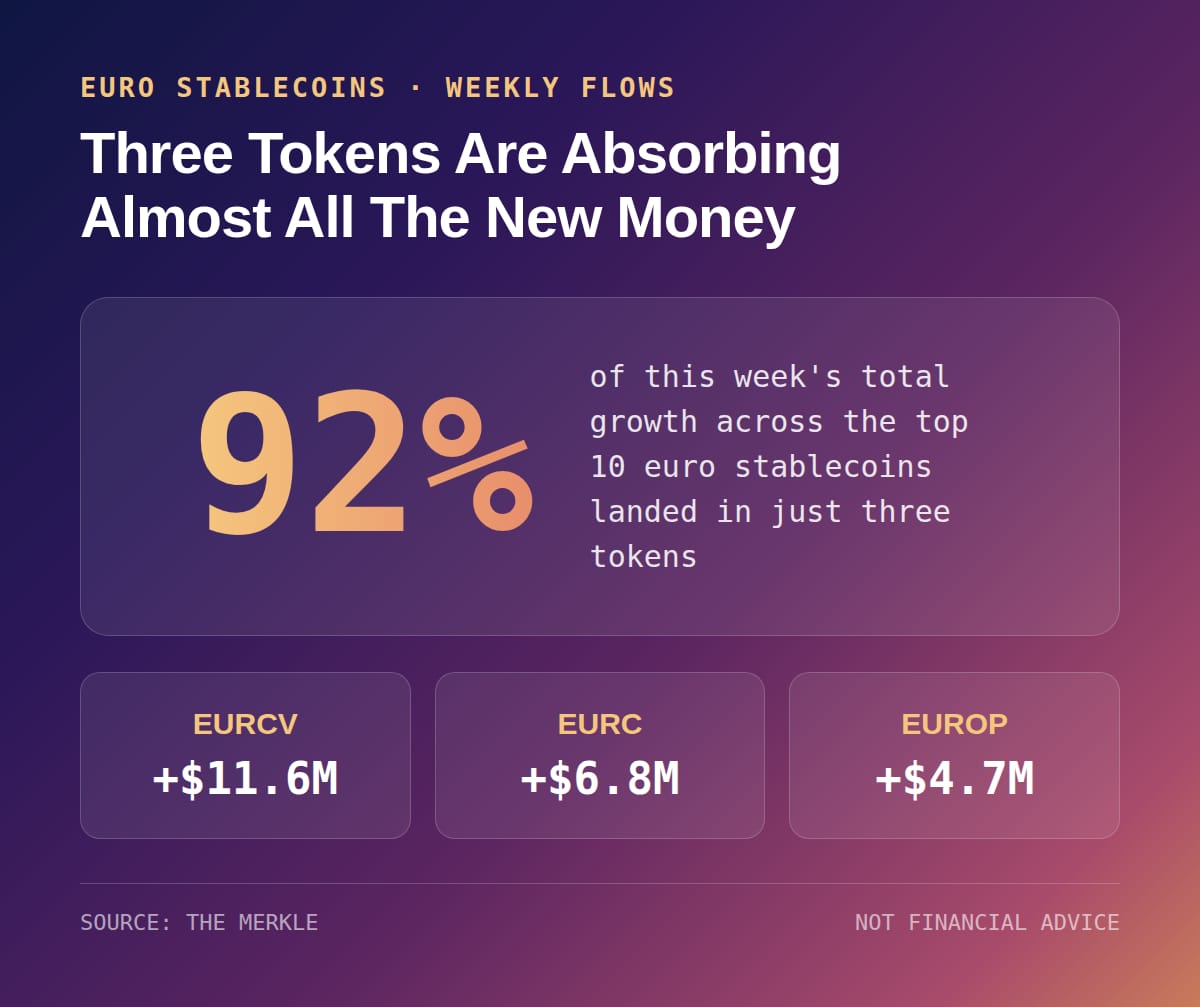
During the most recent seven-day period, the euro stablecoin sector witnessed its weekly gains almost entirely coalesce around three specific assets. EURCV, issued by Societe Generale’s digital asset arm, SG Forge, led the pack with an impressive $11.6 million added to its market capitalization. Following closely were Circle’s EURC, which saw an inflow of $6.8 million, and Schuman Financial’s EUROP, adding $4.7 million. Cumulatively, these three tokens accounted for a staggering 92% of the total growth recorded across the top ten euro stablecoins.
This level of concentration is particularly striking given the presence of ten listed competitors in the market. In practical terms, it signifies that while a multitude of euro stablecoins exist, only a select few are actively capturing meaningful new demand. The remaining seven tokens barely registered any movement, underscoring a widening divergence between those with real distribution and adoption, and those that are technically operational but struggling to attract significant liquidity. For a sector still striving to establish its relevance against the backdrop of dollar-pegged giants, this intense concentration offers critical insights into where institutional and retail interest is genuinely focused.
Societe Generale’s EURCV: A Traditional Finance Powerhouse Emerges
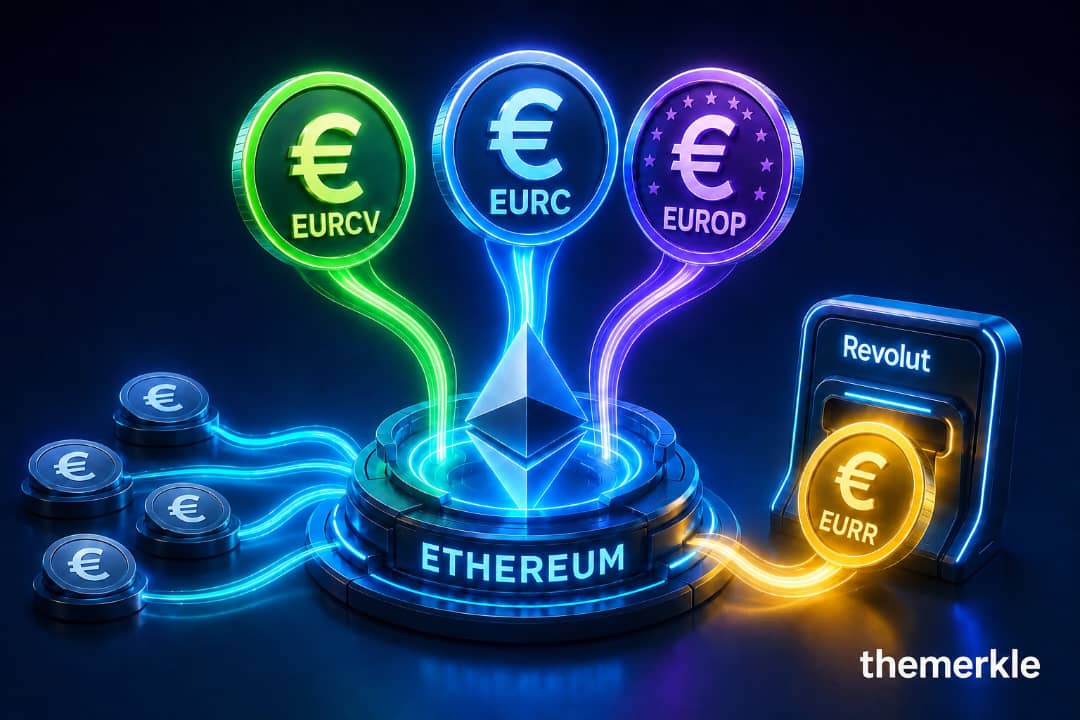
The most significant development of the week was the exceptional performance of EURCV. Its $11.6 million gain not only positioned it as the single biggest mover but also saw it slightly outpace the combined growth of its two closest rivals, Circle’s EURC and Schuman Financial’s EUROP. This achievement is particularly noteworthy as EURCV is a bank-issued token, challenging established crypto-native competitors that typically boast stronger brand recognition within the digital asset community.
Societe Generale, a major French multinational investment bank and financial services company, launched SG Forge, its blockchain-focused subsidiary, to cater to the growing demand for digital assets among institutional clients. EURCV, their euro stablecoin, represents a deliberate strategy to bridge traditional finance with the burgeoning decentralized finance (DeFi) ecosystem. Over the past couple of years, SG Forge has meticulously built out a multi-chain footprint for EURCV, extending its presence beyond its original Ethereum deployment. This strategic expansion aims to enhance accessibility and utility across various blockchain networks, and the recent inflows suggest that this foundational work is now translating into tangible market capitalization growth, rather than merely generating headlines about new technological integrations.
The success of EURCV highlights a critical trend: the increasing convergence of traditional finance (TradFi) and decentralized finance (DeFi). Banks, with their inherent trust, regulatory expertise, and vast client networks, are uniquely positioned to gain significant traction in the stablecoin market, especially as regulatory clarity like MiCA emerges. Their ability to navigate complex financial regulations and offer institutional-grade solutions provides a compelling advantage over purely crypto-native entities, particularly for corporate and institutional users who prioritize compliance and security.
The Resilience of Crypto-Native Challengers: EURC and EUROP
While EURCV celebrated an unusually strong week, it is crucial to note that Circle’s EURC and Schuman Financial’s EUROP are by no means struggling. Both tokens posted solid weekly gains, indicating robust demand within their respective user bases.
Circle, a leading global financial technology firm and the issuer of USDC, one of the world’s largest dollar stablecoins, leverages its extensive infrastructure and brand reputation for EURC. EURC continues to benefit from Circle’s broader stablecoin ecosystem, including its strong developer community and integrations across various DeFi protocols. The token is also actively expanding its presence across emerging networks like Base, aiming to broaden its reach and utility. Circle has been proactive in emphasizing EURC’s MiCA compliance and full reserve backing, positioning it as a transparent and reliable option for users within the European regulatory framework.
Schuman Financial’s EUROP, on the other hand, carves its niche by leaning heavily on its robust regulatory credentials. With French ACPR (Autorité de Contrôle Prudentiel et de Résolution) licensing and KPMG-audited reserve structures, EUROP specifically targets institutional clients for whom regulatory clarity and independent verification of reserves are paramount. This focus on uncompromising compliance and auditability resonates strongly with financial institutions seeking to engage with digital assets while adhering to stringent internal and external regulatory requirements. Both EURC and EUROP are fully reserve-backed, ensuring that each token is redeemable for one euro, a fundamental aspect of stablecoin stability and trustworthiness.
Ethereum’s Enduring Gravitational Pull
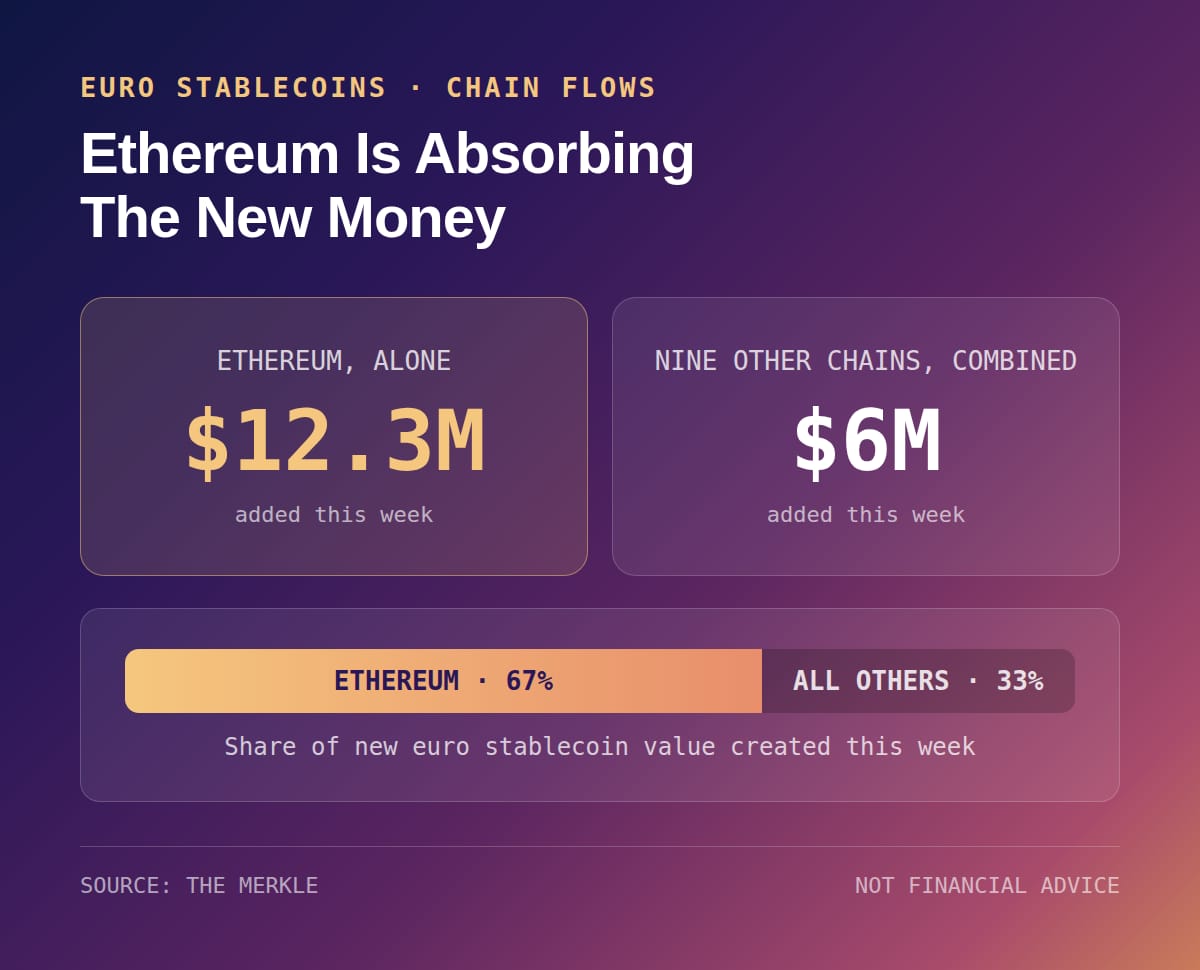
The concentration trend extends beyond individual tokens to the underlying blockchain networks. Chain-level data from the past week reveals a similarly lopsided story: Ethereum alone absorbed the lion’s share of new euro stablecoin value. The market capitalization of euro stablecoins on Ethereum increased by $12.3 million. In stark contrast, all other nine chains combined—including prominent networks such as Solana, Polygon, Avalanche, XRP Ledger, and Stellar—collectively added only $6 million.
This means Ethereum captured approximately two-thirds of all new euro stablecoin value created during the week, despite euro stablecoins being deployed across a genuinely wide array of networks. This pattern aligns perfectly with the token-level narrative, as EURCV, EURC, and EUROP all maintain significant presences on Ethereum. Ethereum’s established DeFi ecosystem, its robust security, and its widespread adoption by institutional players make it a preferred destination for significant capital inflows, even as scalability concerns push many projects to explore alternative layers and networks.
This data serves as a powerful reminder that while multi-chain expansion is crucial for accessibility, interoperability, and reaching diverse user bases, it does not automatically translate into balanced liquidity growth. Issuers can deploy their tokens on numerous networks, yet often find that a single, dominant chain continues to absorb the bulk of new capital and liquidity, especially for institutional and DeFi-driven demand. The ‘original’ or most mature chain frequently retains a strong gravitational pull for substantial value, serving as the primary hub for deep liquidity and complex financial operations.
Revolut’s EURR: A Glimmer of Future Retail Adoption
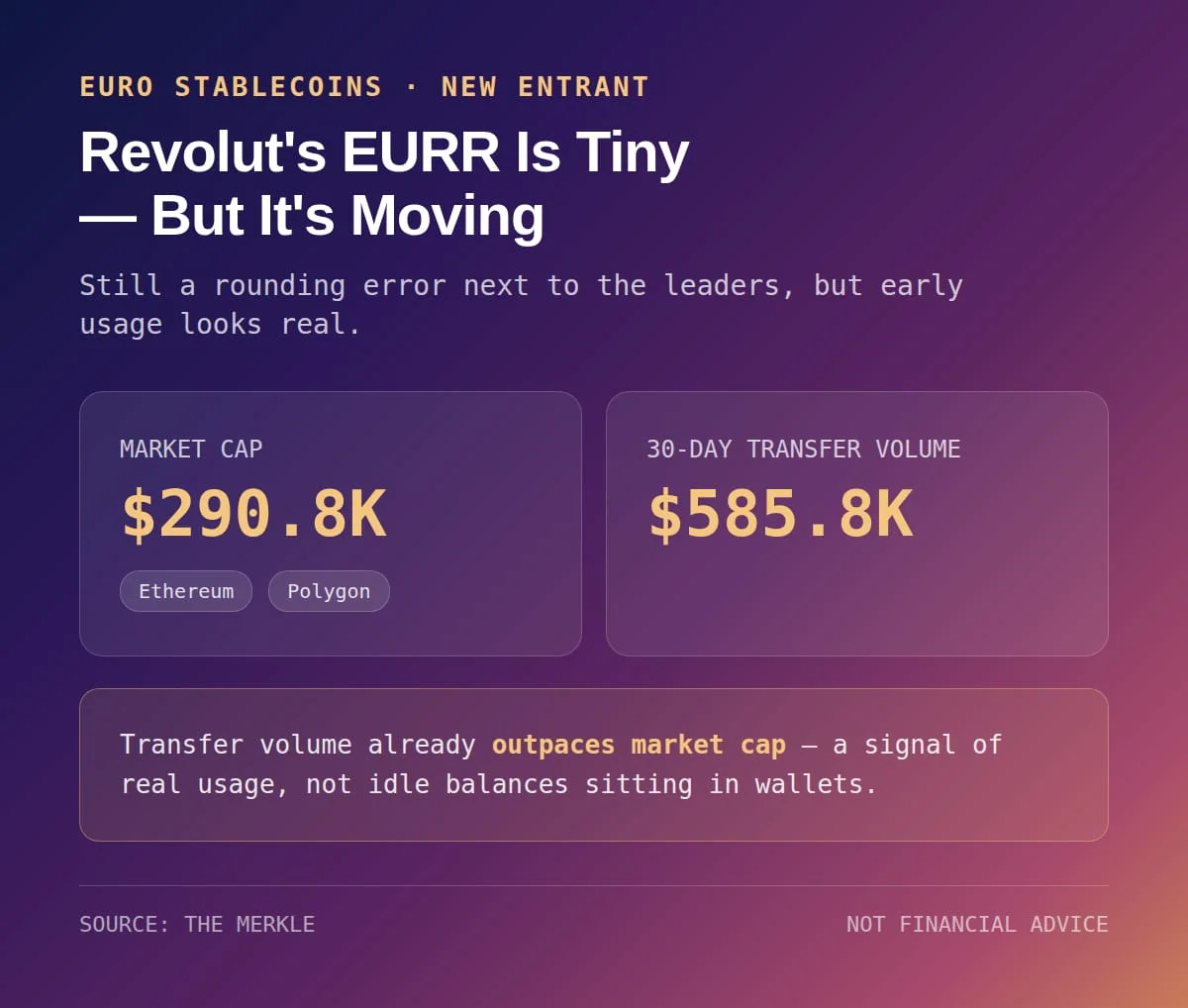
Amidst the concentration of institutional flows, a new entrant provides a glimpse into the future of retail euro stablecoin adoption: Revolut’s EURR. Currently, EURR’s market capitalization stands at a modest $290.8 thousand, with $585.8 thousand transferred over the past 30 days across Ethereum and Polygon. These figures are minuscule compared to the tens of millions in weekly movement seen by EURCV and its peers, indicating that EURR is still in its nascent stages. Having only recently begun rolling out to customers in a select few European markets, it is closer to a pilot phase than a comprehensive market test.
However, the significance of EURR lies not in its current size, but in its distribution model. Revolut, a global financial superapp, boasts tens of millions of existing users across Europe and beyond. A euro stablecoin directly integrated into such a widely adopted retail banking application possesses a fundamentally different growth ceiling compared to tokens that primarily reside within crypto-native wallets or cater to specialized DeFi users. This direct access to a massive, non-crypto-native user base could unlock unprecedented levels of mainstream adoption for stablecoins.
The fact that EURR’s transfer volume already outpaces its market cap suggests genuine usage rather than just idle balances. This indicates that customers are actively moving and utilizing the stablecoin, even in its limited rollout phase. If Revolut successfully scales EURR to its entire user base, it could dramatically alter the competitive landscape, introducing a new dimension of retail-driven demand that complements the institutional flows currently dominating the market.
Broader Implications for Europe’s Stablecoin Race
Stepping back from the weekly numbers, the overarching picture that emerges is one of a market still very much in its formative stages, actively identifying its leaders. The 92% concentration of weekly growth in just three tokens, coupled with two-thirds of new value landing on a single blockchain, is not indicative of a mature, evenly distributed sector. Instead, it signals a race where distinct competitive advantages are proving decisive.
Regulatory credibility, exemplified by MiCA compliance and robust auditing, is becoming an indispensable factor for institutional trust. A strong chain presence, particularly on established networks like Ethereum, continues to be crucial for deep liquidity and integration into the broader DeFi ecosystem. Perhaps most critically, existing distribution networks – whether through a major bank’s institutional client base, an established crypto infrastructure provider, or a widely used retail banking app – are proving to be powerful determinants of success. The number of blockchains a token’s logo appears on, while useful for marketing and accessibility, does not automatically translate into meaningful market share without these underlying pillars.
The success of Societe Generale’s EURCV underscores the growing influence of traditional financial institutions in the digital asset space. As regulatory frameworks become clearer, more banks are likely to leverage their existing trust, compliance capabilities, and client relationships to offer digital asset services, including stablecoins. This trend signifies a gradual but fundamental shift in the crypto industry, where institutional participation is moving beyond mere investment to active product development and market leadership.
While euro stablecoins remain a fraction of the overall stablecoin market compared to their dollar-pegged counterparts, weeks like this one provide invaluable insights into where the early momentum is truly concentrating. For the immediate future, the spotlight remains firmly on Societe Generale’s EURCV, Circle’s EURC, and Schuman Financial’s EUROP. However, the quiet entry of Revolut’s EURR, with its vast retail potential, hints at an exciting and potentially disruptive challenger on the horizon. The journey of euro stablecoins from niche crypto assets to mainstream financial instruments is still unfolding, with regulatory developments, technological innovation, and strategic partnerships continuing to shape its trajectory. The coming months and years will undoubtedly reveal whether this concentration solidifies into a lasting oligopoly or if new contenders can successfully carve out their own significant niches in Europe’s evolving digital economy.














