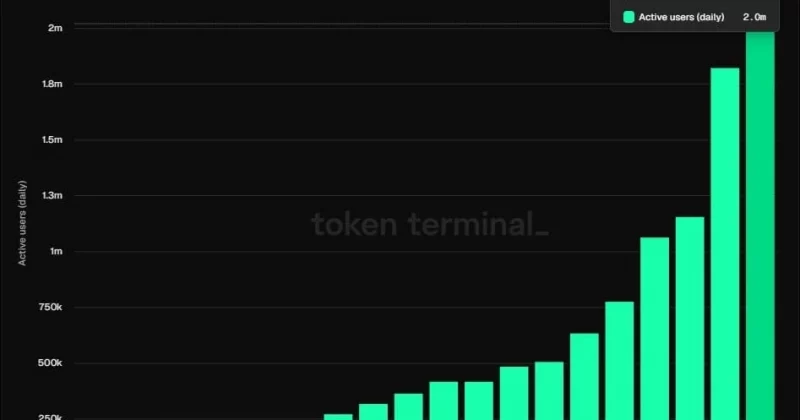
Tron has achieved a significant milestone, surpassing the 4 million daily active user (DAU) threshold and overtaking Solana as the top-performing major blockchain network. This remarkable growth is not fueled by speculative trading in decentralized finance (DeFi) or the hype surrounding non-fungible tokens (NFTs), but rather by the robust utility of stablecoins, with Tether’s USDT standing out as the primary driver. The network’s ability to facilitate high-volume, low-cost transactions has cemented its position, primarily through its role as a critical infrastructure for stablecoin operations.
The Engine of Growth: Stablecoins on the Tron Network
The ascent of Tron to the forefront of blockchain adoption is a testament to the growing demand for stable, reliable digital currencies. In the fourth quarter of 2025, Tron averaged approximately 2.8 million daily active users, positioning it just behind Solana’s 2.9 million users. This competitive landscape shifted dramatically in early 2026, as Tron’s DAU climbed to around 3.2 million. The most recent figures reveal a substantial leap, with the network now boasting over 4 million daily active users, solidifying its dominance.
This surge in user activity is intrinsically linked to the immense volume of stablecoin transactions occurring on the Tron network. USDT, the flagship stablecoin issued by Tether, plays a pivotal role. USDT transfer volumes on Tron frequently exceed an astounding $20 billion per day. By May 2025, the circulating supply of USDT on the Tron network had already surpassed $75 billion, representing more than half of Tether’s entire global supply. This concentration underscores Tron’s critical function as the primary network for USDT issuance and circulation.
Beyond stablecoins, Tron’s underlying infrastructure supports a vast ecosystem of activity. The network consistently processes over 8 million daily transactions, demonstrating its capacity and efficiency. This high transaction throughput has contributed to the accumulation of a substantial user base, with more than 306 million total user accounts registered on the platform since its inception.
The Strategic Advantage: Why Stablecoins Drive Mass Adoption
Tron’s foundational design, established by founder Justin Sun in 2017 with its mainnet launching in 2018, was built with scalability and efficiency at its core. From its inception, the network prioritized achieving high transaction throughput and maintaining exceptionally low transaction fees. This strategic focus has proven to be a critical differentiator, especially in the context of global financial infrastructure.
The emphasis on low fees and high speed is particularly attractive for stablecoin transactions. Unlike speculative trading, which can be volatile and sensitive to market sentiment, stablecoins are primarily used for utility: remittances, cross-border payments, and as a hedge against volatility in other cryptocurrencies. The ability to move significant value quickly and affordably makes Tron an ideal platform for these essential financial operations.
The network’s architecture, often described as an Ethereum Virtual Machine (EVM)-compatible blockchain, allows for the seamless deployment of smart contracts and decentralized applications (dApps). However, its ability to handle a massive number of transactions with minimal latency and cost is what has truly set it apart for stablecoin-centric use cases. This is in contrast to some other networks that may experience congestion and higher fees during periods of intense speculative activity.
Implications for Investors and the Broader Ecosystem
The significant transaction volume on Tron, largely driven by stablecoins, suggests a baseline level of activity that is structurally tied to global remittance flows and cross-border commerce. This inherent utility provides a degree of stability to the network’s performance, differentiating it from networks primarily driven by speculative ventures.
The native cryptocurrency of the Tron network, TRX, plays a crucial role in this ecosystem. TRX is required to pay for transaction fees, ensuring the smooth operation of the network. Furthermore, TRX holders can participate in the network’s governance, influencing its future development and strategic direction. This dual utility of TRX – as a medium for fees and a tool for governance – provides a foundational demand for the token.
However, the overwhelming reliance on a single asset, USDT, for such a significant portion of Tron’s activity presents a notable risk. This concentration creates an existential threat: any disruption to USDT’s dominance or operational integrity could have profound consequences for Tron’s user numbers and overall network health.
Potential disruptions could arise from various sources. Serious regulatory action against Tether, the issuer of USDT, could significantly impact its stability and usability. Similarly, if competing stablecoins, such as Circle’s USDC, were to gain substantial traction on the Tron network, it could dilute USDT’s dominance and alter the network’s user base dynamics. Such shifts could lead to a reversal of the impressive user growth Tron has experienced.
The implications for investors are multifaceted. On one hand, Tron’s demonstrated ability to attract and sustain a massive user base through essential financial services presents a compelling investment thesis. The network’s infrastructure is proving its worth in facilitating real-world economic activity. On the other hand, the concentration risk associated with USDT cannot be ignored. Investors would be wise to monitor the regulatory landscape surrounding stablecoins and the competitive dynamics between major stablecoin issuers.
A Historical Perspective: The Evolution of Tron
Tron’s journey to its current leadership position has been marked by strategic development and a consistent focus on its core value proposition. Founded by Justin Sun, a prominent figure in the cryptocurrency space, Tron aimed to decentralize the internet and build a robust blockchain platform capable of supporting a wide range of applications.
The initial vision for Tron was ambitious, seeking to disrupt the dominance of established tech giants by providing a decentralized alternative for content creation and distribution. While these broader goals are still in development, the network’s success in attracting stablecoin activity has provided a strong foundation for its growth.
The launch of the Tron mainnet in 2018 marked the beginning of its operational phase. Early on, the team focused on optimizing the network for speed and cost-efficiency, anticipating the need for a scalable blockchain that could handle a high volume of transactions. This foresight has proven invaluable as the demand for digital currencies and cross-border payment solutions has surged.
Over the years, Tron has undergone several network upgrades and protocol enhancements aimed at improving its performance, security, and scalability. The network’s ability to adapt and evolve in response to market demands has been a key factor in its sustained growth. The recent achievement of surpassing 4 million daily active users is a culmination of these efforts and a validation of its underlying technology and strategic direction.
Looking Ahead: Challenges and Opportunities
The future of Tron appears robust, given its established position as a leader in stablecoin transactions. The network’s infrastructure is well-suited to handle the increasing global demand for fast, low-cost digital payments. As more individuals and businesses seek alternatives to traditional financial systems, Tron’s utility-focused approach positions it favorably.
However, the network must also navigate the inherent risks of its concentrated reliance on USDT. Diversifying its use cases and potentially fostering the growth of other stablecoins or digital assets on its platform could mitigate this risk. Continued innovation in its smart contract capabilities and dApp ecosystem could also attract a broader range of users beyond those focused solely on stablecoin transfers.
The regulatory environment for cryptocurrencies and stablecoins is also a critical factor to watch. Governments worldwide are increasingly scrutinizing the digital asset space, and any new regulations could impact the operations of stablecoin issuers and blockchain networks. Tron’s ability to adapt to these evolving regulatory landscapes will be crucial for its long-term success.
In conclusion, Tron’s ascent to the top of the blockchain rankings, driven by its unparalleled capacity for stablecoin transactions, represents a significant shift in the digital asset landscape. Its success highlights the growing importance of utility and efficiency in driving mass adoption, underscoring the potential for blockchain technology to facilitate essential financial services on a global scale. While challenges remain, particularly concerning its reliance on USDT, Tron’s robust infrastructure and strategic focus have positioned it as a key player in the evolving digital economy.