
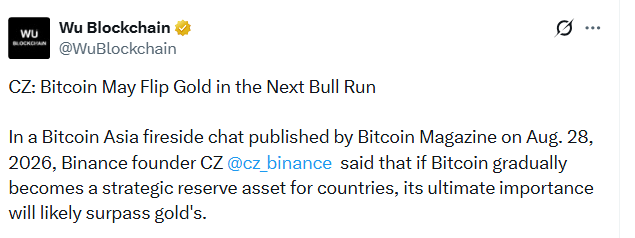
Changpeng Zhao (CZ), the influential founder of Binance, has articulated a bold vision for Bitcoin’s future, predicting its eventual prominence over gold as a global reserve asset. Speaking at the recent Bitcoin Asia 2026 event, a prominent gathering of cryptocurrency enthusiasts and industry leaders, CZ shared his conviction that Bitcoin is poised to surpass gold in significance, potentially during the next major bull market cycle. This forecast, disseminated via the X platform and highlighted by market analyst Wu Blockchain, suggests a fundamental shift in how sovereign nations and institutional investors perceive and allocate their strategic reserves.
The historical precedent of gold as the world’s most valued asset is undeniable. For millennia, gold has served as a benchmark for wealth, a hedge against inflation, and a cornerstone of national treasuries. Its current market valuation stands at an impressive $15.899 trillion, dwarfing Bitcoin’s market capitalization of approximately $1.6 trillion. This vast disparity underscores gold’s entrenched position, attributed to its perceived stability, inflation-resistant properties, and the deep-seated trust it commands among global investors. The established infrastructure for gold custody, storage, and trading, coupled with centuries of sovereign backing, has solidified its role as the preferred asset for safeguarding wealth.
However, CZ’s perspective challenges this long-held paradigm. He posits that Bitcoin’s trajectory is fundamentally different, driven not solely by intrinsic value but by evolving global financial dynamics and the increasing adoption of digital assets by nations. His argument hinges on the notion that gold’s dominance is more a product of its historical inertia and established institutional frameworks rather than an inherent superiority in its fundamental properties. CZ suggests that the "real liquidity" of gold lies not in the metal itself, but in the maturity of its market, the vast investor base that holds it, and the robust reserve systems that governments have meticulously built around it over generations.
The Shifting Sands of Global Reserves: Bitcoin’s Emerging Role
CZ’s prediction gains traction when considering the ongoing diversification of global reserve assets. As economies evolve and new technologies emerge, nations are increasingly exploring alternative avenues to diversify their holdings beyond traditional assets. This trend, he argues, will inevitably lead to a greater allocation of capital towards digital assets like Bitcoin. The current ten-fold difference in market capitalization between gold and Bitcoin, while substantial, is not an insurmountable barrier. As institutional adoption accelerates and more countries begin to view Bitcoin as a strategic reserve asset, this gap is expected to narrow significantly.

The process of this shift, however, is not anticipated to be instantaneous. Nations that have historically invested heavily in gold reserves possess deeply entrenched financial systems and long-standing geopolitical relationships tied to the precious metal. The transition from a gold-centric reserve strategy to one that incorporates or prioritizes Bitcoin will likely be a gradual evolution, requiring careful planning, regulatory clarity, and a sustained demonstration of Bitcoin’s reliability and scalability as a store of value and medium of exchange.
Bitcoin Asia 2026: A Forum for Future-Forward Discussions
The Bitcoin Asia 2026 event, where CZ shared his insights, serves as a crucial barometer for the evolving cryptocurrency landscape in the region and globally. Such forums provide a platform for key industry players to discuss emerging trends, address challenges, and shape the future narrative surrounding digital assets. The conference likely brought together innovators, policymakers, and investors, fostering dialogue on topics ranging from regulatory frameworks to the integration of cryptocurrencies into traditional financial systems. CZ’s participation and pronouncements at such a high-profile event lend significant weight to his projections.
The event’s timing also coincides with a period of significant activity and price appreciation in the Bitcoin market. Following a period of volatility, Bitcoin has demonstrated a robust recovery, recapturing significant price levels and exhibiting signs of consolidation. This renewed market strength, often fueled by positive sentiment and increasing investor confidence, provides a fertile ground for discussions about Bitcoin’s long-term potential and its role in the global financial architecture.
CZ’s Bullish Outlook: Beyond Speculation to Strategic Allocation
CZ’s optimism extends beyond mere price predictions; it encompasses a strategic view of Bitcoin’s utility for sovereign entities. He envisions a future where Bitcoin is not just a speculative investment but a fundamental component of national economic strategy. This includes its potential integration into institutional capital, pension investment schemes, and, most crucially, national capital reserves. The Binance founder has even encouraged governments worldwide to proactively develop clear regulatory frameworks for cryptocurrencies and to seriously consider allocating portions of their capital reserves to Bitcoin.
He cites the growing interest and, in some cases, adoption by nations such as the United States, the United Arab Emirates, China, and Japan as indicators of this burgeoning trend. While direct official statements from all these nations regarding Bitcoin as a primary reserve asset might be nuanced, the increasing exploration of blockchain technology and digital currencies by their central banks and financial institutions signals a growing engagement with the digital asset space. For instance, El Salvador’s adoption of Bitcoin as legal tender, while unique, serves as a precedent that other nations are observing and analyzing. The UAE’s focus on digital asset innovation and potential adoption of central bank digital currencies (CBDCs) also indicates a forward-looking approach to digital finance. China’s development of its digital yuan (e-CNY) showcases a significant state-led initiative in the digital currency space, which, while distinct from decentralized cryptocurrencies, reflects an increasing embrace of digital financial technologies. Japan, a major global economy, has been actively exploring the regulatory landscape for digital assets, with its financial services agency working on frameworks to support innovation while mitigating risks.
The Case for Bitcoin: Decentralization, Scarcity, and Digital Scarcity
The underlying appeal of Bitcoin, according to proponents like CZ, lies in its inherent characteristics: decentralization, a fixed and predictable supply, and censorship resistance. Unlike fiat currencies, which can be devalued through inflationary monetary policies, Bitcoin’s supply is capped at 21 million coins. This scarcity, coupled with its decentralized nature, which removes reliance on any single authority, makes it an attractive alternative for nations seeking to diversify away from traditional financial systems susceptible to political influence and economic instability.
Furthermore, Bitcoin’s digital nature allows for seamless and borderless transactions, offering potential efficiencies in international trade and reserve management. The ability to hold and transfer Bitcoin securely and transparently on a global ledger presents a compelling proposition for modernizing national treasuries.
Implications for the Global Financial Landscape
If CZ’s predictions materialize, the implications for the global financial landscape would be profound. A significant shift of national reserves from gold to Bitcoin would not only alter the balance of power in financial markets but also necessitate a re-evaluation of existing financial infrastructure and regulatory frameworks. Central banks would need to develop robust mechanisms for securing, managing, and transacting with Bitcoin. The valuation of both gold and Bitcoin would likely experience significant fluctuations as this reallocation occurs.

The increased adoption of Bitcoin by sovereign nations could also accelerate the development of a more inclusive and decentralized global financial system. It could empower smaller economies by providing them with greater control over their reserves and reducing their dependence on dominant fiat currencies.
However, challenges remain. Volatility, regulatory uncertainty, and the environmental impact of Bitcoin mining are persistent concerns that need to be addressed. The scalability of the Bitcoin network to handle the transaction volumes required for national reserves is another area of ongoing development and debate.
Looking Ahead: A Transformative Era for Digital Assets
CZ’s vision of Bitcoin surpassing gold as a primary reserve asset is a bold one, but it is grounded in observable trends of increasing institutional and sovereign interest in digital assets. The Bitcoin Asia 2026 event likely served as a critical platform to amplify this message and foster further discussion. As the digital asset space matures and regulatory clarity improves, the narrative of Bitcoin as a legitimate and potentially superior reserve asset is gaining momentum. The coming years will be crucial in determining whether CZ’s optimistic forecast will translate into a tangible transformation of the global financial order, marking a new era where digital scarcity and decentralization redefine the very concept of national wealth.