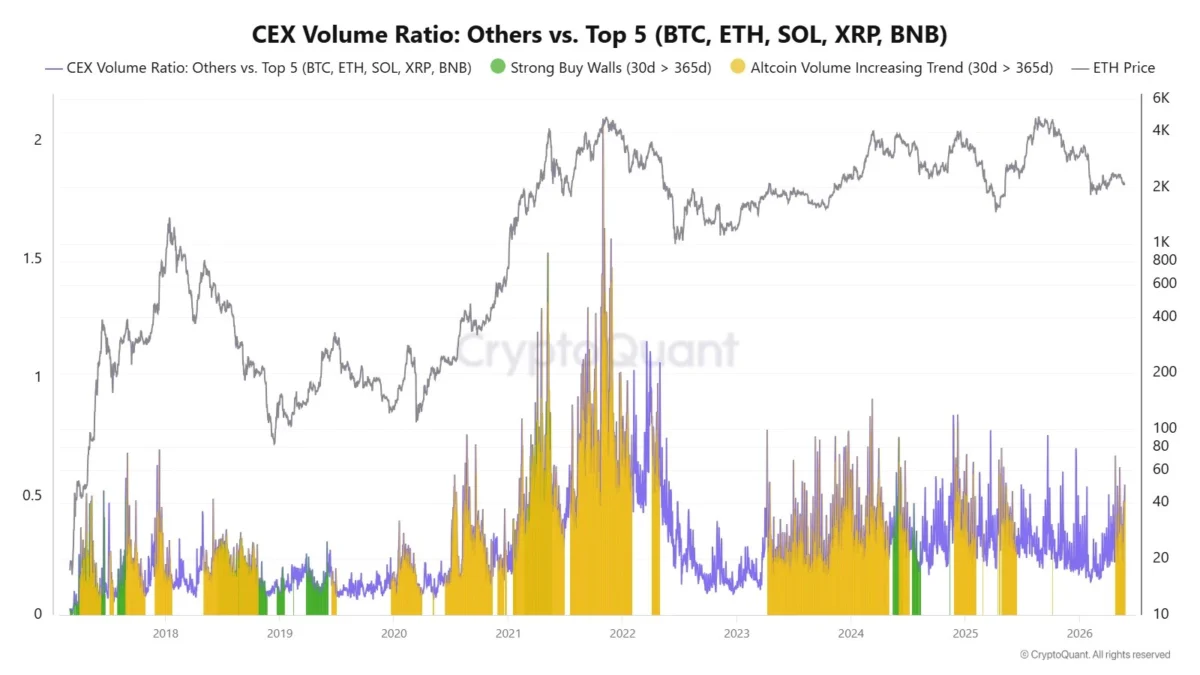
The cryptocurrency market is currently navigating a period of profound structural change, characterized by a notable divergence between aggregate market sentiment and the underlying trading behavior within specific sub-sectors. While the broader digital asset landscape has been defined by months of selling pressure, sideways price action, and a general sense of investor exhaustion, new data from the blockchain analytics firm CryptoQuant suggests that a quiet but deliberate accumulation phase may be underway. Specifically, the trading volume for altcoins excluding the top five market leaders is beginning to rise, even as total market activity remains depressed. This anomaly suggests that a cohort of sophisticated participants is positioning for a potential shift in market leadership, favoring high-risk, high-reward assets at a time when the majority of the market has disengaged.
The Anatomy of the Volume Divergence
To understand the significance of the current trend, it is necessary to examine the macro environment that frames it. For much of late 2024 and early 2025, the cryptocurrency market has struggled to maintain the momentum generated during the initial recovery attempts seen in the first quarter of the previous year. Trading volumes across major centralized exchanges (CEXs) have been in a steady decline, a phenomenon often associated with "retail fatigue." Investor sentiment has followed a similar trajectory, moving from cautious optimism to a state of persistent negativity as macro headwinds—including fluctuating interest rate expectations and regulatory uncertainty—continue to dampen enthusiasm.
However, beneath this surface-level stagnation, CryptoQuant has identified a behavioral outlier. When filtering for exchange volume of altcoins excluding the "Big Five"—Bitcoin (BTC), Ethereum (ETH), Solana (SOL), XRP, and BNB—the data shows a consistent upward trend. This category, often referred to in market indices as "OTHERS," represents the broader ecosystem of mid-cap and small-cap digital assets.
The fact that this specific segment is seeing increased activity while the rest of the market grows quieter is statistically significant. In a typical bull market, volume rises across the board as retail "FOMO" (fear of missing out) drives indiscriminate buying. In the current environment, the rising volume in the OTHERS category suggests "deliberate" rather than "reactive" decision-making. These participants are not chasing a rally; they are likely building positions in anticipation of one, operating in a vacuum of general market interest.

A Chronology of Market Exhaustion and Localized Recovery
The path to this current divergence has been marked by several distinct phases over the past twelve months. Following the Bitcoin ETF-led surge in early 2024, the market entered a period of "concentration," where the vast majority of capital inflows were restricted to Bitcoin and a handful of dominant Layer-1 protocols. This left the broader altcoin market in a state of prolonged attrition.
- The Q3 2024 Drawdown: During this period, most mid-cap altcoins saw valuations drop by 50% to 70% from their yearly highs. This phase was characterized by "capitulation," where long-term holders finally exited their positions, citing a lack of a clear "altcoin season."
- The Q4 2024 Stagnation: As Bitcoin attempted to stabilize near its all-time highs, altcoins failed to follow suit. The OTHERS/BTC ratio reached multi-year lows, confirming that Bitcoin dominance remained the primary theme of the cycle.
- The February 2025 Recovery Attempt: A brief spark of life returned to the market in early 2025, but it was short-lived. While Bitcoin and Ethereum tested key resistance levels, the broader altcoin market saw only marginal gains before returning to a sideways grind.
- The Current Divergence (Q2 2025): We are now in a phase where aggregate volume is hitting yearly lows, yet the OTHERS segment is beginning to show a "rounding bottom" in terms of exchange activity. This suggests that the "weak hands" have been flushed out, leaving behind a core group of accumulators.
Analyzing the OTHERS/BTC Ratio: Technical Stabilization
The technical backdrop for this volume divergence is found in the OTHERS/BTC index, which tracks the total market capitalization of all cryptocurrencies excluding the top 10 assets, relative to the price of Bitcoin. This index is a primary gauge for the health of the speculative altcoin market.
Historically, the OTHERS/BTC ratio has undergone long periods of underperformance followed by explosive "catch-up" rallies. Currently, the ratio is attempting to stabilize after a brutal two-year downtrend. On the weekly charts, the structure remains technically weak, as the ratio continues to trade below its 50-week, 100-week, and 200-week moving averages. However, the velocity of the decline has slowed significantly.
Since the beginning of 2025, the OTHERS/BTC ratio has been oscillating within a tight consolidation range near the 0.12 region. In technical analysis, such prolonged sideways movement following a steep decline is often interpreted as a "basing" phase. It indicates an equilibrium where selling pressure is being met with equal parts absorption by buyers.
The CryptoQuant report emphasizes that the defense of this 0.12 range, coupled with rising volume during minor recovery attempts, is a classic signal of seller exhaustion. If the ratio can successfully reclaim the 50-week moving average—which has acted as a ceiling for over 18 months—it would likely trigger a trend reversal that could see capital rotate rapidly out of Bitcoin and into higher-beta altcoin assets.

Institutional Influence vs. Retail Absence
One of the most striking aspects of the current cycle is the role of institutional capital. Unlike previous cycles where retail investors drove the initial stages of an altcoin rally, the 2024-2025 period has been dominated by institutional "flight to quality." This has benefited Bitcoin and Ethereum immensely but has left smaller projects starved of liquidity.
Industry observers and analysts suggest that the current rise in OTHERS volume may be the first sign of "institutional creep" into the broader crypto ecosystem. As the returns on Bitcoin become more correlated with traditional equity markets, professional traders may be looking toward the altcoin sector for "alpha"—returns that outperform the market benchmark.
While official statements from major asset managers remain focused on Bitcoin and Ethereum ETFs, the "on-chain" reality suggests a more nuanced approach. Venture capital firms and crypto-native hedge funds, who have remained quiet during the recent downturn, appear to be the primary drivers of the deliberate positioning noted by CryptoQuant. For these entities, the current lack of retail interest provides the ideal "low-slippage" environment to build large positions without triggering immediate price spikes.
Macroeconomic Factors and Liquidity Cycles
The broader economic environment continues to play a pivotal role in how altcoins perform. Throughout 2024, high interest rates in the United States and a strong Dollar Index (DXY) created a "risk-off" environment. In such periods, investors typically gravitate toward the safest assets, which in the crypto context means Bitcoin.
However, as the Federal Reserve signals a potential shift toward a more neutral monetary policy in late 2025, the "global liquidity cycle" is expected to turn. Historically, altcoins are highly sensitive to increases in global M2 money supply. When liquidity enters the system, it tends to flow down the "risk curve"—starting with Bitcoin, moving to Ethereum and major Layer-1s, and finally flooding into the OTHERS category.

The rising volume in smaller altcoins may be a leading indicator that market participants are anticipating this liquidity injection. If the U.S. dollar begins to weaken or if global central banks resume balance sheet expansion, the "deliberate" positions being built today could become the foundation for a significant market rotation.
Implications for the Remainder of 2025
The findings from CryptoQuant suggest that the "death of altcoins" narrative may be premature. While the cycle has undoubtedly been frustrating for those expecting a 2021-style mania, the underlying data points to a market that is maturing rather than disappearing.
The implications of this volume divergence are twofold. First, it suggests that the "bottoming process" for altcoins is well underway. While a confirmed breakout has yet to occur, the increase in activity during a period of peak pessimism is a historically reliable contrarian indicator. Second, it highlights the importance of selectivity. In previous cycles, almost all altcoins rose together. In this cycle, the divergence suggests that capital is being directed toward specific projects with perceived long-term value, rather than being spread thinly across the entire sector.
As we move into the second half of 2025, the key levels to watch will be the 50-week moving average on the OTHERS/BTC chart and the persistence of volume growth in non-top-5 assets. If these trends continue to develop, the "quiet" accumulation seen today may eventually lead to a "loud" expansion in the months to come. For now, the market remains in a state of tension—a battle between the prevailing sentiment of exhaustion and the data-driven reality of strategic positioning.