This Friday, we examine Ethereum, Ripple, Cardano, Binance Coin, and Hyperliquid in greater detail. The cryptocurrency market, known for its inherent volatility and rapid evolution, continues to present a complex landscape for investors and enthusiasts alike. As the digital asset space matures, understanding the performance and potential trajectory of key players becomes paramount. This week, we delve into the recent price action and technical indicators surrounding five prominent cryptocurrencies: Ethereum (ETH), Ripple (XRP), Cardano (ADA), Binance Coin (BNB), and the relatively newer entrant, Hyperliquid (HYPE). Each of these assets is navigating unique challenges and opportunities, influenced by broader market sentiment, technological developments, and regulatory considerations.
Ethereum (ETH): Navigating the $1,500 Crucial Support Zone
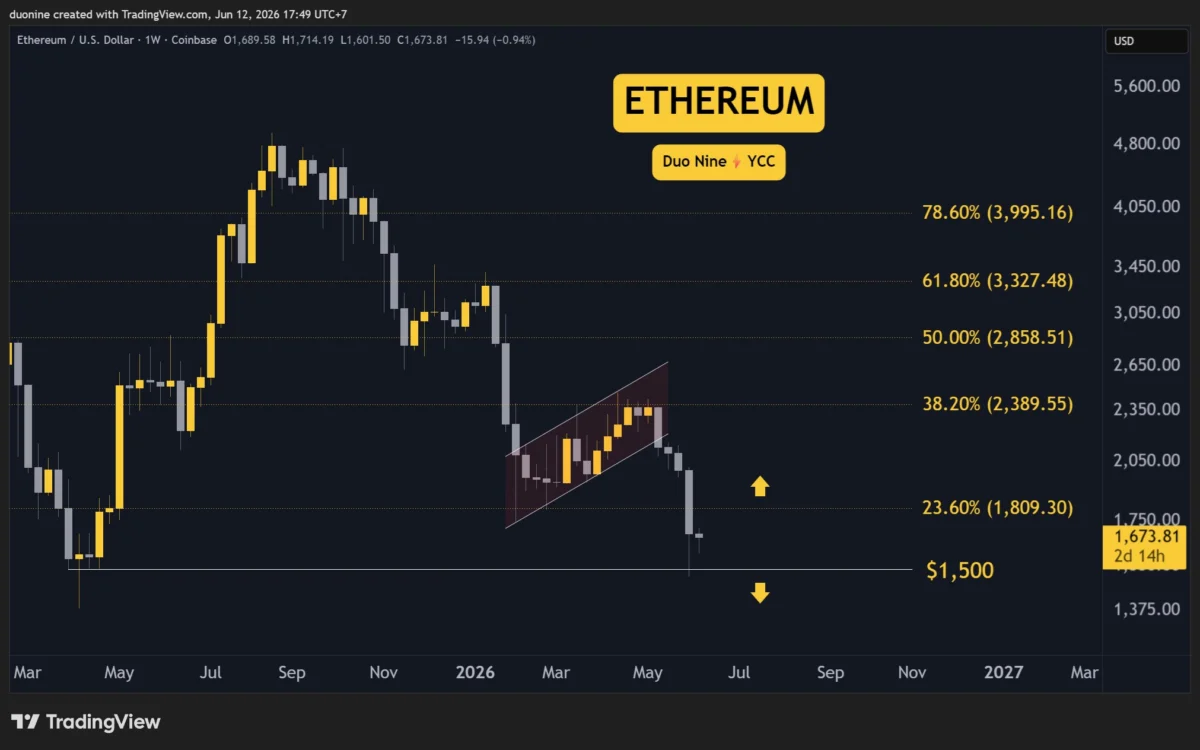
Ethereum, the second-largest cryptocurrency by market capitalization, has experienced a period of consolidation this week, trading in a relatively flat pattern as it hovers just above the critical support level of $1,500. This stabilization follows a significant downturn, with ETH prices having fallen approximately 37% since early May. This sharp decline has put the asset at a pivotal juncture, where its ability to hold this key support could determine its near-term future.
The $1,500 mark is not merely an arbitrary price point; it represents a historically significant level for Ethereum. This area has demonstrated its strength as a robust support zone in the past, most notably serving as the springboard from which ETH launched its impressive ascent towards its all-time high of nearly $5,000 in August 2025. The repeated affirmation of this level as a floor suggests that a considerable number of buyers are likely to be actively entering the market, seeking to capitalize on what they perceive as an attractive entry point. The presence of these buyers is crucial for preventing further price erosion.
Looking ahead, Ethereum finds itself at a critical decision point. A successful defense of the $1,500 support would be interpreted as a strong signal of resilience and could potentially trigger a relief rally, offering a much-needed reprieve for investors. However, the market remains keenly aware of the downside risks. Any significant weakness or breach below $1,500 could have dire consequences, potentially ushering in a renewed wave of selling pressure. Such a scenario would likely lead to the formation of a lower low, emboldening sellers and casting a shadow over Ethereum’s short-to-medium term prospects. The broader implications for the decentralized finance (DeFi) ecosystem, which relies heavily on Ethereum’s infrastructure, would also be significant. A sustained downturn could impact innovation and investor confidence across the sector.
Ripple (XRP): The Battle for $1 Continues
This past week, Ripple’s native token, XRP, concluded trading with a modest 1% gain. While the percentage increase itself may not be headline-grabbing, the more significant development lies in the continued resilience of the $1 support level. Despite recent attempts by sellers to breach this crucial psychological barrier, it has, for now, held firm. This sustained defense of $1 is a testament to the buying interest present at this price point, indicating a potential floor for XRP’s current price action.
However, the market battle is far from over. A renewed test of this key psychological level appears probable in the coming days. The ability of buyers to successfully defend against a second concerted attempt by sellers to break down below $1 will be a critical determinant of XRP’s immediate future. A successful defense could reignite interest and potentially pave the way for an upward price movement. Conversely, a breach would signal a significant weakening of support and could trigger further declines.
The critical levels to watch for XRP remain $1 and $1.30. The $1 mark, as discussed, is the immediate support, while $1.30 stands as a key resistance. For XRP to build substantial bullish momentum and signal a more sustained recovery, a decisive break above the $1.30 resistance will be imperative. This level has acted as a ceiling in previous trading periods, and overcoming it would indicate a significant shift in market sentiment and a potential resumption of an upward trend. The ongoing regulatory scrutiny surrounding Ripple and XRP, particularly the protracted legal battle with the U.S. Securities and Exchange Commission (SEC), continues to be a significant factor influencing investor sentiment and price action. Any definitive resolution to this legal uncertainty could have a profound impact on XRP’s trajectory.
Cardano (ADA): Signs of Stabilization Amidst a Bearish Trend
In a surprising turn of events, Cardano (ADA) experienced a relatively strong week, posting a 4% gain. While this upward movement was insufficient to reclaim the previously lost support at $0.24, which has now transitioned into a resistance level, it did provide a brief period of relief for ADA holders. This indicates that some buying pressure is emerging, offering a potential counterbalance to the prevailing bearish sentiment.
The $0.15 level appears to be holding firm as a support, successfully halting further declines and preventing sellers from completely dominating the chart. This suggests that there is a segment of the market that views ADA at these price levels as undervalued. However, the overarching trend for ADA remains bearish. Since its peak in 2025, the cryptocurrency has consistently been making lower lows, a classic indicator of a downtrend. This pattern suggests that while short-term bounces may occur, the long-term direction remains downward without a significant shift in market dynamics.
Looking ahead, the loss of support at $0.24 was a significant setback for the bulls. Recovering this level may prove to be a challenging and lengthy process. The current lack of clear signals indicating a bottom formation for Cardano’s token adds to this uncertainty. Investors will be closely monitoring the development roadmap of Cardano, particularly upcoming upgrades and partnerships, which could provide the fundamental catalysts needed to break this bearish cycle. The emphasis on scientific rigor and peer-reviewed research within Cardano’s development ethos, while ensuring long-term stability, can sometimes lead to slower adoption and price appreciation compared to more agile competitors.
Binance Coin (BNB): Sideways Consolidation Continues
Binance Coin (BNB), the native token of the Binance ecosystem, has seen a 2% increase this week. Crucially, it has managed to maintain its position above the key support level at $580. This level has been tested multiple times throughout 2026, and on each occasion, buyers have stepped in, repelling the downward pressure and preventing a sustained break below. This recurring defense highlights the significance of $580 as a robust floor for BNB.
Simultaneously, BNB has encountered persistent resistance at the $690 mark, a level that has effectively capped its upward movements throughout 2026. This interplay between a strong support and a stubborn resistance has led to a period of sideways consolidation for Binance Coin. It can be argued that the cryptocurrency has been trading within a defined range between $580 and $690 for the entirety of the year.
Looking ahead, Binance Coin’s price action in 2026 has been characterized by a lack of a decisive trend. Until either the $580 support or the $690 resistance is decisively broken, significant price movements are unlikely. The future trajectory of BNB is intrinsically linked to the performance and regulatory landscape of the Binance exchange itself. Any significant developments, positive or negative, concerning Binance could directly impact BNB’s price. The utility of BNB within the Binance ecosystem, including trading fee discounts and participation in token sales, provides a fundamental demand driver, but this is currently being offset by broader market conditions and the absence of a clear breakout pattern.
Hyperliquid (HYPE): Correcting After a Record High
Hyperliquid (HYPE), a relatively newer entrant in the cryptocurrency market, has experienced a 4% decline this week. This correction comes after its bullish momentum faltered at the all-time high of $75. Following this peak, sellers gained the upper hand, driving the price down to the key support level at $52, which was recently tested. This price action indicates a potential shift in market sentiment following a period of significant gains.
At the time of this report, sellers have seemingly confirmed $63 as a resistance level. This suggests that the immediate outlook for HYPE is cautious, with a potential retest of the $52 support on the horizon. Such a re-test could be interpreted as a sign of weakness in the current price action, especially if the support fails to hold. However, it is important to note that as long as HYPE remains within its ascending channel, it may be too early to declare a long-term bearish outlook.
Looking ahead, this correction was arguably expected and is a normal part of market cycles following a rapid ascent to new highs. The critical question for investors is whether the $52 support will hold. A failure to maintain this level could trigger a more aggressive correction, potentially sending HYPE prices back into the $40s. The rapid growth and high volatility often associated with newer cryptocurrencies like Hyperliquid mean that while the potential for substantial gains exists, the risk of significant losses is also elevated. Investors are closely watching the development of its underlying technology and its ability to capture market share in the competitive decentralized exchange (DEX) landscape. The platform’s focus on high-frequency trading and perpetual futures could attract a specific demographic of traders, but its long-term sustainability will depend on broader adoption and robust security measures.
Disclaimer: The information presented in this article is intended for informational purposes only and does not constitute financial advice. Cryptocurrencies are highly volatile assets, and investors are advised to conduct their own thorough research and consult with a qualified financial advisor before making any investment decisions. Past performance is not indicative of future results.