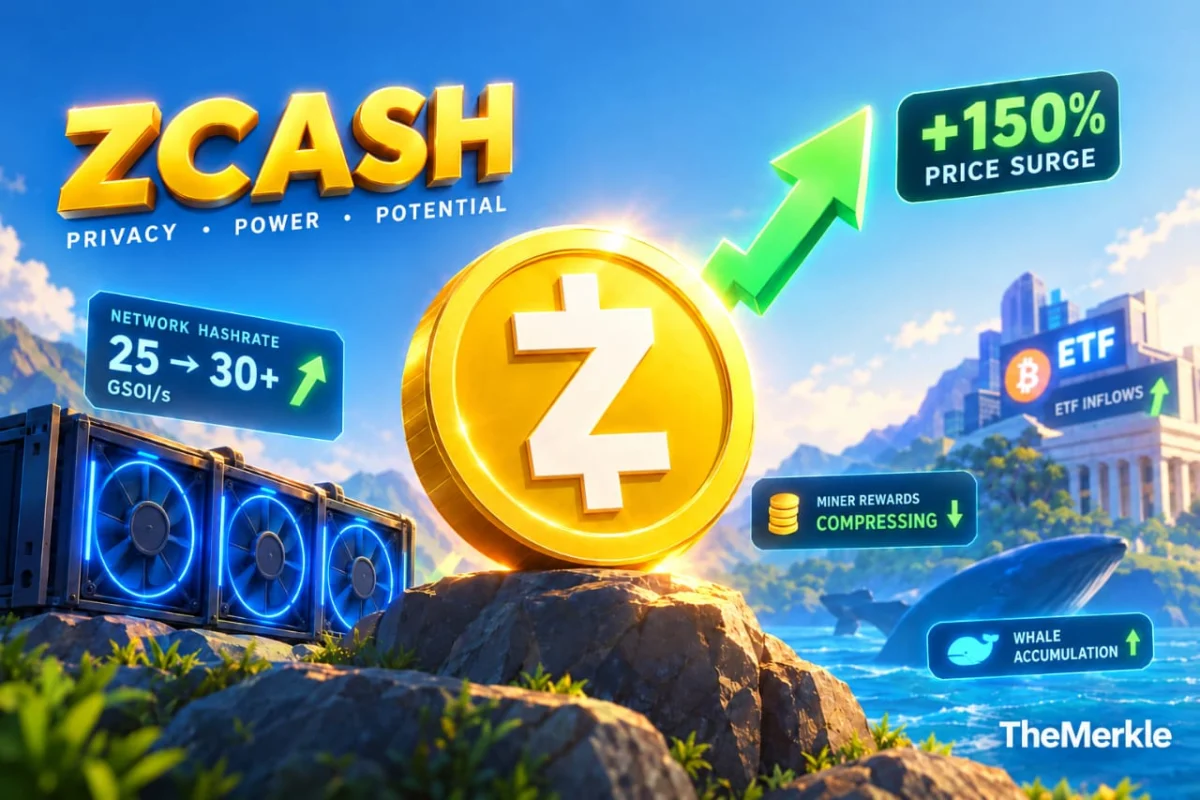
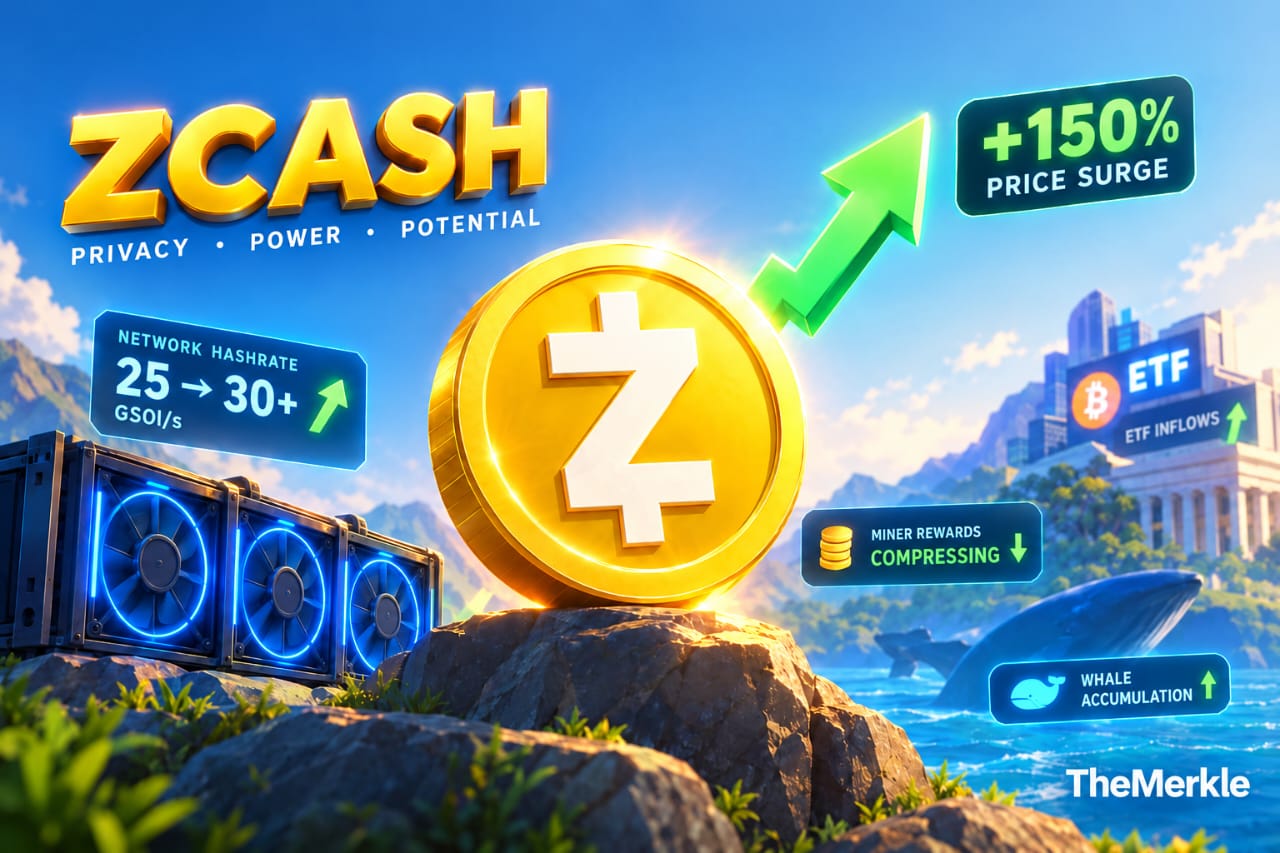
A striking divergence has emerged in the cryptocurrency market, with Zcash (ZEC), a leading privacy-focused digital asset, experiencing an astounding 150% price rally over the past month. This meteoric rise has been fueled by a confluence of accelerating institutional inflows, significant whale accumulation, and the strategic launch of regulated derivatives. Yet, beneath the surface of this bullish momentum lies a peculiar contradiction: the very participants securing the Zcash network – its miners – are reportedly earning less per unit of hardware than they were before this dramatic surge began. This intricate dynamic, a testament to the self-correcting mechanisms inherent in Proof-of-Work (PoW) networks, reveals a complex interplay between market demand, network security, and mining economics, a pattern not entirely new to the crypto landscape.
The Unprecedented Zcash Rally: From Margins to Mainstream Spotlight
The period spanning late August to late September has seen Zcash transform from a relatively quiet and often overlooked privacy coin into one of the most discussed assets in the digital currency space. Its valuation has climbed approximately 150% within this timeframe, attracting considerable attention from both retail and institutional investors. This significant appreciation represents more than just speculative fervor; it is underscored by tangible institutional demand, suggesting a deeper, more structural shift in market perception.
Historically, Zcash, like other privacy coins, has navigated a challenging regulatory environment, often relegated to the periphery of mainstream crypto conversations due to concerns over anonymity and potential misuse. However, the recent price action indicates a potential turning point. The scale of capital flowing into ZEC-related investment products points to a growing comfort, or at least a calculated risk appetite, among institutional players for assets offering enhanced privacy features. This rally has not only rewarded existing holders handsomely but has also thrust Zcash into a more prominent position, forcing a re-evaluation of its role and potential within the broader digital asset ecosystem. The concurrent timing of the price surge and the institutional capital deployment strongly suggests a symbiotic relationship, with each factor reinforcing the other in a powerful feedback loop.
Institutional Floodgates Open: Grayscale’s ETF and the Dawn of Regulated Derivatives
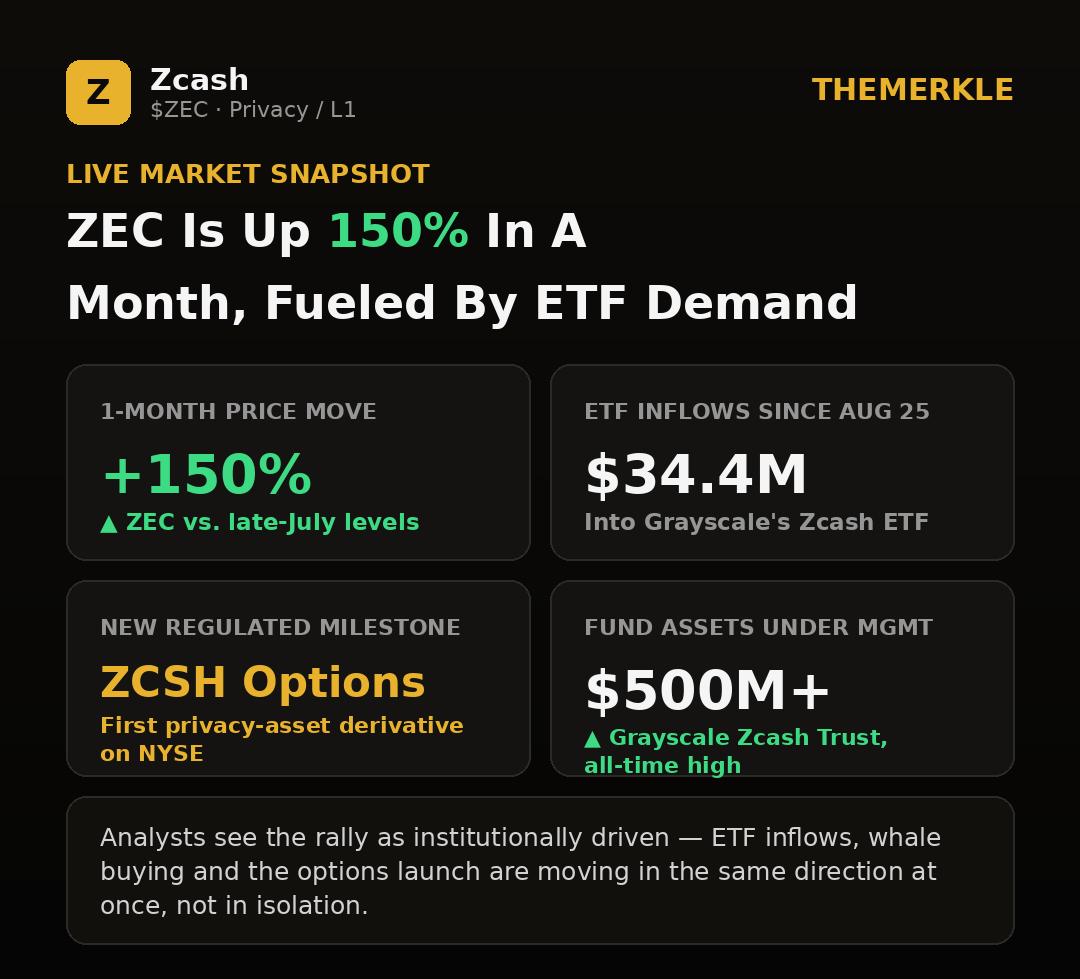
A primary catalyst for Zcash’s recent ascent is the substantial and accelerating institutional demand, most notably channeled through Grayscale’s Zcash Trust. Since August 25 alone, the Grayscale Zcash Trust (ZCSH) has pulled in approximately $34.4 million in inflows, a meaningful figure for a fund dedicated to an asset that has largely operated outside the mainstream spotlight. This consistent influx has propelled the fund’s assets under management (AUM) to surpass the $500 million mark, with ZCSH now holding over 550,000 ZEC. The accumulation of half a billion dollars in a fund entirely dedicated to a privacy coin is a notable milestone, signaling a robust institutional appetite for regulated exposure to this asset class.
Adding another layer of institutional validation and market accessibility, the New York Stock Exchange (NYSE) recently announced the launch of options trading on Grayscale’s Zcash ETF, ZCSH. This development marks a significant regulatory milestone, representing the first time a regulated derivative product for a privacy asset has secured support on a major US exchange. Given the historically cautious stance of US regulators towards privacy-focused cryptocurrencies, this move by the NYSE and Grayscale is particularly noteworthy.
The introduction of call and put options on ZCSH provides institutional and sophisticated retail participants with new avenues for engagement. Investors can now hedge existing Zcash exposure, manage risk, or take leveraged directional bets on ZEC’s price action through a regulated derivatives structure. This mechanism was previously unavailable for privacy assets, significantly expanding the toolkit for professional investors. Grayscale emphasized that ZCSH operates as an exchange-traded product not registered under the Investment Company Act of 1940. This structure offers greater operational flexibility but is explicitly aimed at investors who are comfortable navigating heightened volatility and possess a thorough understanding of the associated risks, rather than targeting a conservative, retail-first mutual fund demographic. The launch of these options further legitimizes Zcash as an investable asset within traditional financial frameworks, potentially paving the way for broader institutional adoption and deeper market liquidity.
Whale Accumulation: On-Chain Signals Reinforce Institutional Thesis
The institutional demand narrative is not confined to regulated investment vehicles; it is also echoed through significant on-chain accumulation by large-scale investors, commonly referred to as "whales." Blockchain analytics platform Lookonchain has identified substantial buying activity from wallets potentially belonging to the same entity. These wallets have reportedly spent 3,700 ETH, valued at approximately $9.23 million, alongside 2 million USDC, to acquire a total of 8,994 ZEC, worth an estimated $11.23 million. Crucially, this aggressive buying spree appears to be ongoing, indicating sustained conviction from these large holders.
This scale of whale accumulation, occurring concurrently with record ETF inflows and the inauguration of a regulated derivatives market, paints a compelling picture. It suggests a rally underpinned by genuine, multifaceted demand rather than one built purely on fleeting retail momentum or speculative hype. The convergence of these factors – institutional product launches, significant capital inflows, and observable on-chain whale activity – creates a robust foundation for the recent price appreciation, indicating a strategic long-term view from sophisticated market participants.
The Miner’s Paradox: Higher Price, Lower Profitability
Despite the euphoric price action and the influx of institutional capital, a critical and counterintuitive aspect of the Zcash rally concerns its network miners. Even with ZEC trading at dramatically higher valuations, miners are, in fact, earning less money per unit of computing power than they were before the rally commenced. This seemingly paradoxical situation highlights a fundamental economic principle governing Proof-of-Work (PoW) networks.
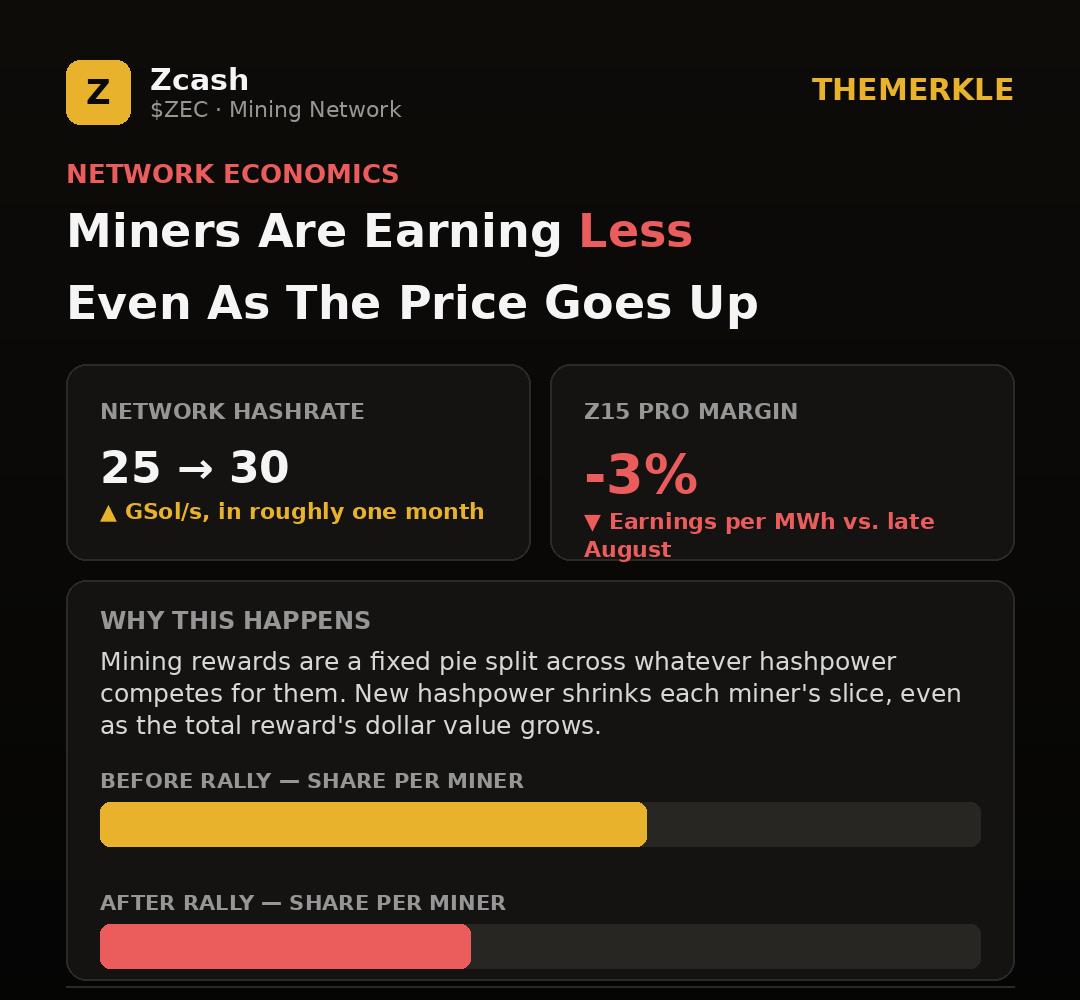
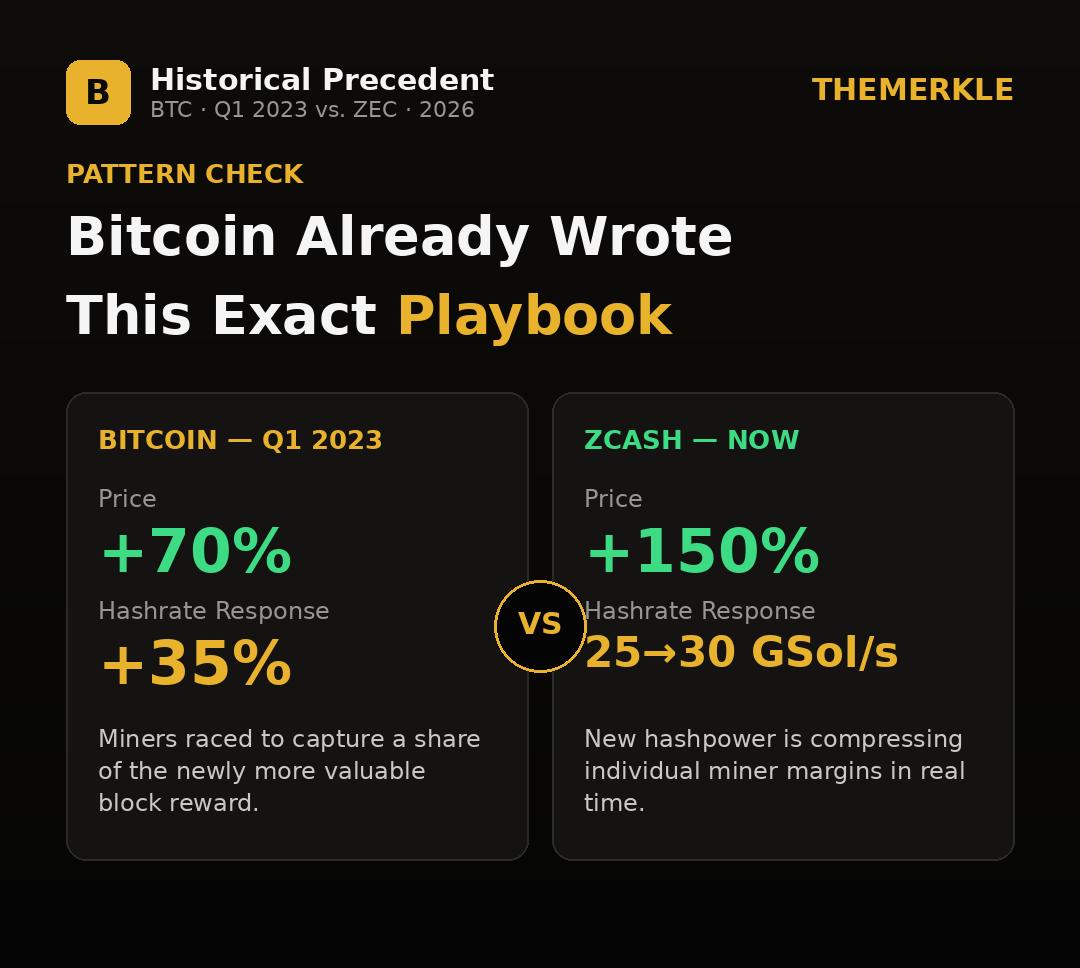
Zcash’s network hashrate, a measure of the total computing power dedicated to mining, has witnessed a sharp increase. It jumped from approximately 25 GigaSolutions per second (GSol/s) to above 30 GSol/s within the same period as the price surge. GigaSolutions per second (GSol/s) represents billions of solutions per second, indicating the speed at which miners are trying to find the next block. This surge in hashrate is a direct consequence of the higher ZEC price, which attracts new miners to the network and incentivizes existing miners to redirect their hardware towards Zcash, all in pursuit of the higher expected rewards.
However, this increase in competition has been so substantial that it has effectively outpaced the benefit derived from the higher coin prices. According to current estimates, a top-tier Z15 Pro miner, a benchmark for Zcash mining hardware, is now earning approximately 3% less per megawatt-hour (MWh) than it was in late August. This means that while the dollar value of the ZEC rewards has increased, the cost-efficiency and individual profitability for miners have declined.
This phenomenon runs counter to the intuitive assumption that a higher coin price should invariably lead to greater profit per mining machine. The core explanation lies in the economics of PoW networks. Mining rewards are fundamentally a fixed pie – a predetermined number of coins issued per block. This fixed reward is then split among all the hashpower competing for it at any given moment. When a coin’s price rallies significantly, it acts as a powerful magnet for hashpower. More miners, or more powerful machines, join the network, intensifying the competition for the same fixed block reward. As a result, each individual miner’s share of that reward shrinks. While the total dollar value of the reward pool expands, the increased competition can dilute individual earnings to the point where the two forces – rising price and rising hashrate – either cancel each other out or, as observed with Zcash, lead to a net reduction in per-unit profitability.
A Familiar Playbook: Bitcoin’s 2023 Echoes
What lends significant credibility to this pattern, moving it beyond a Zcash-specific anomaly, is its striking resemblance to events observed in the Bitcoin network earlier in 2023. During the first quarter of that year, Bitcoin (BTC) experienced a rally of roughly 70%. In response, its network hashrate climbed by approximately 35%, as miners aggressively sought to capture a share of the newly more valuable block rewards. The underlying mechanism was identical to what is currently unfolding with Zcash: higher prices attract increased hashpower, and this influx of new computing power compresses margins for all existing miners, often rapidly enough to offset a significant portion of the price gain itself.
This comparison is profoundly useful because it reframes the situation with Zcash. Rather than suggesting "something is wrong with this rally," it illustrates that "this is precisely how Proof-of-Work economics functions, time and again." It reveals a self-correcting mechanism embedded within the architecture of these networks. Price rallies invariably pull in more security (in the form of increased hashrate), that added security then dilutes the rewards for individual miners, and the market eventually seeks a new equilibrium. This equilibrium is typically reached when marginal miners either successfully adapt their operational costs, upgrade to more efficient hardware, or, if profitability becomes unsustainable, drop off the network entirely. This continuous dynamic ensures that the network remains adequately secured while also preventing an indefinite upward spiral in miner profitability that could otherwise destabilize the ecosystem.
Broader Implications and Future Trajectories
The current state of Zcash, characterized by a robust investment-driven rally and a simultaneous contraction in miner profitability, carries several broader implications for the project and the wider cryptocurrency market.
For Zcash’s Network Security: The surge in hashrate, even if it reduces individual miner profitability, is ultimately a positive development for network security. A higher hashrate makes the network more resilient against potential 51% attacks, where a malicious entity could theoretically gain control of more than half the network’s computing power. The fact that miners are flocking to Zcash, despite compressed margins, suggests a collective belief in the durability of ZEC’s higher price and the long-term viability of the network. This enhanced security is a direct, albeit sometimes overlooked, benefit of strong price action in PoW systems.
For the Privacy Coin Sector: The institutional acceptance and regulatory milestones achieved by Grayscale’s Zcash ETF and its options trading could set a precedent for other privacy-focused digital assets. It signals a nuanced approach by regulators and financial institutions, acknowledging market demand for privacy while integrating these assets within regulated frameworks. This might encourage other privacy coins to pursue similar pathways for mainstream adoption, potentially unlocking new capital flows for the sector.
For Crypto Mining Economics: Zcash’s current scenario serves as a fresh case study illustrating the dynamic and often challenging economics of PoW mining. It underscores the critical importance of operational efficiency, access to cheap energy, and continuous hardware upgrades for miners to remain competitive. As prices fluctuate and hashrate responds, miners must constantly adapt to maintain profitability. The market’s natural rebalancing act ensures that only the most efficient and well-resourced miners can thrive during periods of intense competition.
Future Outlook: Moving forward, the interplay between ZEC’s price, the network hashrate, and miner margins will be a crucial area to observe. With the institutional and options trading infrastructure now firmly established, the question shifts from "will the rally sustain?" to "how will the network adapt to this new equilibrium?" If the price continues to hold or climb, it could attract even more hashrate, pushing miner margins further down. Conversely, if the price consolidates or corrects, less efficient miners might drop off, leading to a hashrate reduction and a potential increase in profitability for those who remain. This continuous dance between market demand and network supply-side economics is a hallmark of decentralized PoW systems.
In conclusion, Zcash is currently navigating two distinct, yet interconnected, narratives. On the investment front, the rally appears structurally sound, driven by genuine institutional interest and robust market infrastructure. On the mining front, the network is demonstrating the expected behavior of a PoW system responding to rapid price appreciation, with hashrate chasing rewards and individual miner margins compressing as a direct consequence. Neither story inherently invalidates the other; instead, they paint a comprehensive picture of a maturing cryptocurrency ecosystem where market forces and network mechanics continually self-correct and adapt. The coming months will reveal how these forces ultimately shape Zcash’s trajectory, both as an investment asset and as a decentralized, privacy-preserving network.
Disclosure: This is not trading or investment advice. Always do your research before buying any cryptocurrency or investing in any services.