The Solana blockchain has achieved a momentous milestone, with its Real-World Asset (RWA) ecosystem now boasting over 400,000 unique holders. This dramatic expansion represents an explosive growth trajectory, escalating from fewer than 10,000 holders recorded in early 2025 to its current impressive figure by September 2026, according to metrics shared by Everstake, a prominent blockchain staking provider. This surge in adoption firmly establishes Solana as a leading contender in the burgeoning blockchain tokenization sector, demonstrating its increasing mainstream traction beyond the typical early-adopter crypto community.
This significant increase in RWA holders underscores a broader trend towards the convergence of traditional finance with blockchain technology. Real-World Assets encompass tangible and intangible assets from the traditional financial world, such as real estate, commodities, stocks, bonds, and intellectual property, which are tokenized on a blockchain. The process of tokenization transforms these assets into digital tokens, enabling fractional ownership, enhanced liquidity, increased transparency, and more efficient transfer mechanisms. Solana’s high-throughput, low-latency, and cost-effective network infrastructure has positioned it as an attractive platform for developers and institutions looking to tokenize a diverse range of assets.
The Exponential Rise of Solana’s RWA Footprint
The data provided by Everstake highlights an unprecedented rate of adoption within Solana’s RWA segment. The jump from a sub-10,000 holder count in early 2025 to exceeding 400,000 by September 2026 signifies a more than 40-fold increase over approximately 20 months. This sustained, exponential growth is a powerful indicator of both growing interest in tokenized assets and Solana’s increasing capability to support such large-scale operations.
"This is HUGE!" Everstake declared on the X platform, celebrating the network crossing 400,000 RWA holders for the first time. The sentiment reflects the broader excitement within the crypto community regarding the potential of RWAs to unlock trillions of dollars in value by bringing illiquid assets onto decentralized ledgers. Solana’s architectural design, which prioritizes speed and scalability, makes it particularly well-suited for handling the transaction volume and data requirements associated with widespread RWA adoption. Unlike some earlier blockchain iterations that struggled with congestion and high fees, Solana offers an environment conducive to the fluid trading and management of tokenized assets, appealing to both retail and institutional participants.
The implications of this growth are far-reaching. It suggests that a significant number of individuals and entities are actively engaging with tokenized versions of traditional assets on Solana, whether through holding tokenized funds, fractionalized property, or other asset-backed tokens. This trend is critical for the long-term maturation of the blockchain industry, as it demonstrates a tangible bridge between the digital and physical economies, moving beyond purely speculative digital assets.
Understanding Real-World Asset Tokenization on Solana
The concept of tokenizing real-world assets is not new, but its implementation has gained considerable momentum, with Solana emerging as a key player. RWAs can include anything from government bonds and corporate debt to luxury goods and fine art. By representing these assets as digital tokens on the Solana blockchain, several advantages are realized:
- Fractional Ownership: High-value assets like real estate or expensive art can be divided into smaller, affordable tokens, making them accessible to a broader investor base.
- Increased Liquidity: Traditionally illiquid assets can be traded on secondary markets 24/7, significantly improving their liquidity.
- Enhanced Transparency: All transactions are recorded on an immutable ledger, providing a transparent and auditable history of ownership.
- Reduced Intermediaries and Costs: The blockchain can automate processes typically handled by banks, brokers, and lawyers, thereby reducing fees and speeding up transactions.
- Global Accessibility: Investors from anywhere in the world can participate, breaking down geographical barriers.
Solana’s technological prowess, characterized by its proof-of-history consensus mechanism combined with proof-of-stake, allows it to process tens of thousands of transactions per second at fractions of a cent per transaction. This technical foundation is crucial for supporting a high volume of RWA-related activities, from issuance and trading to settlement and management. Projects building RWA solutions on Solana often leverage its robust smart contract capabilities to encode legal agreements, compliance rules, and ownership rights directly into the tokens, streamlining complex financial operations.
While regulatory clarity remains an evolving landscape for tokenized assets globally, the rapid growth in Solana’s RWA holder count indicates a strong market demand and confidence in the network’s ability to facilitate these innovative financial instruments. As regulators begin to provide clearer frameworks, platforms like Solana are well-positioned to capitalize on the increasing institutional and corporate interest in bringing traditional assets on-chain.
Solana’s Network Sees Historic Token Creation Surge
Beyond the remarkable growth in RWA holders, the Solana network has also set a new benchmark for on-chain activity, registering an unprecedented number of newly minted SPL tokens. On September 9, 2026, over 263,000 distinct SPL tokens were created within a 24-hour period. This figure dramatically surpasses the daily token creation rates observed during the peak of the memecoin frenzy in December 2024, which typically ranged between 40,000 and 50,000 tokens per day. The current record represents a 5-6x increase over those previous highs, signaling an explosion of developer and user activity on the network.
The surge in token creation was largely driven by memecoin launchpad platforms, with Pump.fun playing a particularly dominant role. According to data, Pump.fun was responsible for deploying 34,184 of the 40,360 tokens launched via such platforms during that period. This intensive activity translated into significant revenue for the protocol, with Pump.fun pulling in $1.8 million in fees within 24 hours. Its contribution to the Solana ecosystem’s overall financial health is also notable, as Pump.fun alone contributed $124 million to Solana’s total Q1 2026 revenue of $342 million, accounting for approximately one-third of the network’s earnings during that quarter.
This proliferation of new tokens, while partly fueled by speculative memecoin launches, also reflects a vibrant and expanding developer ecosystem. The ease and low cost of deploying new tokens on Solana encourage experimentation and innovation across various use cases, including new DeFi protocols, gaming assets, NFTs, and potentially more RWA-related ventures. The fact that this record token creation occurred on a day when the total crypto market capitalization actually experienced a slight decline, as noted by Rabbit.io, further underscores the internal strength and independent momentum of the Solana ecosystem. It suggests that specific catalysts within Solana are driving activity, rather than simply broad market exuberance.

SOL Price Performance and Technical Outlook
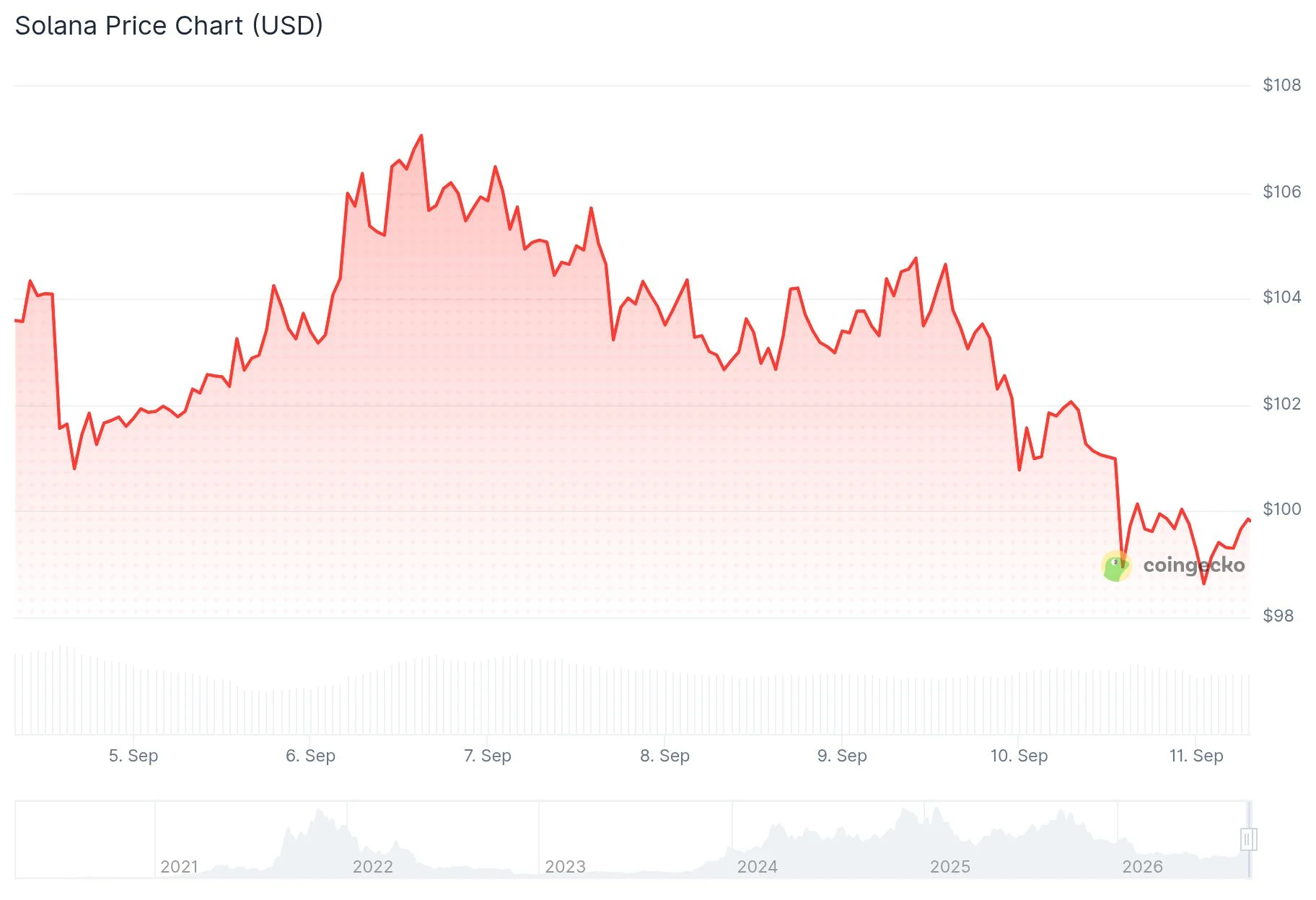
Amidst these significant on-chain developments, the native SOL token is navigating critical price levels. At present, SOL is trading near the $102 mark, reflecting a modest 1.44% pullback over the last 24 hours. However, a broader perspective reveals a more robust performance: the token has climbed approximately 33% in the past month and maintains a 1.45% gain over the trailing seven days, indicating underlying strength despite short-term fluctuations.
The psychologically significant $100 threshold has emerged as a crucial support level for SOL, particularly following its recent ascent from $76 to $109. Technical analysis reinforces this, with the 20-day Bollinger Band middle line positioned at $101.87, serving as a primary support level that market participants are closely monitoring. Maintaining price action above this level is considered vital for sustaining bullish momentum.
Crypto analyst Ash Crypto highlighted several macro indicators suggesting significant bullish potential for SOL. His analysis points to Solana posting its first positive monthly close in ten months, a development often interpreted as a shift in long-term sentiment. Furthermore, the monthly Moving Average Convergence Divergence (MACD) indicator is nearing a bullish crossover pattern, which is typically a strong buy signal. Adding to the optimistic outlook, the monthly Relative Strength Index (RSI) has finally broken through a two-year downtrend resistance, indicating that the asset may be emerging from a prolonged period of undervaluation or consolidation and could be poised for an upward trend.
However, current short-term technical readings suggest a cooling of buying momentum. The MACD indicator line is at 4.74, positioned beneath the signal line at 5.70, resulting in a histogram value of -0.96. This configuration often suggests that the immediate upward pressure is subsiding, and the price might consolidate or experience a minor correction before its next significant move.
Critical $109 Barrier in Focus
For SOL bulls, the $109–$110 price zone represents the most significant near-term obstacle. The upper boundary of the Bollinger Bands currently rests at $109.03, establishing this area as a definitive resistance ceiling for any immediate upward movement. A decisive push through this barrier would be a strong bullish signal, likely unlocking a pathway toward the $112–$116 price range. This zone represents the next major resistance cluster, and a successful breach could fuel further rallies.
Conversely, a failure to maintain support above $101.87 could trigger a decline toward the lower Bollinger Band, situated around $94.70. This level would then become the next critical support to prevent a more significant retracement. Market participants are closely watching these levels, as the outcome will largely dictate SOL’s price trajectory in the immediate future.
Adding to the optimistic, albeit aggressive, long-term outlook, prominent trading account The Moon Show shared a forecast on the X platform suggesting SOL could eventually climb to $1,000. Describing the current market structure as one that "most traders are not ready for," this target, while representing an aggressive projection, illustrates the increasingly bullish sentiment surrounding Solana within certain crypto circles. Such forecasts, though speculative, contribute to the narrative and can influence long-term investor psychology.
Broader Impact and Implications for the Blockchain Ecosystem
Solana’s sustained growth in RWA holders and record token creation carries significant implications not just for the network itself, but for the broader blockchain and traditional finance ecosystems. The increased adoption of RWAs on Solana positions it as a formidable competitor to other layer-1 blockchains like Ethereum, Avalanche, and Polygon, which are also vying for dominance in the tokenization space. Solana’s technological advantages in speed and cost could give it an edge in attracting large-scale institutional players who require efficient and reliable infrastructure for handling high-volume transactions.
The robust activity on Solana, particularly in token creation, points to a thriving developer community and a dynamic ecosystem. This continuous innovation is crucial for attracting new projects and users, further cementing Solana’s role as a versatile platform for various decentralized applications, including DeFi, NFTs, gaming, and enterprise solutions. The revenue generated by protocols like Pump.fun also demonstrates sustainable economic models emerging within the Solana ecosystem, which can contribute to the network’s long-term stability and development.
However, rapid growth also comes with challenges. Network stability, while significantly improved, remains a focal point of ongoing development. Regulatory uncertainty surrounding tokenized assets could also pose hurdles, requiring Solana and its ecosystem projects to navigate complex legal landscapes. Despite these challenges, the current trajectory suggests that Solana is successfully bridging the gap between blockchain innovation and real-world utility, making it a critical player in the ongoing evolution of the digital economy.
The confluence of explosive RWA growth, unprecedented on-chain token creation, and positive technical signals for the SOL token paints a compelling picture for Solana’s future. As market participants continue to monitor the key price levels and the broader macroeconomic environment, the network’s foundational strength and expanding utility are likely to remain central to its narrative. The vision of a tokenized global economy, where traditional assets are seamlessly integrated into blockchain networks, appears to be gaining significant ground, with Solana at the forefront of this transformative movement.