
The global cryptocurrency mining industry is currently grappling with a tectonic shift in economic viability as mining profits for Proof-of-Work (PoW) assets have plunged into negative territory following the historic Ethereum Merge. This transition, which saw the world’s second-largest blockchain move from a Proof-of-Work to a Proof-of-Stake (PoS) consensus mechanism, has effectively displaced a massive fleet of hardware, leading to a "hashrate flood" that has overwhelmed alternative networks. As thousands of miners migrated their Graphics Processing Units (GPUs) to smaller chains like Ethereum Classic (ETC), Ravencoin (RVN), and Ergo (ERG), the resulting surge in mining difficulty has rendered the practice unprofitable for the vast majority of participants, signaling what some analysts describe as the end of the GPU mining era.
The Genesis of the Crisis: Understanding the Merge
For nearly a decade, Ethereum served as the primary destination for GPU miners. Unlike Bitcoin, which transitioned to specialized Application-Specific Integrated Circuit (ASIC) hardware years ago, Ethereum remained "ASIC-resistant" for much of its life, allowing hobbyists and industrial-scale operations alike to secure the network using consumer-grade graphics cards. At its peak, the Ethereum network commanded a hashrate exceeding 1,000 Terahashes per second (TH/s), representing billions of dollars in hardware investment and energy consumption.
On September 15, 2022, the "Merge" officially integrated the Ethereum Mainnet with the Beacon Chain, replacing miners with validators. Under the new PoS system, the network is secured by participants who "stake" their ETH rather than those who expend computational power. While this reduced Ethereum’s energy consumption by an estimated 99.9%, it simultaneously rendered the global ETH mining fleet obsolete overnight. With no blocks left to mine on the Ethereum network, miners were faced with three choices: sell their equipment, repurpose their GPUs for non-crypto tasks like AI rendering, or point their hashing power toward other PoW blockchains.
The Mechanics of Hashrate Displacement and Difficulty Spikes
The fundamental issue facing the mining community is the sheer disparity in scale between Ethereum and its PoW successors. Before the Merge, Ethereum’s hashrate was orders of magnitude larger than all other GPU-minable coins combined. When this massive wave of computational power attempted to squeeze into smaller networks, it triggered a programmed response known as a difficulty adjustment.

In a Proof-of-Work system, the network aims to maintain a consistent block production time (e.g., one block every 15 seconds for Ethereum Classic). To achieve this, the network monitors the total hashrate; if more miners join, the "difficulty" of the mathematical puzzles required to mine a block increases. Conversely, if miners leave, the difficulty drops.
When the Merge occurred, the hashrate of Ethereum Classic (ETC) skyrocketed from approximately 60 TH/s to over 300 TH/s in a matter of days. While the network remained secure, the rewards for individual miners were diluted to a fraction of their previous levels. Because the market capitalization and daily issuance value of ETC are significantly lower than those of pre-Merge Ethereum, there is simply not enough "block reward" value to distribute among the influx of miners. This has created a scenario where the cost of the electricity required to run the machines far exceeds the value of the cryptocurrency earned.
Quantifying the Losses: Data from the Field
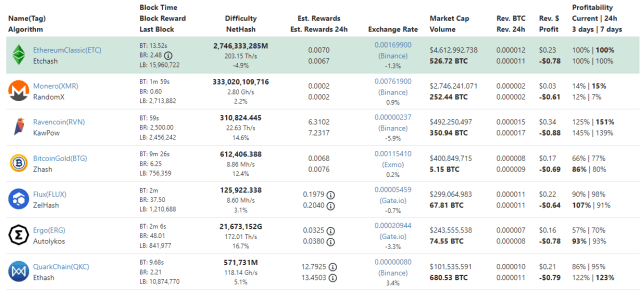
According to data from the mining profitability calculator WhatToMine, the economic outlook for GPU mining is currently dire. For a typical setup utilizing three AMD RX 480 graphics cards—a staple of the mid-range mining community—the net profit for mining Ethereum Classic stands at approximately -$0.78 per hour. This calculation assumes an average residential electricity price of $0.10 per kilowatt-hour (kWh).
Even those equipped with the most powerful consumer hardware available, such as the NVIDIA GeForce RTX 3090 Ti, are unable to escape the trend. Despite the high efficiency and massive throughput of these flagship cards, hourly profits remain stuck in the negative, hovering around -$0.50 per hour. These figures do not account for the initial capital expenditure (CAPEX) of the hardware, maintenance costs, or cooling requirements, suggesting that the "real-world" losses are even more significant.
The situation is equally grim across other alternative chains. Ravencoin (RVN), Ergo (ERG), and Beam (BEAM) have all seen their mining difficulty reach record highs, while their respective market prices have failed to rally enough to offset the increased competition. For the first time since the early days of the GPU mining boom in 2017, there is virtually no "safe haven" coin where a standard GPU rig can generate a positive yield.

A Timeline of the Post-Merge Transition
The week following the Merge provided a clear chronology of the industry’s struggle to adapt:
- September 15, 2022 (The Merge): Ethereum successfully transitions to PoS. ETH mining pools shut down, and hashrate begins to spike on Ethereum Classic and Ravencoin.
- September 16–17, 2022 (The Difficulty Explosion): Mining difficulty on ETC increases by nearly 500%. Profitability calculators across the web turn red as the "break-even" electricity price for most hardware drops below $0.05/kWh.
- September 18–20, 2022 (The Great Sell-Off): Large-scale mining farms begin liquidating inventory. Secondary markets like eBay and StockX see a surge in used GPU listings, leading to a sharp decline in hardware prices.
- September 21, 2022 – Present (The Stagnation): The hashrate on alternative chains begins to stabilize as unprofitable miners go offline. However, the remaining hashrate is still too high for the current market prices of these coins to support profitable operations.
Industry Reactions and the Secondary Market Collapse
The impact of the Merge has reverberated through the hardware and retail sectors. NVIDIA and AMD, the two primary manufacturers of GPUs, have already noted a decline in demand for their products. During the mining bull run of 2021, GPUs were frequently sold at 200% to 300% above their Manufacturer’s Suggested Retail Price (MSRP). Today, those same cards are being sold at deep discounts as former miners attempt to recoup their losses.
Industry experts have expressed a range of views on the future of the sector. Some, like Ethereum co-founder Vitalik Buterin, have long argued that the transition to PoS was a necessary evolution for the network’s sustainability and scalability. Conversely, PoW advocates argue that the migration of miners to other chains is a "cleansing" process that will eventually find a new equilibrium.
"We are seeing a total reset of the GPU mining economy," says one lead analyst at a major mining pool. "The ‘easy money’ era of Ethereum mining is over. What remains is a highly competitive, low-margin industry where only those with near-zero electricity costs—such as those using stranded gas or renewable energy surpluses—can survive."
Broader Implications: Is GPU Mining Dead?
The current state of negative profitability raises the question of whether GPU mining can ever return to its former glory. For a PoW coin to become as profitable as Ethereum once was, it would require a massive increase in its market capitalization. For instance, for Ethereum Classic to support the hashrate that once lived on Ethereum, its price would likely need to increase by more than 1,000%, assuming the hashrate remained constant.
Furthermore, the environmental narrative has shifted. With Ethereum’s carbon footprint virtually eliminated, remaining PoW chains are facing increased scrutiny from regulators and ESG-focused investors. This could limit the capital inflow needed to drive the prices of alternative PoW coins higher.
However, some market observers suggest a "wait and see" approach. Historically, crypto mining has moved through cycles of boom and bust. While the current outlook is bleak, the emergence of a new, highly-valued PoW project or a significant bull run in the broader crypto market could theoretically restore profitability. Additionally, some mining operations are pivoting to provide "high-performance computing" (HPC) services, utilizing their GPU clusters for AI training, 3D rendering, and scientific research instead of blockchain hashing.
The State of Ethereum (ETH) Price Post-Merge
While the technical execution of the Merge was widely considered a success, the immediate impact on the price of Ether (ETH) has been characterized by volatility and downward pressure. At the time of writing, ETH is trading at approximately $1,400, representing a decline of roughly 6% over the past week.
Market analysts attribute this "sell the news" reaction to several factors. First, the broader macroeconomic environment—marked by high inflation and rising interest rates—has dampened investor appetite for risk assets. Second, the end of the mining era has removed a segment of "forced buyers" who previously needed ETH for gas fees or operational hedging. Despite the price dip, proponents of the Merge remain focused on the long-term benefits of the transition, including the significant reduction in ETH issuance (the "Triple Halving" effect), which is expected to create deflationary pressure on the asset over time.
As the dust settles on the post-Merge landscape, the mining community remains at a crossroads. The transition has proven that while code can be upgraded, the physical and economic infrastructure built around it cannot be transformed as easily. For now, the "Golden Age" of GPU mining appears to be in the rearview mirror, replaced by a harsh reality of negative margins and a desperate search for the next profitable frontier.