The cryptocurrency market has witnessed a notable uptick in the trading activity surrounding the PI Network’s native token, PI, this past week, with a 5% price increase sparking renewed interest. As the digital asset navigates this positive momentum, the crucial question on the minds of investors and observers alike is whether this upward trend will attract further buying pressure and sustain its ascent. Technical indicators suggest that PI is currently testing key resistance levels, with the psychological barrier of $0.10 being a primary target. However, underlying concerns regarding declining trading volume cast a shadow over the otherwise bullish sentiment, prompting a deeper analysis of the factors influencing PI’s potential trajectory.
PI Consolidates Above Key Support, Eyes $0.10
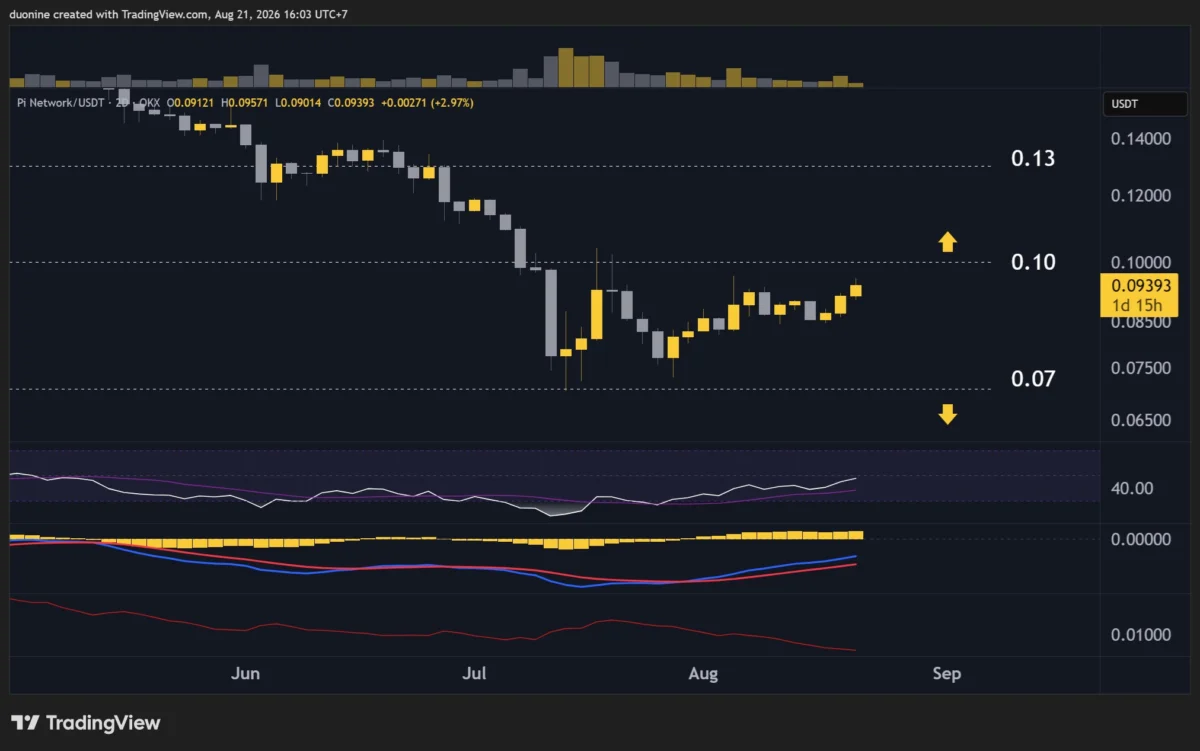
PI’s price action in recent days has been characterized by consolidation, following the successful retest and confirmation of the $0.070 level as a significant support zone. This foundational stability has paved the way for a renewed push towards higher price points, with the $0.10 mark emerging as the immediate and most psychologically impactful resistance. This level represents not only a technical hurdle but also a crucial psychological threshold for market participants. The prevailing bullish sentiment across the broader cryptocurrency market, often referred to as a "bullish market context," suggests that a test of this $0.10 resistance is a plausible scenario.
However, despite the visual cues of higher lows and an ostensibly bullish price chart, a closer examination of the trading volume reveals a persistent trend of decline over several months. This gradual erosion of trading volume is a critical indicator, suggesting a potential lack of robust conviction among a wider pool of buyers. It may also serve as an explanation for PI’s relatively subdued gains when compared to other altcoins that have experienced more substantial rallies, such as XRP or Ethereum (ETH), which have benefited from increased market attention and speculative interest.
Momentum Indicators Signal Potential Upside, But Caution Prevails
Despite the volume concerns, several momentum indicators are currently painting a more optimistic picture for PI. Since the beginning of August, the price has exhibited a consistent uptrend, marked by a series of higher highs and higher lows. This price progression, when viewed in conjunction with technical indicators like the Moving Average Convergence Divergence (MACD) and the Relative Strength Index (RSI), suggests that underlying momentum may be shifting in favor of the bulls. These indicators are typically used by traders to gauge the strength and direction of price trends, and their current readings imply that further price appreciation is likely in the short to medium term. The potential for higher highs to form on the chart is a direct consequence of this strengthening momentum.
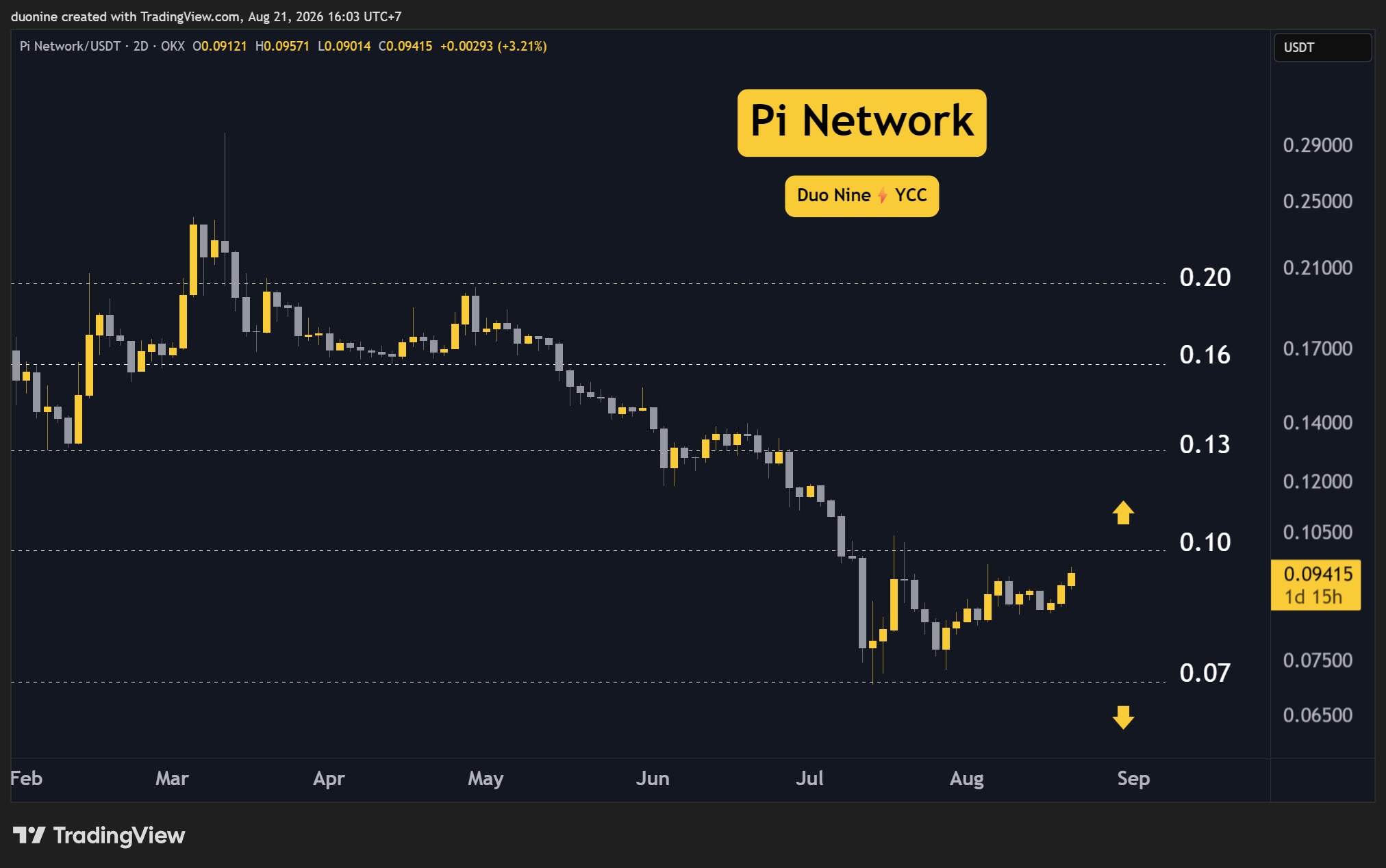
The primary challenge standing between PI and sustained gains remains the formidable resistance at the $0.10 mark. This level has historically acted as a significant barrier, often leading to a resurgence of selling pressure as traders take profits or initiate short positions. For PI to transition from a period of consolidation and potential upward movement to a more sustained recovery, it is imperative that this $0.10 level is not only tested but also decisively breached and subsequently converted into a key support. Such a breakout would signal a significant shift in market sentiment and could pave the way for further upward movement towards subsequent resistance levels, such as $0.13 and $0.16. The successful transformation of resistance into support is a classic hallmark of a healthy bullish reversal, suggesting that buyers have overcome previous selling pressure and are now in control of the price action.
The Crucial Role of Trading Volume in PI’s Future
The persistent decline in trading volume presents a significant caveat to the otherwise optimistic technical outlook for PI. Historically, cryptocurrencies experiencing substantial price rallies are often accompanied by a corresponding surge in trading volume, reflecting increased participation and demand. The absence of this phenomenon in PI’s recent price action raises questions about the sustainability of its upward momentum.
Analysts emphasize that until the volume profile demonstrates a clear upward trend, mirroring or even exceeding previous peaks, the overall market outlook for PI remains cautiously bearish. A declining volume during an uptrend can indicate that the price is being driven by a relatively small number of participants, making it more susceptible to sharp reversals if those participants decide to exit their positions. This scenario allows sellers to potentially regain control at their discretion, particularly at key resistance levels.
The recent price gains are undoubtedly a positive development for PI holders, but they require further validation through increased trading activity. A "clean break" above the $0.10 resistance, supported by a substantial uptick in volume, would be the critical catalyst needed to confirm a genuine reversal and foster confidence among a broader base of investors. Any failure to break through this key resistance level is highly likely to result in the return of bearish sentiment, as sellers capitalize on the perceived weakness. To avert this outcome, buyers will need to actively drive volume higher, thereby reinforcing the current bullish momentum and demonstrating a stronger commitment to pushing the price upwards. The interplay between price action and volume will be a crucial determinant of PI’s short-term trajectory.
The PI Network Ecosystem: A Foundation for Growth?
Understanding PI’s price action requires a brief look at the underlying PI Network project itself. Launched in 2019, the PI Network is a mobile-first cryptocurrency designed to be mined by everyday users through their smartphones without significant battery drain or data consumption. The project’s core vision is to create a widely adopted cryptocurrency accessible to a global audience, fostering a decentralized ecosystem where PI can be used for transactions and services.
The network has reportedly amassed a large user base, with millions of "pioneers" actively mining PI. However, the token has not yet been listed on major public exchanges, and its primary utility has been confined to internal transactions and a growing network of PI-based applications and merchants within its closed ecosystem. This unique development model has led to considerable debate and speculation within the crypto community. While proponents see it as a strategic approach to building a robust community and utility before a public launch, critics often point to the lack of official exchange listings and the limited verifiable market price as reasons for caution.
The anticipation surrounding a potential public listing and broader market integration has been a recurring theme among PI enthusiasts. Such an event would undoubtedly unlock new avenues for price discovery and potentially introduce significant liquidity into the market. However, the timeline for this integration has remained uncertain, contributing to the speculative nature of PI’s current valuation. The recent price movements, therefore, can be interpreted as a reflection of internal market dynamics and community sentiment, rather than a direct response to broader external market forces typically seen with exchange-listed cryptocurrencies.
Historical Context and Future Outlook
The PI Network’s journey has been marked by a deliberate, phased approach to development. The project has emphasized building its community and ecosystem before embarking on a full-scale public launch. This strategy has allowed it to cultivate a dedicated user base and develop a range of applications that aim to utilize PI as a medium of exchange. However, this unconventional path has also meant that PI’s price has largely existed within a speculative or internal valuation framework, making traditional price analysis challenging.
The current 5% weekly gain, while positive, must be viewed within this context. It suggests that there is active interest and trading within the existing PI community or among early adopters. The identification of $0.070 as a key support and $0.10 as a significant resistance indicates that these levels are being closely watched and traded upon by participants within the PI Network’s sphere.
The critical juncture for PI lies in its ability to translate this internal momentum into external market validation. Should the PI Network announce a public listing on major exchanges, it would introduce a new set of dynamics. This would expose PI to a much larger pool of potential investors, institutional interest, and a more transparent price discovery mechanism. The success of such a launch would hinge on several factors: the overall health of the cryptocurrency market at the time of listing, the perceived utility and adoption of PI within its ecosystem, and the regulatory landscape.
For now, the focus remains on the technical levels identified. A sustained push above $0.10, ideally with increasing trading volume, would be a significant step towards confirming a more robust uptrend. Conversely, a failure to break this resistance could lead to a retracement, retesting the $0.070 support level. The long-term prospects of PI will ultimately be tied to its successful transition from a pre-launch phase to a fully integrated cryptocurrency within the global digital asset market, a transition that remains highly anticipated by its community. The coming weeks and months will be crucial in determining whether PI can overcome its current challenges and achieve its ambitious goals.
Disclaimer: The information presented in this article is for informational purposes only and does not constitute financial advice. Cryptocurrency investments are highly volatile and carry significant risk. Readers are advised to conduct their own thorough research and consult with a qualified financial advisor before making any investment decisions.