Prominent cryptocurrency personality Arthur Hayes has reaffirmed his optimistic projections for Ethereum (ETH), the second-largest cryptocurrency by market capitalization. In a recent interview with Unchained, Hayes expressed unwavering confidence in his year-end price target for ETH, maintaining that the asset is still poised to conclude the year at $5,000. This conviction comes despite Ethereum’s current failure to surpass its all-time high of $4,891, which was established in late 2021. Hayes disclosed that at Maelstrom, his family office and investment fund, Ethereum constitutes their second-largest holding, trailing only Bitcoin.
"So obviously, ETH did very well. I think it’s in the most hated large-cap shitcoin out there. Number 2 largest coin by market cap, it has not eclipsed its 2021 all-time high, and so, I think from a risk-reward perspective, at least in the way that I manage the portfolio at Maelstrom, this is our largest position outside of Bitcoin," Hayes articulated during the interview, emphasizing his strategic allocation within Maelstrom. This statement underscores a contrarian investment approach, where an asset’s perceived negative sentiment, coupled with its technical potential, can present a compelling opportunity.
Hayes remains undeterred by the inherent volatility of the cryptocurrency market, acknowledging that any digital asset can theoretically plummet to zero. However, he firmly believes that Ethereum possesses a significantly lower probability of such an extreme outcome when compared to many other altcoins. "Because (ETH) hasn’t moved that much in this cycle, I think it has a lot of catching up to do. Concept starts moving, the reflexive train is going to get going," he added. This perspective suggests that Ethereum’s relative underperformance in the current market cycle, compared to its historical performance and the broader market’s ascent, might indicate an impending period of accelerated growth.
Historical Context and Ethereum’s Trajectory
Ethereum’s journey since its inception in 2015 has been one of continuous innovation and adaptation. Launched by Vitalik Buterin and a core team of developers, Ethereum was conceived not merely as a digital currency but as a decentralized platform capable of running smart contracts. This groundbreaking feature unlocked a vast array of decentralized applications (dApps), including decentralized finance (DeFi) protocols, non-fungible tokens (NFTs), and decentralized autonomous organizations (DAOs). The platform’s utility has been a primary driver of its value, distinguishing it from Bitcoin, which primarily functions as a store of value and medium of exchange.
The period leading up to late 2021 saw an unprecedented surge in cryptocurrency valuations, with Ethereum reaching its zenith. This bull run was fueled by a confluence of factors, including increasing institutional adoption, retail investor enthusiasm, and the proliferation of DeFi and NFT use cases. However, the subsequent market correction in 2022, often referred to as a crypto winter, saw significant price declines across the board. Ethereum, like many other digital assets, experienced a substantial drawdown from its all-time high.
The Significance of the $5,000 Price Target
Hayes’ prediction of $5,000 for Ethereum by year-end is not an arbitrary figure. It represents a significant upward movement from its current trading levels and, more importantly, an acknowledgment of its potential to surpass previous highs. For an asset to achieve such a target, several market dynamics would need to align favorably. These include continued positive sentiment in the broader crypto market, sustained development and adoption of Ethereum’s ecosystem, and potentially, favorable regulatory developments.
The former BitMEX CEO noted that a segment of market participants has historically expressed skepticism towards Ethereum and has yet to fully engage with the asset. He anticipates that a decisive break above the $3,000 threshold could serve as a catalyst, shifting sentiment and validating his $5,000 year-end forecast. A sustained move above $3,000 would not only represent a significant psychological victory but also signal renewed bullish momentum, potentially attracting hesitant investors back into the market.
Ethereum’s Technical Evolution and Future Catalysts
Hayes’ commentary implicitly references the fundamental underpinnings of Ethereum’s value proposition. While the price may not have reached new all-time highs in the current cycle, the network itself has undergone significant technical upgrades. The most transformative of these was the Merge, which transitioned Ethereum from a proof-of-work (PoW) consensus mechanism to a more energy-efficient proof-of-stake (PoS) system. This upgrade drastically reduced Ethereum’s energy consumption, addressing a major criticism and aligning it with environmental sustainability concerns.

Furthermore, the transition to PoS has paved the way for further network enhancements, such as sharding, which aims to increase transaction throughput and reduce gas fees. These ongoing developments are crucial for Ethereum’s long-term scalability and its ability to support a growing ecosystem of dApps. The success of these future upgrades, such as the planned Danksharding, could significantly boost network capacity and user experience, further solidifying Ethereum’s dominant position in the smart contract platform landscape.
Market Performance and Data Analysis
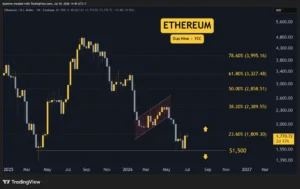
As of the time of reporting, Ethereum was trading around the $2,438 mark. The asset had experienced modest gains of 0.98% over the preceding 24 hours and 1.89% over the last seven days. Despite the broader market’s fluctuations, Ethereum had demonstrated robust performance over the past 30 days, achieving a 30% increase and positioning itself among the top five gainers within that period. This recent upward momentum, while not yet challenging its all-time high, provides a foundation for Hayes’ optimistic outlook.
Supporting Data Points:
- Market Cap: Ethereum’s market capitalization, as the second-largest cryptocurrency, stands as a testament to its significant adoption and investor confidence. Fluctuations in its market cap are closely watched indicators of broader market sentiment.
- Transaction Volume: Analyzing transaction volume on the Ethereum network can provide insights into user activity and the demand for its services. An increase in transaction volume often correlates with increased utility and potential price appreciation.
- Total Value Locked (TVL) in DeFi: The total value locked in decentralized finance protocols built on Ethereum is a key metric for assessing the health and growth of its dApp ecosystem. A rising TVL indicates increasing capital flowing into DeFi applications.
- Gas Fees: While the Merge and subsequent upgrades aim to reduce gas fees, they remain a critical factor influencing user experience and the cost of transacting on the network. Persistently high gas fees can deter users and developers.
- Developer Activity: The number of active developers contributing to the Ethereum codebase is a strong indicator of the network’s ongoing innovation and commitment to improvement.
Expert Opinions and Market Sentiment
Arthur Hayes is a highly respected figure in the cryptocurrency space, known for his bold predictions and deep understanding of market dynamics. His consistent bullish stance on Ethereum, even when faced with skepticism, carries considerable weight. His perspective is often informed by his experience as the co-founder and former CEO of BitMEX, a prominent cryptocurrency derivatives exchange, which provided him with a unique vantage point on market sentiment and trading behavior.
Other market analysts have also weighed in on Ethereum’s prospects. While some echo Hayes’ optimism, citing the ongoing development and potential for institutional adoption, others remain more cautious, pointing to the ongoing regulatory uncertainties and the competitive landscape of smart contract platforms. The narrative around Ethereum often oscillates between its technological advancements and its price action, making it a subject of continuous debate within the crypto community.
Broader Implications for the Crypto Ecosystem
Ethereum’s performance and evolution have far-reaching implications for the entire cryptocurrency ecosystem. As the foundational layer for a vast array of decentralized applications, its success is intrinsically linked to the growth and adoption of DeFi, NFTs, and Web3 technologies. A strong and upward-trending Ethereum price can inspire greater confidence in the broader altcoin market, potentially triggering what is commonly referred to as an "altcoin season."
Furthermore, Ethereum’s ongoing upgrades and its transition to proof-of-stake are setting new standards for blockchain technology. The success of these initiatives could influence the development trajectory of other blockchain networks and accelerate the industry’s move towards more sustainable and scalable solutions. The continued development and adoption of Ethereum’s ecosystem are critical for the realization of a decentralized internet and the broader adoption of blockchain technology.
Hayes’ assertion that Ethereum is the "most hated large-cap shitcoin" is a provocative statement that highlights the polarized views surrounding the asset. While its technological prowess and ecosystem are widely acknowledged, its price performance relative to its 2021 highs has led some investors to question its future trajectory. However, Hayes’ belief that it has "a lot of catching up to do" suggests a conviction that the market has yet to fully price in Ethereum’s fundamental value and future potential. The coming months will be crucial in determining whether his $5,000 year-end target proves to be an accurate foresight or an overly ambitious projection. The interplay of technological advancements, market sentiment, and macroeconomic factors will ultimately shape Ethereum’s path forward.