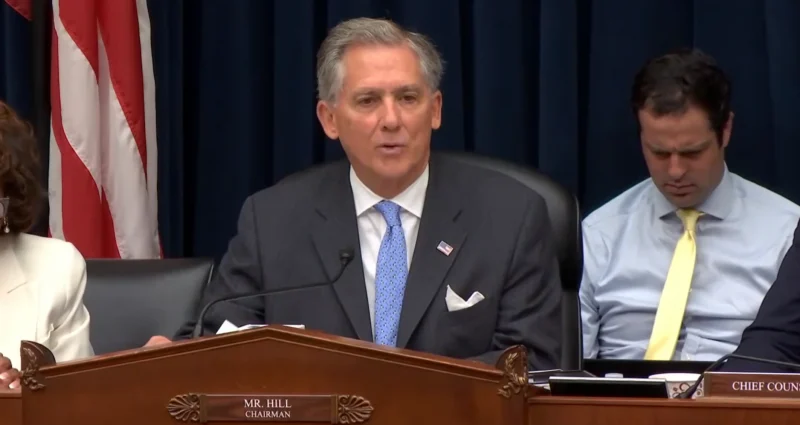
The House Financial Services Committee has officially commenced the markup of H.R. 8957, titled the American Reserve Modernization Act of 2026, a pivotal piece of legislation that seeks to fundamentally alter how the United States government manages its multi-billion-dollar holdings of cryptocurrency. Introduced as part of a broader legislative package on September 16, the bill proposes the creation of a formal Strategic Bitcoin Reserve and a separate Digital Asset Stockpile, both to be housed within the United States Department of the Treasury. This move signals a significant shift in federal policy, transitioning from a reactive approach of seizing and selling digital assets to a proactive strategy of long-term custody and institutional oversight.
The Framework of the American Reserve Modernization Act of 2026
H.R. 8957, spearheaded by key members of the House Financial Services Committee, aims to consolidate the management of digital assets that are currently scattered across various federal agencies. Under the current system, agencies such as the Department of Justice (DOJ), the Internal Revenue Service (IRS), and the Federal Bureau of Investigation (FBI) often manage their own seized digital assets, leading to a fragmented approach to security, liquidation, and reporting.
According to the prepared remarks of Chairman French Hill, the American Reserve Modernization Act would mandate that all federally held Bitcoin and other digital assets—primarily those acquired through criminal or civil forfeiture—be transferred to the custody of the Treasury. The bill emphasizes the need for "consistent oversight," with the stated goals of strengthening national security, increasing transparency, and ensuring strict accountability for the nation’s digital wealth. By centralizing these assets, the legislation seeks to prevent the haphazard selling of large quantities of Bitcoin, which in the past has led to market volatility and missed opportunities for capital appreciation for the federal government.
A Strategic Shift in Asset Management
The establishment of a Strategic Bitcoin Reserve represents a departure from the traditional "dispose-as-soon-as-possible" model applied to forfeited assets. Historically, the U.S. government has auctioned off seized Bitcoin in batches. Notable examples include the 2014 auction of nearly 30,000 BTC seized from the Silk Road marketplace, which was purchased by venture capitalist Tim Draper. At the time, those assets were worth roughly $19 million; today, their value would exceed $1.8 billion.
The proposed Digital Asset Stockpile would function alongside the Bitcoin Reserve, serving as a repository for other cryptocurrencies, such as Ethereum, stablecoins, and various tokens recovered during federal investigations. By creating a formalized structure within the Treasury, the U.S. aims to treat digital assets with the same level of strategic importance as gold reserves or the Strategic Petroleum Reserve.
Historical Context and the Evolution of Federal Bitcoin Holdings
The United States government is currently one of the largest holders of Bitcoin in the world, though its holdings have fluctuated due to ongoing law enforcement actions and subsequent liquidations. To understand the impetus for H.R. 8957, one must look at the timeline of major federal seizures:
- 2013–2015 (Silk Road): The FBI and DOJ seized over 144,000 BTC from Ross Ulbricht and the Silk Road marketplace. Most of these were sold in a series of auctions.
- 2020 (The "Individual X" Seizure): The DOJ seized approximately 69,370 BTC linked to the Silk Road, which had been sitting dormant for years.
- 2022 (Bitfinex Hack Recovery): In a landmark case, the DOJ seized approximately 94,000 BTC stolen during the 2016 hack of the Bitfinex exchange. This remains one of the largest financial seizures in history.
- 2023 (James Zhong Case): Authorities seized over 50,000 BTC from James Zhong, who had defrauded the Silk Road marketplace years prior.
As of late 2024, estimates suggest the U.S. government holds upwards of 200,000 BTC, valued at approximately $12 billion to $15 billion depending on market conditions. The lack of a centralized strategy for these assets has been a point of contention among lawmakers who argue that the government is failing to leverage its "digital gold" to hedge against inflation or reduce the national debt.
Political Landscape and Legislative Momentum
The markup of H.R. 8957 occurs within an increasingly "pro-crypto" political environment in Washington. While digital assets were once a niche or even stigmatized topic, they have become a mainstream economic issue. The American Reserve Modernization Act follows a similar proposal by Senator Cynthia Lummis (R-WY), known as the "BITCOIN Act" (Boosting Innovation, Technology, and Competitiveness through Optimized Investment Nationwide), which suggested the U.S. Treasury purchase 1 million BTC over five years.
While H.R. 8957 focuses primarily on assets the government already owns through forfeiture, it creates the legal and administrative infrastructure necessary for future acquisitions. Chairman French Hill’s remarks highlighted that the bill is not just about the assets themselves, but about the "modernization" of the American financial system.
The legislative session on September 16 was not limited to crypto; the committee also marked up measures regarding the Consumer Financial Protection Bureau (CFPB) accountability, fraud prevention in banking, and housing affordability. However, the Bitcoin Reserve bill has garnered the most attention from market analysts and international observers.
Analysis of Economic and National Security Implications
The establishment of a Strategic Bitcoin Reserve carries significant implications for the U.S. dollar and global finance. Proponents argue that Bitcoin serves as a "non-sovereign reserve asset" that can protect the Treasury’s balance sheet from the devaluation of fiat currency. In an era of rising national debt—currently exceeding $35 trillion—some lawmakers view a Bitcoin stockpile as a futuristic safeguard.
From a national security perspective, centralizing custody within the Treasury aims to mitigate the risk of internal theft or mismanagement. In the past, there have been instances of federal agents (such as in the Silk Road case) stealing seized Bitcoin for personal gain. H.R. 8957 seeks to implement institutional-grade "cold storage" solutions and multi-signature authorization protocols to ensure that these assets are as secure as the gold held at Fort Knox.
Furthermore, the "Game Theory" of sovereign Bitcoin reserves suggests that if the U.S. officially designates Bitcoin as a reserve asset, other nations may feel compelled to do the same to avoid being left behind. This "Sovereign Bitcoin Race" could lead to increased global demand and further legitimize digital assets as a cornerstone of modern central banking.
Official Responses and Partisan Perspectives
While Chairman French Hill and several Republican colleagues have championed the bill, the reaction across the aisle has been more nuanced. Some Democratic members of the committee have expressed concerns regarding the environmental impact of Bitcoin mining and the potential for digital assets to be used in money laundering, despite the bill’s focus on assets already seized from criminals.
Consumer advocacy groups have also weighed in, suggesting that the government should prioritize the liquidation of these assets to provide restitution to victims of the crimes from which the assets were seized. However, H.R. 8957 includes provisions to ensure that victim compensation remains a priority, even as the assets are moved under Treasury oversight.
Industry leaders have largely praised the move. "The transition of the U.S. government from a seller to a ‘HODLer’ would be a watershed moment for the industry," noted one prominent digital asset analyst. "It signals that the world’s largest economy recognizes Bitcoin not just as a tool for illicit finance, but as a legitimate financial instrument with long-term value."
Technical Challenges of Centralized Custody
Implementing the American Reserve Modernization Act will require significant technical upgrades within the Department of the Treasury. Managing hundreds of thousands of private keys across various blockchains requires specialized infrastructure. The bill suggests that the Treasury may partner with private-sector custodians or develop its own proprietary "federal-grade" custody solution.
Key technical considerations include:
- Air-Gapped Storage: Ensuring that the majority of the Strategic Bitcoin Reserve is kept offline to prevent hacking.
- Multi-Party Computation (MPC): Distributing the "keys" to the reserve across multiple officials and departments to prevent any single point of failure.
- Auditability: Providing the public with "Proof of Reserves" to ensure that the government actually holds the assets it claims to have, while maintaining the necessary level of security.
The Global Context: Competition and Adoption
The U.S. is not the only nation grappling with how to handle digital assets. El Salvador famously became the first country to adopt Bitcoin as legal tender and maintains its own national reserve. More recently, reports have surfaced that nations like Russia and various Gulf states are exploring Bitcoin for international trade and reserves to bypass Western-led financial sanctions.
In Europe, Germany recently completed the sale of nearly 50,000 BTC seized from a movie piracy site, a move that was criticized by some German lawmakers as a strategic error given the subsequent rise in Bitcoin’s price. The U.S. House Financial Services Committee appears to be learning from these international examples, opting for a "wait and hold" strategy rather than immediate liquidation.
Conclusion and Future Outlook
H.R. 8957, the American Reserve Modernization Act of 2026, represents a milestone in the legislative history of digital assets. By proposing a formal Strategic Bitcoin Reserve and a Digital Asset Stockpile, the House Financial Services Committee is acknowledging that the future of national finance may be inextricably linked to the blockchain.
As the bill moves through the markup process and toward a full House vote, it will likely face intense scrutiny regarding its implementation details. However, the core message remains clear: the United States is moving toward a future where digital assets are no longer viewed as mere evidence in criminal trials, but as essential components of the national treasury. Whether this leads to a broader "Bitcoin Standard" or simply serves as a more efficient way to manage forfeited property, the impact on the global cryptocurrency market and the perception of digital wealth will be felt for decades to come.
The committee is expected to continue its deliberations over the coming weeks, with a focus on refining the custody protocols and the specific triggers for when and how the Treasury may eventually utilize these assets for the public good. For now, the "Strategic Bitcoin Reserve" has moved from a theoretical concept discussed in white papers to a concrete legislative proposal on the floor of the United States Congress.