The recent launch of Circle’s Arc blockchain on September 16, 2026, was accompanied by a seemingly routine, yet profoundly significant, announcement: the simultaneous deployment of ArcScan, a dedicated block explorer developed by Etherscan. While the debut of a block explorer for a new blockchain might typically be relegated to niche infrastructure news, the synchronized nature of this launch, coupled with Arc’s specific design as a payment-centric chain, underscores a deliberate strategy by Circle and Etherscan to establish an unprecedented level of transparency and auditability from day one. This move diverges sharply from the conventional rollout practices within the decentralized ecosystem, where explorers often lag behind mainnet launches, leaving early users and developers navigating a landscape prone to confusion and uncertainty.
The Synchronized Debut: A New Standard for Blockchain Launches
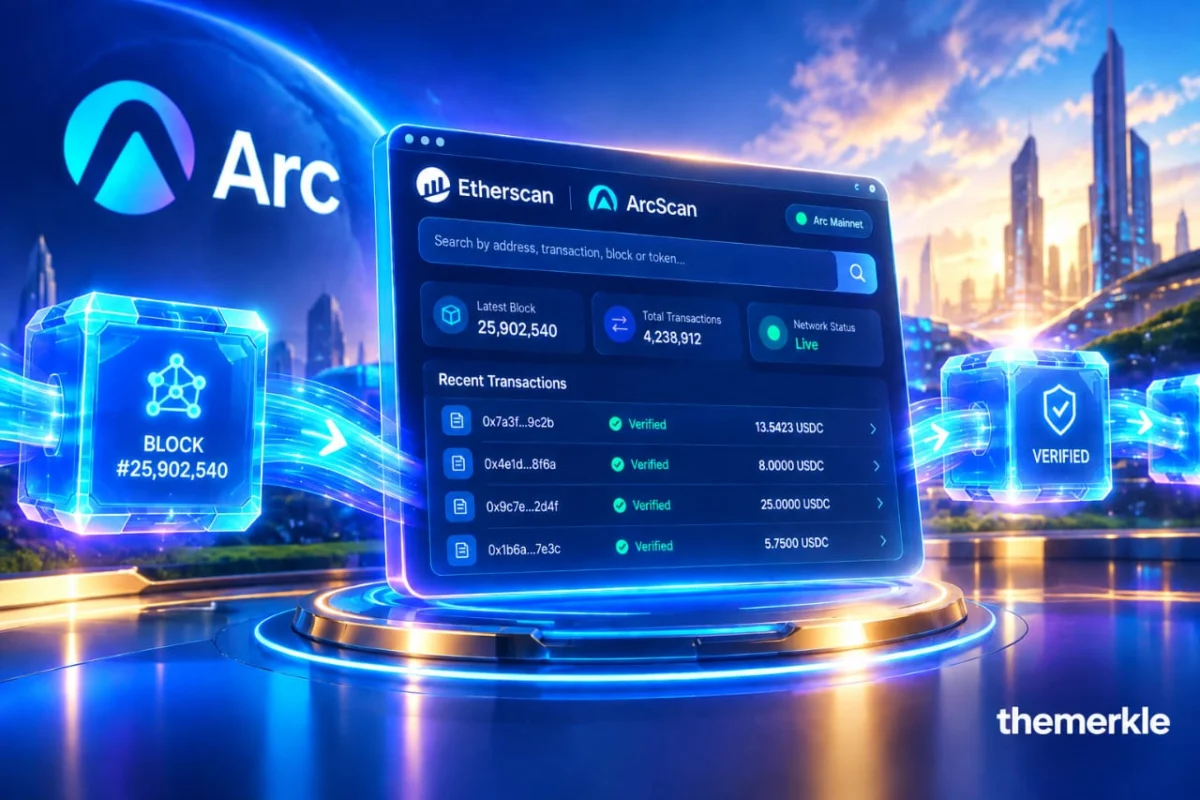
On the designated launch date, Circle officially unveiled Arc, a Layer 1 blockchain engineered specifically for payment transactions, utilizing USDC for gas fees instead of a proprietary native token. Within the same operational window, Etherscan, the preeminent blockchain explorer provider for Ethereum and its expansive ecosystem, confirmed the immediate availability of ArcScan at arc.etherscan.io. This instantaneous pairing of a new blockchain with a robust, trusted block explorer is a notable departure from industry norms. Historically, new blockchain networks frequently spend weeks, if not months, after their mainnet launch, grappling with the development and deployment of reliable explorer tools. During this interim period, users and developers often rely on a fragmented collection of third-party or community-driven tools, which vary widely in their accuracy, security, and user experience.
The strategic timing of ArcScan’s launch suggests a calculated decision by both Circle and Etherscan to embed trust and transparency into Arc’s foundational layer. For a blockchain positioned as critical payment infrastructure, the ability to verify transactions, monitor network activity, and audit smart contract interactions from the moment of inception is not merely a desirable feature but an essential prerequisite. This immediate provision of a comprehensive explorer signals a profound understanding that for Arc to achieve its ambitious goal of becoming a reliable global payment rail, it must first be unequivocally auditable.
Arc’s Strategic Foundation: Beyond Speculation to Payments
Arc is not merely another entry into the crowded field of speculative Layer 1 blockchains vying for developer attention and market share. It is a purpose-built network conceived by Circle, the financial technology firm behind USDC, one of the world’s largest and most widely adopted stablecoins. The decision to construct a dedicated blockchain, distinct from existing networks like Ethereum, implies a clear vision for an environment optimized for high-volume, low-cost, and secure payment transactions.
A critical design choice for Arc is its utilization of USDC for gas fees. This mechanism eliminates the volatility and speculative pressures often associated with native utility tokens on other blockchains, aligning Arc more closely with traditional financial systems where transaction costs are stable and predictable. This fundamental characteristic reinforces Arc’s positioning as a robust financial utility rather than a platform primarily for decentralized applications (dApps) or token trading. The immediate integration of established decentralized finance (DeFi) infrastructure, such as Uniswap v4, further underscores Arc’s intent to serve as a practical, ready-to-use payment and financial settlement layer, rather than a nascent ecosystem awaiting development. This context profoundly amplifies the significance of ArcScan’s day-one availability, transforming it from a mere technical convenience into a core component of Arc’s value proposition.
Etherscan’s Integral Role: Bridging Trust and Transparency
Etherscan’s participation in this synchronized launch is a critical element in establishing Arc’s credibility. Etherscan is widely regarded as the gold standard for blockchain explorers, having served as the primary interface for exploring the Ethereum network since its early days. Its reputation is built on reliability, accuracy, and an intuitive user experience, making it an indispensable tool for millions of users, developers, and auditors worldwide. The Etherscan brand has become synonymous with transparency and data integrity within the blockchain space.
The extension of this trusted brand to Arc through ArcScan provides an immediate and invaluable transfer of credibility. For a new blockchain, particularly one aiming for institutional adoption and high-value payment flows, earning user trust is paramount. By leveraging Etherscan’s established reputation, Arc bypasses the arduous process of building trust from scratch, a challenge that many new chains struggle with for years. This strategic partnership communicates a strong message to potential users, developers, and regulatory bodies: Arc is committed to the highest standards of transparency and verifiable operations, backed by an entity that has proven its capability in the most scrutinized blockchain environment.
Addressing the ‘Explorer Problem’: A Proactive Approach to Ecosystem Clarity
The "explorer problem" is a pervasive issue for many nascent blockchain ecosystems. Without an authoritative and fully functional block explorer available at launch, users face a myriad of challenges. These include difficulty verifying the legitimacy of smart contract addresses, confirming the successful execution of transactions, and distinguishing between genuine and counterfeit tokens. The absence of a centralized, trusted data source often leads to a fragmented information landscape, where unofficial tools, sometimes of questionable quality and security, fill the void. This can quickly result in an ecosystem cluttered with misinformation, unverified data, and potential avenues for scams and exploits. The subsequent cleanup effort, often spanning months, can hinder adoption, erode user confidence, and divert valuable developer resources.
Arc’s approach, launching with ArcScan fully operational, proactively mitigates these risks. From the moment Arc went live, users and developers had access to a verified, comprehensive source of on-chain data. This includes real-time transaction tracking, smart contract verification status, token information, and wallet balances. This immediate clarity is crucial for fostering a secure and trustworthy environment, particularly for financial applications where the integrity of every transaction is paramount. It demonstrates a foresight that prioritizes user safety and data accuracy over rapid, unchecked expansion, setting a new benchmark for how new blockchains, especially those targeting high-stakes financial applications, should approach their initial deployment.
The Credibility Transfer: Etherscan’s Reputation as a Cornerstone
The value of Etherscan’s involvement extends beyond mere technical provision. It represents a significant "credibility transfer" for Arc. In the highly competitive and often skeptical blockchain industry, a new project’s success is heavily dependent on its ability to inspire confidence. Etherscan’s long-standing track record as a neutral, reliable, and essential piece of infrastructure for Ethereum provides Arc with an immediate stamp of approval. This is particularly salient given the increasing scrutiny from regulators globally regarding transparency and auditability in the digital asset space.

For institutions considering building on Arc, the presence of an Etherscan-powered explorer from day one significantly reduces perceived risk. It implies a commitment to open data and verifiable operations that resonates with traditional financial compliance standards. This reputational leverage is something that no new, unproven explorer could offer, regardless of its technical sophistication. It positions Arc not just as another blockchain, but as a network designed with institutional-grade transparency in mind, right from its inception.
Strategic Management of Ecosystem Growth: The Developer Support Window
A few days following the mainnet and ArcScan launch, Etherscan introduced another strategic initiative: a free priority support window for developers submitting token information updates on ArcScan, active until September 30, 2026. This might appear to be a minor customer service gesture, but it reveals a deeper, proactive strategy for managing ecosystem growth and maintaining data hygiene.
One of the persistent challenges for any new blockchain is the initial flood of projects, each eager to get their tokens properly labeled, verified, and displayed accurately on the block explorer. Without a managed process, this influx can quickly overwhelm explorer teams, leading to a backlog of unverified, mislabeled, or even fraudulent token entries that can persist for months. This clutter not only degrades the user experience but also creates fertile ground for scams and impersonations.
Etherscan’s priority support window directly addresses this critical bottleneck. By offering a fast, no-cost path for legitimate developers to submit and update their token information, ArcScan aims to prevent the accumulation of unverified data before it becomes a problem. This forward-thinking approach ensures that Arc’s ecosystem data remains clean, accurate, and trustworthy from its earliest stages, fostering a healthier environment for both developers and end-users. It demonstrates a commitment to operational excellence that extends beyond the initial launch, focusing on sustained data integrity.
Guardrails for Trust: Ensuring Data Integrity on ArcScan
Crucially, the priority support window came with clearly defined conditions that underscore Etherscan’s unwavering commitment to data accuracy and security. Submissions remain subject to project review and eligibility criteria; priority processing expedites the queue but does not guarantee verification, ranking, or approval; and, most importantly, every label and piece of metadata submitted must be factually accurate.
This last requirement is particularly telling. A significant number of cryptocurrency scams exploit loopholes in explorer review processes by submitting misleading names, logos, or descriptions to impersonate legitimate projects. By drawing a hard line on factual accuracy, even while offering expedited processing, Etherscan and Circle are implementing essential guardrails against such malicious activities. This disciplined approach ensures that speed does not come at the cost of security or reliability. It reinforces the notion that Arc is building an ecosystem where data trustworthiness is paramount, distinguishing it from platforms where lax data governance can lead to widespread confusion and financial losses. This blend of efficiency and stringent verification criteria makes the developer support window not just an asset for growth, but a critical component of Arc’s security and trust infrastructure.
Broader Implications for the Blockchain Landscape
The meticulously planned launch of Arc and ArcScan offers significant implications for the broader blockchain industry. It sets a new precedent for how institutional-grade blockchains, particularly those targeting regulated financial activities, should approach their public debut. This integrated strategy signals a maturity in the blockchain space, moving beyond the "move fast and break things" ethos towards a more deliberate, compliance-focused, and user-centric development paradigm.
For regulatory bodies grappling with how to oversee the burgeoning digital asset market, Arc’s model presents a compelling case study. The emphasis on immediate auditability, stable transaction costs, and proactive data integrity measures aligns closely with traditional financial regulations concerning transparency, consumer protection, and anti-money laundering (AML) protocols. This approach could potentially pave the way for greater institutional adoption of blockchain technology for core financial services, by demonstrating a clear path towards meeting regulatory expectations.
Moreover, the successful implementation of such a strategy by Circle, a major player in the stablecoin market, and Etherscan, a critical infrastructure provider, could inspire other projects and enterprises to adopt similar best practices. It underscores the growing understanding that for blockchain technology to move beyond speculative trading and into mainstream utility, especially in critical sectors like payments, robust trust infrastructure must be prioritized from inception.
Regulatory Foresight and Future Outlook
The careful sequencing of Arc’s mainnet launch, the simultaneous deployment of a trusted explorer, and the subsequent structured process for developer documentation strongly suggests a blockchain built for the long term, designed to withstand intense scrutiny. This is not the behavior of a project rushing to capitalize on fleeting hype; it is the deliberate construction of a foundational layer intended for enduring utility.
Arc’s explicit positioning as real payment infrastructure, rather than a platform for speculative assets, inherently demands a higher degree of auditability and transparency than the average Layer 1 blockchain. The decision by Etherscan to build ArcScan on day one, rather than weeks or months post-launch, is a subtle yet powerful operational detail that communicates a profound expectation regarding Arc’s future usage and importance. It signals that both Circle and Etherscan anticipate Arc handling significant, high-value payment volumes, requiring an unimpeachable record of all on-chain activity. This early signal of robust infrastructure and stringent data governance is precisely why this seemingly routine explorer launch warrants far more attention than it typically would, marking it as a potentially transformative moment for the integration of blockchain into global financial systems.
In conclusion, the debut of Circle’s Arc blockchain, meticulously paired with Etherscan’s ArcScan, transcends the typical new blockchain announcement. It represents a strategic blueprint for fostering trust, ensuring transparency, and proactively managing ecosystem integrity from day one. This integrated approach not only sets a new standard for blockchain launches but also underscores a mature and deliberate effort to build digital payment rails that can truly meet the demands of a global, auditable financial system.