The digital asset market is currently witnessing a significant transformation in its internal liquidity structure as Bitcoin, the world’s largest cryptocurrency by market capitalization, faces a critical technical crossroads. Market analyst Justcryptopays has recently highlighted a pivotal development: Bitcoin’s breach below a long-standing key trendline, an event that historically serves as a precursor to a shift in market leadership. As the industry moves into the opening stages of 2026, this technical breakdown suggests that the overwhelming dominance Bitcoin maintained throughout much of the previous year may be entering a period of cooling, clearing the path for an "altcoin season" that many investors have been anticipating.
For the better part of late 2024 and 2025, Bitcoin acted as a vacuum for global liquidity, driven by institutional adoption and the stabilization of spot exchange-traded funds (ETFs). However, the recent price action indicates a saturation point. As Bitcoin struggles to maintain its footing above the $90,000 psychological threshold, currently trading at approximately $90,525, the capital that once sought refuge in the "digital gold" is now beginning to circulate into higher-beta assets. This rotation is not merely a retail phenomenon but appears to be a strategic reallocation by larger market participants seeking higher percentage returns in a stabilizing macroeconomic environment.
The Technical Breakdown of Bitcoin’s Dominance
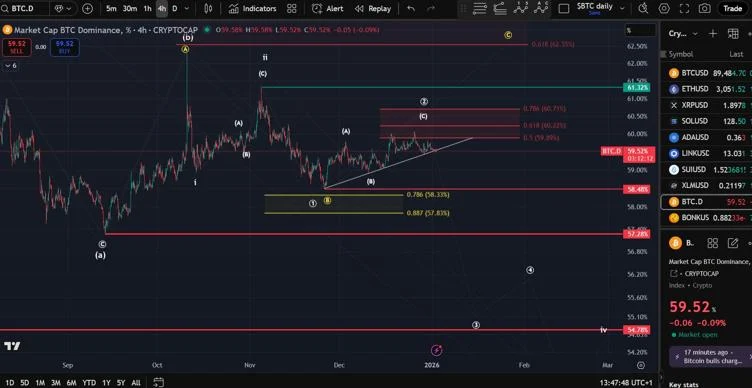
The breach of the key trendline identified by analysts marks a departure from the parabolic trajectory Bitcoin enjoyed during its ascent toward the $100,000 milestone. Trendlines serve as the backbone of technical analysis, representing the collective conviction of buyers. When a benchmark asset like Bitcoin falls below such a line, it often triggers a "risk-off" sentiment for that specific asset while simultaneously encouraging "yield-seeking" behavior elsewhere in the market.
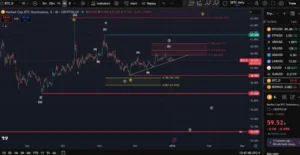
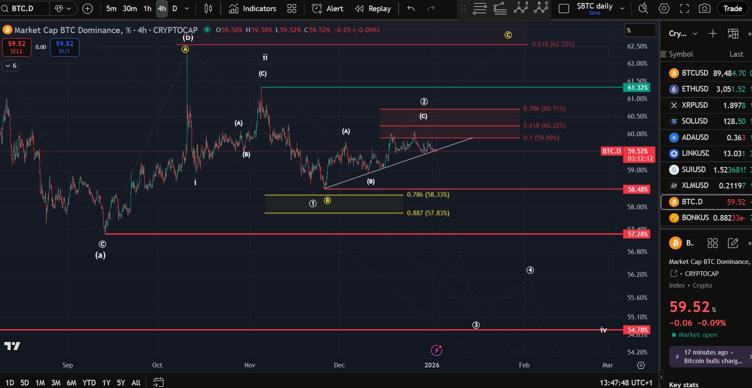
Currently, Bitcoin is battling significant resistance at the $90,000 to $92,000 range. While it remains above $90,000 at $90,525, the lack of aggressive buying pressure at this level suggests exhaustion. This exhaustion is further evidenced by the Bitcoin Dominance Index (BTC.D), which measures Bitcoin’s share of the total crypto market cap. After reaching multi-year highs in 2025, the index is showing signs of a reversal. Historically, when Bitcoin price consolidates or enters a minor correction after a major rally, and dominance begins to fall, the "overflow" of capital moves directly into Ethereum and subsequently into large-cap altcoins like Solana, XRP, and Cardano.
A Chronology of Market Sentiment: From 2025 Bearishness to 2026 Optimism
To understand the significance of the current shift, one must examine the market’s trajectory over the past twelve months. The year 2025 was characterized by a grueling battle against bearish momentum. Despite Bitcoin reaching new all-time highs earlier in that cycle, the broader altcoin market suffered from a lack of sustained liquidity. Many tokens faced 50% to 70% drawdowns from their peaks as investors prioritized the perceived safety of Bitcoin amidst global regulatory uncertainty and fluctuating interest rates.

The transition into 2026 has brought a change in narrative. The "shaking off" of 2025’s bearish sentiment is now a primary objective for market bulls. The first quarter of 2026 has seen a stabilization of the regulatory landscape in several key jurisdictions, providing a clearer framework for decentralized finance (DeFi) and Web3 projects. This clarity has allowed developers and investors to move past the "fear phase" and focus on fundamental growth. Consequently, the break in Bitcoin’s trendline is being viewed not as a market-wide collapse, but as a healthy distribution of wealth across the broader ecosystem.
The Altcoin Vanguard: Ethereum, Solana, and Beyond
As capital rotates, several key assets are positioned to lead the charge. Ethereum (ETH), the perennial leader of the altcoin market, is seeing renewed interest as the ETH/BTC trading pair begins to show signs of bottoming out. For much of 2025, Ethereum underperformed Bitcoin, leading some to question its long-term utility. However, with the shift in capital dynamics, Ethereum’s role as the primary settlement layer for decentralized applications is once again attracting institutional attention.
Solana (SOL) continues to demonstrate high levels of retail engagement and on-chain activity. Its ability to handle high throughput at low costs has made it the preferred destination for the current memecoin and NFT resurgence. Analysts suggest that if Bitcoin continues to trade sideways or slightly downward, Solana could be one of the primary beneficiaries of the "wealth effect," where profits taken from Bitcoin are moved into high-performing ecosystems.
Other legacy assets like XRP and Cardano (ADA) are also seeing a resurgence in trading volume. XRP, in particular, has benefited from the resolution of long-standing legal hurdles, allowing it to re-enter the portfolios of conservative institutional investors. Cardano, having spent much of 2025 in a consolidation phase, is now breaking through key moving averages, signaling a potential trend reversal. Even the memecoin sector, often dismissed as purely speculative, is showing signs of maturity with projects building out actual utility and community-governed treasuries.
Supporting Data and Moving Averages
Technical indicators across the board support the theory of an impending altcoin rally. For instance, Chainlink (LINK), a critical infrastructure provider for the blockchain industry, recently broke its 21-day Moving Average (MA). This specific indicator is often used by swing traders to identify short-to-medium-term trend changes. When a "blue-chip" altcoin like Chainlink moves above its 21-day MA while Bitcoin is breaking below a trendline, it provides a clear signal of divergence.
Furthermore, exchange inflow and outflow data show a decrease in altcoin deposits on centralized exchanges. This suggests that investors are moving their altcoin holdings into cold storage or DeFi protocols for staking, reducing the immediate sell pressure. In contrast, Bitcoin inflows to exchanges have seen a slight uptick, indicating that some holders are preparing to realize profits or hedge their positions, further supporting the capital rotation thesis.
Market Implications and Analyst Perspectives
The broader implications of this shift are multi-faceted. For the market to remain healthy, it requires a "virtuous cycle" of capital. If Bitcoin were to continue its dominance indefinitely, the rest of the ecosystem would starve for liquidity, eventually stifling innovation. A period where altcoins outperform Bitcoin—commonly referred to as "Alt Season"—is necessary to fund the development of new technologies in the Web3 and DeFi spaces.
Industry observers and fund managers have noted that the "Bitcoin-only" strategy that dominated 2025 is now being replaced by a "Barbell Strategy." In this approach, investors maintain a core position in Bitcoin for stability but allocate a significant portion of their portfolio to a basket of high-growth altcoins. This shift in strategy is a direct response to the technical signals currently being emitted by the market.
"We are seeing a classic transition," noted one senior market strategist. "Bitcoin has done the heavy lifting of bringing the market to new heights. Now, it is time for the ecosystem to build on that foundation. The break below the trendline isn’t a death knell; it’s an invitation for the rest of the market to catch up."
The Path Forward for Investors
As the market navigates this transition, volatility is expected to increase. Altcoins are notoriously more volatile than Bitcoin, and while they offer higher upside potential, the risks are commensurately higher. The struggle to maintain the $90,000 level for Bitcoin will remain a focal point for the coming weeks. Should Bitcoin find strong support at the $85,000 to $88,000 range and begin to consolidate, it would provide the ideal environment for altcoins to thrive.
Investors and traders are advised to remain vigilant, monitoring not just price action but also volume and dominance metrics. The emergence of new sectors within the altcoin space—such as AI-driven blockchain protocols and Real World Asset (RWA) tokenization—could provide new avenues for growth that were not present in previous cycles.
In conclusion, the break in Bitcoin’s trendline and its struggle at the $90,000 mark signal a maturing market. The rotation of capital from the flagship cryptocurrency into the wider digital asset sea is a natural evolution of the market cycle. As 2026 unfolds, the focus is shifting from "Will Bitcoin rise?" to "Which altcoins will lead the next wave of innovation?" For those who have weathered the bearish momentum of 2025, the current technical setup offers a glimpse of a more balanced and potentially lucrative market landscape.