The cryptocurrency market has entered a period of renewed social activity and speculative interest, as evidenced by recent data from blockchain analytics platforms. As the week concludes, a specific cohort of digital assets has captured the attention of investors, analysts, and retail traders alike. According to the latest insights from Santiment’s trending token dashboard, Dogecoin (DOGE), Polkadot (DOT), and the world’s largest stablecoin, Tether (USDT), have emerged as the primary subjects of discourse within the global crypto community. This surge in social volume often serves as a precursor to heightened volatility, reflecting a mix of bullish sentiment, technical curiosity, and macroeconomic concerns.
The current market environment is characterized by a delicate balance between established assets and emerging utility-driven protocols. While Bitcoin remains the primary driver of market direction, the "altcoin" sector is increasingly demonstrating independence, fueled by specific ecosystem developments and high-profile endorsements. The focus on DOGE, DOT, and USDT highlights three distinct pillars of the industry: the cultural power of meme-based assets, the technical sophistication of interoperable blockchains, and the foundational necessity of dollar-pegged liquidity.
Dogecoin: Between Meme Status and Mainstream Financial Utility
Dogecoin, the original meme-inspired cryptocurrency, continues to defy expectations regarding its longevity and market relevance. This Friday, DOGE became a focal point for market participants, largely due to ongoing discussions regarding its supply mechanics and its potential role in the evolving digital economy. Unlike Bitcoin, which has a hard cap of 21 million coins, Dogecoin features an unlimited supply with a fixed annual issuance. While critics often point to this inflationary model as a weakness, proponents argue it makes the asset more suitable for use as a currency rather than a static store of value.
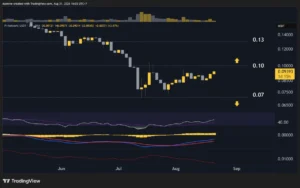
Social media metrics indicate that the conversation surrounding Dogecoin is currently split between technical analysis and speculative fundamental news. On the technical front, DOGE has managed to maintain its position above the $0.15 mark throughout the week, showing resilience in a choppy trading environment. However, market analysts warn that the asset faces a critical juncture. The $0.14 price level has been identified as a "must-hold" support zone. Should DOGE fail to sustain this level, it could trigger a liquidation event leading to lower lows. Conversely, a successful breakout above the 20-day Exponential Moving Average (EMA) could clear a path toward the $0.26 resistance level, representing a significant upside for current holders.
The most potent catalyst for Dogecoin remains its association with Elon Musk and the rebranding of Twitter into "X." The billionaire entrepreneur’s vision for X as an "everything app" includes a robust financial services component, often referred to as "X Payments." Recent regulatory filings show that X has been securing money transmitter licenses across various U.S. jurisdictions, fueling intense speculation that DOGE—Musk’s preferred digital asset—could be integrated as a native payment method. While no official confirmation has been provided, the mere possibility of DOGE being used for peer-to-peer tips, subscriptions, or commerce on a platform with hundreds of millions of users is enough to maintain its status as a top-trending asset.
Polkadot: Technical Resilience and the Quest for Interoperability
While Dogecoin captures the headlines through social influence, Polkadot (DOT) is trending due to its underlying technical strengths and the loyalty of its developer community. As a "Layer 0" protocol, Polkadot’s primary mission is to facilitate interoperability between different blockchains, allowing them to share information and security through its "Relay Chain" and "Parachains" architecture.
In recent days, DOT has seen a notable uptick in social mentions as investors analyze its price action following a period of market turbulence. The asset recently demonstrated what technical analysts describe as a "triple bottom" formation near the $3.47 support level. This pattern is traditionally viewed as a strong bullish reversal signal, suggesting that the selling pressure has been exhausted and that a new accumulation phase is beginning. Following this formation, DOT experienced a 4% bounce, a move that, while modest, signaled to the market that the asset’s floor might be established.
The discourse around Polkadot also extends to its governance model and the upcoming "Polkadot 2.0" upgrades. Unlike many networks where decisions are made by a centralized group of developers, Polkadot utilizes an on-chain governance system that allows DOT holders to vote on everything from technical upgrades to treasury spending. This "decentralized autonomous" approach is a significant draw for institutional investors looking for long-term stability and transparency. Furthermore, the ecosystem’s focus on "Asynchronous Backing"—a feature designed to increase the network’s throughput and scalability—has kept the community optimistic about DOT’s competitive position against other smart contract platforms like Ethereum and Solana.
Tether and the Stablecoin Dominance Factor
Tether (USDT) occupies a unique position in the trending list. As a stablecoin, its price is pegged 1:1 to the U.S. dollar, meaning it does not offer the same speculative profit potential as DOGE or DOT. However, its presence in the "trending" category is a reflection of its role as the lifeblood of crypto market liquidity. When USDT trends, it usually indicates a massive shift in capital or a response to broader regulatory news.
Recent spikes in USDT social volume can be attributed to several factors, including large-scale minting events and its expansion into new blockchain networks. As of mid-2024, Tether’s market capitalization has hovered around record highs, exceeding $100 billion. This dominance is a double-edged sword; while it provides the necessary liquidity for traders to move in and out of volatile positions, it also attracts intense scrutiny from regulators regarding the transparency of its reserves.
Market participants are currently discussing Tether’s role in decentralized finance (DeFi) airdrops and the challenges associated with futures trading. Many new protocols utilize USDT as the primary collateral for their lending and borrowing pools. Additionally, the recent news of new exchange listings for USDT-paired tokens has kept the stablecoin at the center of the conversation. The community remains hyper-focused on Tether’s quarterly assurance reports, which detail the composition of its reserves—including U.S. Treasury bills, gold, and Bitcoin—as these reports are seen as a barometer for the health of the entire crypto ecosystem.
A Chronology of Recent Market Sentiment
The path to the current trending status of these assets can be traced back through a series of key events over the last several months. In the first quarter of the year, the approval of Bitcoin ETFs in the United States brought a wave of institutional capital that lifted the entire market. However, as the initial "ETF hype" cooled, investors began looking for "beta" plays—assets that might offer higher returns than Bitcoin during a broader market recovery.
By the second quarter, the focus shifted toward "real-world utility" and "social dominance." This was when the rebranding of Twitter to X began to take a more concrete shape, and Polkadot’s parachain auctions began to show signs of maturity. The mid-year period saw a "flight to safety" into USDT as global macroeconomic uncertainty—driven by fluctuating interest rate expectations from the Federal Reserve—prompted traders to hedge their bets.
The current "Friday surge" in mentions for DOGE, DOT, and USDT represents a convergence of these themes. It is a moment where the market is attempting to price in future utility (DOGE on X), technical recovery (DOT’s triple bottom), and systemic stability (USDT’s liquidity).
Data-Driven Insights and Market Implications
To understand why these three tokens are trending, one must look at the data beyond social media mentions. Dogecoin’s daily active addresses have seen a 15% increase over the last month, suggesting that it is not just being talked about, but also being moved and used. Polkadot’s developer activity remains among the highest in the industry, often rivaling Ethereum in terms of GitHub commits, which serves as a leading indicator of future network value.
Tether’s "dominance ratio"—the percentage of the stablecoin market cap held by USDT—remains above 70%. This concentration of liquidity means that any news regarding Tether has a magnified effect on the prices of altcoins like DOGE and DOT. If USDT liquidity flows into altcoins, a "bull run" is likely; if it flows back into fiat or Bitcoin, altcoins may struggle.
The implications of these trends are significant for the broader digital asset landscape. First, the continued relevance of Dogecoin suggests that "community" remains a valid fundamental metric in the crypto space, often outweighing traditional valuation models. Second, Polkadot’s resilience highlights a growing appetite for sophisticated infrastructure that can solve the "silo" problem of isolated blockchains. Finally, the focus on Tether underscores the market’s ongoing dependence on centralized stablecoin issuers, a factor that will likely continue to drive regulatory debates in Washington and Brussels.
Looking Ahead: The Road to Q4
As the market moves toward the final quarter of the year, the performance of these trending altcoins will be closely watched. For Dogecoin, the "Musk Factor" will remain the primary driver of price action. Any concrete announcement regarding payments on the X platform could potentially send DOGE toward its previous all-time highs. However, the lack of such an announcement could lead to "rumor exhaustion" and a subsequent price correction.
For Polkadot, the successful implementation of its 2.0 roadmap will be the litmus test for its value proposition. If the network can prove that its interoperability model is superior to the "Layer 2" scaling solutions currently dominating Ethereum, DOT could see a significant re-rating by institutional investors.
For Tether, the focus will remain on transparency and competition. With the emergence of regulated stablecoins like USDC and the potential for central bank digital currencies (CBDCs), Tether must continue to prove its reliability and liquidity to maintain its crown.
In conclusion, the trending status of DOGE, DOT, and USDT is not a random occurrence. It is a reflection of the current market’s priorities: the pursuit of high-impact utility, the validation of technical structures, and the maintenance of essential liquidity. As investors navigate the remainder of the year, these three assets will likely remain at the heart of the conversation, serving as indicators for the health and direction of the wider cryptocurrency market.