The launch of Arc, Circle’s ambitious new blockchain, has immediately propelled it into the spotlight of the decentralized finance (DeFi) world, not only for its innovative approach to gas fees but also for an unprecedented surge in Total Value Locked (TVL). Within mere hours of its operational debut, Arc reported crossing the $300 million TVL threshold, a speed record that has simultaneously garnered both awe and significant skepticism across the crypto landscape. This rapid accumulation of capital, verifiable on public DeFi tracking platforms like DefiLlama, has triggered a robust discussion about the true nature of network growth, distinguishing between organically earned user trust and strategically incentivized capital deployment.
Arc’s Strategic Entry into the Blockchain Ecosystem
Arc is positioned as a pivotal expansion of Circle’s ecosystem, the issuer behind the USDC stablecoin, one of the largest and most widely adopted digital dollars. The blockchain distinguishes itself by directly integrating USDC as its native gas token, a design choice intended to simplify user experience, reduce volatility in transaction costs, and deepen the utility of USDC across the DeFi spectrum. Circle’s overarching strategy with Arc appears to be multifaceted: to create a dedicated, enterprise-grade blockchain environment that leverages the stability and widespread acceptance of USDC, potentially attracting institutional capital and fostering innovative applications built on a robust, predictable financial layer. By removing the need for users to acquire a separate, volatile native token for gas, Arc aims to lower the barrier to entry for both developers and users, particularly those accustomed to traditional financial systems.
The decision to build Arc comes amidst a fiercely competitive environment for Layer 1 and Layer 2 blockchains, all vying for developer talent, user adoption, and, crucially, TVL. While many emerging chains focus on scalability, low transaction costs, or novel consensus mechanisms, Arc’s unique selling proposition is its direct integration with a leading stablecoin and the backing of a major financial technology company. This context is crucial to understanding the scale and speed of its initial capital influx.
The Unprecedented TVL Surge: A Detailed Chronology

The claim of Arc hitting $300 million in TVL within hours was initially met with disbelief, a common reaction to "fastest to X milestone" announcements in the often-exaggerated world of crypto. However, a direct examination of Arc’s live chain page on DefiLlama confirms the metric. The network’s TVL swiftly escalated to over $343.1 million, with DefiLlama’s auto-generated data noting an astounding surge of over 1.1 billion percent since inception. This figure, while mathematically accurate for a network moving from virtually zero to hundreds of millions, underscores the sudden and concentrated nature of the capital inflow rather than gradual, organic growth.
The bulk of this initial TVL was not attributed to a broad base of small retail users engaging in diverse activities but rather to substantial lending deposits concentrated on two prominent DeFi protocols: Morpho Blue and Aave V4. These platforms are well-established within the DeFi ecosystem, known for attracting significant liquidity, often from institutional players or large-scale individual investors. This immediately set Arc’s growth trajectory apart from many other chains that typically see TVL accumulate more incrementally across a wider array of decentralized applications (dApps) and user types.
To put Arc’s speed into perspective, consider the timelines for other major blockchains to reach the $300 million TVL benchmark:
- Arbitrum: Approximately 10 to 11 days. Its history shows reaching $2.2 billion in TVL within two weeks of its August 2021 launch, consistent with the $300 million mark falling within that initial window.
- Robinhood Chain: Roughly 21 days.
- Base: Around 22 days.
- Monad: Close to four months.
- Optimism: Also approximately four months.
- Mantle: Stretched to about six months.
- Linea: Took the longest at roughly nine months.
Arc’s achievement represents a significant deviation from these established patterns, dwarfing the initial growth curves of even highly anticipated and well-funded projects. This stark contrast is at the heart of the ongoing debate, questioning whether such rapid acceleration reflects genuine ecosystem health or a different, more nuanced form of capital deployment.
The Nuance Behind the Numbers: Institutional Capital and Token Incentives
The core of the controversy lies not in the veracity of the TVL number itself, but in its composition and underlying drivers. Unlike chains that typically witness a gradual buildup of retail user activity, diverse dApp launches, and organic liquidity provision, Arc’s initial TVL was characterized by large, concentrated deposits. These were predominantly institutional or large individual funds channeled into lending protocols like Morpho Blue and Aave V4. This indicates a sophisticated deployment of capital, likely from entities with significant resources, rather than a grassroots adoption by a broad user base.

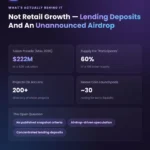
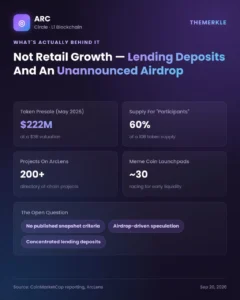
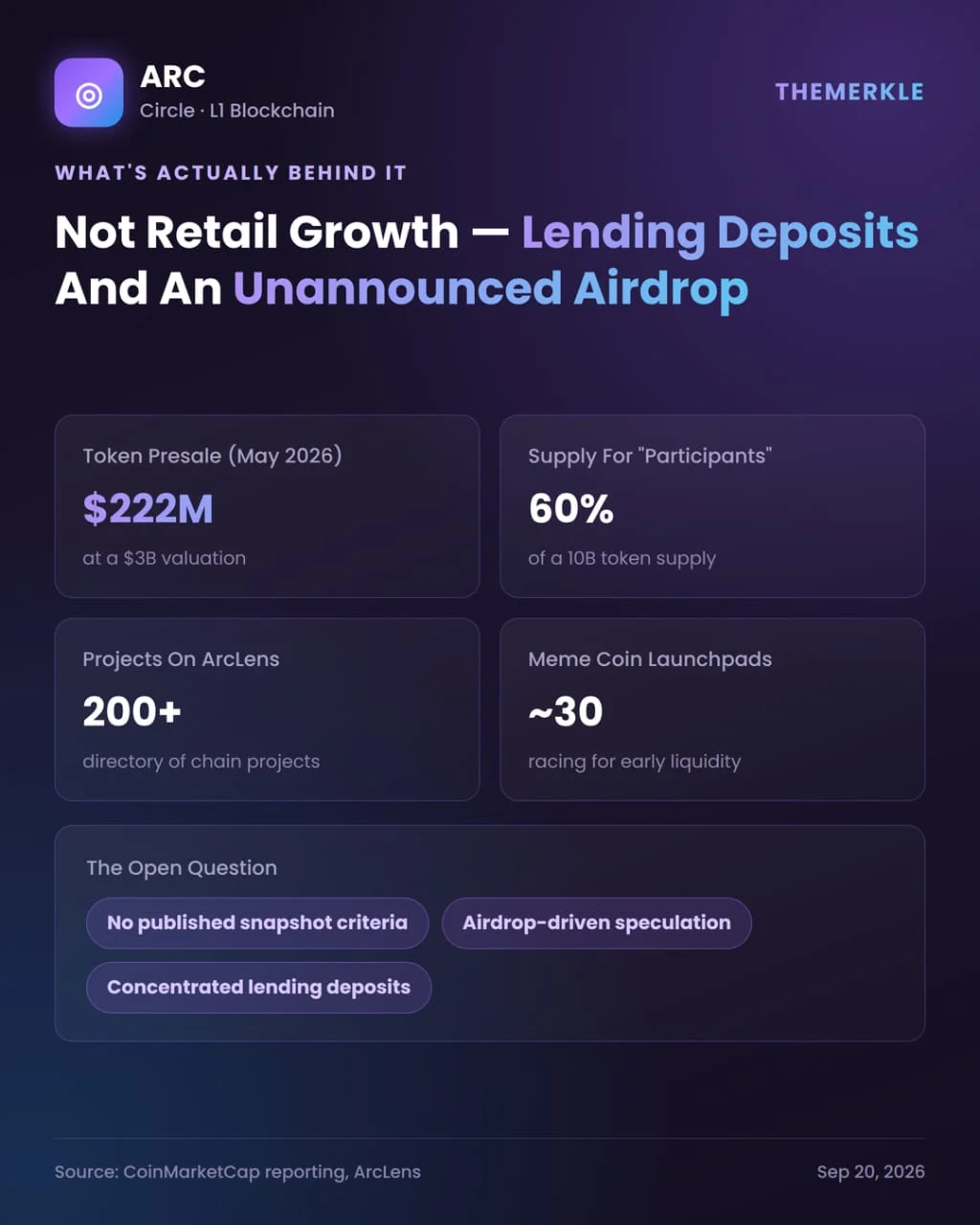
Further complicating the narrative is the influence of Circle’s own strategic financial moves. In May 2026, Circle reportedly raised $222 million in a presale for Arc’s future native token, valuing the chain at an impressive $3 billion. A substantial 60% of the planned 10 billion token supply was earmarked for "network participants," but crucially, the criteria for eligibility for these tokens—often determined by "snapshots" of on-chain activity or TVL contributions—remain unpublished. This lack of clear, upfront criteria for token distribution creates a powerful incentive for "airdrop farming." Market participants, driven by the prospect of significant future token rewards, often deploy large sums of capital into a new chain’s protocols with the sole purpose of qualifying for a potential airdrop, rather than engaging in genuine, long-term ecosystem participation.
This phenomenon is further evidenced by observations within Arc’s nascent retail ecosystem. A directory named ArcLens already lists over 200 projects on the chain, with a notable proportion—approximately 30—identified as meme coin launchpads. This proliferation of speculative ventures, appearing days into the chain’s existence, reinforces the perception that a significant portion of early activity is driven by short-term gains and speculative positioning for the unannounced token distribution, rather than a foundational belief in Arc’s long-term utility or technological innovation. CoinMarketCap’s reporting has also highlighted the "genuinely noisy" nature of this early retail environment, further suggesting a speculative rather than organic growth phase.
The Heart of the Controversy: Quality of TVL and Market Perception
The heated debate surrounding Arc’s record-breaking TVL boils down to a fundamental question: what does a TVL figure truly represent? Critics are not disputing the raw data presented on DefiLlama, but rather the implications of that data. A TVL number primarily accumulated through large institutional lending deposits and speculative positioning for a future token airdrop is fundamentally different from a TVL built organically over weeks or months by a diverse, engaged user base.
The argument centers on the distinction between "speed" and "depth." Arc’s speed in attracting capital is undeniable, a testament to Circle’s significant market influence and its ability to mobilize idle institutional capital on day one. The sheer brand recognition and trust associated with Circle and USDC likely provided a unique advantage, allowing for rapid deployment of funds that smaller, newer chains would struggle to attract. However, critics argue that this speed does not equate to depth—the genuine, decentralized engagement and adoption that signifies a robust and sustainable ecosystem.
For chains like Arbitrum, Base, or Optimism, their ascent to $300 million TVL was characterized by a more gradual, retail-driven growth curve. This often involved users migrating from other chains, experimenting with new dApps, engaging in various DeFi activities, and slowly building conviction in the network’s long-term viability. This type of growth, while slower, is often seen as more indicative of true network effect and user loyalty. The current perception of Arc’s TVL, conversely, suggests a high concentration of "mercenary capital"—funds deployed strategically to capture immediate incentives, with less commitment to the underlying chain’s ecosystem.

Implications for the Broader Blockchain Ecosystem
Arc’s rapid TVL acquisition and the ensuing controversy carry several significant implications for the broader blockchain ecosystem:
- Redefining Growth Metrics: The Arc phenomenon challenges the industry to look beyond raw TVL numbers and delve deeper into their composition. It highlights the need for more sophisticated metrics that can differentiate between incentive-driven capital and organic user adoption. This could lead to a greater emphasis on metrics like active users, transaction counts, diversity of dApps, and genuine economic activity, rather than solely focusing on locked capital.
- The Power of Incentives and Brand: Arc demonstrates the immense power of strong brand backing (Circle) combined with strategically designed token incentives. While effective for initial liquidity bootstrapping, it also raises questions about the long-term sustainability and decentralization of networks that rely heavily on such mechanisms.
- Investor Sentiment and Due Diligence: For investors, both institutional and retail, Arc’s case underscores the importance of thorough due diligence. A high TVL alone may not be a sufficient indicator of a project’s health or future prospects. Understanding the source and motivation behind locked capital becomes paramount.
- Regulatory Scrutiny: As stablecoin issuers like Circle expand their influence into native blockchain ecosystems, regulatory bodies may pay closer attention to the mechanisms of capital mobilization, token distribution, and the potential for market manipulation or unfair advantage, particularly given the large presale and unspecified token eligibility.
- Future of New Chain Launches: Arc’s "speedrun" could set a new, albeit potentially misleading, benchmark for new chain launches. This might pressure other projects to adopt similar aggressive incentive structures to compete for initial liquidity, potentially fostering a less organic, more speculative environment across the industry.
- Arc’s Path Forward: For Arc to transition from a speculative magnet to a genuinely thriving ecosystem, it will need to demonstrate sustained organic growth, attract a diverse range of dApps that offer real utility beyond lending and meme coins, and cultivate a committed user base. The challenge will be to retain the initial capital and convert speculative interest into long-term engagement once the token airdrop event (if it occurs) has passed.
In conclusion, Arc’s astonishing speed in accumulating $300 million in Total Value Locked is an undeniable fact, a testament to Circle’s institutional muscle and strategic planning. However, this record-setting achievement is undeniably accompanied by a strong undercurrent of skepticism regarding the quality and sustainability of this rapid growth. The debate within the crypto community is not about the accuracy of the numbers, but rather their interpretation: whether they signify a genuine embrace of a new platform by a broad user base or a strategic positioning by sophisticated actors seeking future token rewards. Both perspectives, rooted in verifiable data and astute market observation, contribute to a vital ongoing conversation about how we measure and understand success in the ever-evolving world of decentralized finance.
Disclosure: This is not trading or investment advice. Always do your research before buying any cryptocurrency or investing in any services.
Follow us on Twitter @themerklehash to stay updated with the latest Crypto, NFT, AI, Cybersecurity, and Metaverse news!